

 LinkedIn
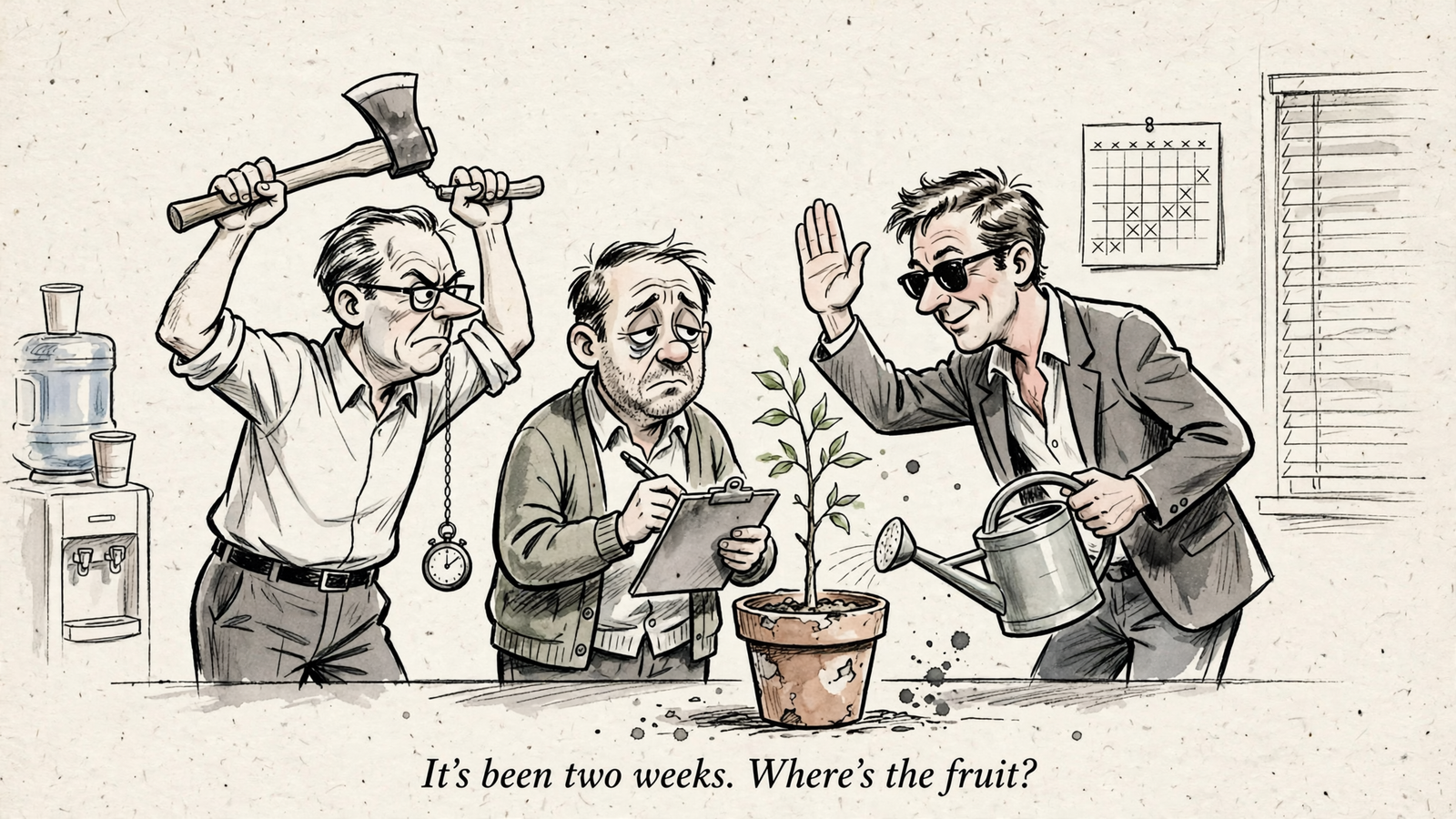
Two weeks of ChatGPT Ads spend, a calendar full of demos, no closed revenue: finance calls it failure, and the agency asks for six months without questions. I would reject both answers. A short test cannot prove long-cycle economics, but a long sales cycle never buys an agency freedom from proof. The useful question is what evidence belongs at each stage, not which side can sound more certain in the meeting.
Myth 1: “A seven-day trial can prove your closed-won ROAS”
People believe this because every new channel pitch seems to start with fast proof. Spend a little, watch the dashboard for a week, decide. That logic is appealing when a purchase can happen shortly after a click. Stretch the sale across discovery, internal reviews and procurement, and the same deadline becomes meaningless.
The median B2B SaaS sales cycle is 84 days across 939 companies, with mid-market at 60 to 90 days and enterprise at 90 to 180 days. A seven-day window closes before a long-cycle cohort has had time to become revenue. Judging closed-won performance then is judging seedlings for not bearing fruit.

What seven days can prove is narrower and still useful:
- Did the ads run?
- Did tracking fire reliably?
- Did UTMs carrying campaign and ad IDs reach GA4, so sessions can be checked independently?
- Did spend stay within the agreed cap?
Those are execution checks, not an economic verdict. I want them precisely because they are available now. There is no reason to wait for procurement to finish before discovering that nobody checked the tracking.
For a more stable read on cost per intent signal, practitioners suggest a clicks objective on a capped daily budget for 4 to 6 weeks before moving to conversions, once the pixel reports reliably. That window still does not manufacture a mature revenue cohort. It gives the test time to produce evidence beyond its first few days.
Use week one to verify execution, not to certify closed-won ROAS. Those are different promises. A provider selling the second on the strength of the first is skipping the expensive part of the argument.
Myth 2: “A booked demo is a qualified opportunity”
Calendars fill and everyone relaxes. Marketing has a number to report, the agency has a conversion to point at, and sales has meetings. A booking looks enough like pipeline to get promoted without an interview.
But a scheduled demo has not necessarily happened, let alone established fit. The median demo-to-close rate sits around 22 to 30% in 2026, and that benchmark measures completed demos, not scheduled ones. Most demos will not become customers. Some bookings will not even become conversations.
I would agree the stages before spend starts, rather than let everyone invent a convenient definition later:
- Scheduled: someone books a meeting.
- Attended: the meeting actually happens.
- Sales-accepted: a rep reviews the lead and agrees to work it against the agreed acceptance criteria.
- Qualified: discovery confirms the relevant need and timing, alongside fit such as title and company size.
Sales acceptance is the middle receipt, not a claim that discovery is complete. Marketing identifies fit and engagement; sales agrees the lead merits work; qualification follows. Keeping those distinctions prevents a booked slot from quietly becoming an opportunity in the next report.
Every rejection also needs a reason code. Wrong title is different from wrong company size. Neither is the same as a lead nobody followed up with. Without those distinctions, I cannot tell poor acquisition from poor handling, and the next optimization meeting becomes a disagreement about whose spreadsheet is more sincere.
Count scheduled, attended, accepted and qualified separately. A full calendar is evidence of bookings. Make it earn the next label.
Myth 3: “If revenue takes months, the agency cannot be judged yet”
This sounds fair because the revenue column really may stay empty for months. The cause is real. The conclusion is not.
Revenue lag does not explain missing UTMs, broken pixels, uncapped spend or a change log with three entries in a month. None of those needs a closed deal to become visible.
I would judge the work available to judge now:
- Tracking: verified in week one, not assumed to work because a dashboard contains numbers.
- Spend control: actual spend checked against the agreed cap.
- Execution: changes logged with their reasons, so activity can be inspected rather than narrated.
- Lead quality: a weekly review against the acceptance criteria established before launch.
If a provider cannot show those four within the first fourteen days, the sales cycle is not the problem. Waiting longer will not turn missing controls into a patient strategy.
There is a useful distinction here: uncertainty about the eventual return is unavoidable early on; uncertainty about whether the agreed work happened is not. I will accept the first. I will not pay extra for the second.
A learning period still needs receipts. Ask for the work, the checks and the decisions while the revenue cohort matures.
Myth 4: “The platform’s conversion count is your sales ledger”
The number sits beside spend in the ad interface. It looks official. That makes it easy to treat the conversion column as the answer and leave CRM reconciliation for some quieter week that never arrives.
The reporting mechanism is why I keep them separate. ChatGPT Ads Manager reports seven core metrics: impressions, clicks, spend, CTR, average CPC, average CPM and conversions. Its last-touch reporting offers 7-, 14- or 30-day click windows and 0- or 1-day view-through windows. Those settings change reporting, not optimization or billing.
A conversion credited inside one of those windows is not automatically a qualified opportunity, and it certainly is not automatically closed revenue. The platform reports the event and attribution it is configured to count. The CRM records what happens as the sale progresses.
Google has its own timing boundary: search conversion windows max out at 90 days, with offline import limits of 90 days after the click and 63 days for enhanced conversions for leads. If a sale falls outside the applicable import window, I cannot simply wait longer and expect that closed-won event to become usable there. An earlier qualified stage has to do that job, while the CRM retains the revenue record.
That is the distinction I want preserved across the reporting setup:
- Platform-claimed conversions: useful for checking delivery and the events the platform credits.
- CRM-confirmed stages: used to assess attendance, acceptance, qualification and eventual revenue.
Independent checks matter too. Use UTMs with campaign, ad-group and ad IDs, plus a GA4 custom channel grouping for ChatGPT. OpenAI provides aggregated metrics, not conversation text, so the reporting plan cannot depend on inspecting private conversations to explain every lead.
When a platform count and the CRM disagree, I investigate the difference. For money decisions, the CRM-confirmed sales outcome wins. A conversion column is a delivery receipt, not a bank statement.
Myth 5: “Managing Google, Bing and ChatGPT together means blending away the results”
A single blended ROAS looks clean in a slide. Spend goes in, pipeline comes out, and nobody has to linger over which channel did what. I understand the appeal. The business outcome is combined, and counting the same demo three times helps nobody.
But combined reporting and blended-only reporting are not the same thing. One gives the business a total. The other removes the parts needed to inspect it.
That matters when the platforms credit different interactions. ChatGPT Ads Manager reports one-day view-through conversions at campaign, ad-group and ad level alongside its Maximize results bidding. A view-through conversion credits an ad impression when someone converts within the window without a qualifying click getting credit.
Mix that with click-based counts from Google and Bing, then add everything together as though each platform identified a different customer, and the total can exceed the deduplicated CRM count. That is not necessarily fraud. It is attribution doing what attribution does, followed by reporting doing something it should not.
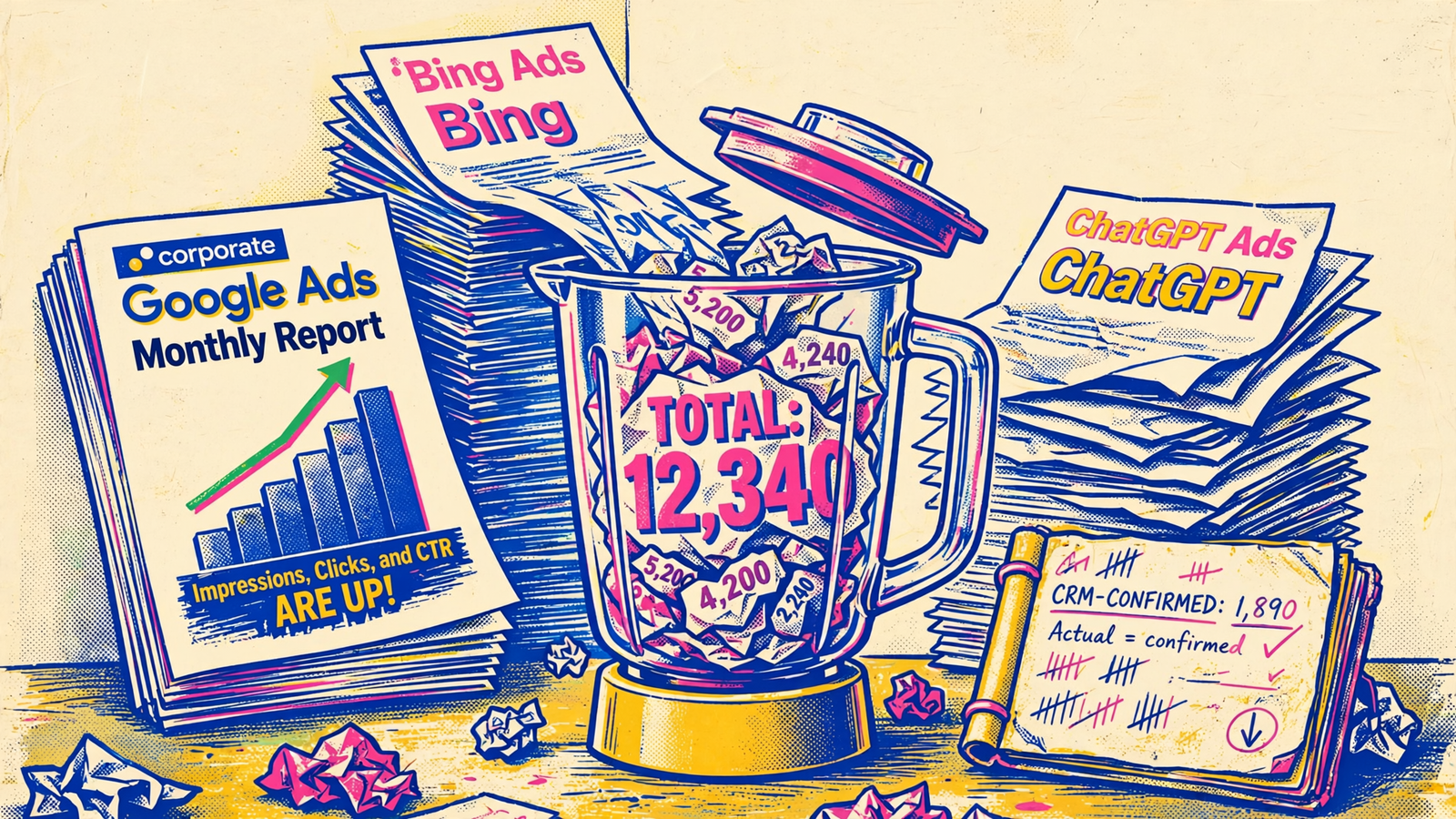
I want both views, with the joins still visible:
- Channel-level spend, cohorts and CRM stages, including cost per sales-accepted opportunity by source.
- Click-based and view-through conversions reported separately.
- Separate UTMs and a GA4 custom channel for ChatGPT.
- One deduplicated CRM outcome for the combined business result.
The channel view helps identify waste. The combined view supports budget decisions without pretending every platform claim is a unique sale. Neither replaces the other.
If an agency will only show the blend, I would ask what the blend is protecting. A total that cannot be taken apart cannot be trusted. Managing the channels together should not make their performance impossible to inspect.
Myth 6: “We either scale now or declare the channel dead”
This is the one I find hardest to kill. The agency sees cheap early demos and wants to double the budget before competitors arrive. Finance sees no revenue after thirty days and wants to cut it to zero. Both want a clean decision because staged patience feels like dithering.
But cheap demos have not yet proved fit, and an empty closed-won column in week four has not disproved a long-cycle channel. The same missing evidence gets used to justify opposite decisions. Convenient, really.
I would put the middle path in writing before spend starts. Not wait and see. A bounded test with decisions attached.
Say the test budget is $20k a month. That is an illustration, not a recommended minimum. The agreement should specify a daily cap, reviews at day 14, day 30 and day 45, and explicit conditions for fixing, stopping or scaling.
For example, the parties could agree to stop or fix the test if:
- Tracking breaks.
- Spend exceeds the cap.
- Show rate falls below 50%.
- Sales rejects more than a third of marketing-accepted leads for fit.
Those are example guardrails to agree, not universal benchmarks. Their purpose is to turn “the leads seem bad” into a condition both sides can inspect. Scaling should require approval, cost per sales-accepted opportunity within the agreed guardrail, and confirmation from reps that the titles match.
A test without caps and kill rules is not a test. It is an open tab. A 4- to 6-week learning window can justify waiting for a steadier signal. It cannot justify spending without controls.

What I would require before signing
Before letting an agency spend against a 90-day sales cycle, I want four commitments in writing:
- Proof of delivery. Actual platform access and evidence that the ads ran in ChatGPT, not just a screenshot of a blended dashboard.
- Execution scope. Who builds the ad groups, who fixes tracking, what work happens and how often. Work done, not advice sent.
- Measurement ownership. The agency owns UTMs, pixel checks and channel-level reporting; the client owns CRM stages and sales feedback. Both sides reconcile to the same sales-accepted count.
- Commercial control. A spend cap, review milestones, stop conditions, no scaling without approval and a clean exit.
I cover the fuller measurement framework in what counts as success when the sale takes six months, and the vetting process in how to hire when the sale closes months later.
This is also why I prefer the way we work at groas: every change is logged with its reasoning, and one human owns the outcome. That gives the buyer something concrete to inspect, rather than a percentage-of-spend retainer that keeps collecting while everyone waits for the cohort to mature.
The scale-or-kill myth survives because it flatters everyone. The agency gets to sound ambitious. Finance gets to sound decisive. Neither has to do the less theatrical work of matching the decision to the evidence.
I would rather demand proof in sequence: delivery and tracking first, then attendance, acceptance and cost per accepted opportunity by cohort. Closed revenue gets the final vote when the cohort matures. A short test cannot prove long-cycle economics. A long cycle cannot excuse missing evidence. Anyone selling either shortcut should not hold your budget.


