

 LinkedIn

Your Google Ads account keeps spending while you wait for permission to add a negative keyword. A freeze should stop execution, not investigation. If you’re the only marketer, the last thing you need is another dashboard to watch. Connect Claude to groas, then connect Google Ads, Meta Ads, and your website. Use read-only access, leave autopilot off, and start each session with: “Research only. Do not change campaigns, budgets, ads, or website content.” The prompt states the job; it doesn’t replace checking permissions. groas supplies the account and market data. Claude works through it. You keep the approval pen.
1. Turn saved Reddit research into an objection brief
This is the job solo marketers skip because it feels like homework. groas collects Reddit research around the clock, so I’d start with what’s already there. Ask Claude: “List the customer complaints, difficulties, and objections relevant to our offer. Quote or paraphrase each one and attach the source thread. Flag anything captured only partially. Keep what customers said separate from the messaging ideas you infer. Don’t write ad copy. Produce the brief.”
An objection is evidence. A messaging angle is an inference. Put them in the same sentence and the inference starts wearing the evidence’s clothes. I want to see what somebody actually said, what context the thread gives it, and what we might do with it. If the capture cuts off before the point is clear, I’d rather see partial next to the entry than a polished paraphrase that fills in the gap.
I’d keep the creative call human, too. In one Reddit discussion about a solo SaaS marketing stack, a founder said they dropped long-form AI copy tools because fixing the output took longer than writing from scratch. They kept Claude for drafts and research. That’s the distinction I’d make here: let Claude organize what people say, then decide which objection is worth addressing and how you’d address it in your own voice.
Open the source thread for the objection you’d actually bring into the next review. If the brief has no source links, it’s not a brief. It’s a vibe.
2. Brief a page that answers an AI citation gap
Ask Claude to use the AI search data groas collects: “List buyer prompts where competitors are named or cited and we aren’t. For each gap, identify the cited sources and the question they answer. Draft a page brief that answers that question with our own evidence. Don’t predict a citation.” I want the question and the source URL next to each other. A visibility score can point at a gap; it can’t tell me what the cited page does to answer the question.
Track mentions and citations separately. An answer can name a business without citing its site, or cite a site without naming the business. Those are different gaps, and collapsing them makes it harder to decide what belongs in the brief. Semrush’s gap analysis uses your domain and up to four competitors to surface missing mentions and citations. The useful part is what you inspect next: the prompts and cited URLs, not just the score.
For a check you can repeat, pick 10 buyer-worded prompts and run the same set across ChatGPT, Google, and Perplexity. That gives you 30 answers to log. Open the sources, record which businesses are named and which domains are cited, and use unpersonalized sessions. The fixed-prompt checklist is worth following for one reason: if you change the questions halfway through, you lose the comparison.
Pick one missing answer you can address with evidence of your own. Write that brief, not a plan to raise a score. If you need a longer baseline before committing to a page, the four-week AI citation audit separates prompts, fetches, and gaps. A recheck can tell you whether the citation appeared. It can’t tell you why on its own.
3. Use paid search to pick one SEO page to brief
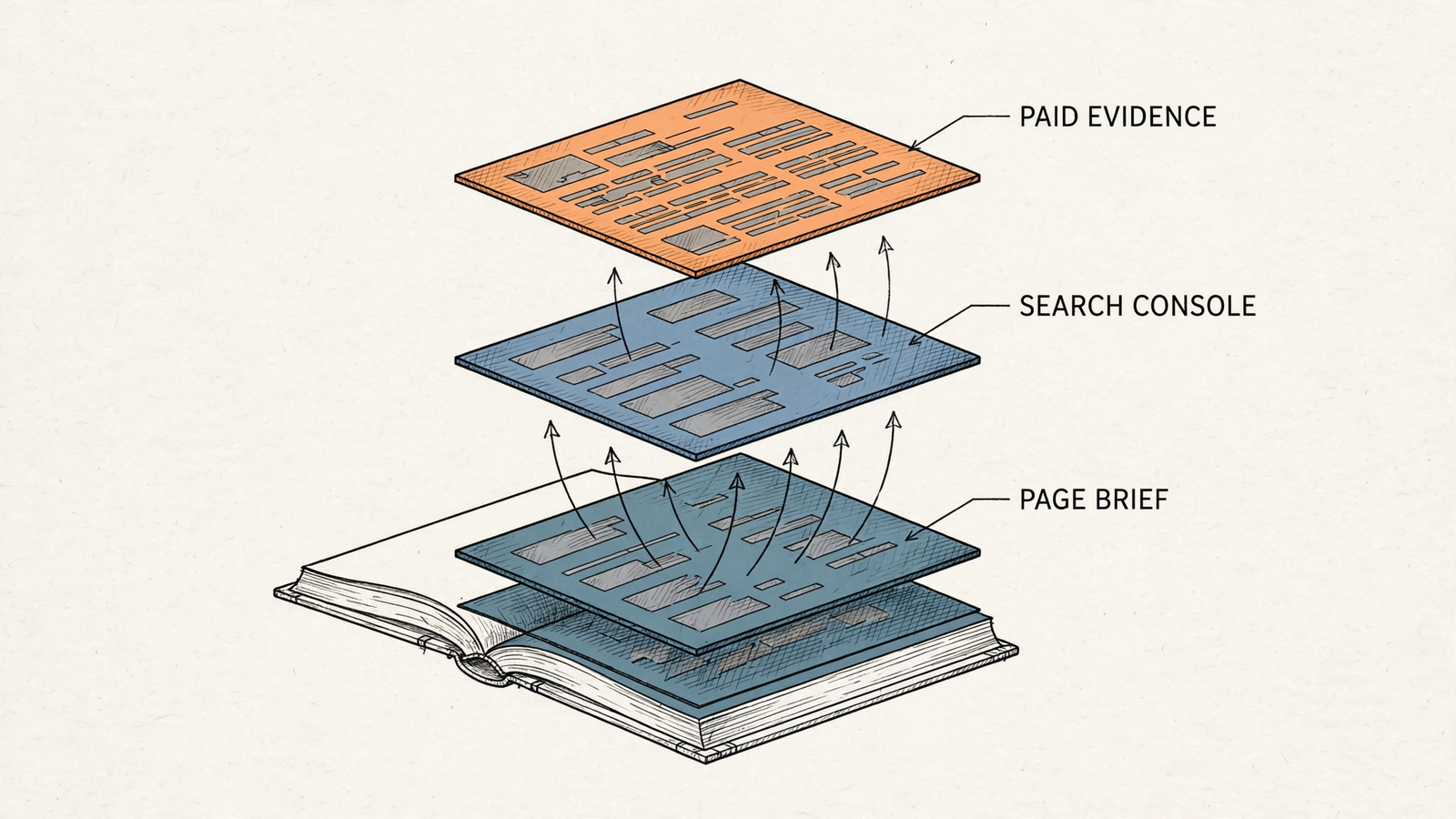
I’d rather start with a query that has already converted than a keyword that merely looks good in a report. Ask Claude: “Compare our paid search queries and conversion evidence with the Search Console data for those terms. Find query clusters we already pay for where we get organic impressions but have no dedicated page, or where we sit on page two. Propose one page brief. Keep paid conversion evidence separate from any SEO ranking prediction.”
The two data sets answer different questions. Paid conversions tell me which searches have already led to action through an ad. Search Console tells me where the site already gets organic impressions. Put the two together and I have a reason to brief a page instead of staring at another list of keywords. Paid conversions help pick the page; they don’t tell you where it will rank.
Have Claude put the paid query cluster, the conversion evidence, and the organic impression and position data side by side. Ask it to label the date range. Search Console’s Performance report defaults to the past three months, and a query may not appear in the report even if you see your site when you search for it yourself. Anonymized queries are hidden, the table shows at most 1,000 rows, and the data runs about two days behind. Those reporting limits matter when Claude treats “not in the table” as “no impressions.”
Start with one cluster where the paid evidence and the visible organic data make the case for a dedicated page. Write the brief while the freeze holds. If Claude puts a ranking promise in it, cut that line.
4. Turn competitor ads into tests, not success stories
groas collects competitor ads, landing pages, and funnels around the clock, so Claude can look at the promise in the ad and what happens after the click. I’d ask it to group current Google and Meta ads by hook, angle, and offer, then count distinct concepts rather than individual ads. Ten variations of the same discount aren’t ten different ideas. For each concept worth borrowing, ask Claude to name the test that would prove or kill the hypothesis and the metric you’d watch.
Competitor ads show what someone ran, not what worked. Meta’s Ad Library and Google’s Transparency Center can show the creative, offer, format, and dates. As this comparison of the public ad libraries explains, they don’t give you the spend, clicks, conversions, or ROAS you’d need to call an ad a winner. And a long-running ad isn’t necessarily paying for itself. It could be brand spend, a small retargeting campaign, or plain neglect. Treat the visible start date as a clue, not a performance signal.
I want three things in each row: what we saw in the ad and on the page, what we think might work for us, and what we’d measure to find out. The first belongs in the evidence column. The other two belong in the test plan. If Claude hands you ten “proven winners,” send the list back. The first one worth taking to an approval meeting is the one with a test you can explain without pretending to know the competitor’s numbers.

5. Find what your ads promise that your landing pages don’t deliver
Pull your live Google and Meta ads and follow each one to its destination. Ask Claude for a two-column map. On the left: the ad’s audience cue, promise, proof, offer, and call to action. On the right: the exact language on the page, where it appears, or a note that it’s missing. Flag the differences that could change someone’s decision: a credit card requirement, a different price, a discount you have to scroll to find. This message-match method uses the same comparison and points to Google’s guidance that an advertised discount should be easy to find on the destination.
Bring the exact words on both sides. “Weak message match” is a diagnosis you can argue about for half a meeting. The discount in the ad and the price on the page are things you can check. I’d look past cosmetic differences and get to the promises a customer could reasonably expect the page to keep. The button can use different words. The offer still has to be the offer.
One review of more than 10,000 ad accounts found roughly 47 ads per landing page on average. I don’t need to turn that into a conversion-lift forecast to see why the page is worth checking. When several ads send people to the same destination, a single discrepancy there can show up in several ad-to-page comparisons. Group the findings by destination so the person approving the fix can see whether it’s one page problem or several different promises.
First, open the ad and the page for the biggest discrepancy and verify Claude’s quotes yourself. Then take that pair to the review with the proposed correction. Don’t publish it during the freeze. When approval comes, you may be able to fix one page instead of touching twelve campaigns.
6. Build a wasted-spend proposal without pausing anything
This is the job that used to eat my Sundays: mine the search terms, find the spend I can’t defend, then wait for someone to approve the negative. I’d ask Claude to pull the last 30 days of Google Ads search terms, sort by cost, and split the rows into wrong intent, spend without conversions, and terms that might deserve their own keyword. If sales take about a week to convert, leave the last seven days out of the judgment. Otherwise you risk calling a click waste before it’s had time to turn into a sale.
Ask for spend, conversions, cost per acquisition against target where there’s a conversion, and the reason each row made the list. For terms with no conversions, compare spend with the target CPA instead of asking for a CPA that doesn’t exist. As a starting point, I’d watch at roughly 1× target CPA and propose an exclusion at roughly 2×, unless it’s a core term. The 15-minute search-term audit lays out those thresholds and the lag adjustment. They’re triage rules, not permission to add a negative. Put the proposed exact-match negatives in an approval table and leave the account alone.
Before the table goes anywhere, check three things:
- Attribution: If Claude brings in GA4, label the conversion windows before comparing ROAS. Different windows can produce different numbers. That isn’t, by itself, a finding about campaign performance.
- Coverage: Say whether a waste percentage uses the visible search-term rows or the whole campaign. In one worked example, £1,550 of a £12,400 campaign sat in unlisted, low-volume other search terms. A percentage with no denominator goes back for revision.
- Match type: A negative added from the report defaults to exact match. Blocking the listed search doesn’t block its plurals or synonyms. Review the actual term and match type you’re asking someone to approve.
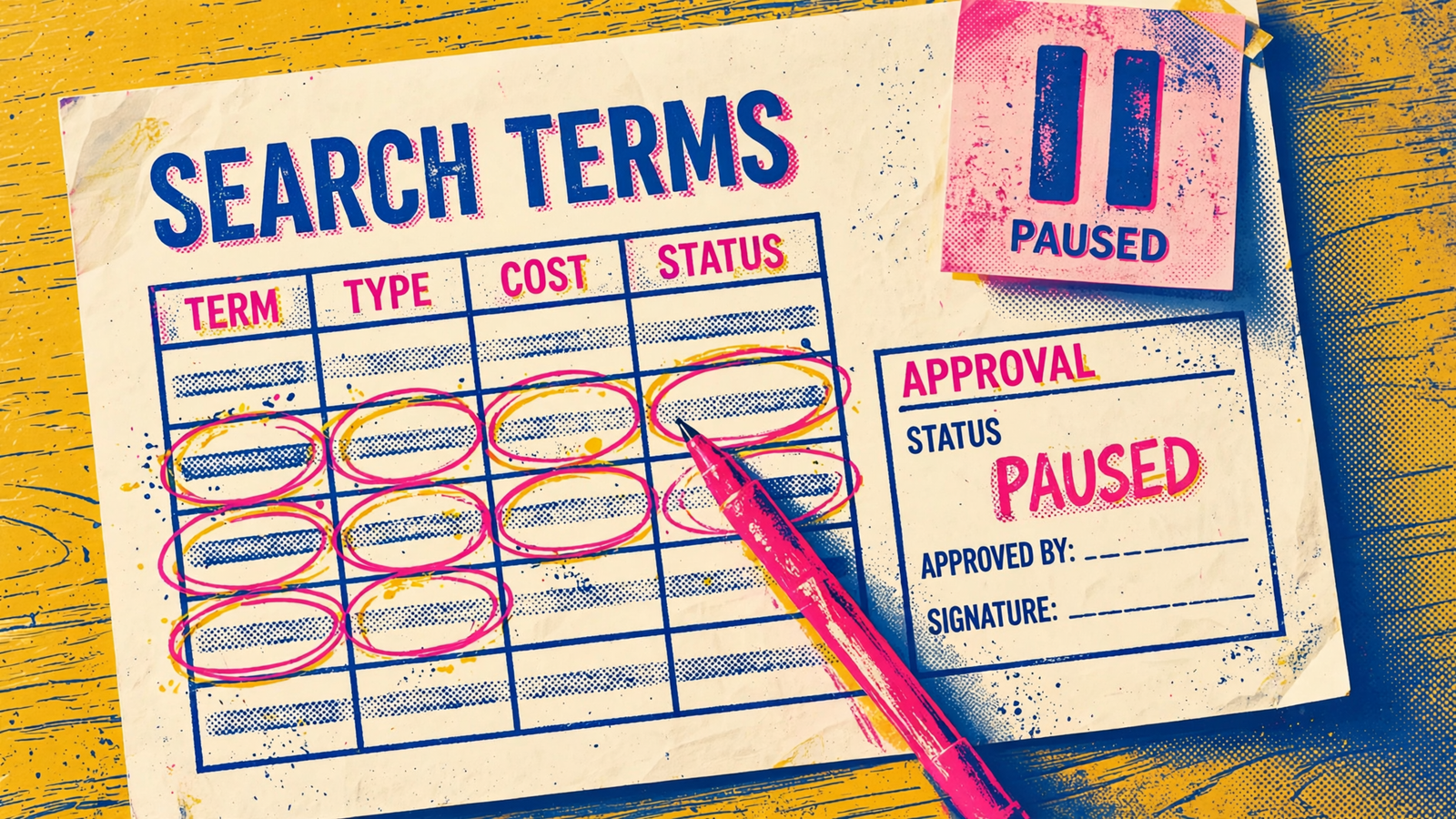
If I had one afternoon, I’d start here. The person holding the freeze doesn’t need a tour of the account. They need to see money already spent, the searches behind it, and a short list of decisions they can make one row at a time. Check the first proposed negative yourself, then put it in front of the approver with the reason attached. The investigation was never the risk. The unapproved change was.





