

 LinkedIn

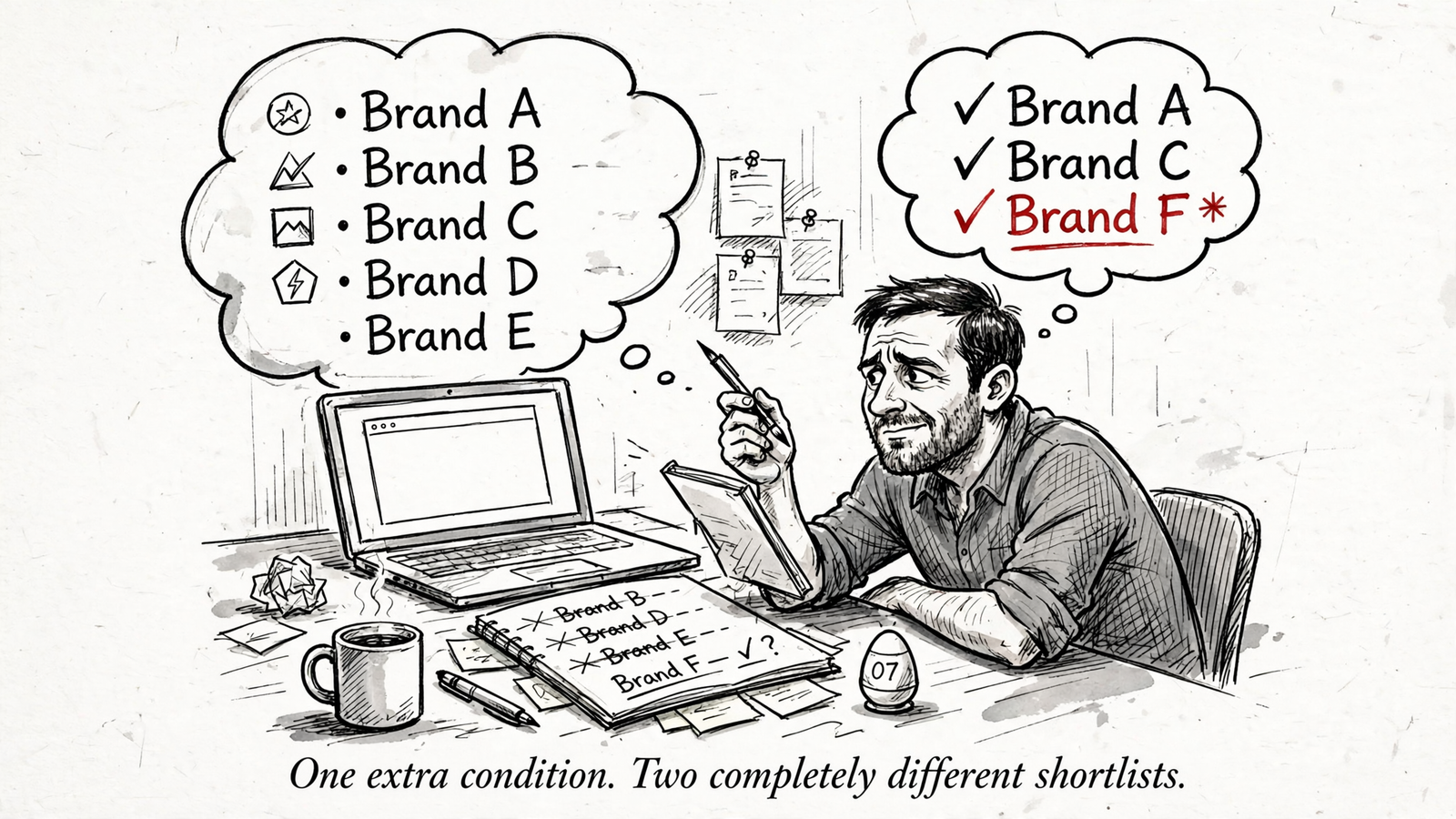
Track 40 versions of “is [Brand] any good” and a perfect mention rate can still hide the buyer who adds one requirement and gets a shortlist without you. If you already collect AI visibility data through groas, I would make the tracked set test buying conditions, not your ability to repeat your name. These seven pairs show which recommendations and cited sources change when one condition changes. They cannot establish why an assistant selected a source. That distinction turns a citation report from a scoreboard into a work list.
1. Pair the category question with a specific job
Keep the broad question, then give its twin a job to do. Hold the buyer context steady:
- Category: “Which marketing tools should a Shopify store doing $20k/month consider?”
- Job: “Which marketing tools should a Shopify store doing $20k/month consider for following up on abandoned carts?”
The second prompt is not just long-tail decoration. It asks for help with a particular task rather than a place in the category. That gives you a useful comparison: which businesses remain on the shortlist, and which sources appear only when the job gets specific?
Perplexity’s source-selection process includes sub-queries, full-page fetching and reranking. A detailed how-to page can therefore compete with a broad homepage on a specific task. That is a reason to test the pair, not proof that any particular page won because of its detail.
Do not assume both engines will even supply comparable citations. In one five-engine test, ChatGPT answered 8 of 20 questions without sources, while Perplexity cited exactly 10 sources on 19 answers. A more specific prompt does not guarantee retrieval.
First step: add the job-specific twin to one category prompt. Then ask your AI with groas connected:
“Compare the saved answers for these two prompts. List which recommended businesses changed and which source URLs appeared or dropped out. Flag answers with no citations.”
Look for the delta. A missing citation is worth recording too.
2. Pair the broad buyer with a one-person team
A buyer constraint can expose a gap that a category prompt leaves comfortably hidden. Try:
- Broad buyer: “Best email tool for an ecommerce business sending 30k emails a month.”
- Constrained buyer: “Best email tool for a one-person ecommerce team sending 30k emails a month.”
The email volume stays fixed. The team size changes. Otherwise, you are testing two requirements at once and guessing which one mattered.
A 122,000-citation analysis found different patterns across the engines: Perplexity favored recency and extractable structure, while ChatGPT favored domain authority and depth. Prior domain citation history was the strongest single predictor on both. None of that means the constrained prompt automatically rewards the page with the neatest checklist. It does make the cited pages worth inspecting for evidence that fits this buyer.
I would look for pricing tables and setup checklists, not another paragraph about being “built for ambitious teams.” A one-person team is ambitious. It is also one person.
First step: add one audience constraint your existing prompt leaves unstated. Ask your AI with groas connected:
“Which brands appear only under the one-person-team condition? Which cited URLs contain concrete information relevant to that condition?”
If you hold the broad prompt and lose the constrained one, check whether your page ever names that buyer. The answer is a page-audit lead, not a diagnosis handed down by the model.
3. Pair the same need with one required integration
This is the cleanest technical constraint to test:
- Without the requirement: “Best helpdesk for SaaS startups.”
- With the requirement: “Best helpdesk for SaaS startups that integrates with HubSpot.”
Change nothing else. Then do the unglamorous check: open the cited pages.
Ask your AI with groas connected:
“For the integration prompt, quote the sentence on each cited page that establishes HubSpot compatibility, or mark it as unproven.”
What the deck calls “AI reasoning” still needs evidence you can inspect. A partner logo or a claim to “integrate with everything” is not the same as a page explaining the actual pairing, its plan requirements and its setup steps.
Perplexity’s reranking process considers topical authority and semantic depth. That gives you something concrete to examine: does the cited page answer the compatibility question, or merely look like it should?
First step: check your own integration page against the cited evidence. If compatibility is established, state the exact pairing clearly near the top. Include the required plan and a testing date only when you can verify them. Do not manufacture precision because a tidy sentence looks quotable.
The useful principle is extractability: making supporting information easy to identify and use. It is something you can improve, not a promise of inclusion.
Write the compatibility evidence a buyer needs, then test whether the citation changes. A cleaner paragraph is a defensible edit. Claiming you have discovered the ranking formula is not.
4. Separate unbranded discovery from the named alternative
These prompts belong beside each other in the test, but not inside one blended success rate:
- Discovery: “Best project tool for client work.”
- Alternative: “Best alternative to [Competitor] for client work.”
The buying need stays the same. The second question introduces an anchor brand and asks for a replacement. That creates a different comparison to inspect: which competitors appear in both answers, and which sources show up only when switching enters the picture?
Look for comparison pages, Reddit threads about switching and review grids. Record what actually appears rather than assuming the alternatives prompt must use them.
The same reporting discipline applies to prompts containing your own name. Prompt-selection guidance recommends keeping branded prompts in their own bucket, because they can inflate category averages and hide comparison losses. A report that rewards you for appearing in a question about yourself is grading generously.
First step: move prompts containing your name out of the unbranded category average. Then ask your AI with groas connected:
“Compare the unbranded and alternatives answers. List competitors that appear in both, and sources that appear only in the alternatives answers.”
Winning discovery does not establish that you win the alternatives question. Keep the two visible. Otherwise, one healthy-looking average can conceal the exact buying situation you need to investigate.
5. Pair the open question with a real budget ceiling
Add one money condition, using the way the buyer actually budgets:
- Open budget: “Best CRM for a 10-person agency.”
- Budget ceiling: “Best CRM for a 10-person agency under $500 per month total.”
“Total” matters to this example. You are testing the agency’s budget, not whether a low-looking per-seat price appears somewhere on the page.
The useful question is whether the answer supports its affordability claim. A clear plan table gives you evidence to check. “Affordable for teams of all sizes” gives you adjectives wearing a finance hat.
First step: add a realistic ceiling to one existing prompt. Ask your AI with groas connected:
“For the budget version, quote the price each cited page shows, including whether it is per seat or total. Mark pages with no price shown.”
Then read the quoted evidence against the requirement. Do not count a recommendation as budget-qualified merely because the assistant placed it under the right heading.
The win here is a checkable price claim, not another mention. If your own page leaves that claim unclear, you have a specific edit to consider. If the cited evidence does not support the answer, record that instead of treating the shortlist as settled.
6. Separate the shortlist from the head-to-head
Keep the buyer context fixed while changing the decision stage:
- Shortlist: “Best time tracking for a 12-person agency billing hourly.”
- Head-to-head: “Harvest vs Toggl for a 12-person agency billing hourly.”
The first asks which products belong in consideration. The second asks the assistant to evaluate two named products. Do not file both under “category visibility” and call the job done.
Inspect whether the source mix changes from listicles and review grids to comparison pages, documentation with limits tables, or threads naming both products. Those are different evidence needs, even when the buyer is identical.
Engine differences make separate tracking useful too. One comparison reported about 9.68 sources per Perplexity answer against ChatGPT’s 3.29. More citation slots do not establish better evidence, and those averages do not predict your next answer. They do explain why raw citation counts across engines make a poor shared scoreboard.
I would use a fixed tracked set layered by buying stage, recording mentions, competitors and URLs across engines. That keeps discovery success from swallowing evaluation gaps.
First step: for your top three discovery prompts, add the head-to-head twin your sales team hears most often. Ask your AI with groas connected:
“For the discovery and two-product prompts, which sources appear only in the comparison answers? What evidence do those pages provide?”
Treat comparison-only sources as a separate work list. If rivals occupy those pages, your category mentions do not make that gap disappear.
7. Pair the recommendation with an explicit evidence requirement
Hold the buying problem and pricing request fixed. Change only the sourcing instruction:
- Recommendation: “Best DLP for a 50-person fintech, with pricing.”
- Evidence required: “Best DLP for a 50-person fintech, with pricing. Cite two sources for each pick.”
Then read the citations instead of counting them.
Adding “cite sources” does not guarantee good sourcing. The answer can attach more links without supplying better support for the recommendation. The citation analysis identifying prior domain citation history as a strong predictor is another reason not to confuse a familiar domain with evidence for the particular claim in front of you.
First step: ask your AI with groas connected:
“For the sources-required version, list each citation and quote the passage supporting the recommendation and price. Mark unsupported claims explicitly.”
Open the pages and check the passages. If one of your pages appears but does not support the claim attached to it, that is not a clean win. A mention with an unsupported citation is a liability, not a trophy.
Where your page lacks useful evidence, make that evidence easier to extract: a self-contained statement, a verified date or number where relevant, and a table where the information calls for one. Formatting cannot rescue a claim the page does not establish.
Before acting on any of these seven pairs, keep the comparison honest. Run each pair in both ChatGPT and Perplexity, save the date and exact wording, and compare repeated answers rather than screenshots. ChatGPT and Perplexity shared only about 11% of cited domains in one comparison. Coverage on one engine is not coverage on the other.
Single answers also move. Across 968 repeated runs, 42.9% flipped the brand mention at least once, median cited-domain overlap was 0.41, and just 3.5% of domains appeared every time. That study recommends reporting rates over 14- to 28-day windows.
My practical rule for this set is simple:
- Keep the exact prompt wording and dated answers in the log.
- Rerun on the same weekday, separately for each engine.
- Wait for a gap to hold across two runs before treating it as a page-fix priority.
- Inspect the cited evidence before approving an edit.
Two runs are a working filter, not proof of causation. The discipline is the point, as in the 30-day citation test and the warning against treating one answer as stable in the measurement myths piece.
Once a gap repeats, ask your AI with groas connected:
“Propose a page-fix queue grounded only in the cited sources for these pairs, ordered by missing evidence. Do not publish.”
Approve changes yourself. The 30-day playbook for getting cited in ChatGPT and Perplexity covers the follow-through from that queue to pages. No wording guarantees a citation, and a changed citation does not tell you why the assistant selected it.
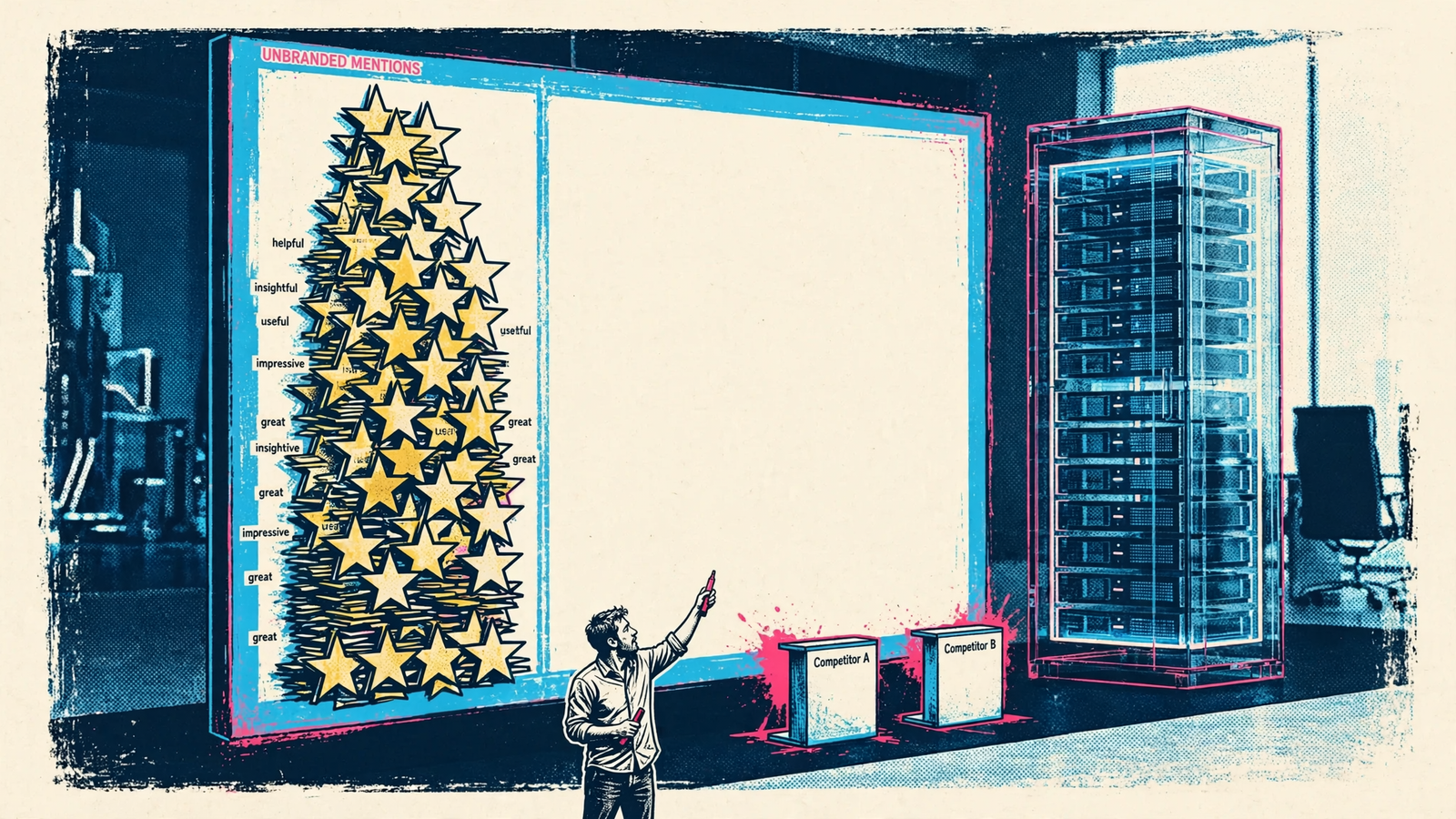
If I had to start with one pair, I would start with number 3, the integration twin. It offers the most direct route to a page fix: a named requirement and evidence you can inspect. When the saved answer in groas cites a rival’s page with a clear compatibility statement, plan requirement and setup steps, compare that evidence with your own page. Write the missing paragraph if it is warranted, rerun the pair twice, and check whether the change holds. That is how a tracker stops being a scoreboard and starts being a work list.


