

 LinkedIn

A small Meta budget does not need a cheaper manager automatically. It needs fewer things to manage. This list is for businesses comparing Meta management services on a $2,000 or $3,000 monthly ad budget, where general management can cost another $500 to $1,500 before creative. My rule: buy fewer deliverables, not a cheaper manager. Cut reporting theatre, needless complexity, and duplicated work before touching the creative and tracking that make the advertising usable.
1. Remove audience splits the budget cannot support
The prettiest diagram in the proposal can be the most expensive mistake: ten to fifteen ad sets, each with its own interest stack, lookalike, and retargeting slice. Every box looks purposeful. Every box needs budget.
An ad set needs around 50 optimization events in a week to exit learning. Split $3,000 a month ten ways and collecting that volume becomes difficult, a problem covered in this account-consolidation breakdown. The structure creates more separate learning problems without creating more money to solve them. You are paying for complexity that the account cannot support.
I used to build the complicated version by hand and defend it. For small budgets, I was wrong.
What I want instead is a targeting rationale in two sentences: one to three ad sets, a broad or Advantage+ audience where appropriate, and a separate budget only when a genuinely different objective or margin justifies it. Every split should earn its share of the budget. An audience name is not a business reason.
First step: ask the bidder to explain every audience box beyond three. For each remaining ad set, get three answers:
- What distinct job does it do?
- Can the budget fund enough results to judge it?
- What evidence would justify keeping or removing it?
If the answer is mostly audience jargon, I would buy fewer boxes. Pool the budget before paying someone to maintain a diagram.
2. Stop paying twice for creative handoffs
The budget trap is familiar: a media-buying fee, a separate creative vendor, and the business owner forwarding files between them.
The buyer says CPA needs new angles. The creative shop says it needs delivery data. Both explanations may be reasonable. Neither resolves the fact that two paid teams are waiting for the client to connect them.
That is the handoff tax. It costs money and delays the next useful ad. On a small budget, it hurts twice: fresh creative every two to three weeks can add $1,000 to $3,000 per month when billed separately from management.
Compare the complete working scope, not the media-buying fee. A $750 management fee plus $1,500 for creative is a $2,250 scope before a dollar reaches Meta. The cheaper-looking proposal is not necessarily the cheaper operation.
First step: put every bid into the same format:
- Management: included work and accountable owner.
- Creative: usable concepts, required formats, and revision responsibility.
- Tracking: setup or maintenance, with responsibility stated.
- Total fee: all of the above, with ad spend separate.
Separate vendors are not automatically the problem. Paying both while nobody owns the handoff is the problem. I want one named person responsible for getting performance feedback into the next creative brief.
Buy the scope the budget can carry
Self-management or a bounded freelancer can work when the business covers the missing essentials. Say the ad budget is $2,000 a month and creative stays in-house. A freelancer at $20 to $45 an hour for five hours of testing-queue management and tracking checks can cost less than a full-service scope. It is not the same scope, though. Someone still has to do the rest.
That ownership question is central to my breakdown of who should run a small business’s Facebook and Instagram ads. If the business cannot maintain the creative and measurement cadence, calling the arrangement “self-managed” does not make the missing work free.
Integrated management earns its fee when one owner coordinates creative, decisions, and tracking without consuming the media budget needed to test. At $3,000 in spend, a $975 minimum management fee adds roughly 33% on top of media. That deserves scrutiny, not automatic rejection.
A flat $1,499 scope that genuinely includes usable creative and tracking can cost less than the $750-plus-$1,500 arrangement. The word includes is doing important work there. Get the deliverables in writing. Buy fewer handoffs, not fewer essential jobs.
3. Replace simultaneous tests with a funded testing queue
I like testing. I do not like selling five-way tests to accounts that can barely fund one.
Each variant needs enough spend and enough useful outcomes to support a decision. Launching more variants does not create more evidence; it divides the available evidence among more ads. Eventually, every result looks interesting and none is dependable.
Say the target CPA is $40 and the test budget is $800. That is a finite allowance for learning, not permission to run every idea in the creative folder. Split it across several simultaneous tests and the account can reach the end of the budget without answering the question that mattered most.
Buy a prioritized queue, not a crowded launch calendar. The useful small-budget range is one to five new concepts a week, rather than dozens, but even that range has to fit the account. “Five available” is not “five required.” Concepts can wait their turn.
First step: ask the bidder to list tests in priority order and price the first two. For each, specify:
- The question the test is meant to answer.
- The budget available to answer it.
- The evidence needed to keep, stop, or extend it.
Treat two to three times target CPA as a review point, not an automatic verdict. A spending threshold alone does not prove that an ad wins or loses, and an ad set’s learning threshold is not a creative-testing finish line.
The next concept enters when there is room to learn from it. A queue is less impressive in a proposal. It is more useful in an account.
4. Replace the monthly presentation with an action log
I used to tell clients the deck was proof of work. I was wrong. Too often, it was proof of hours.
Someone pulls screenshots from Ads Manager, pastes them into slides, and writes three observations that were true last month too. Then the client pays for formatting. Meta does not auction the slides. It auctions the creative, using the conversion signals sent back to it. A 20-slide recap changes neither.
Pay for a record of decisions, not a performance scrapbook. A short action log should show:
- When something changed.
- What changed and why.
- What happened to cost per qualified lead or ROAS afterward.
- What the manager plans to do next.
I also want account-level spend and results. Concise does not mean conveniently incomplete, and a quiet month should not force someone to invent activity for the report.
First step: strike the presentation deck from the proposal and ask for a one-page monthly action log with the next two moves. Ask what that removes from the fee or frees up elsewhere in the scope.
If removing the deck changes nothing, find out why. The point is not merely to receive a shorter document. It is to stop buying production work that does not help the next decision. Put the recovered budget or time into creative, measurement, or media.
5. Delete the extra dashboard, not the measurement
The second dashboard is the deck’s quieter cousin. Ads Manager and Events Manager are already there. Then the proposal adds a branded Looker Studio or Triple Whale-style view, plus time to maintain it.
A dashboard can earn its place. But “all the numbers in one place” is not enough if nobody uses that place to change a budget, stop an ad, or question the conversion data. On a small account, I want a clear answer to three questions: how much was spent, what did it buy, and can the measurement be trusted?
Keep reporting that informs decisions. Cut the duplicate wrapper. That means preserving:
- Ads Manager for delivery and platform results.
- The CRM or Shopify for qualified outcomes and revenue.
- Events Manager for checking event collection and diagnostics.
First step: ask the bidder to remove the custom dashboard line and demonstrate, in one screen share, how they reconcile spend with qualified outcomes. If the extra view solves a specific problem, name that problem. If it only looks nicer, it belongs behind creative in the budget queue.
Protect the signal underneath the report
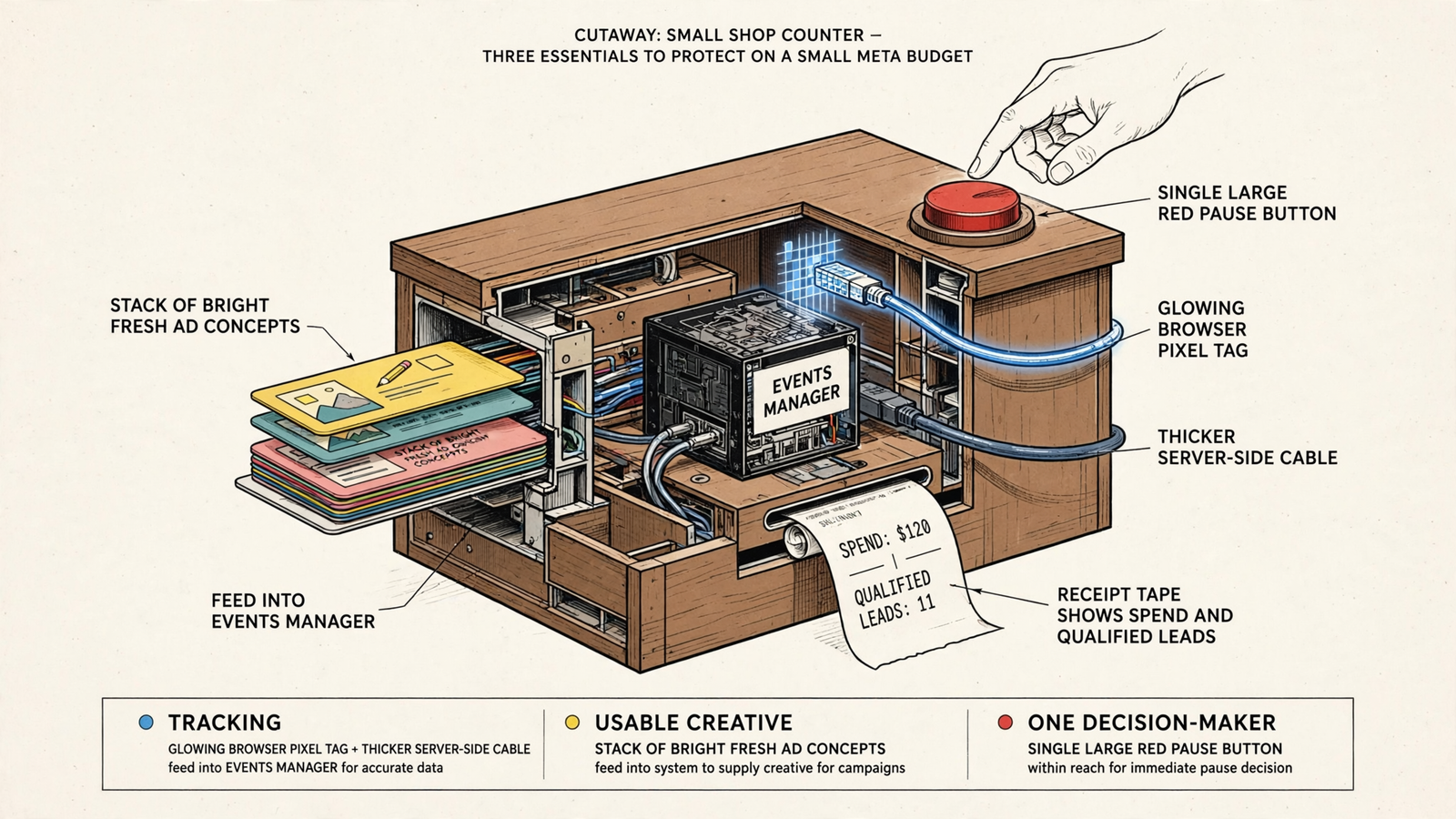
Deleting a dashboard is not permission to neglect tracking. Meta uses the signals sent back to it, so I protect the base pixel, the standard events that match the business outcome, and the pixel-plus-Conversions-API setup where applicable.
Meta reports 17.8% lower cost per result among advertisers using Conversions API for web than among pixel-only advertisers. That is not a promised reduction for an individual account. It is a reason not to treat measurement as disposable overhead.
I want weekly Events Manager checks and someone responsible for investigating drift. A polished revenue chart cannot repair a broken event underneath it.
I protect usable creative for the same reason: the system needs something worth showing, not just a clean record of what happened. The third essential is an owner who can pause a loser on Tuesday without waiting for a meeting.
Tracking supplies the signal. Creative supplies the ad. An owner makes the call. Cut the decorative reporting around those jobs, not the jobs themselves.
6. Cut placement versions that have no clear delivery need
Some proposals charge by placement: a feed cut, a Stories cut, a Reels cut, a right-column cut. Each gets its own production line, even when the work amounts to another version of the same asset.
The problem is not adapting creative. The problem is buying a version for every checkbox before there is a reason to need it.
Buy usable formats first; commission bespoke versions when the account earns them. One strong concept delivered in vertical, square, and 4:5 feed formats gives the account usable assets without automatically turning every placement into a separate production project.
Those adaptations still need care. I am not asking for one file stretched into three shapes. I am asking the proposal to distinguish necessary formatting from a genuinely different creative execution. Otherwise, a large asset count can disguise a very small number of ideas.
First step: ask for the cost of one concept in the three aspect ratios, with bespoke placement work priced separately. Then ask what delivery evidence would justify that extra work.
If a placement is performing and needs creative made specifically for it, there is a case to spend more. Until then, I would rather fund another useful concept than twelve nearly identical files. Protect creative production by refusing to confuse resizing volume with creative progress.

7. Replace overlapping meetings with one accountable owner
A monthly strategy call, a biweekly optimization review, and a weekly project check-in can look like attentive service. They can also mean three calendars, three note-takers, and three opportunities to explain the offer again.
What the deck calls “coverage,” I call people billing to stay aligned with each other.
On a small account, many weekly decisions come down to whether the current test should continue, stop, or receive more budget. That needs someone with authority to act. A committee discussing the decision is not a substitute for making it.
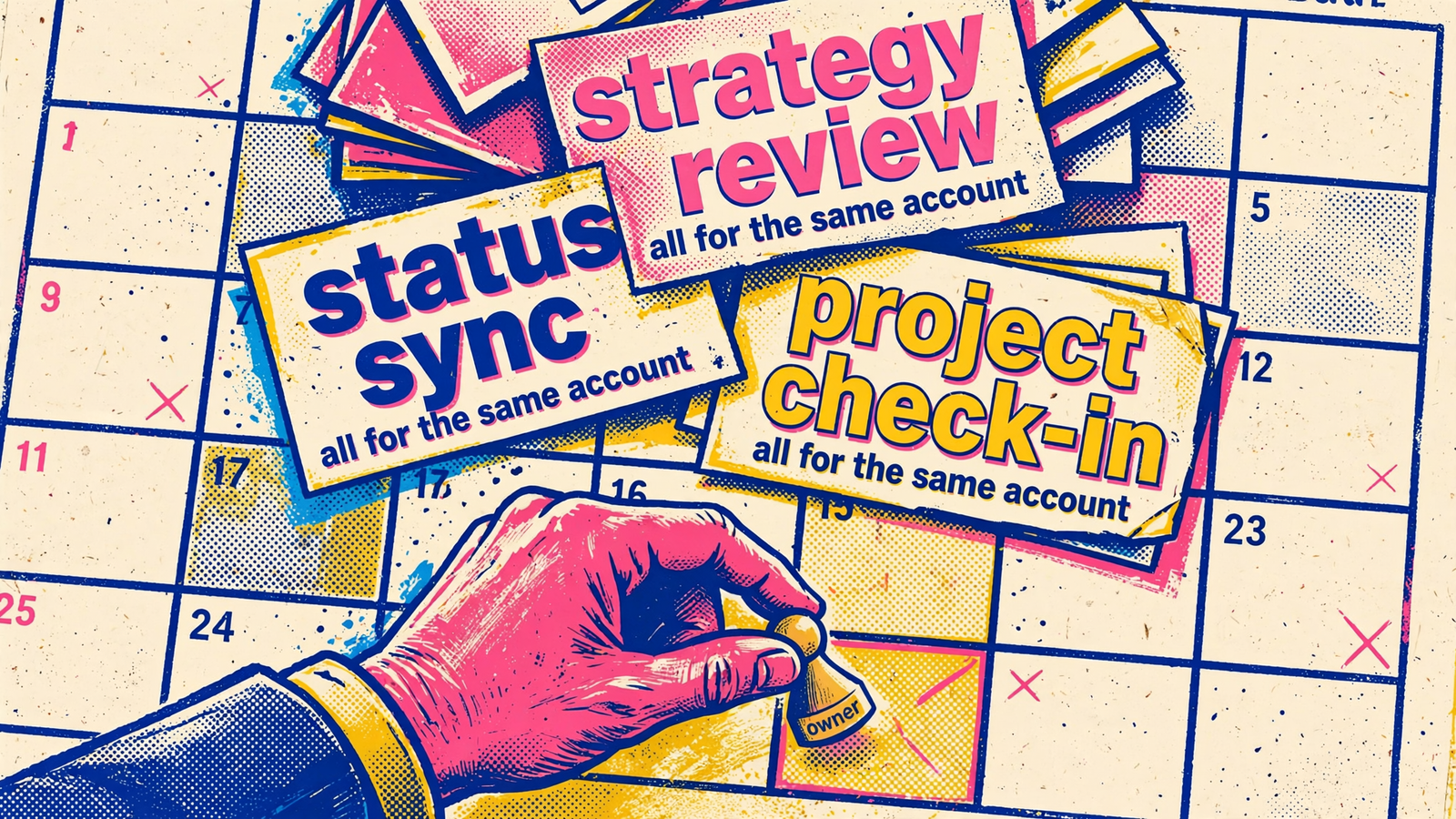
Keep one accountable owner and a clear escalation route. I want:
- One named person who can change budgets and pause creative.
- One asynchronous thread for updates and decisions.
- One route for escalating a CPA spike or tracking problem.
- One monthly 30-minute review, rather than several overlapping standing calls.
First step: ask the bidder to identify which meeting makes which decision. Remove the recurring calls that duplicate another channel, and price asynchronous updates into the remaining scope.
This is not an argument for disappearing behind automation or refusing to speak to clients. The owner still has to explain decisions and answer questions. I am cutting scheduled repetition, not accountability.
If managing $2,500 in media requires three standing meetings, I want to know whether the account is receiving more attention or merely consuming more of mine. Keep the conversation that changes the work. Drop the ceremony around it.
My first move would still be No. 1: collapse the audience splits that cannot justify their budget. A deck wastes hours; fragmentation can waste the media as well. Before negotiating a cheaper manager, I would give the existing budget fewer separate jobs to do.


