

 LinkedIn

A competitor appears in a ChatGPT answer, and suddenly you are shopping for an AI search visibility package. I would not buy a bigger score to solve that problem. The useful purchase is a defined set of buyer prompts connected to inspectable answers, cited sources and approved website work, with a vendor honest enough to admit that no subscription controls the recommendation.
Myth 1: “AI visibility” is one universal score
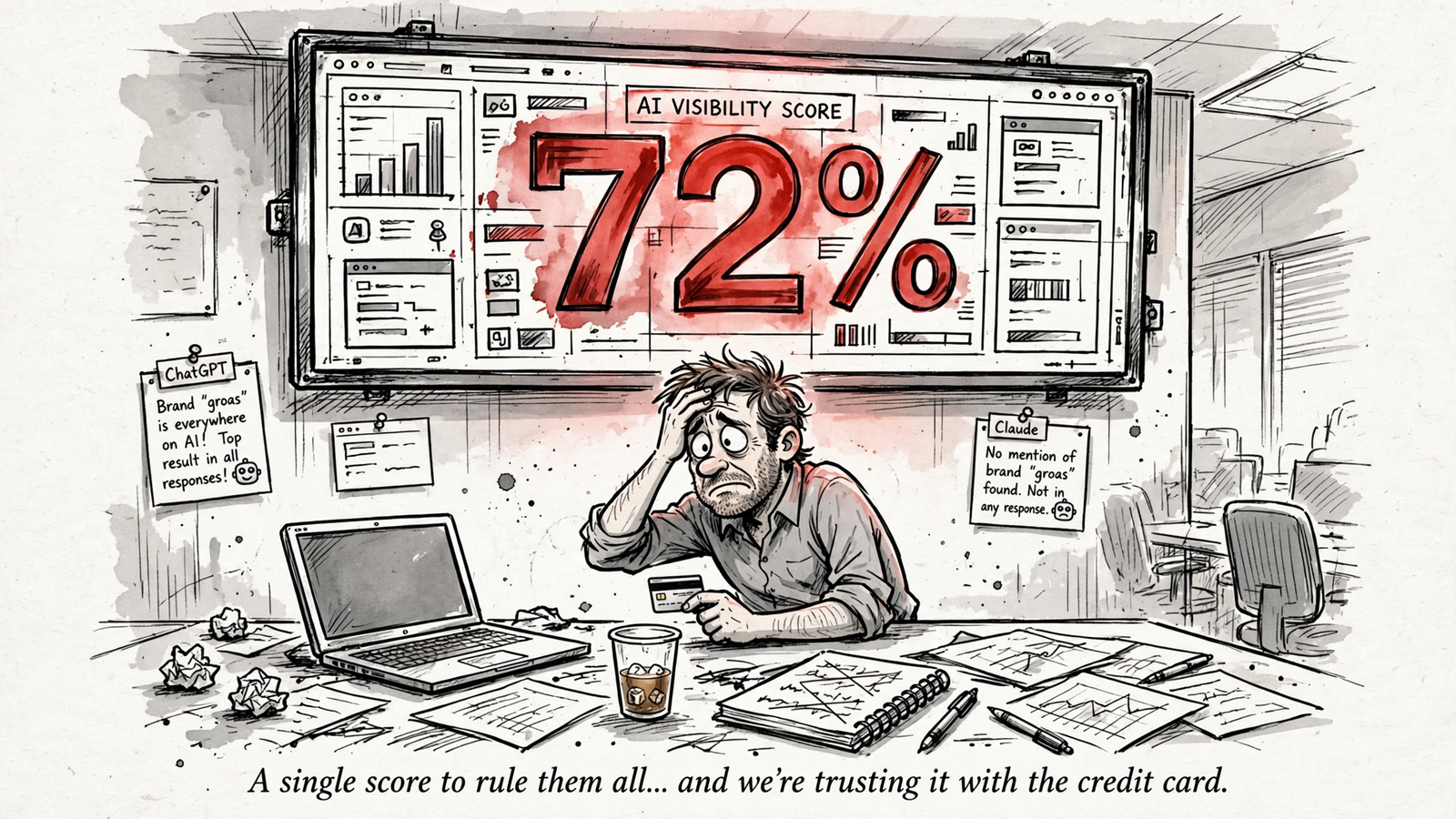
People believe it because the dashboard says 72% in big type. I used to like that kind of number too, back when I reported Search impression share to clients who did not ask what it divided by. A percentage looks settled. The choices behind it rarely are.
Ahrefs defines its AI share of voice as brand mentions divided by mentions of any tracked brand, then shows how weighting by volume turns the same 67% basic score into 31%, 72% or 97%. Change the prompts, assistants, competitor list, country or date, and the percentage can move without anything changing in the market. Ahrefs itself warns to report that scope alongside the number.
So I ask for the scope before looking at the score. With groas connected to Claude, my request would be:
State the monitored scope for this visibility number. Then pull the tracked prompt, assistant, full answer, cited sources and observation date.
That request cuts through most package talk. It turns “your visibility is improving” into something I can inspect: an answer to a particular question, observed in a particular place and time.
If the vendor cannot show which ChatGPT and Claude prompts were run, against whom and when, I cannot tell what the number describes. No scope, no signature.
Myth 2: A mention is a recommendation is a citation
They sound like the same thing in a sales call, which is why vendors let you think they are. They are different events. I want them counted separately:
- Mention: the answer names the brand.
- Citation: the answer links to a source.
- Recommendation: the answer suggests the brand as an option.
- Referral: someone follows through to the site.
The distinction is not pedantry. Semrush looked at 3,981 domain appearances across 115 prompts and found 61.7% were ghost citations: the answer linked the domain without naming the brand. Only 13.2% were both cited and mentioned; 25.1% were mentioned without a link. Citation rate ran nearly double mention rate. A citation count alone does not prove anyone saw the brand name, let alone a recommendation.
Engines also disagree. In that study, Gemini named brands in 83.7% of appearances but cited only 21.4%, while ChatGPT cited 87% but mentioned only 20.7%. In 22% of cases, engines split on whether to name the brand at all. One engine’s score cannot stand in for the others.
The playbook I trust separates citation, mention, recommendation and referral, and it is right to. I go deeper into brand mentions versus source citations separately, but the buying test is simple: ask Claude to pull the full answer and label what happened.
Make them show the sentence before you pay for the score.
Myth 3: Share of voice means much without its denominator
I used to tell clients 20% share of voice was good. I was wrong. Twenty percent against one competitor and 20% against nine are different universes.
The first myth is about what a score measures. This one is about how easily the comparison can flatter you.
Ahrefs is blunt: there is no universally good score. Editing the report can lift you from 18% in June to 26% in July without a single extra buyer seeing you. Remove the biggest competitor, add 50 friendly prompts you already answer well, drop the assistant where you are weak. Same business, better chart.
Sistrix found similar flattery in the prompt set itself. Brands look better inside their own hand-picked prompts than in a broad market pool in three out of four cases, because those prompts cluster near their own language. Competitor readings from your set are especially uncertain.
That is why the definition of share of voice matters more than the headline. Before I accept a comparison, I want three things:
- The full prompt and competitor lists.
- The number of answers included.
- The calculation, including any weighting.
Then I want those conditions held steady when the vendor reports progress. Otherwise, I am comparing two different tests dressed in the same chart template.
A percentage with no denominator is a sales number, not a buying signal.
Myth 4: One sighting means the market moved
One screenshot feels like proof. A competitor appears at the top of an answer, and “we lost AI” suddenly sounds like a reasonable diagnosis. I understand the panic. I do not trust the diagnosis.
Sistrix tracked 10,826 daily series and found 70% of brands that ever appear do so on fewer than 1 in 5 days. Only 6% showed up on 4 in 5 days. In its analysis, one prompt checked for 20 days could read anywhere from 0% to 59% when the true rate was 25%. Using 20 different prompts tightened that range to 16–35%.
That noise is normal. A single new appearance can be flicker, not a market shift.
I separate a new observation from a trend, then separate a possible change from a change in measurement coverage. My request to Claude would be:
Compare repeated observations over the same dates, using the same prompts and assistants. Flag whether the competitor is newly cited or whether tracking coverage changed.
That last part matters. Adding friendly questions can produce apparent “growth” without improving performance on any question already tracked. The dashboard gets a promotion. The business does not.
Do not buy a package off one answer. Buy investigation.
Myth 5: Strong Google rankings guarantee AI recommendations
I ran that play for years: win position two, wait for the clicks. It is tempting to carry the same logic into AI answers. Rank well, get recommended. One familiar chart should explain the next.
But the assistant retrieves sources for its answer, not to reproduce Google’s ten blue links. That breaks the assumption that a strong conventional ranking must become an AI citation.
A May 2026 audit of 55,393 queries summarized by Sona found nearly 30% of cited domains did not appear on the conventional first results page. The Ahrefs comparison in the same summary shows the top-10 cited-URL share falling from 76.1% to 37.9% between July 2025 and March 2026.
I would not read a healthy Search Console chart as proof that ChatGPT recommends the business. I would put the evidence side by side: the pages performing for the buyer query and the sources the AI answer actually cites.
Sometimes the missing evidence does not belong on the homepage, or even on the site. It belongs in a third-party review, a comparison, a Reddit thread or a documentation page the model trusts more than the homepage.
That changes the work worth approving. A rewrite may address the gap. It may also leave the cited source landscape untouched.
Compare rankings with cited sources before approving the rewrite.
Myth 6: “Optimization included” means publishing more articles
Four blog posts a month sounds like work. It is work. That does not make it the right work.
I see the appeal of an article quota: it is easy to price, easy to schedule and easy to put in a monthly report. The awkward question is what those articles are supposed to fix.
If the missing evidence is third-party coverage, a comparison page, a spec table or a Reddit thread the model trusts, four more posts on the company blog do not address that gap. Measuring the absence and filling the editorial calendar are not the same as resolving it. A thermometer does not cure a fever.
I make every proposed page earn its place. Before publication, I want a source-backed change proposal that answers:
- Which buyer prompt are we addressing?
- What did the answer say, and which sources did it cite?
- What exact page or edit addresses the gap?
- What needs approval before anything goes live?
That is a more useful definition of optimization included. It connects the proposed work to observed evidence rather than to an article allowance someone needed to fill.
It also keeps the recommendation honest. Even a sensible edit is a proposed fix, not a purchased outcome. Publication should wait for approval, not happen because the calendar says Tuesday.
Count approved fixes tied to cited gaps, not articles shipped.
Myth 7: Paying for the package buys citations
This is the one I cannot kill. It survives because it sounds like paid search: pay money, get placement.
AI answers do not work that way. A tool can measure answers across ChatGPT and Claude, compare competitors on the same prompts, and draft a fix with evidence attached. It cannot order the assistant to pick a brand. The buying guide I trust puts it plainly: no publisher can promise a specific ChatGPT citation.
When I see guaranteed citations on a package sheet, I read it as someone selling certainty they do not own. A fixed share-of-voice promise or guaranteed ranking inside the product has the same problem.
What I would buy instead
I would buy the inspection loop, not the score. A useful package connects five things without gaps:
- Buyer prompts I recognize. Not 200 variations of the brand name. Questions someone asks before choosing.
- Full answers behind the percentages. Assistant, prompt, answer text, cited sources and observation date, so I can distinguish a mention from a recommendation.
- Competitor comparisons under identical conditions. Same prompts, same assistants, same dates, with the denominator shown. Anything else is chart editing.
- SEO evidence beside AI evidence. Search Console performance alongside the sources the answer actually cites and the third-party coverage the business lacks.
- Approval controls and a change log. Each proposed page or edit tied to a gap, published only after approval and recorded with its date.
Leave out one of those links and the package becomes harder to inspect. I go deeper into the reporting side in 7 myths that make AI visibility reports look more certain than they are.
That is where groas fits for me. Connect ad accounts and the site once, add groas to Claude or ChatGPT over MCP, then ask in plain English:
Show my share of voice against these competitors on these buyer prompts. Pull the answers and citations, then draft a fix tied to the gap. Hold publication for approval.
It brings SEO and AI answers together, with competitor ads, funnels, Reddit, and Semrush and Ahrefs data around them. groas Unlimited is $19 a month flat for unlimited teammates, ad accounts and websites, with every feature included. That is a package for inspection and work, not a promise to control recommendations.
Keep the work log separate from the victory lap
After an approved change, I want the same prompts checked again. I also want the log to show what changed on the site, when it changed and which prompt gap it addressed.
What I do not want is every later improvement automatically credited to that edit. Answers shift for reasons outside the changelog: model updates, a new third-party review, a competitor earning a stronger source. Recording a change and observing later movement does not establish that one caused the other.
That is the discipline I want from the package: inspect the answer, approve the work, record the change, keep observing. No theatrical certainty required.
No subscription controls ChatGPT or Claude. If citations are guaranteed, walk away.


