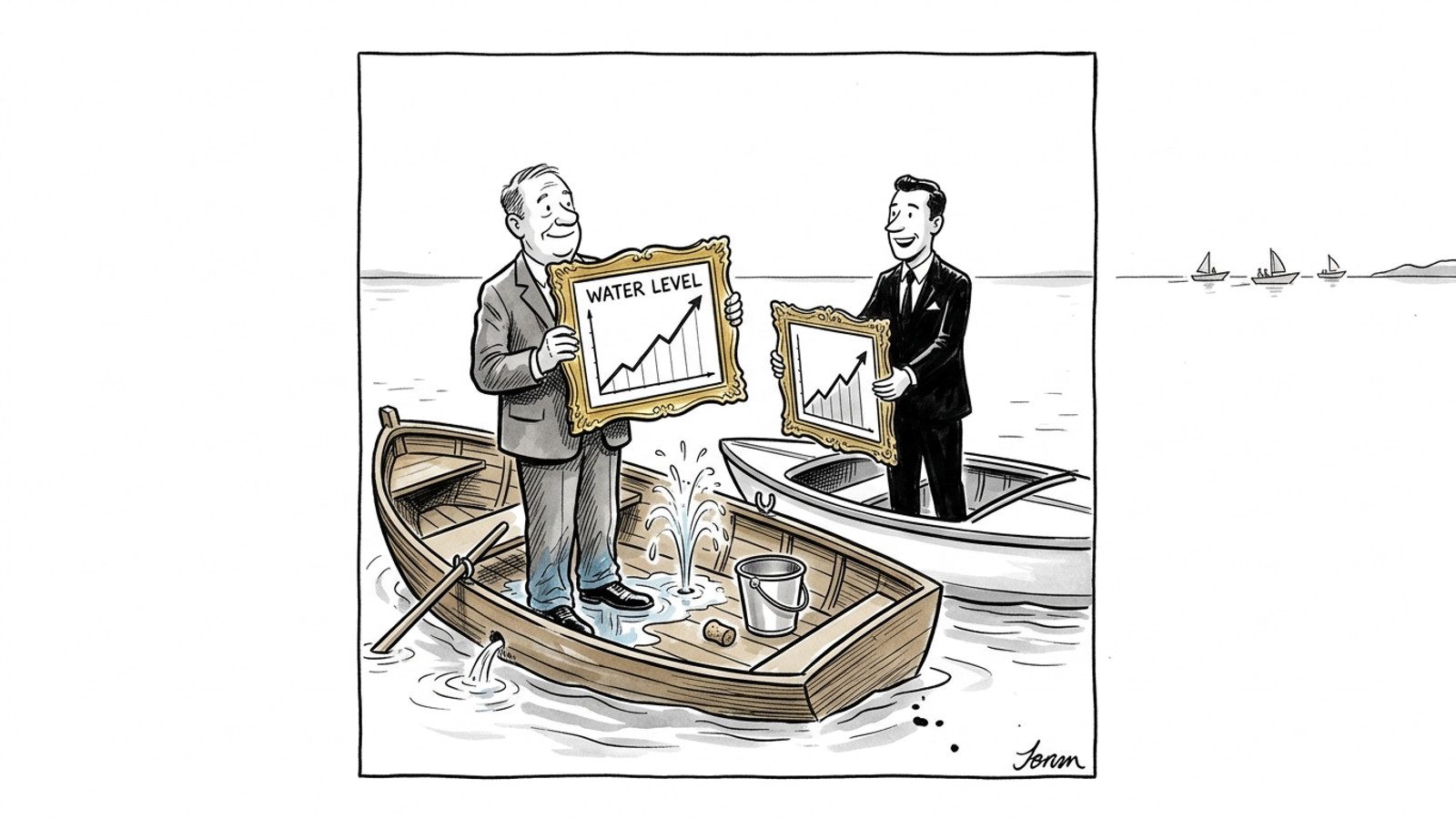

I watched PPC agencies buy thousands of tracked keywords and extra dashboard seats, then wonder why their margins vanished. AEO vendors are selling the same trap with prompts and portals. Back in the PPC-tool boom, an impressive tracking allowance looked like a service an agency could mark up. In practice, someone still had to interpret the data, make the changes, and explain the bill. Now agencies evaluate Answer Engine Optimization (AEO) and Generative Engine Optimization (GEO) software by counting tracked prompts and client logins. That buys a reporting business with a delivery problem. Somewhere between client five and client fifteen, the work that looked negligible on a sales spreadsheet starts eating the retainer.
Myth 1: “More tracked prompts means more client value”
The belief: A monthly report looks more authoritative when it tracks 500 prompt variations across ChatGPT, Perplexity, Claude, and Gemini. If one tool tracks 50 prompts for $150 and another tracks 500 for $300, the second looks like the better agency asset. It gives the account lead more charts to show and the client more apparent coverage.
But an LLM response is not a fixed keyword ranking. Responses are probabilistic and synthesized from more than a single rank position. Tracking hundreds of informational variations such as “what is enterprise crm” and “how does crm work” can run up metered usage without telling you much about whether a buyer will encounter the client. It also creates an explanation job: every thirty days, someone has to decide which movements matter and which are noise.
Start with the buyer’s decisions instead. If the client wants to appear when prospects compare vendors, those comparison questions deserve attention before another batch of broad definitions. Otherwise, the account lead spends the review meeting defending fluctuations in prompts the client never needed to track. More coverage can mean more work without a clearer next move.
What matters is the prompt you can act on. For a client trying to win vendor evaluations, 30 commercial prompts and a plan for the gaps are more useful than 500 variations nobody has time to investigate. Count the questions that could change a buying decision, not the rows you can fit into a report.
Myth 2: “Per-prompt and per-seat pricing will scale with our retainers”
The belief: Start on an entry-level agency plan, add clients, and absorb the software bill as the retainers grow. The spreadsheet looks tidy because the first subscription payment is tidy.
Metered pricing gets less tidy as each client wants more competitors, engines, and frequent checks. Conductor’s AEO pricing breakdown puts dedicated tools in a $500-to-$5,000 monthly range, with prompt volume, engine count, and refresh cadence driving the bill. The credit arithmetic is worth doing before you promise a client daily monitoring. Peec AI’s formula is one prompt × one model × one day = one credit. At that rate:
- 25 buyer-intent prompts across three engines use 75 credits a day for one client.
- Over a 30-day month, that is 2,250 credits.
- Five clients use 11,250 credits before you add another competitor or prompt.
That puts five such accounts beyond a 10,000-credit agency tier. The entry price is not the cost of delivering the service you sold. Otterly AI’s pricing breakdown illustrates the same issue from another angle: its listed $29 entry tier covers 15 prompts, while the listed $189 and $489 tiers cover 100 and 400; Claude and Google AI Mode are separate paid add-ons. These are different meters, but the agency problem is the same. Growth in the client book can force growth in the software bill before it produces any improvement for clients.
The trap is not paying for software. It is quoting a repeatable service using a starter-plan cost, then discovering that the checks your team promised sit on the other side of a higher tier. Add the expected usage for every account before deciding what the retainer can support. Do that while the promise is still yours to change.
Price the service against its working usage, not its starter tier. If you want predictable margins, look for flat per-domain pricing without prompt caps, seat penalties, or a surcharge every time an account manager monitors another model. Otherwise, your team starts rationing the very checks the retainer is supposed to include.

Myth 3: “White-label means putting our logo on a dashboard”
The belief: Map portal.youragency.com, upload an SVG logo, change the accent color, and you have built a proprietary AEO service. The client sees your brand, so the thinking goes, and the software does the rest.
Clients do not hire agencies to acquire another login. As WorkDuo’s agency-platform analysis points out, white-label diagnostic monitoring has a fulfillment problem when the agency cannot act on what it finds. A portal that flags forty missing citations, broken entity schemas, and weak Perplexity visibility may be useful to your team. Hand it to an executive as the deliverable, though, and you have sold an outsourced chore list.
Someone still has to resolve citation gaps, improve the copy, and get technical changes live. If that work depends on a strategist copying findings into tickets and chasing three other people, the logo has not changed the economics. It may even make the handoff harder to spot: the client sees one branded service, while your team manages several separate jobs behind it. White-label the execution, not just the login: the client should see what your agency changed, not merely a branded inventory of what remains wrong.
Myth 4: “Technical fixes need a developer for every client domain”
The belief: Making a site easier for AI-driven search to read means getting into the client’s engineering queue. For a locked-down Shopify store, a rigid Salesforce Commerce Cloud installation, or a complicated WordPress site, the agency writes recommendations and waits for someone with CMS access to implement them.
That wait is where an apparently sound retainer becomes hard to defend. I have watched recommendations sit in a development backlog while the agency keeps presenting the same unresolved issue. An audit in Jira is not a deployed fix. It may be good work, but the client cannot benefit from code that never reaches the site.
Where the edge can shorten the queue
Edge-level infrastructure offers another route for some technical changes. Instead of editing the CMS, a worker at the Content Delivery Network (CDN) layer can modify the response in transit. Technical SEO guidance on Cloudflare Workers describes using tools such as HTMLRewriter to add JSON-LD schema and adjust metadata or crawler-facing responses without changing the origin templates. The Shopify /llms.txt example uses a proxy worker to serve a markdown file without editing Liquid templates or the store’s hosting redirects.
That does not make every technical recommendation instant, and an agency still needs an approved way to deploy at the edge. It does remove one familiar bottleneck: waiting for a separate CMS change every time a suitable response-level fix is ready. That distinction matters when several clients have fixes waiting on different site teams. The agency still owns the recommendation, but it need not assume every implementation must follow the same queue.
When evaluating software, ask how a finding becomes a live change on the client’s actual domain. If the answer is “export a ticket,” budget for the queue.

Myth 5: “We need one tool to track, one to write, and one to build citations”
The belief: An AEO stack should resemble the old SEO stack: an enterprise visibility tracker, an AI writing tool, and a separate outreach or directory service for third-party mentions. Each specialist tool does its job. The agency connects the dots.
Connecting the dots is the expensive part. Tool A flags that ChatGPT cites a competitor for a high-margin query. A strategist opens tool B to produce counter-content, then briefs a contractor or junior specialist to pursue citations through tool C. Subscriptions are only one cost. The handoffs take time, and nobody in that relay owns the revenue outcome from start to finish. What the software deck calls a stack, I call three queues.
Our breakdown of agency AEO tools draws the practical distinction: point tools produce findings for people to coordinate, while an execution platform connects monitoring to changes. Buy the shortest path from a detected gap to a completed action. That is the case for groas for agencies: an autonomous execution engine rather than another reporting portal, with a named strategist supervising direction and guardrails. An agency should not have to build a new coordination department around every client it signs.
Myth 6: “A polished monthly visibility report will keep the client”
The belief: A 20-page PDF charting “AI Share of Voice” across four models proves the agency is on top of generative search. It looks substantial in a review meeting, especially when the graphs move.
The client will eventually ask a less comfortable question: what changed because of it? A diagnostic report can identify citation gaps. It cannot, by itself, fix code, update copy, or earn a mention. Mark up observation as though it were delivery, and the account lead is left explaining why a competitor is still the recommended vendor next month. I have seen the PPC version of this meeting often enough. A better-looking chart does not make the unchanged result easier to sell.
A report can still be useful. It should make the sequence visible: the gap the team chose, the work completed, and the outcome checked afterward. Without that sequence, a rise or fall becomes another interpretation task for the account lead. The PDF is not the problem. Mistaking it for the service is.
Log actions rather than dressing up observations. Show the structural fixes, citation work, and content updates the agency made, alongside the business outcomes the client cares about. Transparent action logs give an account lead something more useful to discuss than a speculative line graph: what was done, why it was done, and what happened next. A report should document the work. It should not stand in for it.

Myth 7: “Our SEO team can absorb AEO if the software tells them what to do”
The belief: Generative engines use web content, so the existing organic team can add AEO to its normal workload. Write a few more posts, add entity terms, check Perplexity between client calls, and follow whatever recommendations appear in the dashboard. This is the hardest myth to kill because it sounds like sensible use of people you already employ.
It ignores the work between a recommendation and a result. Generative answers can change as sources and prompts change; they are not a static rankings sheet you review once a month. The team has to decide which buyer questions matter, investigate citations, update content and schema, coordinate off-site work, and check whether the changes helped. Ask an SEO specialist already spread across eight accounts to do all of that manually, and the “included” AEO service starts taking time from core SEO work. The software may be cheap. The delivery model is not.
That is the same mistake I watched cap PPC agency margins: buying a tool because it measures more, then paying skilled people to turn its warnings into work. I am not arguing that strategists disappear. They should set priorities, protect the client’s guardrails, and answer for outcomes. But software that merely generates homework for humans does not remove the bottleneck. It gives the bottleneck a nicer dashboard.
Frequently asked questions
Do I get more client value from an AEO tool that tracks 500 prompts instead of 50?
Not necessarily. LLM responses are probabilistic and synthesized from more than a single rank position, so tracking hundreds of broad informational variations can run up metered usage without showing whether a buyer will encounter the client. Thirty commercial prompts that could change a buying decision, plus a plan for the gaps, are more useful than 500 variations nobody has time to investigate.
How many credits do buyer-intent prompt checks use per month?
Using Peec AI's formula of one prompt × one model × one day = one credit, 25 buyer-intent prompts across three engines use 75 credits a day for one client, or about 2,250 credits over a 30-day month. Five such accounts use 11,250 credits, which is beyond a 10,000-credit agency tier. Add expected usage for every account before deciding what the retainer can support.
Does putting our logo on an AEO dashboard count as a white-label service?
No. A branded portal that flags missing citations, broken entity schemas, or weak Perplexity visibility is still a chore list unless someone resolves citation gaps, improves the copy, and gets technical changes live. White-label the execution rather than just the login, so the client sees what the agency changed, not merely a branded inventory of what remains wrong.
Can technical AEO fixes be deployed without access to the client's CMS?
Sometimes. A worker at the CDN layer can modify responses in transit; for example, Cloudflare Workers with HTMLRewriter can add JSON-LD schema and adjust metadata or crawler-facing responses without changing origin templates, and a proxy worker can serve a Shopify /llms.txt file without editing Liquid templates. The agency still needs an approved way to deploy at the edge, but it can avoid a CMS change for suitable response-level fixes.
Should I use separate tools for AI visibility tracking, content writing, and citation building?
Point tools produce findings for people to coordinate, and the handoffs between them take time while nobody owns the revenue outcome from start to finish. An execution platform connects monitoring to changes instead. The article recommends buying the shortest path from a detected gap to a completed action rather than assembling a three-tool stack.
Will a detailed monthly AI visibility report keep my client happy?
Only if it documents work rather than standing in for it. A diagnostic report can identify citation gaps but cannot by itself fix code, update copy, or earn a mention. A useful report makes the sequence visible: the gap the team chose, the work completed, and the outcome checked afterward, alongside the business outcomes the client cares about.
Can our existing SEO team just absorb AEO work on top of their current accounts?
It usually cannot without cost. Generative answers change as sources and prompts change, so the team must decide which buyer questions matter, investigate citations, update content and schema, coordinate off-site work, and check whether the changes helped. Software that merely generates homework for humans does not remove the bottleneck; strategists should set priorities and guardrails rather than turn every warning into manual work.