

 LinkedIn

Most owners who tell me Facebook doesn’t work for home services ran the same broken test: an emergency offer, an instant form, a five-mile radius and two weeks of cost-per-lead reports. Meta is the wrong place to catch a 2am burst pipe and a useful place to sell the replacement or tune-up someone can plan. Confuse those jobs, and every number that follows points you in the wrong direction.
Myth 1: Facebook can sell an emergency call the way Google can
Nobody scrolls Instagram at dinner hoping their furnace dies. Google gets the burst pipe and the no-heat call because the homeowner is already looking for help. Facebook reaches the homeowner before that search: the roof with two summers left, the 14-year-old AC, the tune-up they keep postponing. One contractor breakdown I still use suggests roughly a 60/40 split between Google and Meta for HVAC and roofers, with Facebook doing replacement consideration work rather than rescue work.
I used to tell clients Facebook could fill the emergency board. I was wrong. Search captures demand that exists now; a feed ad interrupts someone who may have a problem but is not trying to solve it this minute. That distinction changes the offer. An emergency ad asks a homeowner to act before they have an emergency. A replacement ad asks them to think about a decision they already know is coming.
This does not mean every planned job belongs on Meta. It means you should test Meta against a job the homeowner has time to consider, not demand that it behave like a search result. If the job cannot wait a week, do not judge Facebook on it. Ask any agency pitching you which jobs they would put on Meta and which they would leave on Google. If they cannot separate the two, the campaign is already in trouble.
Myth 2: Instant forms always bring junk leads
People believe this because they tested the default form. The More Volume setting can take two taps inside Facebook: no landing page, little friction and, by the time you call, sometimes no memory of what they clicked. Of course the resulting leads can feel like junk. In home services, those forms run around $28 to $42 per lead against $52 to $78 for website conversion ads. Removing the click and page load can lower the price of a form fill. It does not make that form fill a booked job.
Meta’s own test found instant-form-plus-website campaigns averaging 60% lower CPL and 125% more leads. That is a cost-per-lead result, not a close-rate result. I would not throw out instant forms on that evidence, and I would not declare victory with it either.
Switch the form to Higher Intent, add its review screen, and ask two qualifying questions: own or rent, and age of system. Require a phone number with intent confirmation. The extra friction gives someone a chance to decide whether they actually want the call, while giving your team a better reason to make it. It will not rescue a bad offer or a slow callback. Test the quality of a qualified form, not the price of the default one. Before hiring an agency, ask what disqualifies a lead and whether they will use Higher Intent with filters. If their answer is simply “more leads,” keep asking.
Myth 3: A tight radius around the shop keeps leads local and cheap
The logic feels airtight. Draw a tiny circle, pay only to reach neighbors and avoid towns your trucks do not serve. But the shop is not the customer, and a tiny circle gives delivery little room to work. A one-mile radius can bring higher CPMs and throttled delivery; even within a 15-mile local area, piling on more targeting can leave the audience too small. Practitioners working these accounts often start with a 3-to-5-mile minimum and use drive-time shapes rather than treating the shop as the center of every worthwhile job.
That does not mean drawing a huge map and hoping the dispatcher sorts it out. The boundary should reflect where you will actually send a truck. Within it, give the auction room to find people. An open-location, age-30-to-55 structure with creative doing more of the targeting has been associated with local CPMs of $5 to $15 and CPLs of $5 to $25. Those figures are not a promise for your service area. They illustrate the tradeoff: restricting delivery can cost money, too.
Set the map by your service area, not by the shortest line from your shop. Then ask any agency pitching you what minimum radius it would test before layering interests on top. “As tight as possible” sounds careful. In a small auction, it can be an expensive way to stand still.
Myth 4: You need to target homeowners with interests
Ten years ago, stacking homeowner, home improvement, DIY-store buyer, income and zip codes felt like account management. It also looked impressive in a deck. The targeting tools have changed. Meta consolidated thousands of granular interests in mid-2025, removed detailed exclusions on March 31, 2025, and paused ad sets still using deprecated interests on January 15, 2026. Entered interests now act as suggestions to Advantage+, not the hard filters many owners think they are buying.
Layer those suggestions inside an already small service area and you may leave the auction fewer people to learn from without getting the precision you imagined. The more useful starting point is deliberately plain: service area, a workable age range such as 30 to 55, broad delivery and a conversion event tied to a job worth doing. Then let the offer and creative tell the right homeowner why they should stop scrolling.
Meta says Advantage+ leads campaigns averaged 14% lower CPL and 10% lower cost per qualified lead than non-Advantage+ setups. Fine, but those averages do not replace your own booked-job numbers. A broad audience still needs feedback about which leads became work. Otherwise the system has room to learn but no useful definition of success.
Let creative attract the right homeowner and your conversion event identify the right outcome. Ask an agency what event it will optimize toward, then what it will change if an elaborate interest stack cannot spend. A long targeting list is not a strategy just because it took a long time to build.
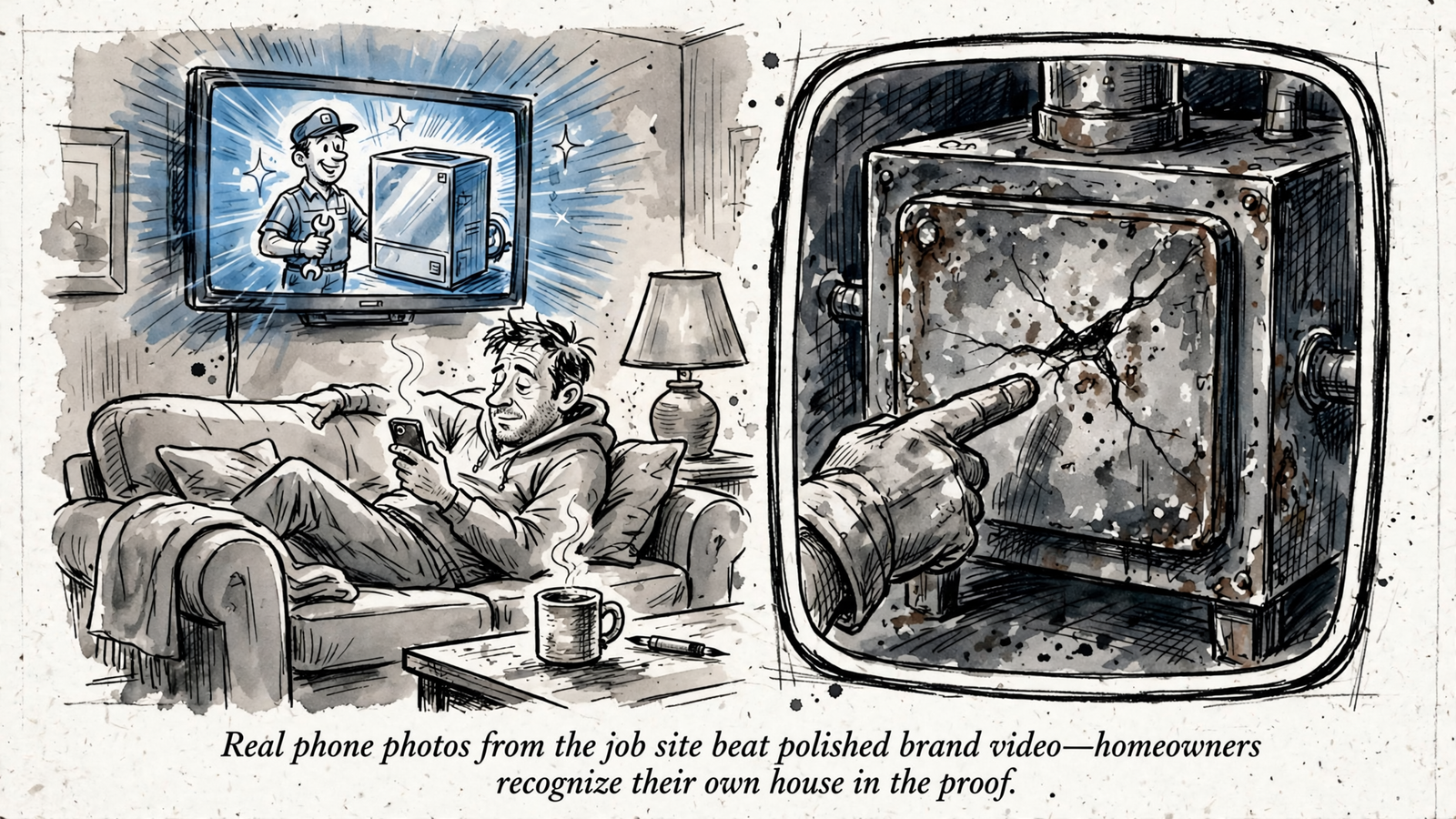
Myth 5: Polished brand video beats phone photos from the job site
A polished video can look like precisely what someone came to the feed to skip: an ad. A 20-second phone clip of a tech explaining a cracked heat exchanger, a before-and-after roof shot with the address cropped out, or a homeowner saying the crew left the yard clean gives people something else. Proof. Contractor guides call before-and-afters a strong asset for roofers and remodelers, and Meta itself advises against overly ad-like creative.
The mechanism is not that shaky footage has magical powers. The homeowner recognizes a familiar problem in a real attic, on real shingles or in a driveway that looks like theirs. A glossy drone shot with stock music can show that your company owns a drone. It may not answer the homeowner’s question about the work.
I would not ban polished video. I would make it earn its place against material your crew can capture while doing the job. Test the same offer with both. Judge the assets by the work they bring in, not by which one looks better in a presentation or racks up views from people who will never book.
Shoot five phone assets for every polished one, then cut the loser on booked jobs. Ask an agency how many new creative variants it plans to test each month and who will hold the camera. If nobody knows, the “creative strategy” may be a folder of old brand footage with a new caption.
Myth 6: Peak season is when to raise the budget
Everyone raises budget in July when the phones already ring, then wonders why leads cost more. By June, HVAC advertisers are chasing the same no-cool demand. Search CPCs and CPLs climb; in heat waves, summer AC keywords can jump 40 to 60 percent. Meta is a different auction, but the planning mistake is the same: waiting until the customer needs help immediately before trying to win their attention.
The alternative is to advertise the work people can schedule before the rush. Run tune-up ads three to four weeks ahead of the peak. March through May AC tune-ups at $79 to $99 and September through November furnace checks can fill the shoulder season at $20 to $40 CPL, rather than $50 to $100-plus in emergency periods. Those are useful planning figures, not permission to ignore what a booked job costs in your own account.
The offer matters as much as the calendar. A tune-up gives a homeowner a reason to respond before the system fails. That relationship can lead to a later replacement or maintenance plan. An emergency message in the same feed asks them to imagine a crisis and act on it now. Most will keep scrolling.
Spend while attention is cheaper and the decision is forming, not only when the phones are loudest. Ask any agency pitching you what it would sell in March to make July less dependent on the emergency auction. “We will raise the budget when demand spikes” is a budget setting, not a seasonal plan.
Myth 7: Cost per lead tells you if it’s working
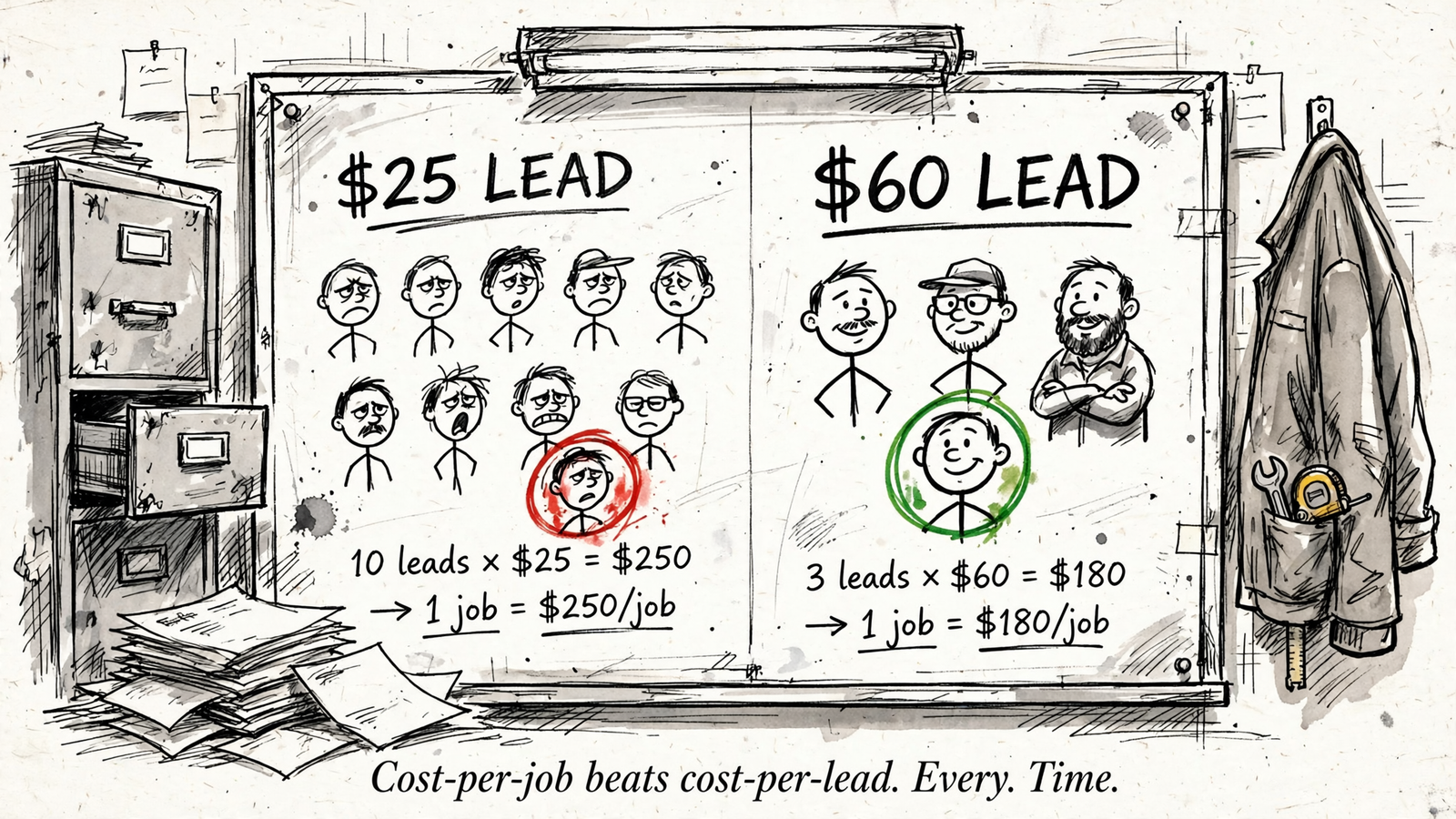
This is the myth I find hardest to kill because the number sits right there in Ads Manager, green and going down. A $25 instant lead feels like winning until you follow it to the schedule. Home improvement on Meta averages around $42.95 per lead, with home services ranging from $34 to $117 and 10 to 20% closing into $170 to $585 per booked job. You can debate which average resembles your market. You cannot skip the arithmetic.
I make owners do the same calculation I used to do at 1am: a $20 lead that closes one in eight costs $160 per booked job, while a $50 landing-page lead that closes one in three costs $150. The expensive lead was cheaper. The deck calls the first campaign efficient. I call it paying to keep your CSRs busy.
Meta optimizes toward whatever you tell it counts as a win. Feed it form fills and it finds more form fillers. Send Qualified, Booked and Completed stages server-to-server through the Conversions API, and the system gets feedback about the work you actually want, even when a signed replacement comes weeks after the click. That feedback loop matters more than the interest stack, the one-mile circle or the polished video. It is why I push clients to fix tracking before they touch creative.
You do not need twenty questions on a discovery call. Six will show whether an agency understands the difference between buying leads and buying work:
- Which jobs will you run on Meta, and which will stay on Google?
- Will you test Higher Intent forms with own-or-rent and system-age questions?
- What service radius will you start with before adding interests?
- How many phone-shot creatives will you test, and who shoots them?
- What will you sell before peak season, rather than only during it?
- Will you feed booked jobs back through the Conversions API instead of stopping at raw leads?
If the pitch promises cheaper leads without asking about your close rate or speed to call, it is selling you the $25 lead that loses. For the longer version of that argument, see The “We’ll Halve Your Meta Cost per Lead” Agency Pitch, Taken Apart. The same discipline matters outside Ads Manager; I covered those fixes in 7 Ways to Lower Meta Lead Costs Outside Ads Manager. And on search, there is a home services lead-quality and booked-jobs case study worth reading alongside this one.
Most owners who say Facebook failed tested emergency work with no-friction forms on a map too small to deliver, then judged the result on cost per lead. Change the job, qualify the response, give delivery room and measure what reaches the board. That is a test of whether Meta can sell planned work. The original setup mostly tests whether someone will tap a form.
One last thing I learned running home service accounts: none of those fixes survives a slow callback. A tune-up lead reached in minutes has a better shot at booking than one left until the next morning to shop competitors. If your office cannot cover the phones during the test, cap the daily budget at what the team can work the same day. Cost per booked job is the number to defend, and the callback is part of the cost.


