

 LinkedIn

A $38 Meta trial signup can sit beside a $400 customer acquisition cost. One number counts people willing to start; the other waits to see who pays. I used to report the first as if it settled the argument. It doesn’t, even if the trial looks cheap against the $30–$80 B2B SaaS benchmark. This list is for SaaS operators who already read agency reports and suspect the math stops too early. Cheap trials are a campaign result. Valuable trials are a business result. Here are seven checks to run before you reward the agency for the first number—or replace it because of the second.
1. Count people and companies, not signup events
Meta reports trial events. Your business needs to know how many new people and companies started trials. Those are not automatically the same count. A page refresh can fire again; a second email from the same person can count again; a revisit from the same workspace can count again. The platform sees events. You pay to acquire people.
There is a tracking version of this problem, too. When both browser and server send a trial event, Meta needs the pixel eventID to match the server event_id, along with the event name, inside 48 hours to deduplicate them. Miss the match and one signup can appear twice. That is not better acquisition. It is two records for one action.
Start with three numbers for the same 30 days: Meta trial events, unique users who started a trial in your database, and unique companies or workspaces. Put them side by side before discussing cost per trial. Then agree on the counting rule in writing. My rule is one work email equals one trial, with additional workspaces from the same company flagged separately. If the agency cannot report on that basis, do not compare its acquisition results with another agency’s. You are comparing definitions.

2. Strip out existing relationships before praising acquisition
An existing customer starting another workspace is not the same acquisition as a new company arriving for the first time. Neither is a teammate joining on a company domain. Both can make cost per trial look excellent while doing little for new-prospect growth. Retargeting can add past customers to the pile. If you blend those people with strangers, the easy conversions lower the price you think you paid to find someone new.
Meta’s Customer Lifecycle Strategy choices make the distinction explicit: Get conversions from all audiences includes past buyers and tends to show a lower cost per result; Acquire new customers excludes them and usually costs more. The cheaper setting is not proof of better prospecting. It may simply be counting people who already know you.
Before the next agency call, ask for trial events split into new prospects and existing relationships using CRM data from the same dates. Check the exclusion setup as well: Existing Customers needs a defined customer list or purchase-based website audience attached to the campaign. If the list has not been refreshed since onboarding, fix that first. Then price new prospects on their own. If their cost is 40% higher than the blended figure, use the higher number when deciding whether prospecting deserves more budget.
3. Price the activated trial, not the signup
A form can remove so much friction that people complete it without much intention to use the product. That helps trial volume and hurts everything after it. In one audit of frictionless B2B lead forms, about 40% of leads did not remember submitting and about 30% were unreachable; an £8 headline CPL became £80–£120 per qualified conversation. A SaaS trial has a different funnel, but the warning is familiar: a cheap start tells you little if workspace creation stalls and the people who signed up never use what they requested.
The next action matters. The trial-conversion figures cited here put median trial-to-paid conversion at 19% for product-led and 12% for sales-assisted trials. They also put trials that activate in the first 24 hours at 2.3 times the conversion rate of those that wait past day three. If one campaign brings people who reach value and another brings people who disappear after the form, their identical cost per trial is concealing a very different purchase path.
Pick one product event that demonstrates value: a connected data source, an invited teammate, or a published first project. Make that your activation definition, then put cost per activated trial beside cost per trial in the weekly report. Do not switch the optimization event just because the new metric sounds tougher; first decide which action actually matters. The distinction between trial starts, activated trials and paid conversions is worth settling before anyone changes the campaign. If activation falls below half your organic baseline, pause scaling and examine the signup path before buying more of the same trials.
4. Break the average apart by segment
A $45 average cost per trial can hide a $22 segment that never pays and a $95 segment carrying the quarter. Meta looks for people likely to complete the event you give it. If that event is a cheap signup, it can find more small teams, wrong regions, students or roles that never get budget approval. The average smooths away the very differences you need to see.
Start with the segments your CRM can identify reliably: company size, industry, role and region. For each, pull trial-to-activated and trial-to-paid alongside cost per trial. Do not let a large volume of inexpensive signups win the budget discussion before you know what happened after signup. If a segment supplies 60% of trials and 10% of revenue, its CPL is not a reason to scale it.
The same logic applies to the signals you feed back into targeting. Lookalikes built from website visitors or cheap leads can reproduce the pattern you are trying to escape. Seed them on paying customers when you can, and use filters such as verified work email or qualifying questions where they help separate buyers from casual signups. Scale the segment with the lowest cost per activated trial, not the lowest cost per trial.
5. Compare cohorts at the same age
A new agency can look brilliant in week two and awful in week six without its work changing at all. Trial starts appear immediately; paid conversions arrive later. If you compare a recent Meta cohort with an older organic cohort, you are giving one group a fraction of the time to pay and the other a full sales cycle. I have made the opposite mistake, too: treating soft paid conversion after nine days as a reason to pause prospecting. I was judging toddlers for not having jobs.
For a 30-day trial, about 70% of conversion happens by day 14. A cohort younger than that is a partial read. Show it, but label it honestly rather than presenting the paid rate as finished.
Ask for paid customers by cohort age: day 7, day 14, day 30 and day 45. Use the same ages for Meta and every source you compare it with. If the latest Meta cohort has 40 trials at day 6 and no paid customers yet, mark the paid result pending, not 0% conversion. Never put a 10-day-old Meta cohort beside a 90-day-old organic cohort and call the difference agency performance. Wait for comparable evidence before rewarding or replacing anyone.
6. Separate demand Meta observed from demand it caused
Meta can report a conversion after an ad appeared in someone’s path without proving that the ad created the decision. Its default 7-day click and 1-day view window can credit a trial that later came through search, direct traffic or email. Modeled conversions complicate the picture further. That helps explain why Meta reports can exceed CRM conversions: the figures cited here put the gap at 1.5 to 3 times, and 3 to 4 times in some accounts. Retargeting is especially good at looking productive when it reaches people already close to signing up.
The distinction is observed sales versus caused sales. A retargeting report tells you Meta was near the conversion. It does not, by itself, tell you what would have happened without the ad. If the budget decision depends on that difference, run a holdout: leave a matched group unexposed, compare revenue, and calculate incremental return as treatment revenue minus scaled control revenue, divided by spend. Then compare incremental return with reported return to get the factor you use to temper future reports. That is what a lift test is meant to answer.
If volume or implementation does not support a holdout yet, do the less glamorous check now. View the comparison on 1-day click, reconcile Meta trials with CRM new users monthly, and carry the resulting Meta-to-CRM discount factor into budget discussions. If Meta claims 100 trials while the CRM shows 50 new prospects, cost per new prospect is twice the reported cost per trial. Make the next decision with the second number, not the screenshot.
7. Demand a report that reaches paid customers
A report that ends at spend, impressions, trials and cost per trial stops exactly where the agency’s best-looking number lives. It leaves you to discover whether those trials activated, whether they paid, and whether they belonged to companies you already had. You cannot make a sound agency decision from a table that omits the outcome you wanted.
Ask for one monthly table with the same cohort dates and definitions throughout:
- Spend and unique trial users and companies
- Activated trials, using the agreed product event
- Paid customers from those cohorts
- Cost per unit at each step
That table shows where to investigate. A flood of trials that never activate points first to what the ads are attracting and how signup works; these fixes for Meta trials that do not activate give the operator a place to start before blaming the product. Strong activation but weak paid conversion is a different conversation. Do not let one cheap number stand in for both.
Then put ownership in writing. You provide the activation definition, a monthly export of unique users and companies with trial starts, a refreshed customer list for exclusions, and CRM access to reconcile paid conversion by cohort. The agency owns deduplicated tracking, exclusion maintenance, optimization toward activation rather than signup volume, and a written note explaining what changed and why. Hire against that measurement contract, not the cheapest signup screenshot.
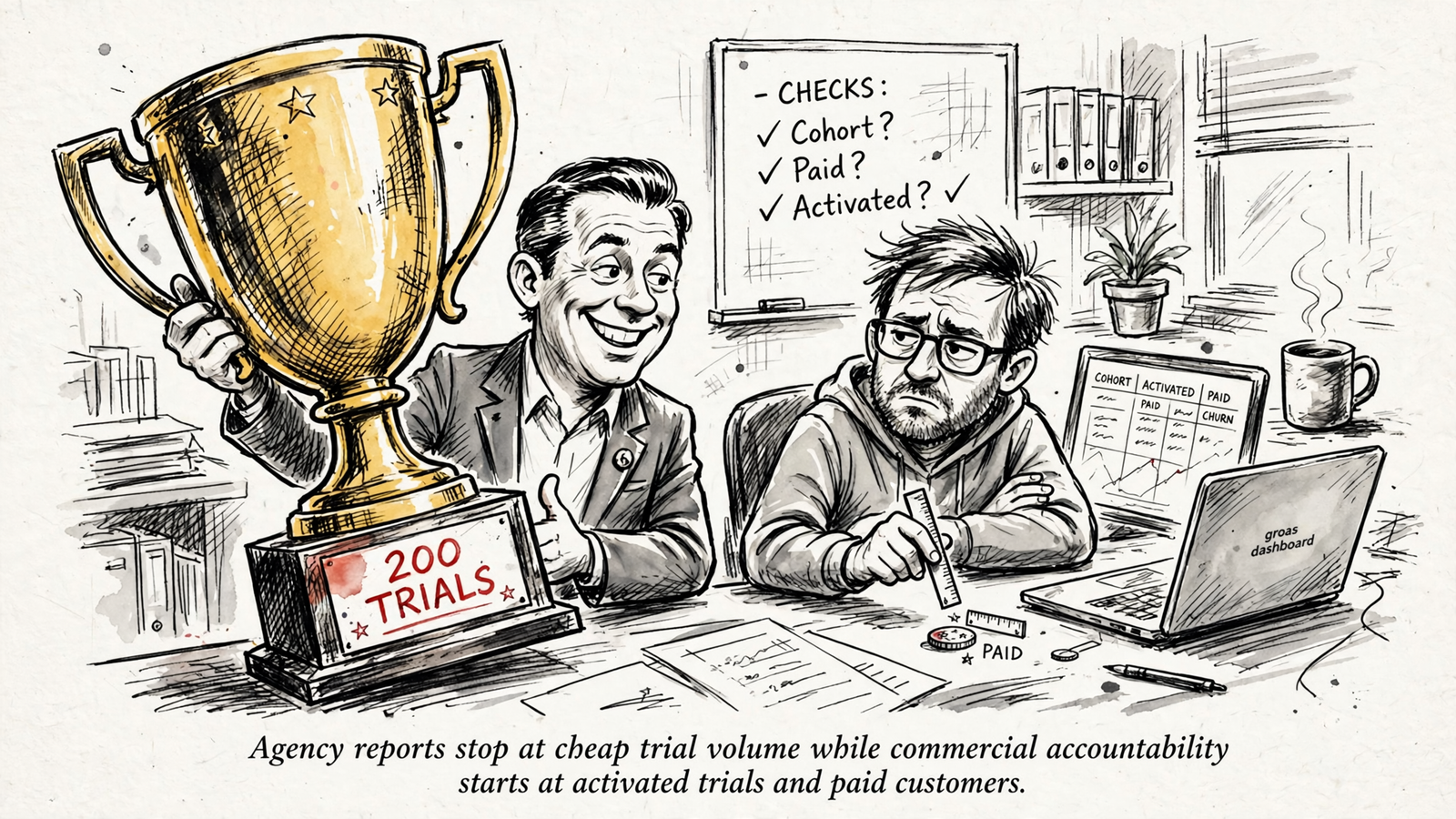
That contract is why I do this work inside groas instead of inside a retainer. An agency paid as a percentage of spend has little reason to make a cheap trial screenshot less flattering. groas runs Meta ads for $1,499 a month flat, whatever you spend, works audiences, budgets and creative around the clock, and logs changes with the reasoning in plain language. A human strategist still owns the result; the repetitive buying work does not have to wait for the next account review. If your report stops at trials, stop optimizing your SaaS Meta ads for free-trial signups and put the account on this contract.
If I could start with only one check, though, I would start with No. 3. Deduplication, exclusions and cohort alignment make the report honest. Activation changes what Meta goes looking for. A trial-start event asks it to find people willing to complete a form; an activated-trial event asks it to find people willing to use the product. That trial may cost more on paper. It is also the one with a path to revenue.