

 LinkedIn

513 live-answer fetches in 30 days. That is how often one groas updates page was pulled during live answer generation, yet the count alone cannot show whether an assistant recommended the business.
I spent years mining search terms at 1am, so I distrust big numbers without a mechanism behind them. A fetch is evidence of access and consumption. It is not proof of a citation, a brand recommendation, or a qualified enquiry. Our own measurements show why those belong on separate lines in an SEO and AI-search report. Counting the first and implying the rest is not attribution. It is optimism with a table.
What the updates page’s crawler traffic actually proves
The measured page covers Google Ads updates. The log separates total hits, verified fetches, and live-answer fetches. Those labels matter: a request claimed a crawler identity, its source passed verification, or content was pulled during live answer generation. Collapsing those categories into AI visibility makes the number easier to sell and harder to interpret.
The figures below come from groas’s supplied measurements. Shares are rounded against total hits.
| What we counted | 30-day total | Share of total hits | What it establishes |
|---|---|---|---|
| Total hits | 850 | 100% | A request claimed an AI crawler identity |
| Verified fetches | 833 | ~98% | Source IP matched the operator list |
| Live-answer fetches | 513 | ~60% | Content was pulled during live answer generation |

Verification is the first filter. A user-agent string saying GPTBot or PerplexityBot is just a claim in a header. Anyone can send one. In one two-week analysis, about 1 in 17–18 AI-crawler claims were spoofed. That finding describes that analysis, not a universal spoofing rate. It explains why accepting the header at face value is a poor reporting habit.
Here, verification means matching the source IP against the operator’s published JSON lists. Most requests to the updates page passed. That supports the conclusion that the traffic came from AI infrastructure. It still says nothing about what appeared in the answer.
The live-answer category gets closer to the event we care about. It records consumption during answer generation rather than background crawling. But consumption is still not recommendation. The assistant may read a page without citing it, name a brand without recommending it, or cite a source without sending a visitor.
So the live-answer total does not establish:
- How many distinct people, prompts, or answers were involved.
- How many answers discussed groas.
- Whether any answer cited, mentioned, or recommended the business.
- Whether anyone clicked, enquired, or entered the pipeline.
The mechanism stops at retrieval. To follow it into an answer, I need answer evidence. To follow it into revenue, I need commercial evidence.
The page with more hits had much less verified activity
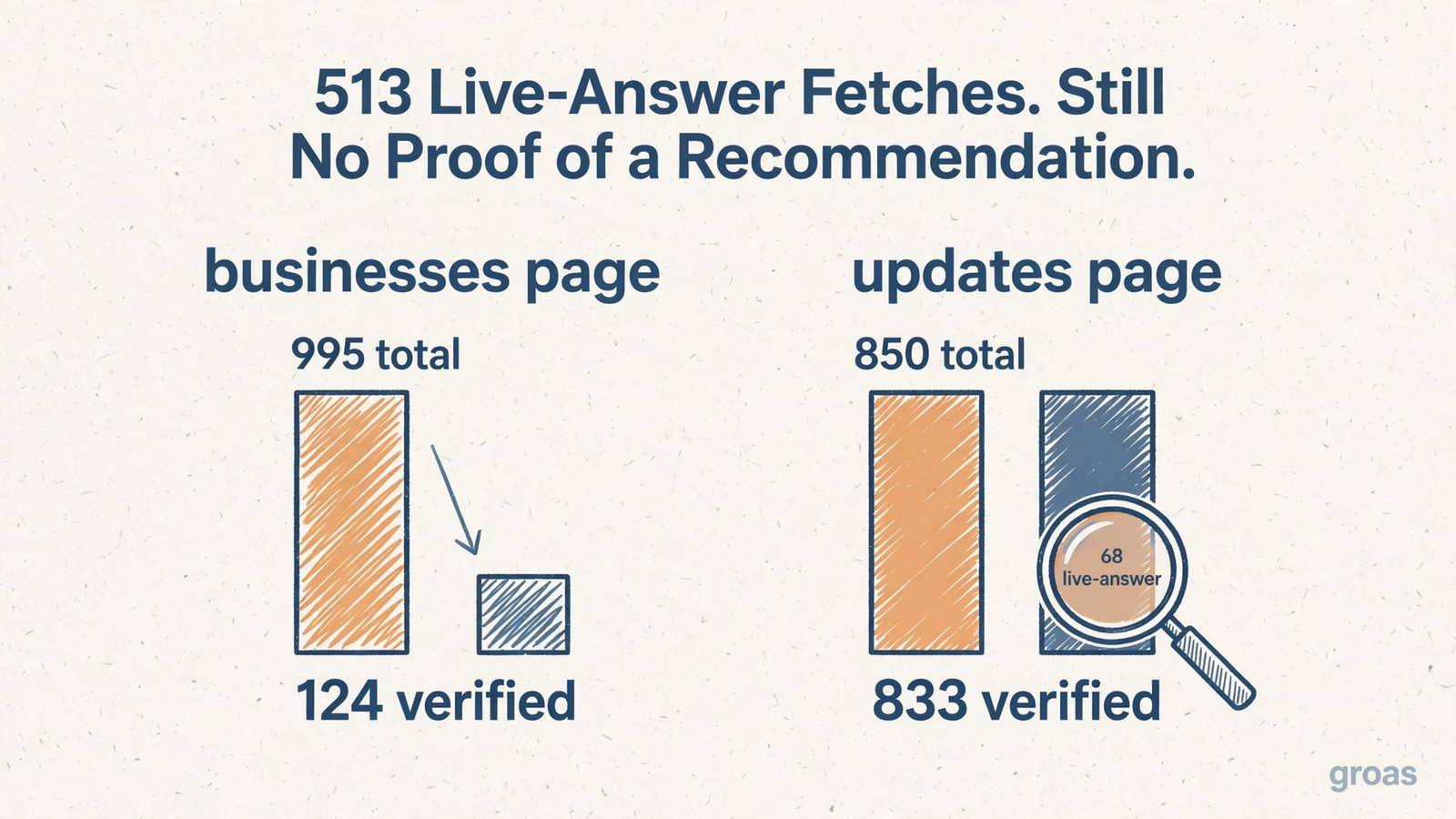
The businesses page makes the problem with raw rankings obvious. It recorded more total hits than the updates page in the same measurement window, but far fewer verified fetches and live-answer fetches.
These figures come from the same groas measurements, with shares again rounded against total hits.
| What we counted | 30-day total | Share of total hits |
|---|---|---|
| Total hits | 995 | 100% |
| Verified fetches | 124 | ~12% |
| Live-answer fetches | 68 | ~7% |
I used to tell clients that more crawler hits meant more interest. I was wrong. Rank these pages by raw requests and the businesses page wins. Rank them by verified fetches or recorded live-answer activity and the updates page leads.
Both pages show access. They do not show equally strong evidence of it, and neither table proves a recommendation. That is the useful comparison. There is no need to turn it into a verdict about which page generates more business; the supplied data cannot answer that.
Unverified does not automatically mean fraudulent, either. It means the source IP did not match the published operator lists at check time. That can reflect spoofing, third-party tools borrowing a familiar user-agent, or infrastructure moving before a list updates.
I would retain those requests in the raw total but exclude them from claims of verified access. Calling all of them genuine overstates the evidence. Calling all of them an attack overstates it in the other direction. Ask which bucket your provider counted before discussing whether the number went up.
Where the logs stop answering the question
The path list we worked from was truncated. A truncated path list cannot establish a content gap. I cannot look at its top entries and declare that buyers ignore the pricing page or that an entire topic is missing. Absence from a cut-off list proves absence from a cut-off list. Nothing more.
The logs also do not reveal which prompt triggered each live-answer fetch or what the resulting answer said. That is not a small omission if the claim being sold is “assistants recommend your business.” It is the missing evidence for the claim itself.
Nor should I expect every citation to have a fresh fetch beside it. In one study joining citations to server logs, OAI-SearchBot had previously fetched 116 of 129 URLs that ChatGPT later cited, yet only 1 of 63 answers had a verified fetch in the preceding 10 minutes. Those are observations from that study, not conversion rates to apply to our pages. They show why crawl activity and answer activity cannot be treated as matching events.
A background fetch can precede a later citation. A live fetch can happen without a recommendation. The log alone cannot distinguish a passing mention from an endorsement.
Answer evidence has limits, too. A 2,961-run study found less than a 1-in-100 chance of the same prompt returning the same brand list twice. That finding is a reason to repeat observations, not to pretend one screenshot represents a stable position.
Finally, these page totals do not establish coverage across ChatGPT, Gemini, and Perplexity. Each engine crawls, stores, and retrieves differently. Activity on an updates page does not tell me whether another engine can access the pricing page or names the brand on a buyer query.
My boundary is simple: logs support access claims. Saved, repeated answer observations support inclusion claims. Neither substitutes for the other.
Ask separate questions about access, inclusion, and pipeline
If I am paying for ongoing SEO and AI-search work, I want the report to answer these questions in order. Each needs its own evidence.
Can assistants access and consume the content?
This is where verified fetches and live-answer fetches belong, alongside the pages, dates, and verification method. Our updates page shows substantial activity in both categories. The businesses page shows less, despite its larger raw total.
The access question is technical, not commercial. A successful fetch tells me the content was reachable. It does not tell me the business was selected, preferred, or contacted. This layer earns its place in the report because access matters, not because it proves everything downstream.
Do buyer-prompt tests show citations or recommendations?
This requires observing answers, not relabelling logs. A practical monitoring method recommends 20–40 real buyer prompts, run 3–5 times per engine in clean sessions. That is a testing framework, not a guarantee of complete coverage.
The prompt set should stay fixed enough to make comparisons useful. For each run, record:
- The engine, prompt, and run date.
- Whether the brand was mentioned.
- Whether the site was cited.
- Whether the answer actually recommended the business.
- Which competitors and sources appeared.
- The saved answer supporting those labels.
A citation and a recommendation are not interchangeable. I want to see the answer, not just a green cell labelled visible.
A GEO reporting checklist makes the broader reporting standard explicit: agree the prompt set before work, cover the named engines, define citation rate and share of voice, compare with a baseline, and retain answers. Ask for the evidence by engine. A blended score can hide exactly where the brand is absent.
Do identifiable visits and enquiries become qualified pipeline?
Citations show presence, not traffic or conversions. Referrals show attributed visits but miss citations nobody clicks. The Cloudflare AEO framing draws that distinction clearly: crawl activity indicates access, while citation presence does not establish traffic or conversions.
For the commercial layer, I want tracked visits, form fills, calls, and qualified pipeline, with attribution limits stated plainly. An identifiable referral is useful evidence. It is not a complete census of everyone influenced by an answer.
That is the standard I would hold groas to as well. Access without citation is plumbing. Citation without pipeline is press. Both can have value. Neither should be passed off as the other.
Put the evidence into a report that cannot blur the categories
The questions above define what must be measured. The report should make it difficult to confuse the answers.
I would keep distinct reporting layers rather than roll everything into a headline visibility score:
| Reporting layer | What belongs there | What it must not imply |
|---|---|---|
| Work and access | Pages changed, technical fixes, verified fetches, live-answer fetches, dates, verification method | That a fetch became a citation or recommendation |
| Answer inclusion | Fixed buyer prompts, engines, repeat runs, saved answers, mentions, citations, recommendations, competitors | That appearing in an answer generated a visit or sale |
| Commercial outcomes | Identifiable AI-referred visits, enquiries, qualified pipeline, attribution limits | That all AI-influenced demand is identifiable |
Show completed work beside the evidence it could reasonably affect. If the provider fixes access, show the technical change and access observations. If the provider says the brand appears more often in buying answers, show comparable prompt runs. If the provider claims business impact, show the commercial trail.
Our updates page belongs in the access layer. The measurements support that placement. Moving the same fetch count into the recommendation layer does not create new evidence; it just gives the old evidence a better job title.
The gaps should remain visible. “Not measured” is a useful entry. A blank disguised by a combined score is not. When answer inclusion or pipeline evidence is missing, the report should say so rather than borrow confidence from the crawler totals.
This is also why I want saved answers, not only summary percentages. The underlying response lets me distinguish a source citation from a brand mention and a brand mention from an actual recommendation. Those differences are the argument, not reporting detail.
Make the next spending decision from answer evidence
Before the next review, I would send this request:
Show me verified fetches separately from total hits. Show me repeated buyer-prompt results separately from fetches. Show me attributable enquiries and qualified pipeline separately from both, with dates and measurement limits.
That is enough to establish whether the conversation concerns measured activity or inferred impact. It does not need a deck. What the deck calls synergy, I call two people counting the same crawler traffic twice.
The same discipline should guide content decisions. In another cut of our logs, two dated posts drew 920 fetches while a service page drew 41. A separate analysis found 905 live-answer fetches clustered around dated pages. These are separate observations, not totals to combine with the tables above. They show where assistants consume content, not where buyers choose a provider.
I would not turn those findings into “publish more dated posts” without looking at buyer answers. Repeated prompt evidence is what helps decide what to rewrite, what to corroborate off-domain, and what to leave alone. Crawl evidence tells the team what machines can reach. It cannot make the commercial content decision by itself.
Keep the access work. Pay for proof of recommendation and pipeline. That is the decision these numbers support. If those last lines stay blank, change providers rather than accept a larger bot count as the result.


