

 LinkedIn

905 live-answer fetches. Not 905 recommendations. Verified AI assistants retrieved two groas Google Ads update pages that many times during a 30-day window, but the count alone establishes no citations, customers or revenue.
That distinction can disappear remarkably quickly on its way into a sales deck. Retrieval becomes “visibility.” Visibility becomes influence. By the final slide, someone is asking you to pay for an outcome the original number never measured.
I would keep the useful finding and reject the upgrade. These pages were retrieved during live answering. Whether the answers cited them, recommended groas or sent a customer requires separate evidence.
The observed result: live answering accounts for 69% of verified fetches
The supplied log summary covers two groas Google Ads update pages. It separates total hits, verified fetches and fetches associated with live answering:
| Page | Total hits | Verified fetches | Live-answer fetches | Live share of verified |
|---|---|---|---|---|
| Google Ads updates page | 850 | 833 | 513 | 61.6% |
| Second Google Ads changes page | 483 | 479 | 392 | 81.8% |
| Combined | 1,333 | 1,312 | 905 | 69.0% |
Source: the supplied page-level log summary for the 30-day window. The figures and calculated shares above describe these pages only; the supplied material does not include links to the underlying logs.
The split matters more than the headline total. Total hits count requests claiming to be bots. Verified fetches count requests that pass IP or reverse-DNS checks against the operator’s published information. Live-answer fetches narrow that verified traffic to retrieval associated with answering a user.
About 69% of verified fetches fall into the live-answer bucket. That is more informative than a large background-crawl total: it places these pages in the retrieval path while an assistant is working on an answer.
It does not place them in the finished answer. That is the boundary the rest of the report needs to respect.
A live fetch establishes retrieval, not a recommendation
AI crawler traffic is not one activity. A log-analysis guide separates it into three groups:
Free tool: the AI Crawler Checker shows which AI crawlers your robots.txt lets in and what they receive when they arrive.
- Training crawlers, such as GPTBot, collect material for future models.
- Search-index crawlers, such as OAI-SearchBot and PerplexityBot, build an index.
- Real-time fetchers, such as ChatGPT-User and Perplexity-User, retrieve pages while a user waits for an answer.
The guide calls the last group “a citation in progress,” while explicitly warning that logs cannot prove a citation happened. I would keep the warning closer to the number than the catchy phrase.
The mechanism is straightforward: an assistant opens a page while assembling an answer. That makes a live fetch stronger evidence of immediate consumption than a background crawl. The assistant may still finish without quoting the page, linking to it or naming the brand.
What these logs establish is a retrieval path, not a recommendation count. Several outcomes remain distinct:
- The answer cites the page.
- The answer names groas without linking.
- The answer describes groas accurately or favorably.
- The answer recommends groas over another provider.
- A reader visits and becomes a lead or customer.
Those are not interchangeable versions of “visibility.” They are different observations, requiring different records.
In PPC, I treat traffic without downstream CPA or ROAS as a diagnostic, not the result. I would apply the same discipline here: record the retrieval, then check what follows.
What the page-level data leaves unanswered
The first limit is the unit being counted. Fetches are events, not people or finished answers. An assistant can retrieve the same URL more than once for a question, and repeated questions can produce different answers.
That variability is why one AI-visibility measurement method recommends at least three runs per prompt in ChatGPT and Gemini. A single answer is a sample, not a stable verdict. A log entry is narrower still: it records retrieval without showing what the user ultimately sees.
The second limit is commercial. The supplied figures contain no page-level revenue, assisted pipeline or holdout showing what happens without these pages. There is no basis here for calculating a return on the content or attributing a customer to a fetch.
The third limit is scope. The supplied material shows two URLs, and the path list behind them is truncated. It supports a positive finding about those pages during the reporting window. It does not support:
- A sitewide AI-fetch total.
- A share-of-voice claim.
- A citation rate.
- A gap analysis for topics the site does not appear in.
- A claim that groas receives more recommendations than a competitor.
That is not a reason to discard the data. It is a reason to stop at the edge of it. These pages are repeatedly retrieved during live answering; the rest remains unmeasured here.
Verification changes what the headline means
Before asking what an assistant says, I want to know whether the request comes from that assistant at all. User-agent strings are self-declared. A familiar bot name is a claim, not verification.
A week-long check of four small sites illustrates how uneven that distinction can be:
| Claimed bot | Requests verified in that check |
|---|---|
| OAI-SearchBot | 98% |
| GPTBot | 94% |
| ChatGPT-User | 81% |
| PerplexityBot | 22% |
Those figures come from that small, week-long sample. They are not universal verification rates, and a request that does not match a published list should not automatically become a confident spoofing diagnosis. The useful lesson is simpler: the bot name alone is not enough evidence.
In the groas summary, verification excludes only a small portion of the total. That makes little difference to the headline here. It does not make the verification step optional elsewhere.
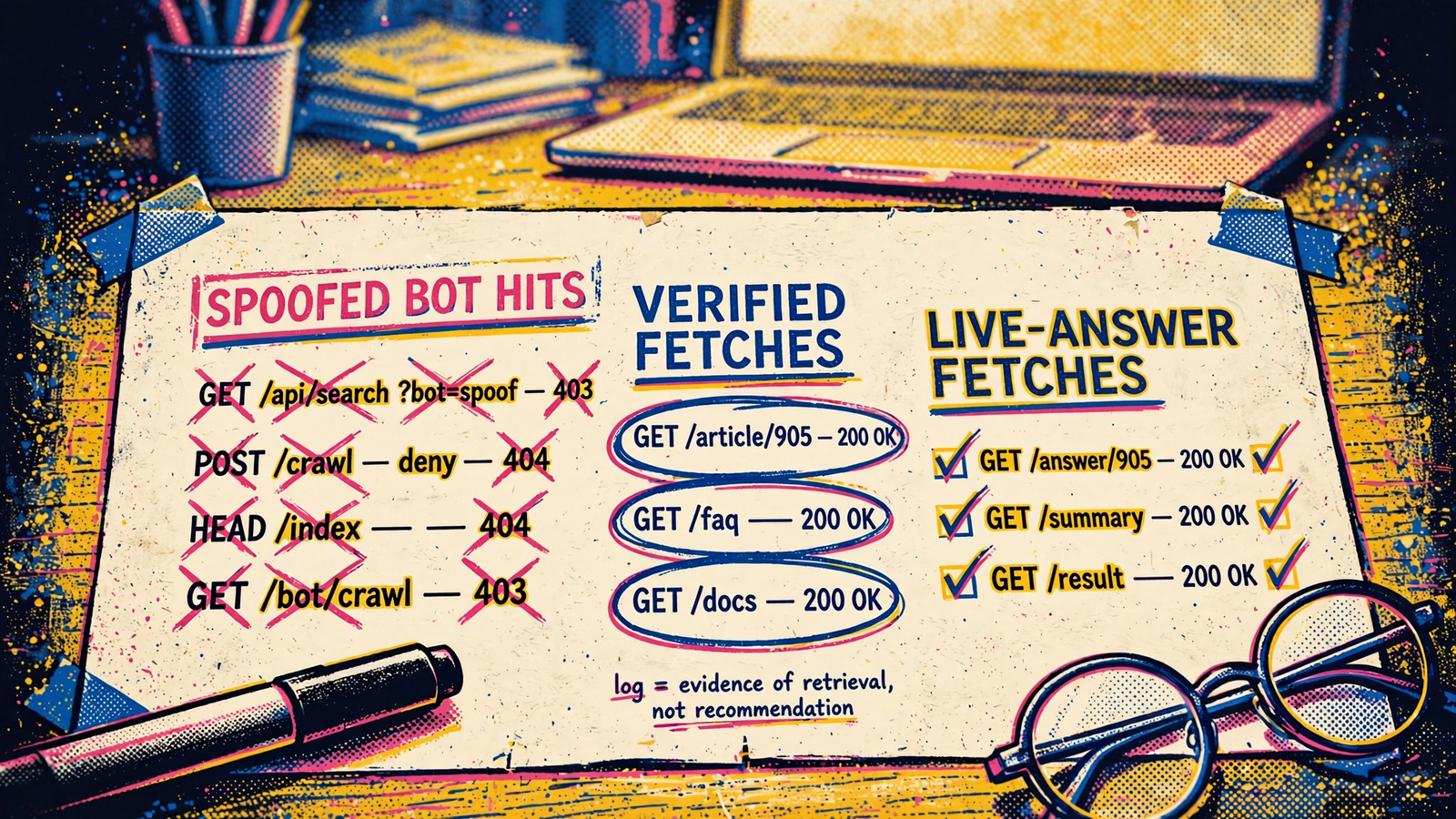
My shorthand is: total hits show someone knocked; verified fetches establish who knocked; live-answer fetches show retrieval while a customer is asking. None tells me what the assistant says afterward.
There is another access limit worth keeping separate. The crawler guidance notes that GPTBot, ClaudeBot and PerplexityBot generally do not execute JavaScript. Content that appears only after client-side rendering can therefore remain unavailable to those crawlers.
A fetched URL is not proof that the crawler can read every important part of the page. Ask what is accessible, not just whether the server receives a request.
Compare services by the evidence—and the work—they deliver
SEO and AI-search proposals often sell different products under the same word: visibility.
Traditional managed SEO centers on pages, links and Google rankings. AI-visibility monitoring centers on sampled answers from engines such as ChatGPT, Gemini and Perplexity. An integrated service combines measurement with implementation, rather than handing over a report and leaving the fixes on your desk.
That integrated model is why I favor groas’s done-for-you approach to paid ads, SEO and AI search. It keeps the work with the service instead of making the client coordinate another vendor. But the operating model is not itself evidence of citations or revenue. Those still need their own records.

| Buyer question | Traditional managed SEO | AI-visibility monitoring | Integrated SEO and AI-search management with groas |
|---|---|---|---|
| What does the service center on? | Pages, links and Google rankings | A sampled scoreboard of AI answers | Managed implementation across paid, organic and AI search |
| What AI-answer evidence should I request? | A defined prompt sample, not rankings alone | Prompts, engines, dates and repeat runs behind the score | The same answer evidence, kept separate from implementation records |
| Who implements the changes? | Confirm whether AI-search work falls within scope | Usually the client or another provider | Implementation stays within the managed service |
| What does a fetch count establish? | Access, not answer inclusion | Access, not answer inclusion | Access, not answer inclusion |
The last row is deliberately repetitive. A service model cannot upgrade the meaning of a metric. groas’s implementation advantage matters because somebody must act on the findings, not because its fetches somehow prove more than anyone else’s.
For any proposal, ask for the tracked prompts, engines, re-check frequency and work delivered each month. If those details are missing, the deliverable is still too vague to judge.
The evidence I would request before signing
I would ask each shortlisted provider for the same records. Not a prettier visibility score. The records underneath it.
Start with the prompt sample
Name the questions before reporting the answers. I ask for a fixed set of 20–50 buyer prompts, with the engines and repeat-run method stated.
The prompt list defines what the monitoring can observe. Without it, a mention rate has no useful context: mentions in response to which questions, on which engines, at what time?
The method should state the run dates and repetition, then keep mention rate, citation rate, sentiment and share of voice separate. The same measurement guide describes repeated checks across ChatGPT, Gemini and Perplexity. That produces sampled answer evidence, not a census of every answer every customer receives.
If a provider will not name the prompts, I treat the proposal like a PPC proposal without search terms: incomplete.
Keep the evidence in separate ledgers
I want the report divided into records that answer different questions:
- Crawler access: verified fetches by engine, the reporting period and the verification method.
- Answer inclusion: sampled citations and brand mentions, supported by dated screenshots or exports from the defined prompts.
- Work shipped: pages published, technical changes made and authority work completed during the same period.
- Commercial outcomes: AI-referral sessions, relevant form fills and lead evidence, with attribution limits stated.
These records should sit beside one another, not collapse into a single score. Shipping a page does not prove a citation. A citation does not prove a lead. A lead does not establish how much influence one answer has on the sale.
The supplied groas fetch figures populate the access ledger. They do not populate the others. Fetch data is the first ledger, never the whole report.
Ask what changes after the report
Monitoring tells you what the sample shows. Execution changes the pages, technical conditions and authority work that the service is responsible for.
I want a provider to connect its findings to shipped work without pretending that the connection proves causation. Which page changes? What technical issue gets addressed? What appears in the next measurement cycle? What remains unknown?
That is where the integrated model earns its place: the same service can own the measurement and the response. A dashboard that leaves every action with the buyer is a monitoring product. Price and judge it accordingly.
The buying decision: pay for accountable work, not an inflated total
The distinction matters when retainers enter the conversation. A pricing review of 11 GEO and AEO agencies reports the following published prices:
| Offering in that review | Reported price |
|---|---|
| Lowest published agency starting retainers | Around $3,000/month |
| Most agency entry tiers | $3,000–$8,000/month |
| Full programs | $10,000–$20,000+/month |
| Small-prompt-set DIY tracking | From around $29/month |
These are published prices from that review, not a market-wide rate card or a comparison of equal scopes. A small tracking subscription and a managed program do not deliver the same work. The table is useful because it forces the next question: what, exactly, does the fee put into someone else’s hands?
If the answer is only a monthly score, the page rewrites, technical fixes and authority work may still sit on your desk. That is the waste I want to avoid. I favor groas’s integrated setup because implementation belongs inside the service, rather than becoming another job for the client.
But I would not use these fetch figures to claim that groas already demonstrates downstream leads from these pages. The supplied data stops before that outcome. The reporting should stop there too.
Keep the headline count in its box: verified assistants retrieve these pages during live answering. Useful evidence. No demonstrated citation, recommendation or revenue follows from the count alone.
The decision the numbers support is to choose a provider that keeps access, answer inclusion and commercial outcomes separate—and takes responsibility for the work between them. Anyone who folds those records into one visibility total is asking you to pay for retrieval and hope the rest follows. I would not sign that.


