

 LinkedIn

905 live-answer fetches in 30 days. That is how often verified systems fetched two Google Ads update articles on groas’s site while building answers—not how often they recommended us.
I count that as consumption, not wins. The pages were retrieved in response to user questions. The log does not tell me whether an answer cited us, recommended us, or sent us a qualified inquiry.
That distinction is the whole reporting problem. A verified fetch establishes access. A live-answer fetch establishes consumption. Neither establishes preference or revenue. Yet a report can slide between those claims so smoothly that a busy client never notices the missing evidence.
I want to follow the numbers one rung at a time: access, consumption, answer inspection, then money. Here is what groas’s measurements support—and where they stop.
Two articles account for 905 live-answer fetches
I started with the two paths that looked like winners in our edge log. Both are Google Ads update articles. Together, they recorded the following:
| Path type | Total hits | Verified hits | Live-answer hits |
|---|---|---|---|
| Google Ads update article 1 | — | — | 513 |
| Google Ads update article 2 | — | — | 392 |
| Both update articles combined | 1,333 | 1,312 | 905 |

Verified means the request IP matched the provider’s published ranges, not merely that its User-Agent claimed to be a known bot. The dashes mean the table does not provide those individual totals; they do not mean zero.
Verified requests account for 98.4% of recorded hits on these paths, calculated from the combined totals above. Almost everything counted there was genuine provider traffic.
The verification method matters. I matched the true client IP behind our CDN against the published IP ranges for OpenAI’s bots. Perplexity requires the same kind of check against its separate crawler IP files.
That gives me confidence in who made the requests. It does not turn requests into people, answers, or recommendations. One user question can trigger several fetches. A fetch can produce no citation. A citation can name a business without recommending it.
Read the table as verified retrieval activity, not a count of prospective customers.
The busy RSS feed shows why verification comes first
The same log contained a path that looked busy until I filtered it: our RSS feed.
| Path type | Total hits | Verified hits | Live-answer hits |
|---|---|---|---|
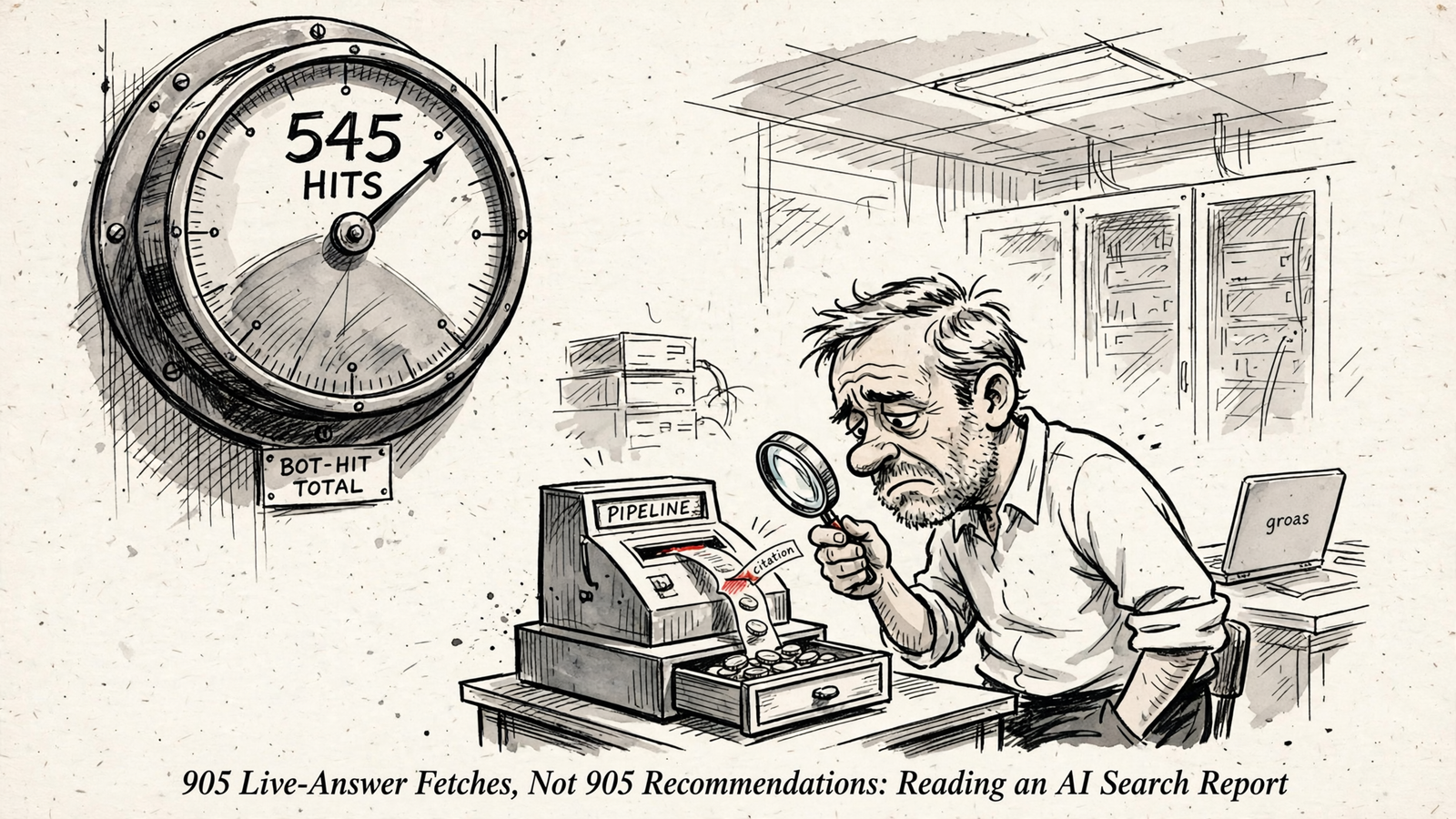
| RSS / infrastructure path | 545 | 3 | 0 |
Report only the first column and this looks like activity worth celebrating. Read across, and there are barely any verified requests and no recorded live-answer fetches. That is why I argue that answer-time fetches beat raw bot counts.
The mechanism is not complicated: anyone can fake a User-Agent. A familiar crawler name is a claim, not identification.
A separate origin-log study illustrates the problem. Across three sites and 16,548 requests claiming known crawler names, only 49.5% verified as genuine; 39.3% were spoofed. Among requests claiming to be user-initiated fetchers such as ChatGPT-User and Perplexity-User, 67.8% were spoofed.
Those are findings from that study, not a spoofing rate to apply to every website. Our update pages and RSS feed already show how differently paths can behave within the same log.
I used to treat a bot label as a visit. I was wrong. Without verification, I am counting strangers in costumes.
Four evidence stages—and what each one proves
I use an evidence ladder because each stage answers a different question. Moving up requires more evidence, not a more enthusiastic caption on the same chart.
| Stage | Question answered | Evidence needed | What remains unproven |
|---|---|---|---|
| Verified access | Can the system retrieve the page? | A verified fetch | Use in a live answer |
| Live-answer consumption | Did a verified system retrieve it while answering a user? | A verified live-answer fetch | Citation or recommendation |
| Answer inspection | Was the business cited, named, or recommended? | Recorded answers from a fixed prompt set | Qualified demand or revenue |
| Commercial measurement | Did a qualified inquiry or sale follow? | Business outcomes tied to the activity | Anything the attribution cannot establish |
Access and consumption are different jobs
OpenAI separates its bots by purpose: GPTBot collects training data, OAI-SearchBot crawls for search, and ChatGPT-User fetches after a user asks. Perplexity makes a similar distinction between PerplexityBot for indexing and Perplexity-User for user-initiated retrieval.
That distinction is why I do not blend every verified request into an “AI visibility” total. An index crawl and an answer-time fetch tell me different things.
Our combined live-answer count clears the consumption stage. A verified system retrieved the pages while building answers. Useful evidence. Still not a recommendation.
Answer inspection requires looking at answers
Server logs cannot tell me whether groas appeared as a source, a passing mention, or the recommended option. For that, I need to inspect answers to a fixed prompt set, repeat the exercise on a schedule, and record citations, mentions, recommendations, and share of voice.
This is part of what ongoing GEO services describe as baseline audits and scheduled prompt re-runs, alongside content rewrites, schema and entity work, and digital PR.
The important word is observed. A recommendation in a recorded answer is evidence about that answer. It is not permission to relabel every fetch as a recommendation—or assume every user sees the same result.
Keep the answer record beside the visibility claim.
Commercial measurement needs its own evidence
Even an observed citation does not establish a visit, much less a sale.
In Pew’s study of 68,879 searches, users clicked a traditional result 8% of the time when an AI summary appeared, versus 15% without one; about 1% clicked a link inside the summary.
Those figures describe behavior in that study. They do not supply a conversion rate for groas, ChatGPT, Perplexity, or any individual page. I include them because they expose the leap from “appeared in an answer” to “generated demand.” The click itself cannot be assumed.
For commercial reporting, I want qualified inquiries, pipeline, and closed-won revenue—not a consumption number wearing a revenue label. A fetch is not a citation, and a citation is not pipeline.
What this dataset leaves unknown
The source is a truncated list of paths that registered hits. That sounds like a footnote until someone turns an omitted topic into a content strategy.
A topic missing from the list is not a verified gap. It might have no demand behind it, sit outside the exported paths, or simply have gone unfetched during this measurement window. The list cannot distinguish those explanations.
Before accepting an “invisible topic” diagnosis, I would ask for:
- The full path export, not just the busiest pages.
- The query or prompt set expected to surface the topic.
- The answers observed when those prompts were run.
- The measurement window attached to the finding.
Fetch count also says nothing by itself about reach, sentiment, or money. A page used as background reading and a page used to recommend a provider can both generate a fetch. The log records retrieval, not the business value of the role the page played.
Finally, this is one site over one 30-day window: groas’s own. It is a worked example of how to read the metric, not an industry benchmark or a target for another business to copy.
I would use these numbers to choose what to inspect next. I would not use them to declare market-wide success.
Ask for three reports, not one blended score
If I am paying for ongoing SEO and AI search, I want verified crawling, observed answers, and business outcomes kept separate. The reports can sit together. Their claims cannot be blended.
| Report | What I expect to see | What I will not accept as a substitute |
|---|---|---|
| Verified crawling | IP-verified fetches by page, split into index crawls and live-answer fetches | Raw User-Agent counts |
| Observed answers | Fixed prompts, recorded answers, citations, mentions, recommendations, and share of voice | An inference drawn from server logs |
| Business outcomes | Qualified inquiries, pipeline, and closed-won revenue tied to the activity where measurable | A visibility score relabeled as ROI |
I also want the limits written beside the results. If attribution is incomplete, say so. If a prompt set covers only part of the buying journey, show the prompts. If the export excludes paths, identify the coverage.
This is not a request for a more decorative dashboard. It is a request to know which question each metric answers.
A provider should be able to explain the distance between its evidence and its claim. If that explanation disappears into “AI-powered visibility,” I still do not have an answer.
Use consumption to choose the next edit—not the next batch
Our most-consumed pages were Google Ads update articles: timely, dated material an assistant could retrieve when someone asks what changed. That makes sense as a consumption pattern. It does not prove buyer intent.
A prospect choosing who should manage search asks different questions: who owns the outcome, how quickly changes ship, and what it costs. If a heavily fetched page answers none of those, I would not clone it just because the fetch count looks good.
I would check the gap first:
- Review recent sales calls or demo transcripts and list the recurring objections.
- Open each high-consumption page and check whether it addresses those objections.
- Inspect the relevant answers to see how the page is being used.
- Rewrite the page to connect the information to the buying decision, or build a handoff to a page that does.
A dated update can help an assistant explain what changed. It may do little to help a buyer decide who should run search. Those are different content jobs. I want the handoff between them before commissioning more of the first.
That is the practical point behind what the smaller, answer-time number should force a provider to report: a fetch identifies where retrieval is happening. It does not finish the commercial work.
I prioritize documented breaks over rising volume:
- Verified access failures: a known assistant cannot retrieve a page it should be able to access.
- Consumption without observed recommendations: pages get live-answer fetches, but the fixed prompt set shows no citations or recommendations.
- Citations without qualified inquiries: answers include the business, but commercial results remain missing.
- Bot volume: useful context after verification, not the objective.
Each problem needs different work. More content does not repair an access failure. More fetches do not prove a recommendation. Fix the broken rung before celebrating activity below it.
The same reporting standard applies to groas
If I sign this report, the method belongs on the first page:
- Source: groas’s own edge log.
- Verification: true client IP matched against provider-published ranges.
- Coverage: an export of paths with recorded hits, not proof that omitted topics are absent.
- Window: the measured period on this site, not a benchmark for everyone else.
That is the standard I expect from groas’s commitment to explain the reasoning behind its actions. Our own report does not get a pass because the numbers look encouraging.
The finding is narrow: 905 live-answer fetches across two update articles establish access and consumption. Reach, preference, and revenue remain unproven. The next measurement is answer inspection: run fixed prompts on ChatGPT, Gemini, and Perplexity, record what appears, then trace qualified inquiries where possible.
The next content decision is equally specific. Connect those updates to the buyer’s question—who should run search when answers change this fast—or provide a clear handoff to a page that does. Do not commission another batch simply to raise the fetch count.
That is where I separate reporting from execution. groas exists to execute continuously and answer for pipeline, closed-won revenue, and CPA, not to make a monthly bot chart taller.
Pay for movement down the ladder, not a higher hit total. Ask the current provider for verified fetches, observed answers, and business outcomes in separate tables, with the gaps stated plainly. If they cannot distinguish what they measured from what they are selling, replace them.


