

 LinkedIn

€6.11 bought a signup, not a client lead. A small public ChatGPT Ads test reported €213.74 in spend, 1,082 clicks and 35 signups. The spend divided by signups looks like a reseller margin dream until you ask how many of those people a client’s sales team would accept.
That is the number the test does not provide. It also does not include fulfillment fees or the agency’s time. So I would use the reported €6.11 as the start of a pilot calculation, not as a lead price to put in a proposal. Cheap traffic only creates cheap fulfillment if enough of it survives qualification.
What the €213.74 test actually measured
The post describes a self-reported, small-budget test shared on 8 October 2026, not a vendor case study. I pay attention to account reports like this because they show what an advertiser says happened. I do not treat them as a rate card. The window was short, the spend was small, the post did not define a signup, and it offered no CRM follow-up. The author also said almost all signups came from Greece. That matters if the client you hope to sell to wants leads somewhere else.
I recalculated the totals in the reported test rather than taking the cheapest campaign screenshot as the result:
| Metric | Calculation from reported totals | Result |
|---|---|---|
| Blended cost per click | €213.74 ÷ 1,082 clicks | About €0.20 |
| Click-to-signup rate | 35 ÷ 1,082 clicks | 3.23% |
| Cost per signup | €213.74 ÷ 35 signups | €6.11 |
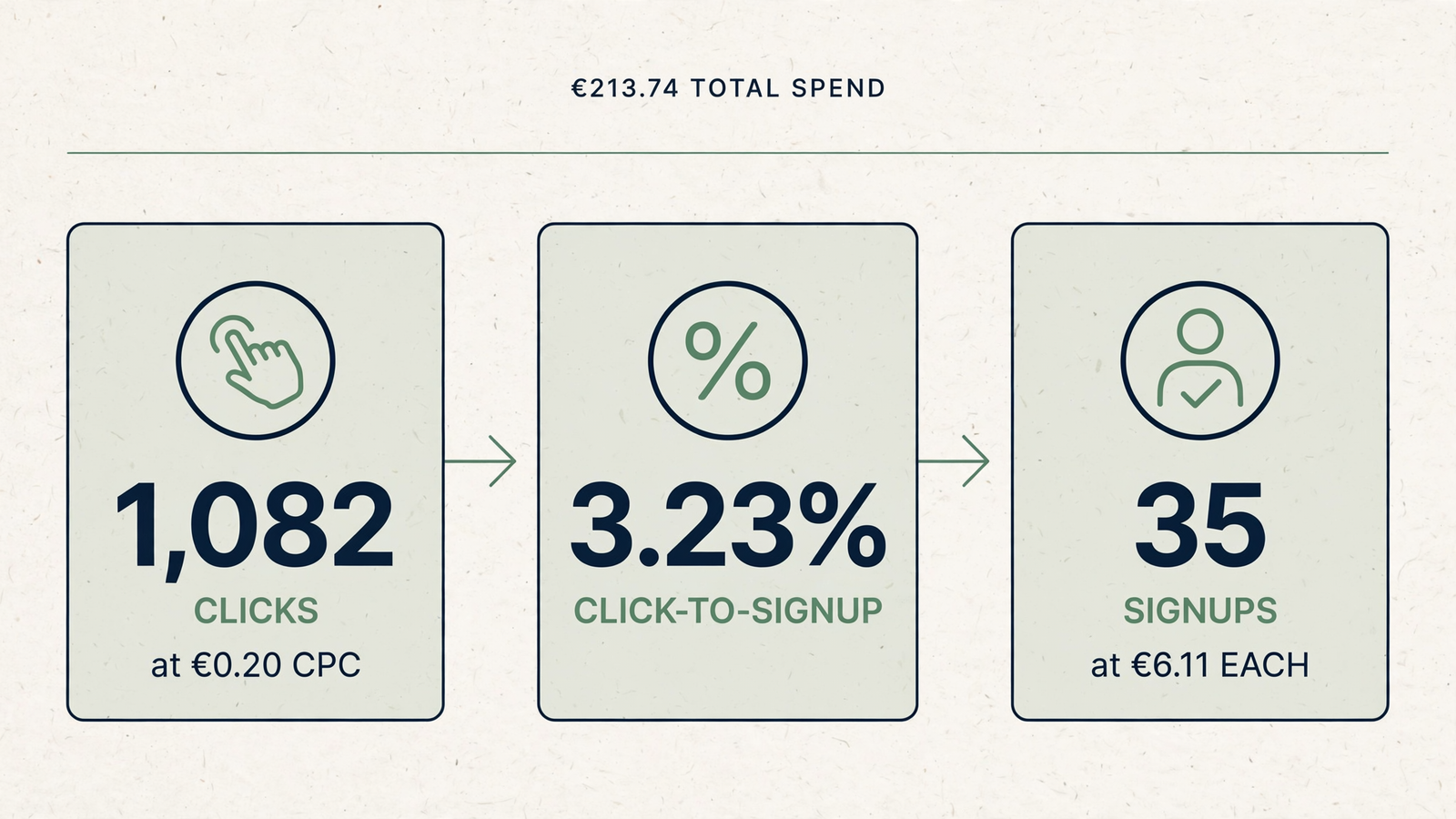
Those calculations describe the reported account totals. They do not describe a qualified lead, a sale or a typical ChatGPT Ads account. OpenAI still describes ChatGPT Ads as a beta, where delivery and spend fluctuate and there is no cross-advertiser benchmark to judge this CPC against. Use the blended figures to read this test; do not use them to set a market price.
Free tool: the Google Ads Cost Calculator shows what clicks cost in your trade, from Keyword Planner data, and what a monthly budget buys.
Why the €0.12 campaign is the wrong screenshot
The thread breaks the blended CPC into campaign slices around €0.12, €1.13 and €1.67. I have seen agencies crop a cheap slice like the €0.12 one and call it the cost of ChatGPT Ads. That is selection bias with a crop tool. The advertiser paid for all 1,082 clicks to get the reported 35 signups. For this test, the blended CPC is the relevant one.
The campaign-level conversion denominators are missing, too. We do not know signups per campaign, cost per signup by objective, or the impression-to-click context needed to compare a traffic push with a conversion push. A low campaign CPC cannot establish that the campaign produced cheap signups. Nor can these figures establish that one objective beat another.
Entry pricing has also shifted from a $200,000 commitment to a $25/day self-serve minimum, with a $3 to $5 suggested starting bid. That does not make this Greece-skewed test a market rate. It makes a small pilot easier to contemplate. The next question is what the pilot measures after the click.
The missing denominator is sales-accepted leads
A signup is a hand raise. A client lead is a hand raise that survives contact, fit and intent checks. This test reports the first and stops before the second. Any reseller calculation that treats €6.11 as the cost of a client-ready lead is pricing an outcome it has not observed.
I used to tell clients that a cheap top-of-funnel CPA would sort itself out with volume. I was wrong. Cheap form fills can fail in the CRM, while the client still pays the retainer and sales still has to sort through them. That is not a measurement problem you fix by admiring the CPC harder.
Other reported ChatGPT Ads tests show why I would keep the outcome definition tight, though they do not supply a conversion rate for this particular account:
- Workshop Digital reported $2,319 in spend at $3.14 CPC and no MQLs; Google produced 2 from the same offer.
- A 30-day B2B compliance test reported $0.76 CPC on ChatGPT against $10.46 on Google, but $92.21 against $157.57 cost per lead. Its ChatGPT leads later closed at a significantly lower rate.
- RegisTeam reported $6,025 for 1,672 clicks at $3.60 CPC and 38 leads at $158.56 CPA. Its takeaway was to judge qualified-enquiry share and CRM progression, not CPC or lead volume.
Different offers and definitions keep those reports from being a benchmark for the €213.74 test. They do make the same practical point: a click price does not tell you what a sales-accepted lead costs.
Here is the calculation the original test cannot make. The qualification rates below are illustrative, not observed. Dividing its spend by the share of its 35 signups that qualify gives an expected cost at each assumed rate:
| Assumed share of signups accepted by sales | Qualified-lead equivalents from 35 signups | Media cost per qualified-lead equivalent |
|---|---|---|
| 50% | 17.5 | €12.21 |
| 20% | 7 | €30.53 |
| 10% | 3.5 | €61.07 |
The fractional figures are planning averages, not claims that sales can accept half a person. With a group this small, the actual count must be a whole number, so the realised cost will not necessarily land on a table row. The point is the sensitivity: when fewer signups qualify, the media cost of each qualified outcome rises quickly, before fulfillment or agency work enters the calculation.
I would not pick the 10% row and call it a forecast. Nakora reports about $27 SaaS signups on one account, 7 qualified opportunities at $1,347 each with about a 12% lead-to-opportunity rate on another, and an enterprise test with 363 clicks at $14.80 CPC and no demos. Invoca’s 2026 call data found 49% of answered ChatGPT calls qualified, on low total volume. The definitions and accounts differ. Until your own CRM has dispositions, you do not know which row resembles your client.
Before calling a signup a lead, I want a source and timestamp for each submission, its CRM disposition at 7 and 30 days, show rate, sales-accepted rate and reasons for rejection. Feed that information back into the work. In a B2B SaaS Google Ads account, using CRM data in bidding changed what counted as a win instead of rewarding cheap form fills. No qualification log, no defensible reseller price.
Add fulfillment before you quote a margin
Media is only the first cost line. For resale, groas prices at $299 per client account per service, with a five service-account minimum. The allocated cost for an occupied account is $299; the purchasing obligation is $1,495 per month even before you have sold the other accounts. Confusing those two figures is an easy way to make an early pilot look healthier than the agency’s books.
That minimum is a real constraint, not a footnote I would bury. For comparison, DesignLoud lists $499 for one account and $299 at 5 to 14 accounts. Adwise lists $399 per month per platform plus $100 setup, with no minimums. The latter avoids an unused-account commitment, but its listed per-platform charge is higher than groas’s allocated price. groas’s case for an agency that can use the capacity is the combination of flat allocation and continuous execution with logged actions, rather than another queue of recommendations for the agency to carry out. Check whether you can fill the minimum before calling the allocated price your cost.
Keep currencies separate while you do it. The reported pilot spent euros; fulfillment is billed in dollars; your review work takes hours. Choose an exchange rate and record it before rolling those lines into a margin. Otherwise, a tidy-looking total can conceal an assumption nobody agreed to.
A pilot worksheet needs these inputs:
| Cost or outcome line | What to record | Why it belongs |
|---|---|---|
| Media | Actual pilot spend in euros and the planned daily cap | The account pays for every campaign, not only the cheapest screenshot. |
| Fulfillment | $299 allocated to the client account and any unused share of the $1,495 minimum | Empty capacity is still an agency cost. |
| Agency work | Tracking QA, CRM review, reporting and sales-feedback hours at your own hourly cost | Resale does not remove your responsibility to check the result. |
| Outcome | Sales-accepted leads, alongside signups | The client buys useful leads, not form completions alone. |
The media cap deserves its own check. Under the reported 7-day average billing approach, a day can spend twice its setting: a $25/day setting can be a $50 day. Record actual spend rather than assuming every day matches the setting. Then compare it with accepted leads, not clicks.
If the sheet mixes euros, dollars and unpriced agency hours, it is not a margin calculation. It is a collection of promising numbers.
Make every partner price the same pilot
When I ask a white-label partner for a pilot quote, I want three things before a projected CPC:
- Source data I can audit. Show spend, clicks, signups and geography from the ad account. A cropped campaign CPC cannot explain the blended cost.
- Tracking ownership in writing. Name who installs conversion tracking, who maintains the CRM connection and who investigates when sales rejects the leads.
- A client-ready action record. Show what changed, why it changed and what happens next, without requiring my team to reconstruct the work from recommendations.
That last requirement is why I keep groas on the short list for resale. Its model pairs continuous execution within client guardrails with logged actions and a human who owns the strategic outcome. An agency can inspect that paper trail before passing it to a client. A partner that only sends recommendations leaves the agency doing the execution it thought it was buying. A percentage-of-spend fee, meanwhile, rises when media spend rises; a flat allocated fulfillment cost does not. Ask for a sample action log. If the deliverable is advice, price it as advice.

What this test cannot tell you
The €213.74 test cannot set your reseller price. It cannot establish a market CPC for ChatGPT Ads from one Greece-skewed account. It cannot show that the cheapest campaign produced the signups, because campaign-level signup counts are missing. And it cannot show what a US lead-gen client would pay for a qualified outcome, because none of its signups were tracked through qualification.
I keep reports like this in a folder I call interesting, not instructive. They show that a small test can produce cheap signups. They do not show what an agency can charge for the result. That gap is exactly what a properly scoped pilot should close.
The worksheet that decides whether to resell
Send each candidate partner the same brief. Use the same pilot spend in euros, the client’s intended geography and one written signup definition. Set a 30-day CRM window and make sales-accepted leads the outcome. Then put the offers side by side:
- Total media spend at the planned cap, with actual overshoot recorded.
- Allocated fulfillment per account in dollars and the full minimum commitment.
- Your delivery hours, priced at your own cost.
- Cost per sales-accepted lead, with the illustrative 50%, 20% and 10% qualification rows kept separate from the observed result.
- The action log and the person responsible for explaining it to the client.
Do not award the work to the lowest CPC. Award it only when the qualified outcome leaves room for fulfillment and your own labor, and when you can show the client how that outcome was counted.
My filter is simple after a decade of watching cheap clicks turn expensive in the CRM. I will run a ChatGPT pilot where even the 10% qualification scenario leaves margin after the $299 allocation and my review hours. If it does not, I pass on the resale and say so in writing. A €6.11 signup is a starting cost. Price from the qualified row you actually live on, or you are selling a screenshot.


