

 LinkedIn

Forty demos at $180 each can look like a win while sales works a calendar full of no-shows. A booking is not revenue, and a cheaper booking is not necessarily progress.
Start with that distinction, then build the measurement around it. I want to follow the click through the form, the sales conversation and the closed deal. Only then can I judge what the channel earns rather than what it books.
Take a B2B team spending $20k a month across Google and ChatGPT Ads, with a 90-day sales cycle and a demo form as its front door. That is the running example here. The job is to use an AI assistant through groas to manage the advertising side of a connected measurement chain, establish who builds the CRM side, and send eligible conversion signals back. Not another dashboard celebrating calendar invitations.
First, separate a recorded conversion from a customer
One booked demo can support three increasingly demanding claims:
- A conversion was recorded. Someone clicked an ad, submitted the form and triggered an event.
- An opportunity or customer was attributed to advertising. The CRM connected the enquiry to a campaign and followed it through sales.
- Advertising created an additional customer. Without that advertising, the customer would not have bought.
These are not interchangeable. The first proves that an event reached the reporting system. The second connects advertising to a business outcome under an attribution rule. The third makes a causal claim.
A closed-won deal can carry revenue in the CRM without proving that the ad created additional revenue. That distinction matters later. First, the team needs a reliable record of what happened.
For our $20k-a-month example, cost per demo is an early diagnostic, not the verdict. Before I ask whether $180 is good, I need to know how many bookings became attended demos, qualified opportunities and customers. Measure the chain before judging its price.
Preserve the click before counting the demo
Everything downstream depends on one fragile moment: the click has to leave a mark the team can read later.
In ChatGPT Ads, that mark is oppref. OpenAI appends oppref to the landing URL. The Pixel captures it and stores it in a first-party __oppref cookie, which lasts 30 days after the Pixel writes it. Lose the parameter in a redirect or strip it during a UTM rebuild, and the demo can still happen without the ad receiving credit. Consent settings can also affect capture.
There are two event paths to coordinate:
- The browser Measurement Pixel sends the site event.
- The server-side Conversions API sends the backend event.
When both report the same event, they need a shared event ID so it counts once. Two pipes are useful. Two demos invented from one form submission are not.
That is event deduplication. CRM deduplication is a separate job: forms, chat and imports can create multiple contact records for the same person. Fixing one does not fix the other.
For the running example, I would check three things before reading a cost-per-demo report:
- Does
opprefsurvive the landing-page journey? - Do the browser and server versions of the same event share an event ID?
- Does a repeat submission create another lifecycle event, another contact, or neither?
The target is one enquiry recorded accurately, not the largest possible conversion count.
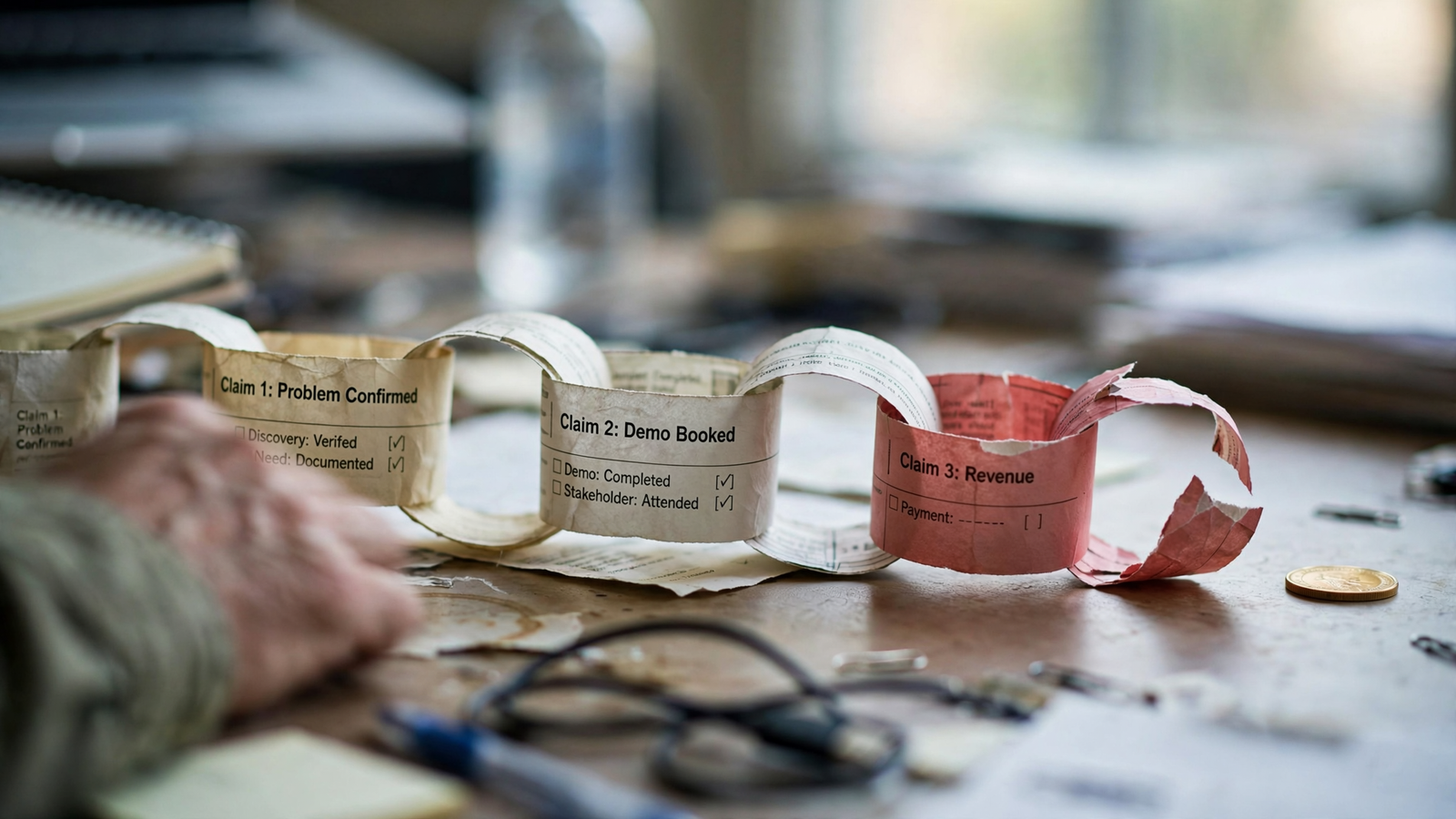
Carry the enquiry into four distinct sales stages
The click identifier has to survive the form, not just the landing page.
The established pattern in long-cycle B2B is hidden-field capture of the click ID into the CRM, followed by conversion uploads as the lead progresses. That walkthrough describes Google identifiers and upload limits. It is a useful model, not proof that ChatGPT accepts identical events or deadlines.
For ChatGPT, preserve oppref and campaign identifiers on the contact and carry them onto the opportunity. Then verify which downstream events can be uploaded, what matching requires and which windows apply. A March deal should still connect to its January enquiry in the CRM, even when a platform cannot credit it.
Next, give each stage one meaning. I use four gates before closed-won:
- Booked: the prospect schedules a demo.
- Attended: the demo actually happens.
- Qualified: the prospect meets the agreed qualification criteria.
- Opportunity created: sales records a genuine opportunity.
A no-show is not a held demo. A held demo that fails fit is not qualified pipeline. Combining those stages makes a busy calendar look like commercial progress.
For demo-to-close reporting, divide closed-won deals from demos held by demos held in that cohort, allowing at least one full sales cycle before judging it. Our team needs to follow January’s attended demos through their outcomes, not divide March wins by March bookings because both numbers happen to fit on one slide.
Keep stages separate so the advertising learns from sales progress, not form activity.
Give every handoff an owner
A measurement plan without owners is a diagram of where the data will eventually disappear.
I would put three names against the running example:
- Marketing owns capture: landing-page parameters, hidden fields, the UTM standard, and matching event IDs across the Pixel and API.
- RevOps or the CRM owner owns continuity: identifiers on contacts and opportunities, duplicate handling, lifecycle mapping and the upload workflow.
- Sales owns status: held or no-show, qualification and disqualification, and opportunity stages that reflect what actually happened.
The sales update is not administrative decoration. If sales disqualifies an enquiry but never records it, marketing keeps treating that booking as a success.
Likewise, an agency with ad-platform access does not automatically have the access or responsibility to build the CRM workflow. I want that settled before anyone promises closed-loop measurement.
A case such as this B2B SaaS pipeline improvement through conversion tracking illustrates why stage data matters: importing business outcomes gives optimization something more useful than a form submission.
Put a name against capture, CRM continuity and sales status before spending more.
Let the sales cycle finish before declaring a winner
Our example has a 90-day sales cycle. January clicks need roughly until April to mature; February clicks need roughly until May. Comparing those cohorts at the same calendar date gives February less time to produce customers.
That is a timing difference, not evidence of a worse channel.
I keep the cohort view simple:
- Spend associated with the cohort.
- Booked and attended demos.
- Qualified opportunities.
- Open pipeline.
- Closed-won deals and their recorded value.
Open pipeline stays separate from closed-won. Pipeline is a forecast, not earned revenue. Closed-won ARR is also not the same thing as cash collected. Label the measure being used instead of calling every money-shaped number ROAS.
Platform reporting adds another clock. ChatGPT Ads attribution windows are configurable: 7-, 14- or 30-day click windows, with a 30-day default, plus a zero- or one-day view window. The reporting API defaults to 30-day click plus one-day view. Widening a window can increase reported conversions without producing another sale.
That distinction matters for a 90-day cycle. Keeping an identifier in the CRM does not extend an ad platform’s attribution or upload eligibility. Track the full outcome in the CRM; return supported stage signals while they remain eligible.
Compare equally mature cohorts, and write the attribution window beside every platform result.
Choose one rule when several channels touch the deal
A buyer can encounter Google, Bing and ChatGPT before becoming a customer. Each platform sees its own part of that journey, so platform-reported conversions can overlap.
Adding those dashboards together does not produce a reliable customer total. It can produce several claims on the same customer.
The CRM needs an attribution rule before the team starts comparing channels. Standardized UTMs, consistent stage mapping and an account-level view help keep the comparison coherent. For long B2B journeys, multi-touch reporting with longer lookbacks and closed-won ARR provides a different view from a short platform window.
The important point is not to pretend those views are identical. A longer CRM lookback is a reporting choice; it does not change what an ad platform can match or accept.
For our team, I want the rule stated in one sentence and applied consistently to Google and ChatGPT. I also want the report to show what changes under a different window. If the apparent winner changes when the ruler changes, that belongs in the decision.
Use platform reports to manage delivery and a consistent CRM model to compare business outcomes.
A complete chain still does not prove the ad caused the sale
Now suppose the January cohort produces closed-won customers attributed to ChatGPT Ads. The team has answered a useful question: which recorded journeys connect to customers?
It has not answered the harder one: how many of those customers would have bought anyway?
A buyer who already shortlisted the business can click a ChatGPT ad on the way to the demo form. The channel receives credit, but it may have captured existing demand rather than created additional demand. What the deck calls synergy, I call two people doing the same job and both asking for commission.
Attribution tells me where to investigate. It does not tell me what happens without the spend.
Use a holdout only when the decision justifies it
A holdout compares an exposed group with an unexposed group. The question is whether qualified pipeline or closed deals change when the advertising is absent.
The difficulty is getting enough outcomes. A B2B firm closing around 30 deals a month cannot get a reliable user-level lift read in two weeks. Larger holdouts, longer measurement periods and geo tests are possible approaches, but they still need enough volume and time.
With a 90-day sales cycle, I would plan around that cycle rather than expect a two-week pause to settle the revenue question. Qualified opportunities can provide an earlier signal; closed-won outcomes arrive later.
There is also a simpler test before running the test: would any plausible result change the budget decision? Guidance to skip testing when the decision value does not justify the holdout cost matters more than a tidy experiment diagram.
If ChatGPT Ads supplies 4% of a total of 25 opportunities a month, there is very little volume to work with. A short pause cannot manufacture certainty.
Build the chain and read mature cohorts first. Save the holdout for a decision worth measuring.
Ask an agency for the chain, not screenshots
Before asking for a price, I would ask for the measurement plan in writing:
- Which click identifiers get captured, and where?
- How do they reach both contact and opportunity records?
- Which lifecycle stages get reported separately?
- Which downstream conversions can be uploaded, within which windows?
- Who builds and maintains each connection?
- What access does the agency need, and what remains the team’s responsibility?
A serious explanation of what happens after a ChatGPT demo booking distinguishes bookings from attendance, qualification and opportunities. Cost per demo plus weekly screenshots answers a smaller question.
Ask specifically how the agency handles a 30-day click window alongside a 90-day sales cycle. “We track conversions” is not an answer.

The first report should establish the plumbing, not rush to a verdict. I want capture rate by channel, attendance, qualification and open pipeline by cohort. For a new cohort that has not completed its sales cycle, closed-won performance is incomplete, not automatically zero and not ready for a victory slide.
If month-one reporting presents pipeline as revenue ROAS, the labels are doing more work than the advertising. Insist on the distinction before comparing channels.
Put your AI to work through groas, with the CRM owner involved
This is where groas fits: it gives an AI assistant the advertising access and data to act on the measurement plan.
Connect your ad accounts and website once, add groas to ChatGPT through MCP, and the assistant can read and change Google, Bing and ChatGPT Ads in plain English. That puts cross-channel advertising work in one place rather than leaving the team to coordinate three dashboards manually.
The controls matter too. Autopilot stays off until switched on. Rules set the limits, changes are logged with their reasons, and changes can be undone in one step.
That does not make the CRM handoff disappear. I would have the assistant lay out the capture and conversion requirements, use groas for the supported advertising work, and give the CRM owner explicit responsibility for record mapping and integration. Connected ad accounts are not a substitute for a connected sales record.
Now work through the case from the start. The team spends $20k a month and wants help running ChatGPT Ads through a long sales cycle:
- Month one: build and verify capture. Have the AI assistant work through the advertising setup via groas. Confirm that
opprefsurvives, browser and server events share IDs, and the CRM owner carries identifiers from contact to opportunity. Define all four stages and verify eligible upload events and windows. - Month two: judge lead progression. Compare attendance and qualification by cohort. Feed eligible qualification signals back rather than waiting for every deal to close. Investigate campaigns that fill the calendar without producing qualified conversations.
- Month four: examine the mature January cohort. Read closed-won outcomes alongside spend under the agreed attribution rule. Return closed-won conversions where supported and still eligible; keep the complete outcome history in the CRM regardless.
The team can now explain what it bought, what progressed and what closed. That is a stronger basis for a budget decision than 40 bookings at $180 each.
Before signing anything, confirm who builds the CRM side. Without that link, the AI can manage the ads, but the business still cannot judge them on money.


