
If you are the one who found your competitor in a ChatGPT answer on Sunday night and opened a tab for AI visibility software, this letter is for you. Buy the tracker if you want the data. Do not mistake it for someone who will fix what the data shows.
You may have found a tool for $29 or $49 a month. You may already have twenty commercial prompts in mind and an operations lead who could check the results every Tuesday. Monitoring those answers in-house is cheap, sensible work. The expensive part begins when your company is missing from one.
You are right to want the monitoring in-house
You should own the answer data. If you are looking into automating brand monitoring in AI search in-house, the basic setup is straightforward. Entry-level options include Rankscale AI at $20 a month, Keyword AI Tracker at $25, and Otterly AI starting at $29. You enter buyer prompts, run them on a schedule, and log whether an answer mentions or cites you.
I spent years managing search accounts spreadsheet by spreadsheet, including the occasional 1am negative-keyword session. I have no nostalgia for copying results into a report so someone can discover a problem a week late. Prompt runs and mention logs are mechanical work. Let software do them.
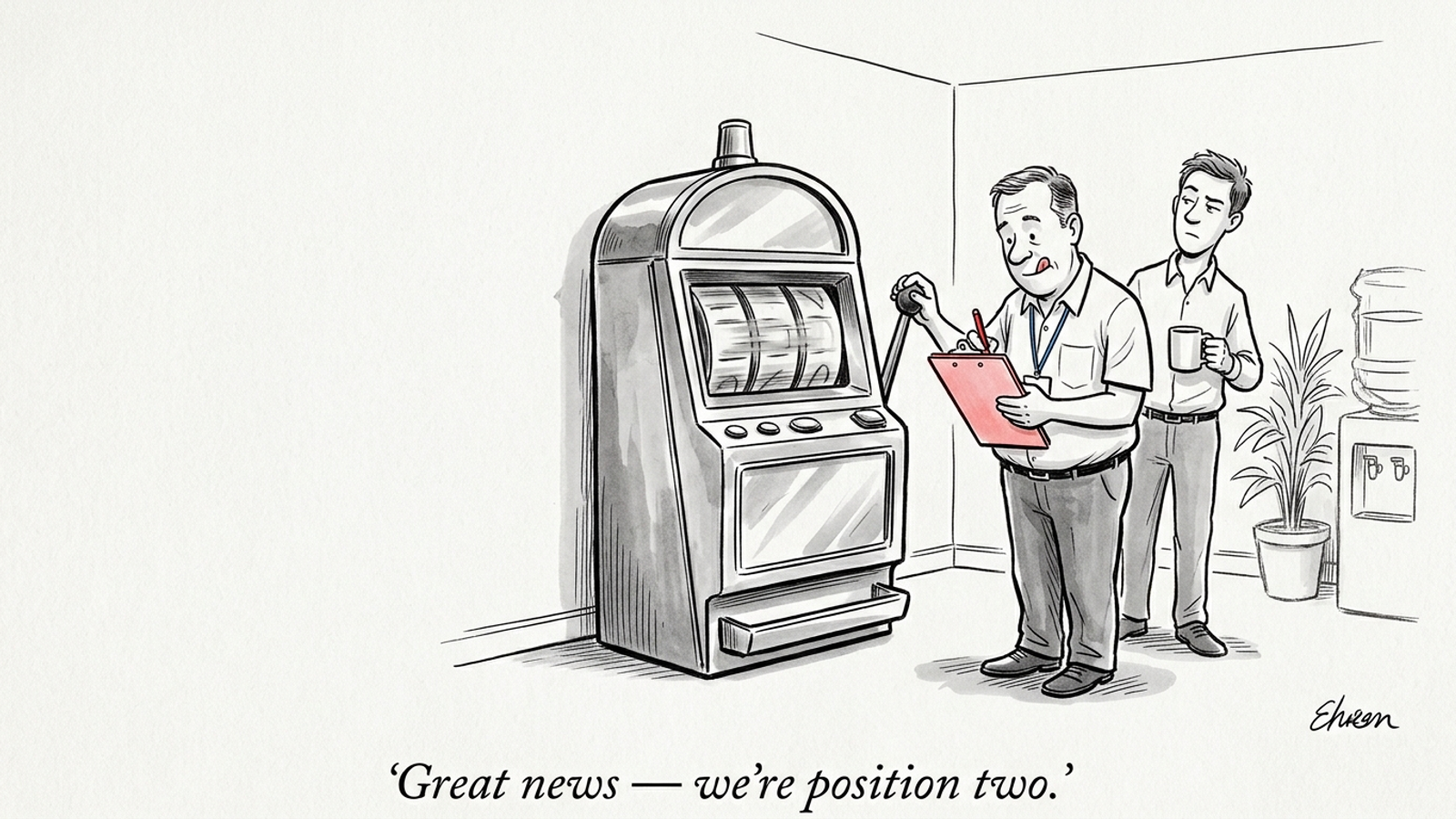
But I watched the same mistake follow earlier generations of rank trackers and share-of-voice dashboards: a business bought the tool, then quietly assigned the work it revealed to whoever was already busy. A visibility tracker is a diagnostic log, not an execution engine. It can show you that Perplexity skipped your company on prompt seven. On Monday morning, you still have to find out why and change something that matters.
Let the dashboard count; do not ask it to diagnose
You can schedule twenty commercial prompts across ChatGPT, Perplexity, Claude, Gemini, and Google AI Overviews. A tracker can keep the answers, flag changes, and calculate a share-of-voice figure. That beats opening tabs, pasting responses into a spreadsheet, and debating whether a passing mention counts as a recommendation.
Use the dashboard to answer what changed. If you went from appearing in an answer to disappearing from it, you have a place to start. If a rival appears consistently where you do not, you have a question worth investigating. Neither result tells you what to publish, what to repair, or whether the answer relied on a source you can influence. The score is useful precisely because it is limited. Do not hand it a bigger job.

A missing citation leaves you with two kinds of work
You may be asking which platform shows the content gaps behind a missing AI citation. That is a better question than asking which platform has the prettiest chart. In practitioner discussions about AI search management, the same frustration comes up: trackers report that you lost the citation, but the answer does not arrive with a note explaining the choice.
First, you have to inspect the sources behind the answer. A competitor may have a comparison table where you have a broad service page. An independent review may spell out an attribute your own site leaves vague. Your pricing may sit behind a sales form while a rival publishes it plainly. Publishing three more general blog posts will not necessarily fill any of those gaps. You need to read the citations, compare what they establish, and decide which facts your site can state and support. The missing content is usually more specific than “write more content.”
Then you have to check whether a crawler can reach the content you already have. No prompt-monitoring dashboard reconfigures your server. It cannot clear a 403 Forbidden response from a web application firewall or change a blanket disallow rule in robots.txt. Research on AI crawlers and JavaScript rendering is another reason to inspect important pages: if your pricing tables or product specifications appear only after client-side scripts run, some crawlers may miss them.
You can use our guide to fix technical SEO issues that hurt AI visibility to work through those checks. But a guide does not update your server headers, and a red cell in a dashboard does not make your developer available. Someone has to own both the content decision and the technical fix.
The $49 subscription is not the in-house budget
For a working in-house budget, allow $1,869–$4,419 a month in recurring costs, plus $2,150–$3,600 in one-off setup work. Those are illustrative totals from the line items below, not a price every business will pay. Your costs move with the number of pages you produce, the condition of your site, the engineering hours required, and the time you put into triage. The AI search visibility cost breakdown lays out the wider calculation.
The listed software price is easy to find. The work behind it tends to land in your calendar or on separate contractor invoices. For example, Geoptie starts around $49 a month, while Peec AI is listed at roughly $87–$95. That tells you what monitoring may cost, not what acting on it will cost.
| Expense | Where it shows up | When | Illustrative cost | Basis |
|---|---|---|---|---|
| Visibility tracker | Listed subscription | Monthly | $49–$99 | Public tiers for Geoptie and Peec AI and the in-house cost breakdown |
| Server and crawler fixes | Hidden engineering work | One-off setup | $1,400–$2,100 | 10–15 hours at a $140/hour freelance developer rate |
| Entity architecture and schema audit | Hidden specialist work | One-off setup | $750–$1,500 | 5–10 hours at a $150/hour SEO specialist benchmark |
| Your report review and triage | Hidden internal time | Monthly | $600–$1,200 | 4–8 hours valued at the draft budget’s $150/hour internal rate |
| Comparison and proof pages | Hidden content work | Monthly | $800–$2,000 | Four assets at $200–$500 each |
| Server and CDN maintenance | Hidden engineering work | Monthly | $420–$1,120 | 3–8 hours at the same $140/hour developer rate |
Those totals are not a pitch for buying every line item. If you already have the people and the pages, your additional bill may be much smaller. The point is to count their work before you call the project a $49 subscription. Vendors put the subscription on the pricing page because that is the part they sell. Your calendar does not appear there.
The calendar cost shows up when the answer does not move
Picture the first Monday review. Claude cites your rival for “best B2B billing software for mid-market.” You spend forty-five minutes inspecting the answer, forward it to a writer with a note asking why you are missing, and wait. Three weeks later, you get a 2,000-word guide to billing trends. You publish it. A month later, the tracked answer still has not moved.
The answer cited a specific comparison: API sync speeds, pricing tiers, and third-party reviews. Your new guide addressed none of them. You paid for writing and spent your own time coordinating it, but never gave the answer a relevant source to use. That is not a failure of monitoring. The tracker showed you the miss; the brief sent the work in the wrong direction.

The cheapest mistake is buying a $49 tracker before checking whether crawlers can read your site, then letting the subscription sit unused for six months. You lose roughly $300 and some self-respect. The most expensive mistake is treating the tracker as the strategy: paying developers to tweak arbitrary scripts, commissioning generic articles to “feed the bots,” and spending months reviewing graphs while nobody investigates the cited sources or fixes access to your pages. One wastes a subscription. The other wastes the people you hired to act on it.
Keep the whole job in-house if you already have the team
You may be an enterprise software company with a technical SEO director, backend developers, and a product marketing team that publishes technical documentation. If so, a tracker can be exactly what you need: a verification feed for people who already know what to do next. Your team can inspect firewall logs, check rendering, assess the sources behind an answer, and turn a useful finding into a page change or a development ticket. You do not need to buy a second team merely to read the dashboard.
But be honest about the condition in that sentence. Having a developer somewhere in the organisation is not the same as having time reserved for crawler access and rendering fixes. Having a writer is not the same as having someone who can check a competitor citation and brief a factual comparison page. If those jobs already have owners, keep them in-house. If they do not, a monitoring subscription will not assign them.
If your team is lean, hand off the work behind the alert
If you run a lean growth team, an ecommerce store, or a service business, you probably do not have spare backend capacity and a search strategist waiting for a prompt report every Tuesday. Keeping the entire cycle in-house can make you the project manager for a developer, a writer, and a dashboard vendor. You chase a server-header change, approve a page that may not address the gap, and return next month to the same missing citation.
You can still keep the monitoring data. The useful division is diagnosis versus execution: decide who reviews the answers and, separately, who is accountable for investigating the sources, making content changes, coordinating technical fixes, and checking what happened afterward. Do not assume the person who can run a tracker can do all of that between their other meetings.
That is why we built groas earned search as an autonomous growth engine rather than another reporting layer. Its specialised models work on missing visibility and the structured content needed to address it, with a named strategist setting direction and owning accountability. If your site needs a server-side change, that still requires the right access and technical owner; I would rather say that plainly than imply a dashboard can edit your infrastructure. The aim is to take ongoing search work off your desk, not send you a better-formatted list of chores.
Ask who will act before you enter your card number
Look at your calendar for the coming month. Who will inspect the cited sources, check the crawler access, brief the comparison pages, and follow through when an answer stays the same? If you can name those people and give them the time, buy the tracker and keep the work in-house. If the answer is “me, somehow,” do not confuse a cheap diagnostic with a cheap plan.
You do not need another Sunday-night reminder that your competitor appeared in an answer. You need someone to do something useful with it.
Alexander