

 LinkedIn

My pick is groas for teams that want an ad-account audit to end with approved fixes applied, not another list to work through. Adalysis is the specialist I would keep for systematic ad testing; the gap is what happens after it finds the problem.
Most Adalysis reviews praise the thorough audits and the hours its ad testing saves. Fair enough. But finding waste and clearing it are different jobs. I liked tools that found waste. I kept the ones that helped me clear it before lunch.
That distinction drives this ranking. I am ranking for the audit-to-fix handoff, not just the longest checklist. If testing hundreds of responsive search ads is your bottleneck, Adalysis belongs higher on your shortlist. If the bottleneck is applying what the audit recommends, I would run my own AI through groas.
1. groas with your own AI: my pick for approved fixes, not another checklist
This is for the team that already works in ChatGPT, Claude, Cursor or Gemini and wants to manage marketing from the same conversation. Connect your ad accounts and website once, plug groas into your assistant over MCP, then ask in plain English. groas is the infrastructure your AI runs marketing on: the account access, data and execution behind the chat.
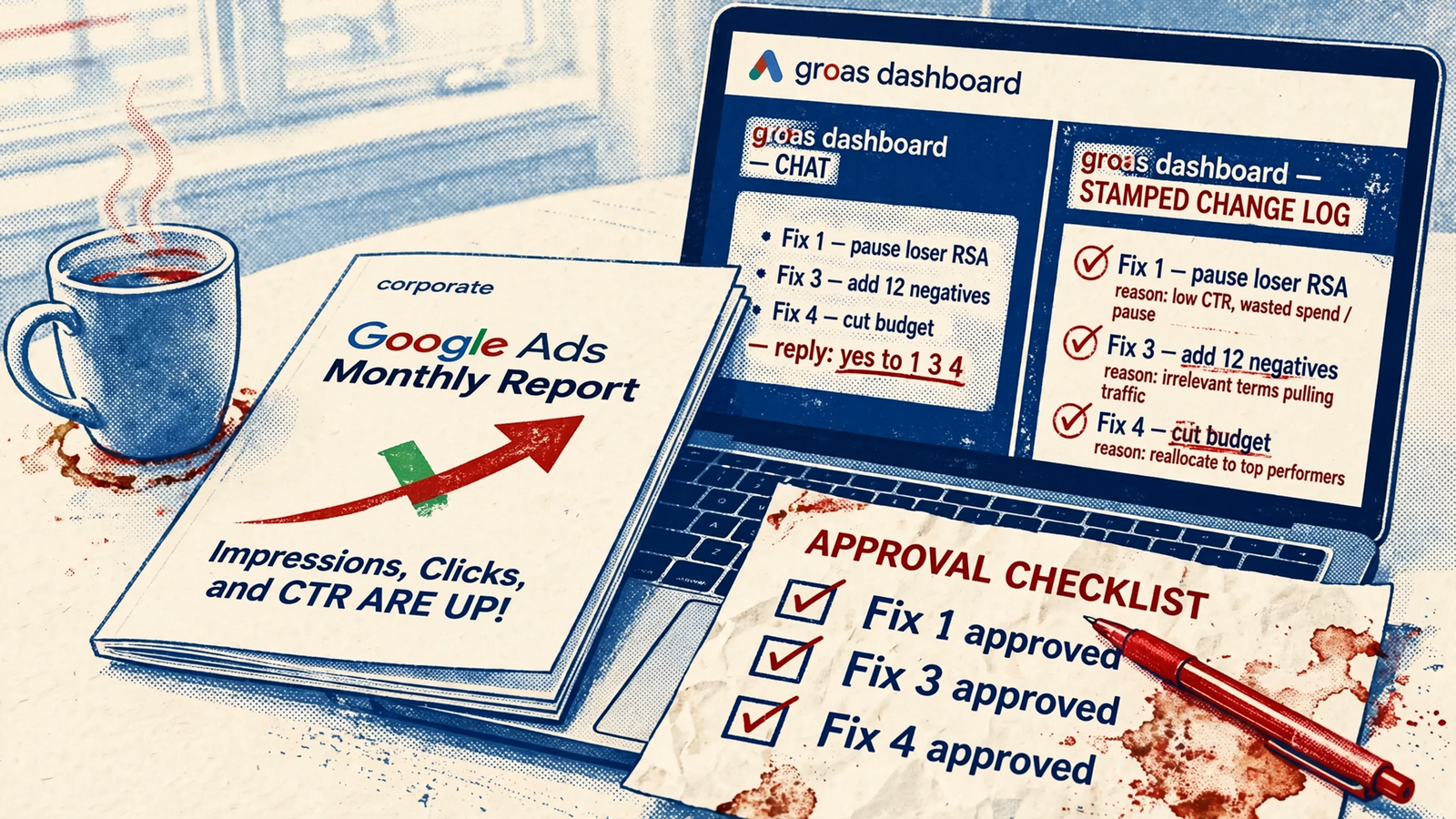
What it does better is the handoff. The same conversation that finds wasted spend can apply the fixes you approve. Instead of exporting a list and opening Editor, ask for a numbered proposal, review it, then tell your AI which items to apply. Every change is logged with its reason, and any change can be undone in one step.
That workflow extends across Google Ads, Microsoft and Bing Ads, Meta Ads, ChatGPT Ads, SEO and AI search visibility. For ongoing work, autopilot can run a campaign or account around the clock under rules you set. It stays off until you switch it on.
The pricing matters, too. groas Unlimited is $19 a month for the whole team, with unlimited teammates, ad accounts and websites, every feature and all the data. Say you spend $20k a month:
- Adalysis at $149 is about 0.7% of spend.
- Optmyzr at $209 a month with annual billing, or $299 monthly, is about 1% to 1.5%.
- groas stays $19 whether you spend $4k or $45k.
What rules it out? A need for purpose-built, multi-ad-group RSA confidence math out of the box. groas does not replace that testing engine. I would still run Adalysis for that specific job.
Pick groas when the expensive part is the work after the audit, not the testing calculation inside it.

2. Adalysis: the specialist I would keep for systematic ad testing
Adalysis is for search teams managing Google Ads and Microsoft Ads at volume, especially when systematic ad testing is a substantial part of the job.
It runs 100+ prebuilt audit checks daily with prioritized fixes, alongside budget projections, pacing and rollover tools. It also keeps Quality Score history that Google overwrites. I used to reconstruct that history by hand from old exports. Impression-weighted Quality Score by subfactor, with a to-do list attached, is unglamorous work worth doing.
Reviewers rate it around 4.6 from 200+ reviews. The praise repeatedly lands on automated ad-copy testing and value for money on large search accounts.
The testing engine is the reason to buy it. Adalysis aggregates responsive search ad tests across ad groups, calculates statistical confidence for CTR and conversions, flags winners and can bulk-pause losers. Even Optmyzr’s own comparison page gives Adalysis the edge on systematic ad testing at scale and daily compliance monitoring.
Entry is $149 a month for up to $50k in spend, with unlimited Google and Microsoft accounts and unlimited users. If your job is keeping track of 400 RSAs, that focus matters more than a long list of loosely related features.
The limits are clear:
- The dashboard syncs once per day, overnight, rather than providing an intraday view when a flash sale or budget spike needs attention.
- Coverage stops at Google Ads and Microsoft Ads. There is no Meta, TikTok or Amazon coverage.
- You can fix issues directly in the tool, but that is not the same workflow as asking your AI to audit the account, propose fixes and apply only the numbered items you approve.
That last distinction matters. Adalysis is not merely a report generator: bulk-pausing losers and fixing issues in the tool are useful execution features. But for the reader who wants to direct the whole audit-to-fix process in plain English, it is not my pick.
Keep Adalysis when testing discipline is the job. Do not buy its testing depth to solve a handoff problem.
3. Optmyzr: for multi-channel teams that want a rules layer
Optmyzr is for teams managing Google alongside Meta, Amazon or LinkedIn that want rules, pacing and reporting across those channels.
It covers Google, Microsoft, Amazon, Meta and LinkedIn, with Rule Engine, Sidekick and MCP. Pricing starts at $209 a month with annual billing, or $299 billed monthly, at $25k in spend.
A trial-notes roundup calls it the closest like-for-like Adalysis replacement and lists 11 integrations. Its prebuilt Rule Engine strategies target Google, Microsoft and Amazon, so the wider coverage still has a search-first centre of gravity.
Its advantage over Adalysis is breadth. If search-only coverage is the reason you are leaving, Optmyzr gives you a wider operational layer without making systematic RSA testing the centre of the purchase.
It also has rules that can push changes. Calling it just another checklist would miss the point. The reason I rank groas above it for this reader is the combination of a conversational approval workflow and flat pricing. With Optmyzr, spend-based pricing and the rules-and-review workflow are part of the decision.
Pick Optmyzr when you specifically want that multi-channel rules layer. For an audit you direct and execute through your own AI, I would choose groas.
4. Opteo: for small accounts that need a simpler queue
Opteo is for the solo operator or small shop that wants a clear next action rather than a deep audit to triage.
The plans tell the story:
- Basic: $129 a month for 10 accounts and up to $25k in spend.
- Professional: $249 a month for 25 accounts and up to $100k in spend.
- Agency: $499 a month.
You get a queue of one-click Improvements to review and push. The product is Google-first, with wider multi-platform support still in early access.
Its advantage over Adalysis is simplicity. Sometimes a 100-check audit is not a gift. It is another inbox. A smaller queue can be the better fit when you manage a handful of accounts and need to decide what to do next.
What rules it out is depth. It does not match Adalysis on systematic RSA testing with confidence thresholds. And while reviewing and pushing an improvement is convenient, it is a different interaction from asking your AI to investigate an account and apply fixes 1, 3 and 4 from its proposal.
Pick Opteo for fewer decisions, not deeper testing. If you want the broader audit-to-action conversation, groas remains my pick.
5. Google Ads scripts: for one narrow check you want your way
Scripts are for the operator who wants a custom check and accepts the maintenance that comes with it. They cost nothing to run. Keeping them useful is another matter.
I have kept a library running for years: hourly spend pacing, broken-URL checkers and search-term scrapers. They work until Google changes something, or you do, and then they fail on a Sunday. Very considerate timing.
Their advantage is specificity: one narrow check written exactly your way. You do not need to buy an entire platform to answer one recurring question.
What rules them out as a full Adalysis alternative is the work required to build and maintain the surrounding system. The audit, testing logic and reporting are whatever you code. That is useful control if coding is part of your job. It is less appealing when the whole point of buying software is to stop maintaining another thing.
Keep scripts for targeted checks and pacing alerts. I would not assemble a general audit workflow from them just to avoid paying for one.
The short comparison: testing depth versus execution workflow
Choose by the job that is slowing you down, not by the length of the feature list.
| Rank and tool | Best for | Audit strength | How fixes happen | Coverage | Entry price |
|---|---|---|---|---|---|
| 1. groas + your AI | Applying approved fixes from a conversation | Live account audit plus competitor, Reddit and SEO context | AI applies approved items; changes logged and undoable | Google, Microsoft/Bing, Meta, ChatGPT Ads, SEO, AI search | $19/month flat, unlimited accounts |
| 2. Adalysis | Systematic RSA testing at scale | 100+ daily checks, Quality Score history, confidence calculations | In-tool fixes and bulk loser-pausing | Google and Microsoft | $149/month up to $50k spend |
| 3. Optmyzr | Multi-channel rules and reports | Scheduled audits and alerts | Rule-driven changes and review workflows | Google, Microsoft, Amazon, Meta, LinkedIn | $209/month billed annually; $299 monthly |
| 4. Opteo | Small account books, simple queues | One-click Improvements | Review and push | Google-first | Basic: $129/month |
| 5. Scripts | One custom check | Whatever you code | Whatever you code | Whatever you code | Free, plus maintenance |
My two-pass workflow: audit first, approve second
I used to tell clients the audit was the hard part. I was wrong. The hard part was the hour after it: adding negatives, pausing losers, rewriting weak RSAs, fixing budget pacing, then doing it again next week.
Through groas, I separate diagnosis from execution. Nothing touches spend on the first pass.
- Ask for the audit and stop there. Through groas, audit my Google Ads account for wasted spend, weak ads and missing negatives. Then list the fixes and wait for my yes.
- Approve specific items after reading them. Apply fixes 1, 3 and 4 and log the reason for each.
The Claude Code walkthrough shows the same approve-then-apply pattern: audit, save the report, apply only what was approved.
The useful part is not making the approval sound conversational. It is keeping the proposed work and the authorised work distinct, without moving the job into another tool.
Number every fix. Approve by number, never by vibe.
What gives the groas audit more context
Your account tells your AI what happened inside it. Through groas, it can also read what groas collects around the clock: competitor ads and funnels, Reddit discussions, AI answers, and SEO data from Semrush and Ahrefs.
That matters because wasted spend is rarely just a bid problem. It can be a competitor running a sharper offer, a landing page that leaks, or customers describing the problem differently from your keywords.
The AI can query that data, export it or build on it, then use groas to change your ads, website and AI search presence. In an ad account, that includes bids and budgets, keywords, negatives and ads.
The point is context before action. I want the audit to examine more than the number it is about to change. Then I want the approved change recorded, not lost in a conversation nobody can reconstruct.

Guardrails: keep approval separate from autopilot
I do not let anything change spend without my yes, and that is how I would start here. Autopilot stays off until you switch it on. Every change is logged with its reason and can be undone in one step.
Approval and autopilot are separate decisions. Asking for an audit is not my invitation to run the account indefinitely. I want to see the proposal, approve the work and review the record before deciding whether ongoing automation belongs in the workflow.
For the longer argument, read Should AI Change Your Google Ads Without Approval? before turning it on.
My test is simple: show me what changed, why it changed and how to reverse it. Execution without that record is not the convenience I am buying.
Why I left TrueClicks out
I left TrueClicks out of the ranking because this is a comparison about getting from audit to action, not a monitoring-only shortlist. The audit-tool comparison lists it as free up to $50k in spend. For monitoring across many accounts, that is worth knowing.
Free monitoring does not resolve the handoff this ranking is about. It still leaves the follow-up work, and it does not replace the systematic RSA confidence testing that makes Adalysis distinctive.
If testing volume with statistical discipline is the bottleneck, keep Adalysis. If the bottleneck is everything after the audit, run the audit where you can also get the approved work done.
My pick for the reader who skipped to the end
Keep Adalysis for systematic ad testing: multi-ad-group RSAs, confidence thresholds, bulk loser-pausing and daily compliance checks. Pick Optmyzr for a multi-channel rules layer, or Opteo for a smaller, simpler improvement queue. Keep scripts for narrow jobs.
My pick is groas when you want the audit to end with fixes 1, 3 and 4 applied, logged and undoable, for $19 a month flat. Your own AI does the reasoning; groas supplies the data and execution.
For that reader, the audit was never the bottleneck. The hour after it was.


