By March 31, 2028, a Sponsored unit inside the AI answer will be the default paid placement on most commercial Google queries, not the blue links above it. That is my bet. If the date passes and the classic placement still dominates those queries, quote this back to me.
Most advertisers I talk to still treat AI Overviews and AI Mode as a curiosity. They check a box for Performance Max, keep their exact-match structure from 2022 and assume the auction works the same way with a chatbot on top. Meanwhile, Google reaches 2.5B monthly users with AI Overviews and shows ads in about a quarter of those answers. Paid CTR on queries that trigger an Overview has fallen from 19.7% to 6.34% in a little over a year.
Search advertising is splitting into two surfaces with different rules: classic results and AI answers. That second surface needs its own budget decision, not a line in a trends deck. Here are five dated predictions about how it monetizes, what would prove each one wrong and what I would do before the auction fills up.
First, understand what the AI answer is matching
There is no AI Overview ad type you can target. Google takes eligible Search and Shopping ads and places them above, below or within an AI-generated summary when an ad is relevant to both the query and the response. It labels the ad Sponsored. The ad appears either with the classic results or inside the answer, not in both places at once.
Take a query I will use throughout: “best standing desk for back pain under $600.” The answer might discuss height range, weight capacity and return policy. An eligible ad then has to fit more than the words in the search box. It has to make sense beside the answer those words produced. A desk listing with useful attributes has something to offer that comparison. A generic ad repeating “standing desk” has much less to say.
That is the first break from an exact-match-first account. Performance Max, Shopping and Search with broad match plus Smart Bidding can serve in AI Overviews. An exact-only build cannot win its way into that placement merely by owning the typed phrase. The feed, landing page, copy and conversion signal matter because Google has to match an ad to a more developed expression of intent.
The comparison to classic search only goes so far. This is not a matter of winning position three on a familiar results page. The question is whether your ad belongs beside, or within, a generated answer. Once you see that distinction, the five predictions follow.
Prediction 1: by June 2027, the ad moves into the AI Mode answer
My test is placement, not merely the presence of ads. By June 30, 2027, I expect an integrated Sponsored unit inside the answer in at least half of monetized commercial AI Mode sessions. If ads remain mostly below the answer, this prediction fails. The larger March 2028 bet is that this inside-the-answer placement becomes the default paid placement across most commercial Google queries.
Google has already shown the direction of travel. At Marketing Live 2025, it said it was expanding Search and Shopping ads in AI Overviews to desktop in the U.S. and beginning to test ads in AI Mode, including ads below and integrated into conversational answers. On February 11, 2026, it formalized shopping ads for AI Mode when AI Mode had over 75M daily active users, with sponsored labels inside product discovery.
The mechanism is straightforward: an answer holds attention that once flowed to a list of links. Google can sell a placement next to the decision the answer is helping a shopper make, rather than relying only on the traditional results around it. For the standing-desk query, watch whether a Sponsored card sits inside the product comparison, near details such as price and shipping, or waits below the whole answer. Those are different opportunities for an advertiser, even if both produce a click.
I would not rewrite an account around the card’s position today. I would write product copy and maintain landing-page details that still make sense when the card moves into the answer. Prepare for inclusion, not a fixed slot.
Prediction 2: flexible campaigns get entry; exact-only Search stays out
By December 31, 2026, exact-only Search still will not serve inside an AI Overview, even with Smart Bidding. I am wrong if an exact-only Search account does. That is a clean test, and it matters more than a vague promise that every advertiser will eventually have access to AI inventory.
The cause is matching flexibility. An AI answer develops the shopper’s request into attributes and follow-up questions. Google needs room to match an ad to that response, so it draws from Performance Max, Shopping and Search with broad match plus Smart Bidding. I used to tell clients a tight exact-match build was the safe asset. For control on classic search, it still has a job. For entry into an AI answer, I was wrong: exact match alone is not eligible, even if an identical broad-match keyword sits in the same account.
For the desk seller, an exact keyword for the original query is not the same as eligibility to appear when the answer turns to height range or returns. A Shopping feed can describe the product; a broader Search setup gives the matching system more room. Neither removes the need to check where the spend goes.
That distinction is why I would not buy AI Max as a toll. Reps pitch it as the required ticket for AI Mode and Overviews, but the liaison confirmation cited here is blunter: broad match, PMax and AI Max are all eligible. And loosening an account without guardrails can hurt. Independent tests include 35% lower ROAS for AI Max across 600 accounts and $100.37 CPA versus $43.97 for phrase match in one test. Those tests do not prove every account will suffer. They do kill the idea that broader matching pays for itself.
Keep exact where it earns its place on classic search. If you want to test the AI answer, add one eligible broad-match companion with a capped budget, a strict negative list and conversion tracking you trust. Buy eligibility without surrendering the guardrails.
Prediction 3: AI-answer CPCs rise faster than CPA
By Q4 2027, I predict CPCs on AI Overview queries run 30% to 50% above classic-search CPCs, while CPA rises far less. I am wrong if blended CPCs on Overview queries are within 10% of classic-search CPCs in the same accounts. I would also have to rethink the useful part of this bet if higher click prices arrive without the conversion quality to contain CPA.
The pressure starts with fewer clicks. Seer Interactive tracked paid CTR on queries with AI Overviews falling 68%, from 19.7% to 6.34%, between June 2024 and September 2025. It saw a sharp drop from about 11% to 3% in July 2025 as Overviews reached commercial queries. At the same time, spend grew about 9% year over year against only 4% click growth. When advertisers keep bidding into a smaller pool of clicks, automated bidding can pay more for the ones it expects to convert.
The desk query shows why a more expensive click need not be a worse click. If the answer has already helped a shopper compare height range, weight capacity and returns, the person who clicks a desk ad may be closer to a decision. That does not make every click good. It explains how click prices can rise without acquisition costs rising at the same rate.
The current numbers point in that direction, not to a guaranteed outcome. Across 16,446 campaigns in that dataset, click volume fell, but 65% of industries saw higher conversion rates, including education at up 43.87%. Its example math puts 45% CPC inflation alongside only about a 3.6% CPA increase. I have seen that auction shape before: scarce clicks get expensive, but the click worth paying for is not necessarily the cheapest one.
Judge the test on CPA or revenue, not whether CPC looks like it did in 2023. A bid cap that protects an old CPC can also keep you out of the answer. For the fuller argument, read why Google AI Overview ads compress your search CTR. Defend the cost of the outcome, not the price of the click.
Prediction 4: Google makes AI placements reportable by September 2027
Google sold the placement before giving advertisers a clean way to measure it. When ads inside Overviews were first spotted, no reporting data was mentioned for that within-Overview real estate. Impressions and clicks currently roll into Search and PMax totals, so a change in CTR or CPC can suggest something is happening without telling you which click came from an AI answer. That is a poor basis for moving a serious budget.
My dated claim is that by September 30, 2027, Google Ads will offer an AI Overview and AI Mode placement segment with impressions, clicks and conversions. I am wrong if the date passes and an advertiser still cannot separate an AI-answer click from a classic click in the interface. Google has a reason to close the gap: when buyers cannot tell which placement produced an outcome, they have less reason to fund that placement separately.
Do not assume every assistant will expose the same data. On the parallel surface, OpenAI says its ads are labeled, visually separate and do not influence what ChatGPT says. It also says conversations stay private and are not sold. That limits the signal an advertiser should expect back from an assistant, even if Google eventually makes its own placements clearer.
Until Google supplies the segment, treat measurement as an experiment, not a magic UTM trick. Dedicated landing-page variants and first-party tracking can help you compare controlled traffic and feed clean conversion data to Smart Bidding. They cannot, by themselves, label an otherwise unreported click as an AI Overview click. Keep the limits of the test visible alongside its results.
Prediction 5: retailers with strong feeds pull ahead of exact-only lead gen
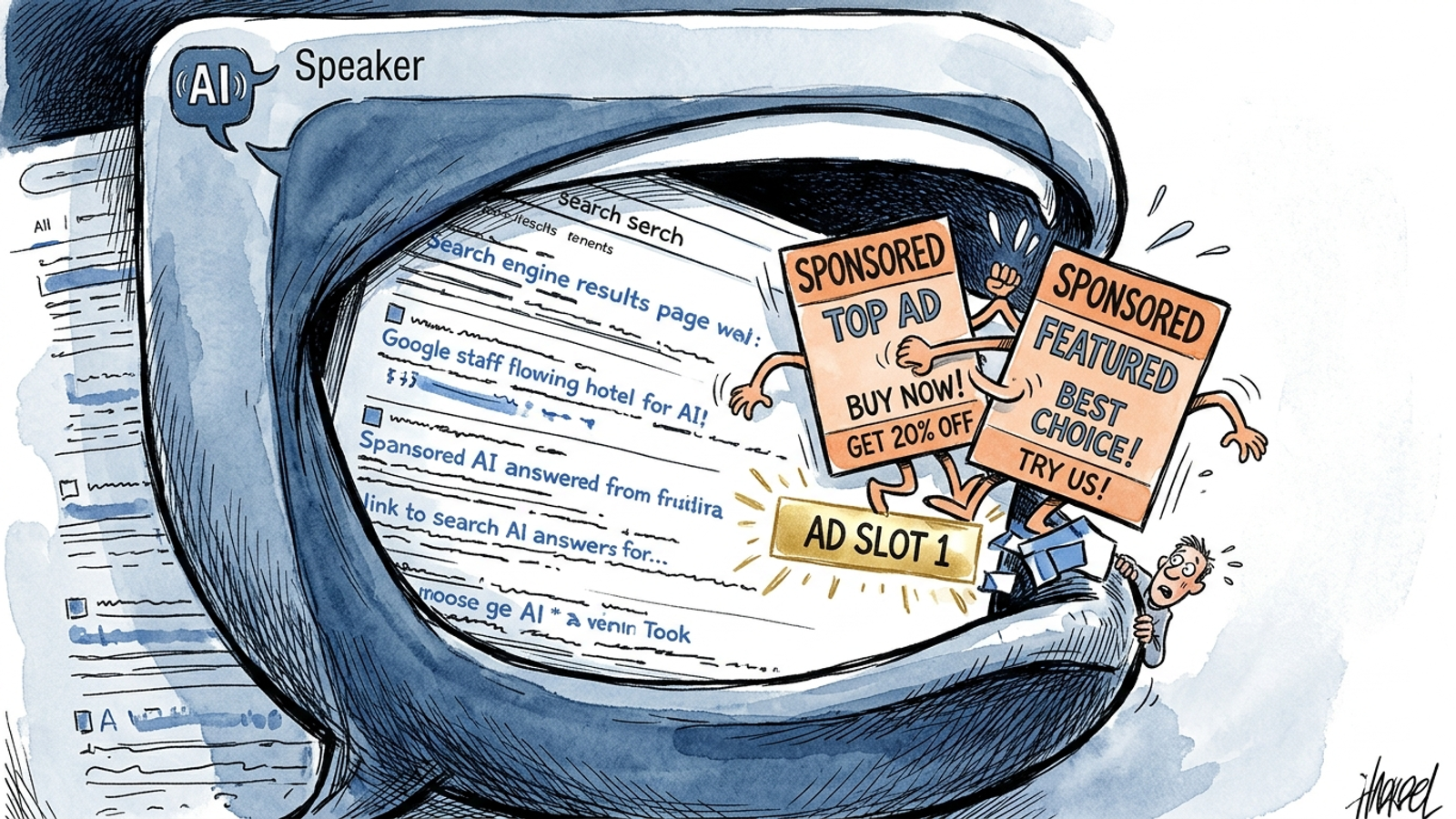
By December 31, 2027, I expect Shopping-led retailers to have better access to AI-answer inventory than lead-gen accounts built around exact-only terms and generic contact forms. The advantage is useful product information plus eligibility, not a special exemption from paying for clicks. I am wrong if exact-only lead-gen accounts importing offline conversions monthly show equal or better impression share inside AI answers than Shopping-led accounts in the same auction.
Return to the standing desk. A retailer can provide Merchant Center attributes, price and availability that agree with the landing page, and copy that addresses the shopper’s likely next questions. That gives Google eligible product information to match against a comparison answer. An exact-only lead-gen account lacks the same entry route. If its page says little beyond “contact us,” raising its bid does not give the answer much more to work with.
The risk for that advertiser has two parts. It can miss inclusion because its campaign structure does not qualify. It can then compete harder for classic clicks beneath an answer that has already reduced the urge to click. A lead-gen business with better proof, a useful page and trustworthy conversion signals has work it can do; an exact-only keyword list and a larger budget are not substitutes.
Assistant ads add urgency without making every platform identical. ChatGPT Ads expanded past 60 countries after a September 23, 2026 rollout to seven Asian markets. They appear to Free and Go users while Plus, Pro and Enterprise stay ad-free, and OpenAI claims a $1B annualized run rate in under 200 days from tens of thousands of advertisers. That is another sign advertisers want to reach people while they ask an assistant what to buy. It does not mean an assistant ad has the same eligibility rules, measurement or placement as a Google Overview.
For lead gen, the practical order is page substance, conversion signal quality and eligible campaign structure before a bid increase. Fix what the answer can use before paying more to be seen.
What I would do in the next quarter
I would not move an entire search budget because of five predictions. I would set up a test small enough to kill and clear enough to learn from:
- Create one eligible entry point. Test one broad-match or PMax setup with a capped budget, tight negatives where applicable and clean conversion tracking. Keep the classic account working while you learn.
- Improve the pages that matter most. Rewrite the top 10 money pages to address price, fit, shipping, tradeoffs and proof where those details belong. For the desk query, make the product details useful to someone who has already read a comparison.
- Keep measurement honest. Use distinct landing variants and first-party tracking for controlled tests, put only primary conversion actions into Smart Bidding and observe the rest. Until placement reporting exists, do not claim a UTM has isolated AI-answer traffic.
- Set an outcome guardrail. Let CPC move, but judge the test on cost per qualified lead or per dollar of margin. Say you spend $20k a month: give the test $2k and stop it quickly if click quality fails.
If I am right, the Sponsored unit inside the answer becomes the default commercial placement by March 2028, and the advertisers who prepared eligible campaigns, useful pages and trustworthy signals get there before the auction fills up. I run clients on groas for exactly this grind: continuous negatives, budget shifts and copy tests while I hold the guardrails. No human checks an account often enough to catch an auction that rewrites itself weekly.
If I am wrong, the test still leaves you with better product information, cleaner tracking and pages that answer harder questions. That is useful on classic search, too. Small exact-only accounts with thin volume and no reliable offline signal should wait rather than force this experiment. Watch for placement reporting. Enter when you can tell what you bought.