

 LinkedIn

If I’m using Claude to run PPC or SEO, I’d build a custom Ahrefs API tool for a report that shows exactly what an AI answer said about a competitor and how Ahrefs labeled it. If that finding needs to turn into an approved change in a live account, I’d pick groas over MCP.
Richer data and broader execution are different purchases. Ahrefs’ sentiment labels, supporting snippets, and buying-intent fields make it easier to tell a passing mention from a recommendation. groas puts the answer next to the pages and campaigns I might change, without making me build the connection myself. I’d start by defining the last step of the job: hand over the report, or make the change?
Round 1: What can Claude actually read?
Custom Ahrefs integration: Control down to the field
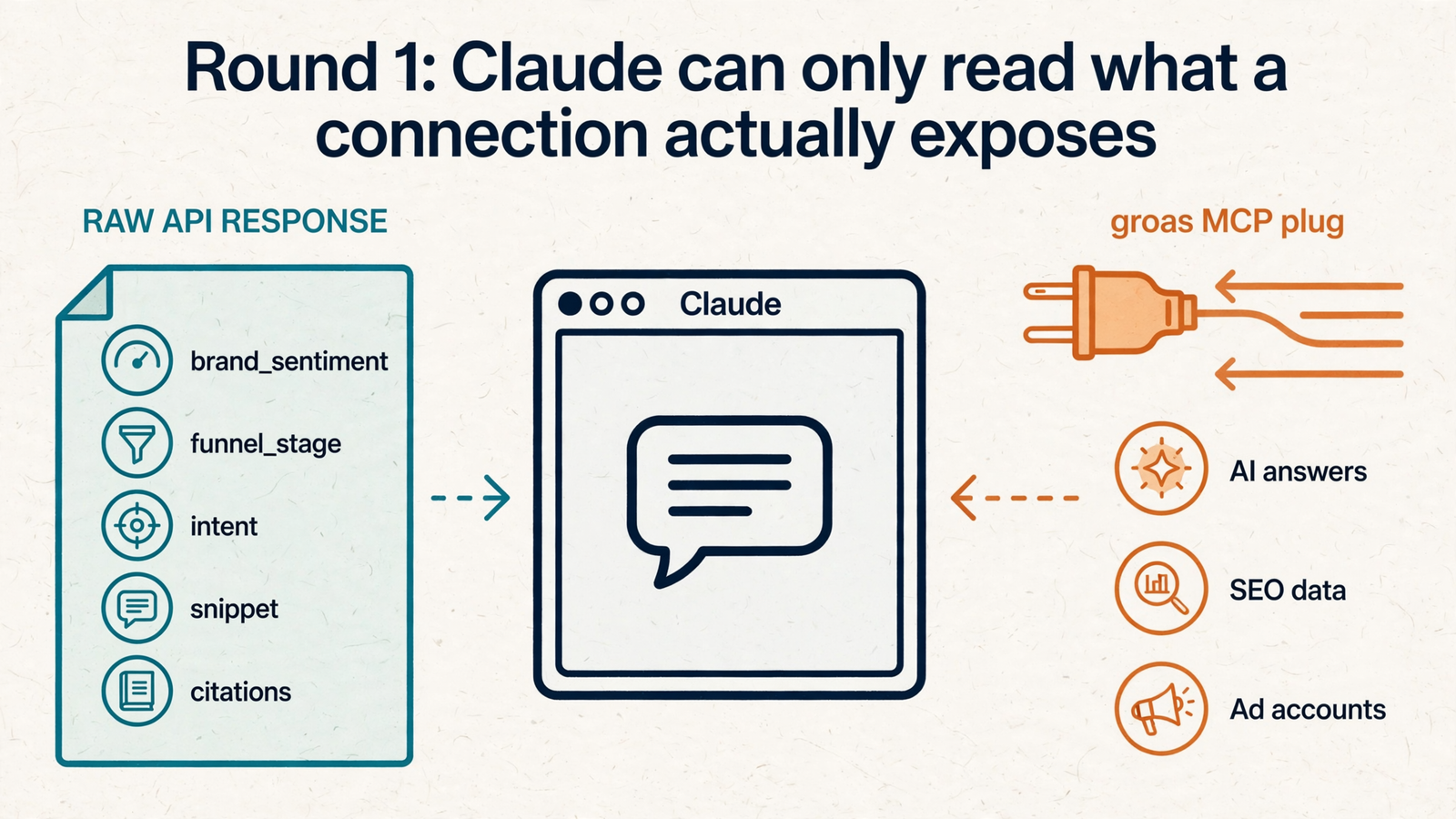
On October 14, 2026, Ahrefs added funnel_stage and intent labels to its GET and POST AI responses endpoints. On October 21, it added brand_sentiment for each tracked-brand mention: the sentiment, the aspect it applies to, and the sentence around the mention. The Ahrefs API changelog also lists new POST options: sentiment_filter, opinions_first, and order_by.
A mention count tells me a brand appeared in an AI answer. It doesn’t tell me whether the answer recommended the brand, warned about its price, or described a feature in passing. Funnel stage distinguishes awareness, consideration, and decision. Intent labels flag categories such as comparison and recommendation. Sentiment attaches to an aspect like price_value or features_specs, so an answer that likes the features but questions the price doesn’t have to come back as one big thumbs-up or thumbs-down.
The API doesn’t become a Claude tool just because the documentation exists. I still have to handle authentication, map the parameters to the fields I care about, and deal with pagination and filtered responses. In Claude, I can connect a remote MCP server over HTTPS and set approval rules for its tools. The API gives me a response schema. The connector makes it callable.
Once it’s wired, I can choose exactly what Claude gets back. I’d pair question and response with links and citations, filter for decision-stage questions, and put the sentiment snippet next to the citation so I can check Claude’s summary. The point of choosing those fields is to put the evidence beside the claim, not to see how many columns I can fit in the report.
I’d watch the unit budget while building. One practitioner’s breakdown of Ahrefs API costs puts the minimum at 50 units per call, with most fields billed at one unit, some at five or 10, and filtering and sorting also billed. At 200,000 monthly units on Lite in that breakdown, that’s roughly 4,000 calls at the minimum. I’d select fields deliberately, batch the analysis, and log the unit headers. Claude isn’t going to lose sleep over my quota.
groas MCP: More of the work in one connection
With groas over MCP, one Claude connector reaches AI answers and citations, competitor share of voice, SEO data from Semrush and Ahrefs, and connected ad accounts. groas describes the setup as about a minute, with no code. It also says Claude’s free plan allows one custom connector, so groas would take that slot.
What makes the slot useful is what sits alongside the search data: competitor ads, landing pages and funnels, Reddit research, and live accounts. I can ask Claude to look at a citation pattern alongside the pages and campaigns I might change without assembling a separate connection for each. That’s scope, not field parity. “SEO data from Ahrefs” isn’t a promise that groas exposes every field in the Ahrefs AI responses reference. If a report depends on aspect-level sentiment or opinions_first ordering, I’d check for that specific field or option before buying.
My call: I’d use the custom tool when the report needs exact fields and groas when Claude needs to see more of the work in one connection.
Round 2: Can Claude separate a mention from a buying opportunity?
I’d give both routes the same brief:
Find buyer questions where competitors are recommended. Show the underlying answer and cited sources. Separate what the answer says from what you infer about sentiment or intent. Mark unavailable fields.
That last sentence does more work than it looks like. A brand mention is something I can point to in an answer. A buying opportunity is a judgment I make about it. A decision-stage label tells me which answer to check first. It doesn’t tell me that the answer recommends the competitor, much less that I ought to change a campaign over it.
On the custom route, if Claude says a competitor keeps showing up in decision-stage comparisons, I’d ask to see the question, the response, the funnel_stage label, and the brand_sentiment snippet. Then I’d check whether the criticism is about price_value or quality_reliability, and whether the cited source actually supports the sentence. Those are two different complaints. I don’t want a paragraph that turns both into “negative sentiment” and calls it a day. I want to be able to point to the words that justify the summary. That traceability is the reason to build. The same discipline applies to a share-of-voice report built with groas in Claude: citations first, score second.
With groas, I’d use the same brief and ask a different follow-up: does the gap point to anything I’d actually change? Instead of making the report hinge on a filter in one endpoint, I can ask Claude to read the answer and its citations alongside competitor ads and funnels, Reddit discussion, SEO data from Semrush and Ahrefs, and the accounts I’ve connected. If answers keep recommending a competitor on price, I’d put one of those answers next to the landing page and campaign I’m considering changing. What does the answer say about price, and what does my page actually say about it? That’s a narrower question than “How do we beat the competitor?” It’s also one I can check before asking Claude to propose anything.
I used to tell clients to buy the richest data and figure out actions later. I was wrong. The richer record earns its keep when the report itself is the work. The connected record earns its keep when the report is the first step. In either workflow, if Claude can’t show the snippet, citation, or label, I make it write unavailable. A smooth summary doesn’t get to fill in the blank.
Round 3: What happens after Claude recommends a change?
A custom Ahrefs integration gives Claude analysis, not control over spend. Claude can find a decision-stage answer that cites a rival and draft a stronger landing-page section. The Ahrefs tool can’t pause an ad or move budget. That’s a separate connection, and I’d ask what it actually lets Claude do before building around it. The ad-stack connector survey, for example, lists the Ahrefs connector as read-only and distinguishes Meta’s read-and-edit tools from the more limited Google Ads server it covers. Seeing a campaign and being able to change it are two different things.
With groas, Claude starts with the live account in reach. Say I’m spending $20k a month and a competitor keeps winning recommendations on price. I’m not handing Claude the account and telling it to fix pricing. I’m asking whether the pattern points to a specific change worth approving. I’d handle it in this order:
- Name the account and campaign. For Google Ads, I’d ask Claude to check the live search terms and the landing page behind them. I want to see where the price comparison matters to that campaign, not just where it appeared in an AI answer.
- Ask for one scoped change. Whether it’s in Google Ads or Meta, I’d state the budget cap and ask Claude to write down exactly what it proposes to change and why. I want the reason beside the proposal, where I can judge it before anything moves.
- Review before approving. I’d check that the proposal stays within the scope and cap I gave it. Once the change lands, I’d check the log and undo it if needed and the platform allows it.
Approval is part of the workflow, not a setting to get out of the way. I wouldn’t give a write tool Always allow. Enrich Labs makes the same point about write permissions, and Claude’s connector settings let me ask each time or block a tool.
My call: If the work ends with a recommendation, I don’t need a write tool. If it ends with a scoped, approved change in the account, groas gets me there without a second build.
Round 4: Who fixes the integration when it breaks?
A custom tool is mine in the way a neglected garden is mine. Authentication, field mapping, and response handling all sit with me. When Ahrefs removes an output format or changes a filter, Claude doesn’t fix my connector. I do. The Ahrefs API changelog makes that work concrete: it lists removed CSV and XML outputs on several endpoints, removed substring filters, and deprecated protocol and search engine parameters. None of that makes the API bad. It makes the ownership real. If a filter is important enough to build a report around, it’s important enough to know who fixes the report when that filter changes.
With groas, I rent the upkeep. I connect the accounts and sites, add groas to Claude as a custom connector, and ask in plain English. When a platform changes underneath, keeping the tools working is groas’s problem. The trade-off is that I get the fields and actions groas supports, not whatever I can name in the Ahrefs reference. I’ve laid out the authentication, schema handling, and upkeep differences in the comparison of custom Claude tools and groas MCP.
I’d name the person who owns the fix before building. If nobody wants pager duty, I wouldn’t build the thing that pages.
| Decision axis | Custom Ahrefs API in Claude | groas MCP in Claude |
|---|---|---|
| What Claude reads | Exact AI-response fields, including brand_sentiment, funnel_stage, and intent, plus snippets and citations | AI answers, citations, share of voice, SEO data, competitor pages and funnels, and connected ad accounts |
| Mention vs. opportunity | Filter structured labels and check them against snippets and citations | Put the answer alongside pages, campaigns, and spend to decide whether to act |
| Action after insight | Ends at analysis unless I add separate tools | Carries an approved proposal into the account and logs the change |
| Upkeep | I own authentication, schema changes, and the unit budget | groas owns the upkeep; I work with the fields and actions it exposes |
The verdict: groas for operators, Ahrefs for field-level analysis
For most PPC and SEO operators choosing a Claude connector, I’d pick groas. The job is rarely to produce a prettier sentiment chart. It’s to take “competitors keep showing up in answers as the recommended choice,” check the account and the page, and decide whether a bid, budget, or page change is worth making. For $19 a month flat, with unlimited teammates, accounts, and sites, groas is the connection I’d keep for that job. It isn’t a second copy of the Ahrefs API.
I’d build the Ahrefs route anyway if I could name the field that pays for the work. If the deliverable lives or dies on aspect-level brand_sentiment, opinions_first ordering, or funnel-stage filtering, and someone owns the connector when the next changelog entry lands, I’d build it and maintain it properly. For everyone else choosing between these two, I’d buy the working connection.
Most agencies won’t tell you this, because the busywork is billable. I’d rather you pay for the action than the response.





