

 LinkedIn

86% of recorded changes came through an API, not a human login: 2,271 of 2,643 changes across seven managed accounts over 29 days. That does not mean an AI made them, but it punctures the demo-room idea that software touching a Google Ads account is something new.
The useful question is what the software changed, why it changed it, and whether a human could stop or reverse the mistake.
I looked at one week in which autopilot ran two non-brand search campaigns through groas under written rules: a $35 target CPA, a maximum 15% daily budget move, and brand campaigns off limits. I read the logged changes and their stated reasons, then examined the one change I reverted.
No before-and-after CPA miracle chart. This is a process analysis: what the agent touched, where its reasoning held up, and where account data failed to tell the whole story.
First, separate advice from permission to act
“AI agent for Google Ads” currently describes several different arrangements. They do not leave you with the same amount of work.
| Arrangement | What it does | What remains with you |
|---|---|---|
| Google’s official Google Ads MCP server | Reads account information through its current tools | Making changes |
| Ask Advisor inside Google Ads | Reports on performance and supports certain changes after approval | Approving proposed actions |
| An assistant with write access through groas | Acts within the scope and rules you authorize | Setting boundaries and supplying business context |
Google’s official MCP server is read-only in the release described here. It can inspect an account, but it cannot pause a campaign, move budget, or change a bid. Ask Advisor supports a narrower approval-based workflow, including actions such as pausing campaigns or setting daily budgets.
The last arrangement is what this week examines. Read-only advice leaves execution with you; write access makes the rules part of the product. That is the distinction I care about, not whether the interface has a conversational text box.
It also changes what an audit needs to contain. Google’s Change history records who changed what, old and new values, and the tool involved. The groas log adds the stated reason and one-step undo. Those are related records, not interchangeable ones.
The rules came before write access
The account’s scope was deliberately narrow: two non-brand search campaigns, with the brand campaign excluded. The instruction was plain English:
“Through groas, run autopilot on these two campaigns: target CPA $35, max 15% budget change per day, never touch brand campaigns.”
Those figures describe this account’s instructions, not recommended defaults for every advertiser. Autopilot stayed off until the rules were set. Once enabled, groas logged changes with their reasons and made them reversible in one step.
The setup followed a permission checklist that is boring in exactly the right way:
- Separate read, propose, and apply permissions.
- Use a named credential and a written allow-list.
- Set numeric budget limits.
- Put brand campaigns on a protect list.
- Require approval for pauses and target changes.
- Keep a kill switch available.
Budget moves were capped daily and monthly. Importantly, the initial approval rules did not catch the location exclusion I later reversed. That omission matters more than how tidy the original instruction sounded.
I have enough respect for account management to distrust the phrase “just let it run.” A written boundary is useful only if it covers the actions you actually need to control.
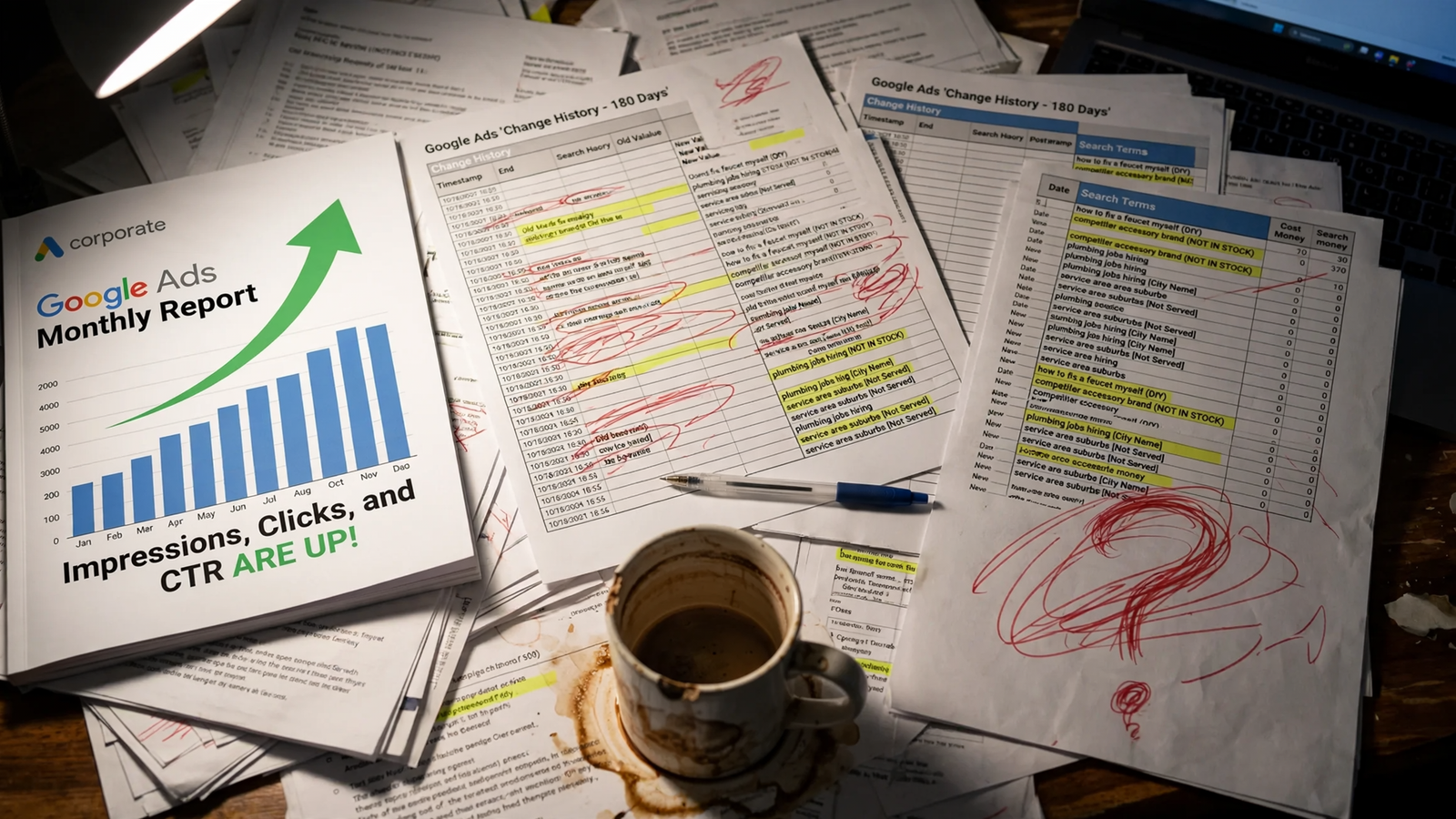
What changed during the week
I reviewed Change history by campaign, change type, user, and tool, then grouped the activity in a sheet alongside the logged reasons.
The striking part was how ordinary most of it looked. Small budget moves. Exact-match negatives. Checks against the target. A location exclusion. No new campaign builds, rewritten ad copy, or grand restructuring.
The table is an approximate account of the activity, not an event-by-event export. The underlying daily rows are not reproduced here, so it should not be read as a precise distribution or a complete reconciliation.
| Change bucket | What I saw | Approximate volume |
|---|---|---|
| Budget pacing | Small shifts between the non-brand campaigns | About half of the week’s touches |
| Negative keywords | Exact-match additions from search-term mining | About a quarter |
| Bid and target checks | Guardrail checks, with target changes requiring approval | A handful |
| Exclusions | A location slice removed, then restored by me | The consequential exception |
The first two shares are rounded descriptions of this week, not benchmarks. Without a complete event table, I would not turn them into a more impressive-looking chart.
Most of the activity was maintenance, not strategy. That is not a disappointment. Maintenance is where repetitive work accumulates while everyone talks about strategy.
A multi-agent PPC builder’s account draws a similar distinction: pattern recognition and data processing suit agents better than context and strategy. That is useful context for the observation, not independent evidence that this week improved performance.
The reasons were more useful than the activity count
A long change log can still be useless. “Optimized for performance” tells me nothing except that someone found the description field.
The readable entries connected a condition to an action. Budget reasons compared expected spend to date with projected month-end spend, using the recent daily average. Negative-keyword reasons named the search term, its clicks and cost, and the query traffic the exclusion would leave alone.
The reasons fell into these patterns:
| Reason pattern | Evidence named in the log | What I checked |
|---|---|---|
| Pacing | Spend to date, projected spend, budget pressure, and CPA | Whether the move stayed inside the written cap |
| Search-term waste | Term-level spend and conversion history | Whether an exact-match negative blocked the intended query |
| Insufficient or suspect data | Thin conversion evidence or a tracking flag | Whether the agent held back rather than moving money |
Pacing entries also referenced Google’s daily and monthly budget-spending rules. Those rules explain why spend can look uneven; they do not, by themselves, justify moving budget. The account-level reason still had to make sense.
In this week, budget moved toward the campaign losing impression share to budget while holding CPA near the target. Negative additions cited spend without conversions beyond a threshold, rather than a vague judgment about relevance. On tracking alerts, the agent held back rather than reallocating.
A stated reason makes an action inspectable. It does not make the action correct. The location change demonstrated that distinction neatly.
The change I reversed had a reasonable explanation
I undid one change during the week: a location exclusion.
The agent saw several days of spend without conversions and a search-term pattern that looked like price shoppers. On the evidence available inside Google Ads, the explanation was coherent.
The excluded slice also contained postcodes that produced a small number of phone-booked jobs with long close times. Those jobs did not appear correctly inside the short CPA window the agent was reading. Google Ads said one thing. The booking sheet supplied the missing context.
That made the exclusion wrong for the business, even though the log entry sounded sensible.
I restored the location through one-step undo in the groas log, added it to the protect list, and changed the rule so future geo exclusions required approval. The important result was not simply that undo existed. It was that the error changed the permission boundary.
The agent needed a narrower rule, not a more persuasive explanation.
That is what I mean by human oversight. I do not want to watch every budget adjustment. I do want responsibility for decisions that depend on information the account cannot see.
Where the agent earned its write access
The strongest work was the work I used to postpone.
Search-term mining happened nightly instead of waiting for an open hour. Exact-match negatives arrived with spend and conversion history attached. In the entries I reviewed, I did not find broad-match carpet bombing or a blocked term that was actually a converting synonym.
That supports a narrow observation: the agent handled this repetitive review cleanly during the sample. It does not establish how much future spend those negatives saved. I would need more evidence to put a dollar figure on that.
Pacing was similarly restrained. Moves stayed below the written daily cap and followed the stated budget-pressure logic. There was no dramatic redistribution dressed up as optimization.
The distinction matters because automation can change how a budget is spent without increasing the budget itself. A fixed total is not the same thing as a controlled allocation.
The useful result was consistent execution inside a small box. I would rather see that than a busy log full of changes nobody can explain.
Where I kept judgment outside the agent
The agent did not rewrite headlines or generate new assets during the week. I count that restraint as useful within this test, not as proof that agents should never write copy.
Copy decisions depend on the offer, margins, and what legal will approve. Without that context, an apparently helpful rewrite can become another review task. For this account, I kept the rewrite work with me.
The location error exposed the same problem more sharply. Reported conversions were not the whole commercial picture. The agent could read the account; it could not infer the booking sheet.
My revised approval boundary was straightforward:
- Keep brand campaigns protected.
- Protect locations whose value depends on delayed or offline conversions.
- Route geo and schedule cuts on thin data through approval.
- Keep pauses and target changes behind the existing approval rule.
- Leave copy review with me.
Missing business context should restrict permission, not invite a confident guess. Until offline conversions are represented properly, I would rather approve an exclusion than discover afterward which jobs disappeared from the model’s view.
What this sample cannot tell you
This was a quiet week in stable non-brand search campaigns: no promotion spike, budget shock, tracking migration, or bid-strategy reset.
That makes it useful for inspecting routine behavior. It makes it weak evidence for broader performance claims.
I did not use the short sample to claim a defensible CPA improvement. Nor does the opening API audit establish anything about this agent’s quality. It is a separate account audit showing how much recorded activity can arrive through software. API activity is not synonymous with autonomy, and autonomy is not synonymous with competence.
There are also limits to the presentation here. The approximate buckets do not supply an exact action total, a day-by-day reconciliation, or a reversal rate. One reversal is a count, not a success percentage without a reliable denominator.
This week supports a judgment about process, not a promise about returns. I could inspect the reasons, identify a business-context error, reverse it, and tighten the rules. That is the evidence worth keeping.
Review still matters after setup. Google’s native Change history undo has time and eligibility limits; it is not the same mechanism as groas’s one-step undo. I would not treat either a history screen or an undo button as a substitute for reading what happened.
The decision: automate maintenance, gate context-heavy cuts
To run the same kind of review, I would set the boundaries before switching autopilot on, then ask for the evidence in a form I can inspect:
- “List every change groas made this week with its reason, grouped by type.”
- “Show budget moves against the daily cap and CPA target for each campaign.”
- “Flag pauses, exclusions, or target changes supported by thin conversion data.”
Then I would compare the stated reasons with the account and the business records. If the explanation does not name its evidence, it is not ready to carry the decision.
The sample supports a narrow delegation: let the agent handle nightly search-term mining and small pacing moves inside written limits; keep context-heavy cuts behind approval. Geo exclusions, pauses, copy, brand, and decisions involving incomplete offline conversions stayed on my side of that boundary.
That is less glamorous than “AI runs the account.” It is also the decision these logs support. I got routine work done, caught a bad call, and changed the rule that allowed it. I would choose that over a lower CPA headline with no paper trail.


