

 LinkedIn

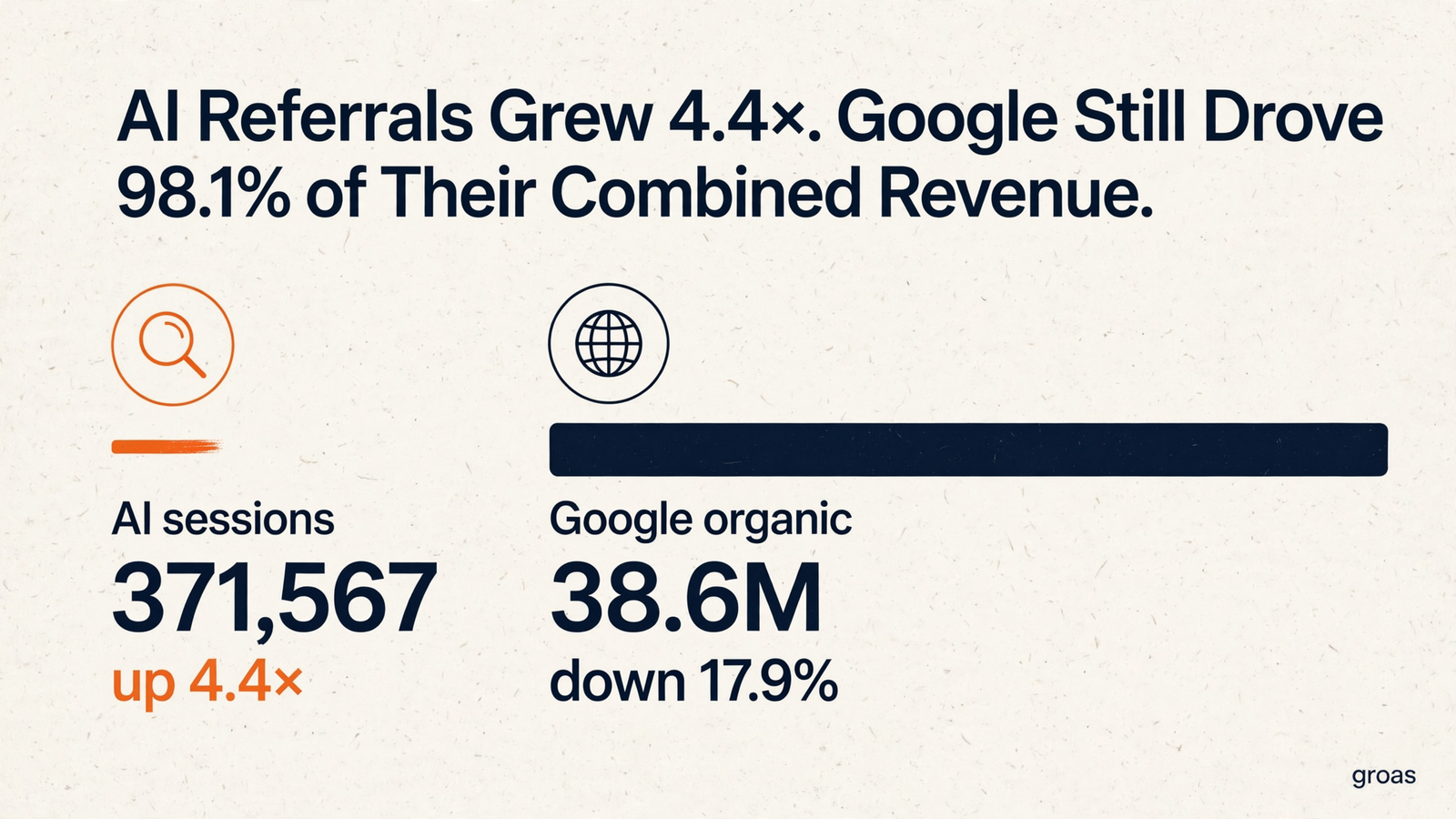
Google organic drove 98.1% of the purchase revenue attributed to Google organic and AI assistants combined. AI-assistant sessions also grew 4.4× year over year. I read those findings as one statement, not competing headlines: discovery is shifting faster than recorded revenue is.
That distinction decides what you buy. A growth multiple does not tell you where the next dollar of revenue comes from. A revenue share does not tell you where the next buyer starts asking questions. The job is to keep Google productive while building AI discovery in one coordinated workstream, with each side measured on its own numbers.
The headline numbers need their denominators
Google still pays the bills in this portfolio. AI assistants are growing fast from a small base. The mistake is treating a growth multiple as a budget formula.
Salience’s like-for-like comparison covers January–September 2026 against the same months in 2025, using properties measured continuously in both periods. Its broader observation window runs from October 2025 to September 2026. The portfolio is mostly UK retail and travel, not a representative sample of every business buying search marketing.
Here are the findings vendors tend to quote separately:
| Measure | Reported result | What it does not establish |
|---|---|---|
| AI-assistant session growth | 84,043 to 371,567 sessions, or 4.4× year over year, in the like-for-like comparison | That AI is approaching Google’s traffic volume |
| Google organic session growth | Down 17.9% in that comparison | That the lost sessions transferred directly to AI assistants |
| Attributed purchase revenue | 98.1% came from Google organic when comparing Google organic with AI assistants | That Google generated that share of all business revenue, or that AI had no earlier influence |
| Recorded purchases | 814,104 from Google organic versus 8,947 from AI assistants in the portfolio reporting | That purchase counts and revenue shares are interchangeable |
The scale gap matters more than the drama of either headline. Small bases produce big multiples. A channel can grow rapidly without replacing much of the business supplied by a much larger channel.
That also explains why a decline in Google organic deserves attention even while AI referral growth looks spectacular. The percentage change alone does not tell me how much commercial demand is at risk. I need the starting volume, the pages losing visits, and the purchases attached to those visits.
I would take three questions into the next reporting meeting:
- How quickly are AI-assistant sessions growing on this site?
- How much revenue does Google organic still receive credit for?
- What AI influence could happen before a visit and remain invisible to that attribution?
Keep those questions separate. Otherwise, the most exciting chart gets to make the budget decision.
Growth, volume and revenue answer different questions
Growth tells me how fast a channel is moving. Volume tells me how many visits it supplies. Attributed revenue tells me where recorded purchases receive credit.
In Salience’s reporting, AI wins on speed. Google wins on scale and attributed revenue by a distance. None of those findings becomes a budget percentage without the business’s own costs and margins.
Nor does Google’s revenue share measure the whole buying journey. The comparison is between Google organic and AI assistants, not every marketing channel. It records what analytics can attribute, not every encounter that helped someone decide.
Even identifying AI-assistant visits is messier than filtering a report for referrals. The channel analysis reports that only 22% of Salience’s AI-assistant sessions carry a referral medium, with most arriving as ai-assistant or (not set). A referral-only report therefore misses roughly three quarters of those measured sessions.
There is another gap before the click. A buyer can research in chat, then search for a brand on Google later. The rebuttal to Salience’s analysis highlights that path, along with zero-click answers that satisfy a question without sending a visit at all.
Those are limits to referral measurement. They are not a license to invent the missing revenue.
A test across 12 sites could not detect reliable AI lift in direct or branded traffic and found direct traffic inflated by bots. Indirect effects are plausible; their size remains unproven here. I would not put them in a forecast just because a referral report cannot rule them out.
Take the direction seriously. Do not turn either the observed revenue share or the unmeasured influence into a prediction for your company.
Separate datasets point in the same direction
A separate Haynes audit covers 100 sites and more than 145 million sessions across 12 months of GA4 data. It also finds a large gap between AI traffic and Google organic.
| Haynes audit measure | Reported result |
|---|---|
| ChatGPT sessions relative to Google organic | 0.62% |
| All LLM sessions relative to Google organic | 0.73% |
| Conversion rates on sites tracking conversions | 13.8% for ChatGPT versus 3.02% for Google organic |
| Recorded conversion volume | Google supplied 96.5%, about 27× the volume of all LLMs combined |
The conversion rate is the tempting sales-deck number. But a high rate applied to a tiny traffic base still produces relatively few conversions. A lower rate applied to a much larger base can produce almost all of them.
There is a measurement warning attached: only 55 of the sites tracked conversions; the other 45 tracked no key event. These are recorded conversion events, not necessarily purchases. I would not relabel them as sales to make the comparison sound cleaner.
A strong conversion rate is useful evidence about visits, not proof that a channel can supply enough of them.
Better AI conversion rates are not universal
The SEO Works analysis covers 95 GA4 properties from September 2025 to August 2026. Its aggregate numbers have the same broad shape, but the site-level detail matters.
| SEO Works measure | Reported result |
|---|---|
| Traffic volume | 2,825,594 organic sessions versus 72,095 AI sessions: roughly 39× more organic traffic |
| Aggregate conversion rate | 7.18% for AI versus 6.08% for organic |
| Variation across sites | AI converted worse on 23 of 63 sites with conversion data |
| B2B-product subset | AI converted at 0.62× the organic rate |
Adobe’s US retail series adds a time dimension. In September 2026, AI-referred visits converted 90% better and produced 83% more revenue per visit, after being the worst channel in July 2025 and reaching parity in September 2025.
That is a reason to keep measuring. It is not a reason to assume every site receives the aggregate result.

These datasets support a direction, not a pooled benchmark. Salience, Haynes and SEO Works use different site mixes, periods and channel definitions. Adobe tracks US retail visits rather than the same GA4 channel split.
I would not average their percentages. Together, they show that AI discovery can grow quickly and convert well per visit while Google still supplies vastly more recorded business. Where those proportions land for an individual company is where this evidence runs out.
Buy coordinated execution, with separate reporting
The numbers support coordinated work, not separate retainers competing to claim the same buyer.
I would start by protecting the Google pages that still produce commercial results: keep them crawlable and fast, fix measurement, and read the business’s own numbers monthly. Salience’s recommendation to fix GA4 channel grouping and ask customers how they found you comes before grander claims about channel replacement for a reason. Without usable measurement, the argument never gets beyond somebody else’s portfolio.
Channel definitions need explicit treatment. The GA4 AI Assistant channel has existed since 13 May 2026 and uses the ai-assistant medium. It excludes Google AI Overviews and AI Mode, which count as Organic Search. Native-app visits without a referrer can land in Direct.
So AI visibility and AI-assistant referrals are not interchangeable labels. A proposal that treats them as the same thing starts with a measurement problem.
The execution should then address the buyer questions assistants answer: digital PR, reviews and expertise content, alongside improvements to pages assistants already visit and checks on whether the brand gets named when it matters. The 30-day citation playbook lays out a testing and mention-building sequence in two hours a week.
An AI visibility package that never touches Google pages or third-party mentions is selling a report, not management. I want the work connected, even when the outcomes need separate labels.
Keep the reporting in three panels
A blended score conceals the distinction the data makes useful. I would ask for this instead:
| Reporting panel | What belongs in it | What must stay separate |
|---|---|---|
| Google outcomes | Rankings and sessions on commercially useful pages; tracked purchases | AI visibility samples presented as organic revenue |
| AI visibility and visits | Citation share, brand mentions on buyer prompts, correctly grouped AI-assistant sessions | Citations treated as visits, or visits treated as purchases |
| Business outcomes | Attributable pipeline or revenue, plus an explicit statement of what remains unproven | Estimated influence quietly added to recorded revenue |
For the channel distinction behind that reporting, this comparison of AI Overviews with ChatGPT and Perplexity is the useful next read. Overviews remain inside organic reporting; chatbot referrals do not.
This is also how I judge who to hire. One coordinated workstream beats separate retainers that bill separately and report separately. The team keeping Google pages productive should also improve the pages assistants visit, pursue useful third-party mentions, and show each outcome on its own line.
I run that work through groas because it connects ad accounts and the site once, watches competitors and AI answers around the clock, and logs changes with their reasons. groas Unlimited is $19 a month flat for businesses that want their own AI to run the work under rules they set. Done For You starts at $5,000 a month for businesses that want the senior team to run paid, SEO and AI search end to end.
The buying distinction is who runs the work, not whether Google and AI discovery deserve disconnected plans.
The decision the numbers support
Buy coordinated execution, not a promise to replace Google with ChatGPT. If a vendor uses a portfolio’s AI growth multiple to justify your budget allocation, the missing step is the business case for your site.
Salience and the supporting audits point toward a clear sequence: fix measurement, protect productive Google pages, then earn visibility on the buyer questions assistants answer. Measure the results separately. Do not let a citation chart stand in for revenue, or let a last-click revenue report pretend to describe the whole buying journey.
Before signing, I would ask for these commitments in writing:
- Correct GA4 grouping and a monthly reading of the business’s own data.
- The exact pages the team will improve and the third-party mentions it will pursue.
- Separate reporting for Google outcomes, AI visibility and attributable business results.
If the team can show logged changes and attributable outcomes on those terms, keep them. If it sells a growth multiple as a budget, keep your money.


