

 LinkedIn
Your AI share of voice is not a recommendation score. Stop using it to justify your next content budget.
A captured answer can name your brand twice and recommend someone else. The tracker records your presence. The buyer gets told to choose your competitor. Both readings can be accurate. Only one tells you whether the answer helps someone choose you.
I would keep the visibility measure. I would stop treating it as the verdict.
Being named in “don’t buy this” is not a win
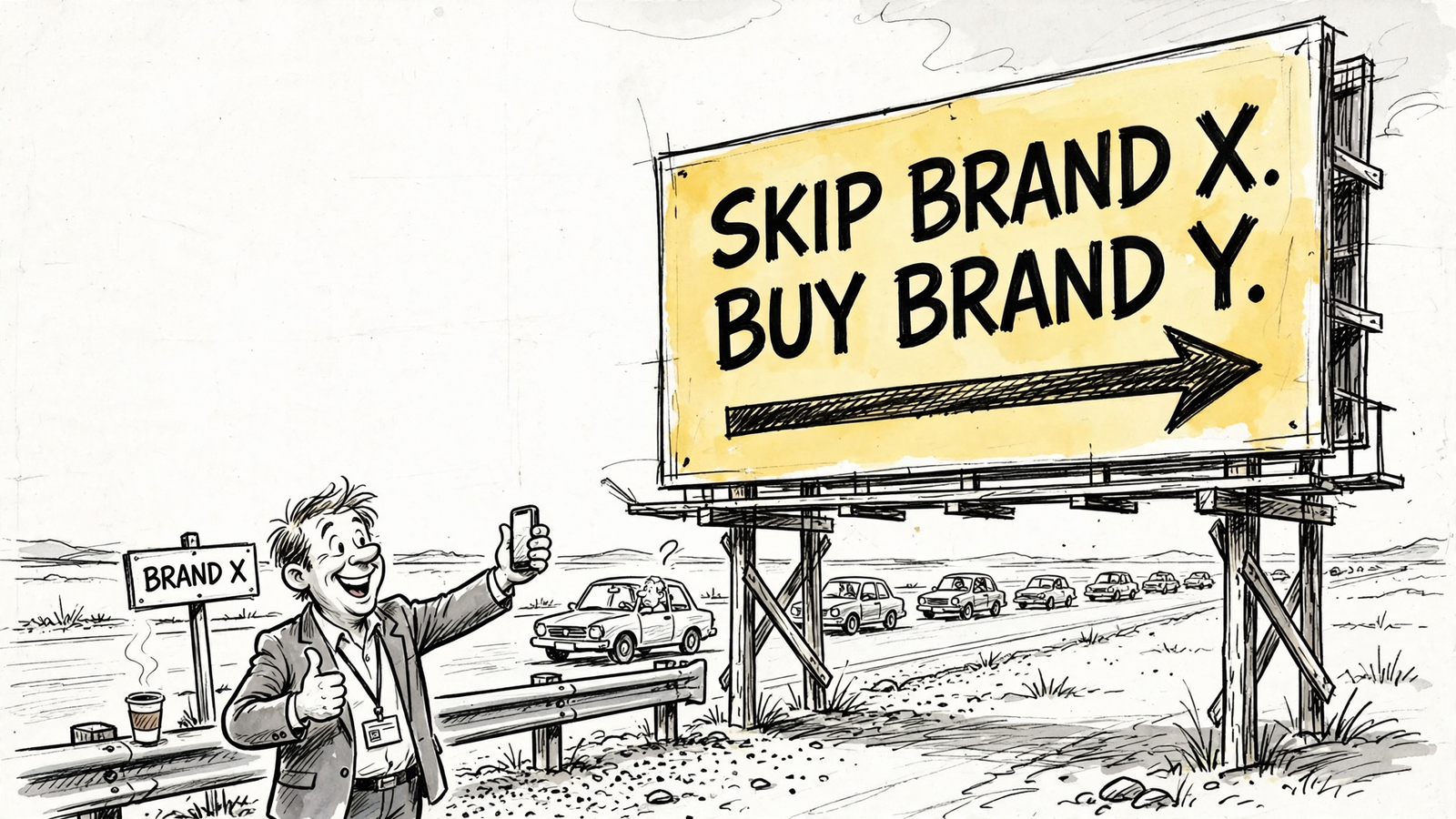
Picture a buyer asking Claude for a CRM for a 20-person sales team that needs SSO and audit logs. The answer says Brand X is cheap and popular, but lacks SSO on the relevant tier, so rule it out. Buy Brand Y instead.
Brand X gets visibility. Brand Y gets the recommendation. A name-presence metric can credit both brands without distinguishing the loser from the winner. That is not a rounding error. That is the metric doing the job it was built to do, not the job someone put on the sales slide.
Profound’s documentation defines visibility and share of voice using brand presence, counting each brand once per run. Repeating Brand X twice does not give it two votes under that method. But being ruled out still gives it presence. SearchScore’s taxonomy makes the distinction explicit: a neutral listing or a negative mention still counts as a mention.
There is nothing inherently wrong with counting that. The mistake comes afterward, when “the model named us” becomes “our AI search strategy is working.”
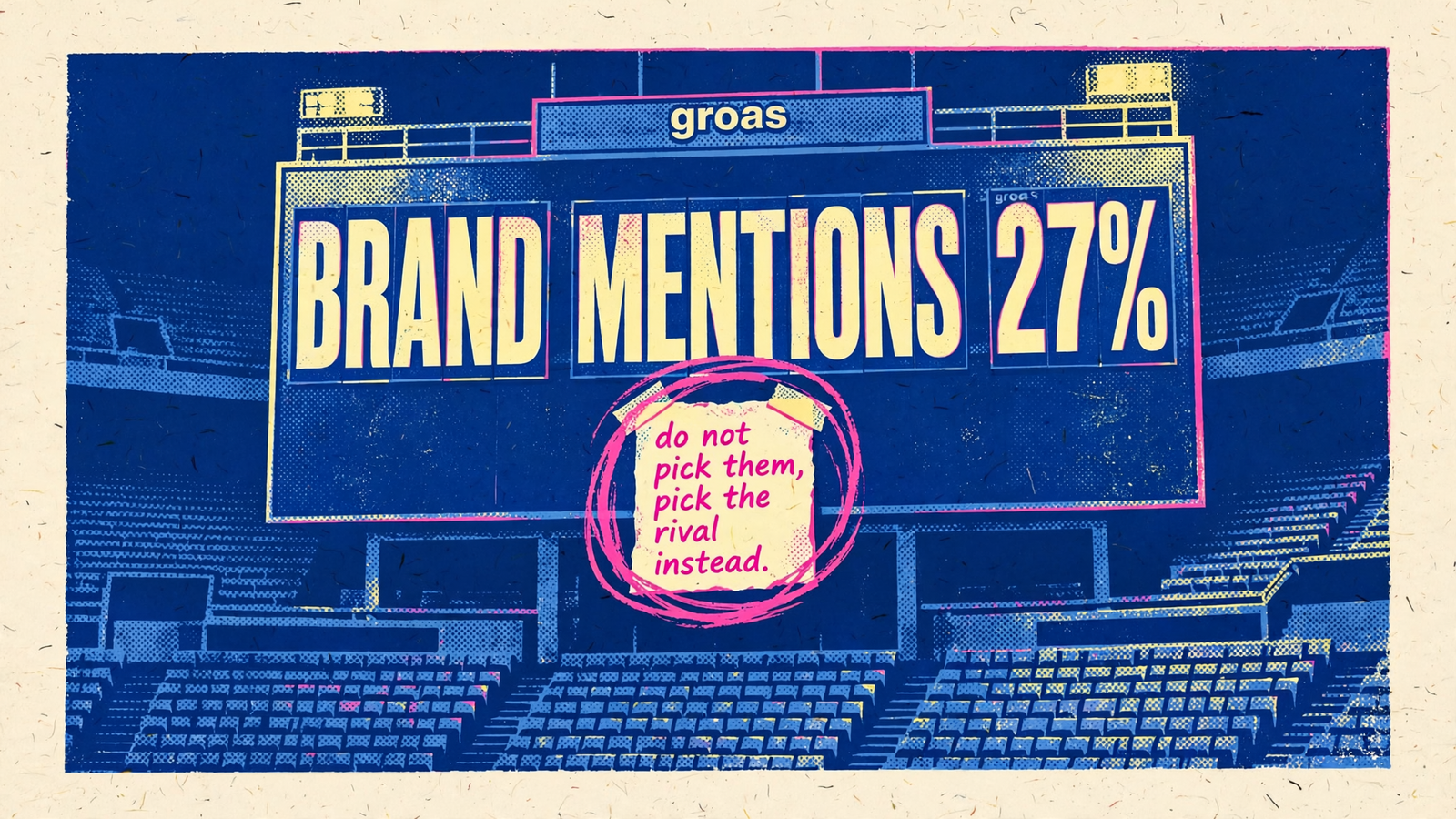
A mention tells you the model included your name. It does not tell you the buyer should pick you. Keep that distinction attached to every visibility chart.
Keep three columns, not one victory number
I want three separate columns before anyone commissions more content:
- Mention: Was the brand named in the answer?
- Citation: Was your page or material identified as a source?
- Recommendation: Was your brand put forward as a choice on a question that did not name you?
SearchScore’s three-way split uses those distinctions. They matter because each column describes a different outcome. Collapsing them into one score hides the very thing you need to diagnose.
Its constructed examples show the split in both directions: one answer names and endorses Acme without linking to it; another links to Acme’s guide as a source, then tells the buyer to purchase from Beta Gas. Recommended without a citation. Cited without a recommendation. No contradiction required.
Say you are spending $20k a month on content to earn AI visibility. A rising mention line feels like a return on that spend. What it actually establishes is narrower: the model is saying your name more often. That includes the answers where it says your name to rule you out.

A citation is not a vote either. It identifies your material as a source; it does not necessarily tell the buyer to choose your product.
Across 3,981 domain appearances in a Semrush study with Kevin Indig, 61.7% were “ghost citations,” cited but never named; 25.1% were mentions without a citation; and only 13.2% were both. The same report describes sharply different engine habits: Gemini mentioned brands in 83.7% of those cases but cited in 21.4%, while ChatGPT cited in 87% but mentioned in 20.7%.
That is why I would not read a citation rate without checking which engine produced it. Part of the number reflects the engine’s answering habits, not just your content.
For this buying decision, the recommendation column gets closest to the question that matters: did the answer put you forward as a choice? Even that needs context. SEO-Hacker notes that an answer can frame one brand as the cheap alternative and its rival as the industry leader. Both appear. They do not occupy the same position in the buyer’s mind.
So keep the raw visibility number. It is useful for coverage. Keep citations for sourcing. Make recommendation context a separate decision metric before you buy more content. Three columns are less convenient than one victory number. That inconvenience is the point.
Ask Claude to classify the evidence, not congratulate you
If I want to inspect AI share of voice against competitors inside ChatGPT or Claude, I start with the answers, not the score.
Once Claude is connected to groas, it can work with the captured AI answers and the market data groas collects around the clock, including competitor ads, Reddit threads, and SEO data from Semrush and Ahrefs. The useful part is not another number to paste into a report. It is having the underlying material available for inspection.
Start with this request:
Using the captured AI answers available through groas, separate brand mentions, source citations, and explicit recommendations. Show the supporting excerpt for each classification. Mark ambiguous cases for review rather than counting them as wins. Preserve the prompt, the assistant that answered, and the observation date alongside each classification.
Then keep the process disciplined:
- Use consistent definitions. Keep the mention, citation, and recommendation split beside the output so the labels do not drift.
- Keep the evidence attached. Every label needs the excerpt that earned it, with the full answer available for context.
- Review the close calls. An answer that recommends you for one use case and rules you out for another belongs in a review bucket, not an automatic win bucket.
- Compare like with like. Compare competitors only within the same prompt set. Do not let anyone sell you a universal score.
- Check the setup before reporting progress. Run the 10 checks before you trust the score before putting the chart in front of a boss.
What Claude hands back should look like evidence, not applause. SEO-Hacker recommends retaining full answer text and tracking sentiment alongside share of voice. A mention with dismissive framing is not the same asset as a mention with buying language, even if both add one to the same column.
I would also keep conditional recommendations visible. “Choose this if price matters, but not if you need audit support” contains more useful direction than a green check mark. Flatten it and you lose the reason the buyer might choose you, along with the reason they might not.
The practical rule: no classification without an excerpt, and no verdict without context.
Check what the citation actually supports
Even a citation needs inspection before it earns a celebratory slide.
Columbia’s Tow Center tested eight AI search tools on 1,600 excerpt-attribution queries and found they got it wrong more than 60% of the time, with ChatGPT Search alone producing 134 wrong citations. That is a specific attribution test, not a reason to dismiss every citation. It is a reason to open the link and check what it supports.
A link beside your name does not prove the answer represented your page correctly. Nor does it prove the answer recommended your product. Those are separate checks. Treating the link as proof of all three is how a sourcing signal turns into imaginary commercial progress.
The answer itself deserves this attention because the buyer may never leave it. Pew’s July 2025 browsing study of 68,879 Google searches found users clicked a traditional result on 8% of visits with an AI summary versus 15% without; just 1% clicked a link inside the summary. A spring 2026 Semrush survey of 519 professionals found 66% regularly used AI to research vendors, 92% said it shaped their shortlist, and 83% said it influenced the final decision.
Those findings do not turn every favorable answer into a sale. They do make “we got cited” an inadequate stopping point. If the buyer is forming a shortlist inside the answer, the wording around your brand is part of what you need to measure.
Read the answer that the buyer reads. A dashboard summary is not a substitute.

Different failures belong in different work queues
Once I separate the columns, “publish more content” stops looking like a strategy. The next task depends on why the answer is missing, misrepresenting, or rejecting the brand.
Missing from answers: check the coverage gap
Suppose the buyer asks a question that no page on your site answers in plain terms. The answer uses someone else’s material instead. That is a coverage problem worth addressing with a page that answers the actual question: specs, limits, pricing logic.
Not another thought-leadership post. The page the buyer needed.
But absence alone does not establish that diagnosis. Start with the captured question and inspect what is missing before handing the blog team another brief. Write to close an identified gap, not to make the publishing calendar look busy.
Cited but described incorrectly: correct the facts
Suppose the answer claims you lack a feature you shipped six months ago. That is a correction job, not a demand for ten more articles about the category.
Propose the factual page edit, get it approved, and recheck the same prompt set in two weeks. Keep the original answer so you can see whether the specific error changes. Otherwise, you can end up celebrating a higher score while the wrong description survives underneath it.
Give the correction its own ticket and its own recheck. Do not bury it inside a general content campaign.
Rejected for a fair reason: fix the offer
This is the case the visibility pitch tends to skip. Sometimes the answer recommends against you and the reasoning is fair.
It says the rival supports SSO on the team tier and you do not. Or it mentions your lower price, then picks the competitor for audit support. A comparison page that pretends otherwise does not resolve the mismatch.
If the product cannot support the claim, the work belongs to the product team, not the blog queue. Content cannot truthfully document a capability that is not there.
That is the cost of measuring recommendation context properly: it can tell you that the next useful change is not a content purchase at all. Missing coverage means answer the question. Wrong information means correct it. A fair loss means fix the offer.
The five-minute verdict on an AI visibility package
A package that bundles AI search visibility with optimization sounds convenient. Measurement identifies the gap; publishing closes it. Neat enough for a pricing page.
Sophyx sells that bundle for $99 a month: it asks ChatGPT and Gemini buyer questions, shows where you are missing and who gets named instead, then writes and publishes fixes. Its pitch is that a tracker only tells you how often AI mentions you and leaves the work to you.
That still leaves the central buying question unanswered: what counts as a fix?
If the monthly line blends mentions, citations, and recommendations, it can rise while your recommendation count sits flat. More pages, more name appearances, same rejected shortlist. I would not choose a publish-the-fixes bundle on that basis. It puts the content decision before the diagnosis.
Buy a different thing: access to inspectable answers and a workflow that ties each label to evidence. With groas connected to Claude, you get captured AI answers alongside the market data, and Claude can separate the three outcomes against the same prompt set. You can inspect why you lose before deciding whether the next job is writing, correction, or a change to the offer.
groas Unlimited costs $19 a month, flat, for the whole team, with every account and every feature included. That is the better fit for this job: investigate the answer first, then choose the work, rather than treating another batch of published pages as the default remedy.
The cost you still have to accept is judgment. Someone has to review ambiguous answers, check the supporting excerpts, and act when the problem is not something content can fix. A tidy blended score makes that work disappear from the report. It does not make the work unnecessary.
And no tool can guarantee an assistant will recommend you. Prompts shift, models refresh, competitors publish. Anyone selling a guaranteed recommendation is selling the 2012 rank guarantee with a new label.
Inspect the answer and its context before you treat a higher score as progress, or your next content budget will buy you a louder loss.


