

 LinkedIn

A Google Ads account can look tidy while counting the same purchase twice. I want an audit that tests where money is leaking, not one that rewards a tidy setup.
Generic graders score fixed categories such as wasted spend, Quality Score, impression share and account activity. That tells me how an account looks against a checklist. It does not establish whether the conversion signal deserves to drive bidding.
This protocol asks a different question: where is this account losing money, according to its own data? Connect ChatGPT or Claude to the account through groas, then run six tests in order. Each has a question, a setup, a prompt and a decision rule. I expect specific hypotheses I can verify, not a longer report with a nicer grade.
Set the control before asking the AI anything
The control is your business record, not the number at the top of Google Ads. Before running a prompt, collect real orders or qualified leads and real revenue for the last 90 days.
Those records give the audit something outside the ad platform to check. They are not a demand that every store order appear in Google Ads. They are a way to investigate whether the platform is counting the business outcome you actually want.
Connect your ad accounts and site to groas, then add groas to ChatGPT or Claude as an MCP connector. Give the assistant three pieces of context:
- Your primary conversion: a purchase, a qualified lead or another defined outcome.
- Your target CPA or ROAS.
- Your margin, including meaningful differences between products.
Keep the audit read-only. Ask the assistant to return evidence, suspected cause, likely impact and confidence for every finding, and to say when data is missing. Staged tests with business context give it a more useful job than “audit my account.”
A finding without enough evidence stays unresolved. That is more useful than a confident guess in a colored box.
Test 1: Is bidding learning from real conversions?
Question: Does each primary conversion action represent the order or qualified lead it claims to measure?
Setup: Pull 90 days of conversion actions, including action name, primary or secondary status, Count setting and monthly volume. Keep your business records beside them.
Prompt to paste:
Audit my conversion actions. Flag possible duplicates, primary versus secondary mistakes, Count errors and sudden volume changes. Compare purchase counts with my stated real orders for the same period. Explain discrepancies to investigate rather than assuming the totals must match.
My expectation is that this test will uncover problems worth fixing before anything else. The mechanism is straightforward: when a Google Ads purchase tag and an imported GA4 purchase both count the same checkout as a primary outcome, the account can learn from a duplicated signal.
The assistant should identify the actions involved, not merely announce that tracking looks suspicious. Check the Count settings and treatment of soft actions: One for leads, Every for ecommerce purchases, and secondary status for actions that should remain observational rather than define the main outcome.
Decision rule: A discrepancy starts an investigation; a confirmed duplicate or incorrect primary action stops the audit. Fix the signal before using it to judge keywords, bids or budgets.
Test 2: Which search terms take money and return nothing?
Question: Which campaigns, ad groups, keywords and search terms spend without producing the primary conversion?
Setup: Pull 90 days of cost and conversion data at each level, plus search terms and existing negatives.
Prompt to paste:
List every campaign, ad group, keyword and search term with spend above my target CPA and zero primary conversions in 90 days. Show cost, clicks, the conversion action used and whether a negative already blocks the term. Group search-term findings by theme.
My expectation is that this will produce the most immediately actionable findings. Match expansion buys a query, nobody reviews it, and the same query bills the account again next week. A tidy campaign structure does not prevent that. Relevant negatives do.
Look for recurring themes such as free, jobs, DIY and salary, but judge them against the actual offer. The word is not the verdict. The mismatch is.
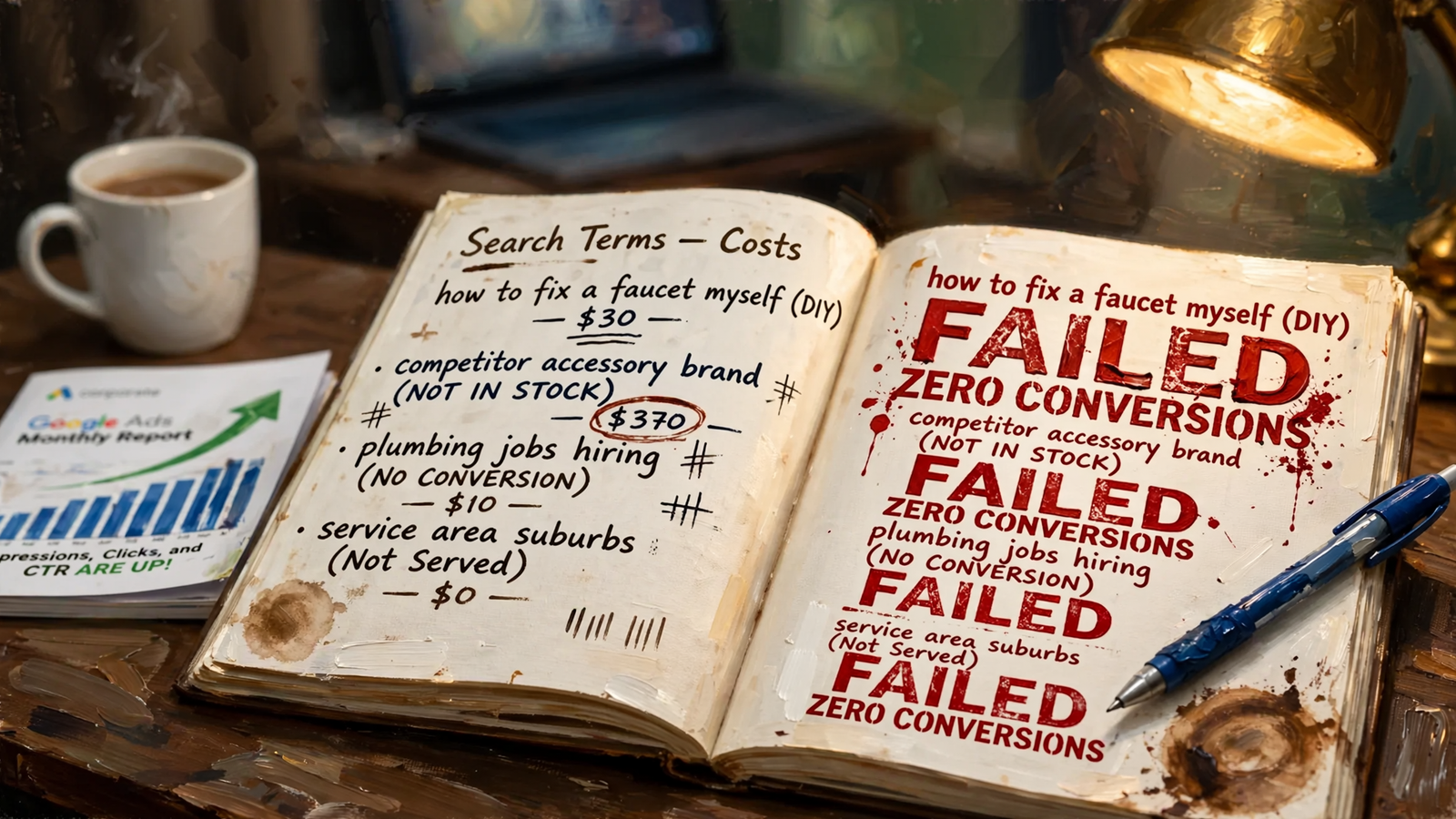
Spending more than target CPA with zero conversions is a review flag, not an automatic conviction. Say the account spends $20k a month against a $100 target CPA. A term at $140 with no conversions deserves scrutiny. That number alone does not establish why it failed.
Confirm the tracking, dates and recent changes. Then decide whether to block a clearly irrelevant term or test a plausible one in isolation. Group confirmed failures by theme and check whether one campaign or broad keyword produces most of them.
For a manual cross-check, use the complete 10-area audit checklist. Fix recurring themes before chasing one-offs.
Test 3: Does the bidding target fit the available data?
Question: Does each campaign have enough useful conversion data to judge its current strategy and target?
Setup: Pull the last 30 and 90 days by campaign: bid strategy, target CPA or ROAS, conversion count and cost.
Prompt to paste:
For each campaign, show bid strategy, target, cost and conversions over the last 30 and 90 days. Flag thin conversion volume, targets that conflict with my economics and campaigns stuck in learning. Separate observed problems from assumptions about their cause.
My expectation is that some apparent bidding failures will turn out to be thin data or an unrealistic target. A campaign producing eight conversions a month gives the audit little evidence for a confident verdict. The strategy name does not solve that problem.
Consider whether thin campaigns should be consolidated or an impossible target loosened. Do not let the assistant turn a conversion-count threshold into a universal law. The point is to test whether the structure and target make sense together, not replace one checklist with another.
The target must fit both the data and the business economics. Google’s Optimization Score is not a substitute for that judgment. A higher score cannot make an unworkable CPA profitable.
Decision rule: if volume is thin, record the finding as uncertain. Review structure and target before blaming the creative or declaring the bidding strategy broken.
Test 4: Do weak assets coincide with weak results?
Question: Which ad groups show creative weaknesses while spend keeps flowing?
Setup: Pull 90 days of impressions, CTR, conversion rate, responsive search ad strength and available asset-level performance labels.
Prompt to paste:
Flag ad groups with one ad, duplicate ads, low-performing assets, missing asset types and Performance Max asset groups with poor ad strength. Show spend, CTR and conversions beside each flag. Distinguish asset labels from evidence of poor business performance.
My expectation is that the audit will find neglected creative: duplicate ads, missing sitelinks or callouts, and headlines that have outlived their usefulness. Those are candidates for a test, not proof of the cause of a high CPA.
Google prioritizes better-performing assets. That does not mean a weak label proves one headline is dragging down the whole ad group. I want the label beside the performance data, not standing in for it.
Use labels to choose what to inspect, not to declare what caused the result. Replace weak headlines and add missing assets where the evidence supports the work. Keep the reason for each edit explicit.
Decision rule: a label alone is not a failed test. A neglected ad group with weak results earns a specific creative hypothesis and a controlled change.
Test 5: Does the landing page keep the ad’s promise?
Question: Does the page deliver what the ad offers, and how does it compare with the pages competitors currently send traffic to?
Setup: Review your top 10 landing pages by spend. Collect each page’s headline, offer, mobile load time and form length, alongside the competitor ads and funnels groas monitors. If a measurement is unavailable, mark it missing rather than asking the assistant to guess.
Prompt to paste:
Compare my top landing pages with the competitor pages in my market. Flag message mismatch, slow mobile loads, missing proof and forms that ask for more than the offer earns. Cite the page evidence for each finding and identify measurements you cannot verify.
My expectation is that this test will find the quiet CPA tax. An ad promises pricing in 30 seconds; the page opens with the company story and hides the form. The click arrives, but the promise does not.
A rival showing a price, three proof points and one button gives the assistant something concrete to compare. It does not prove that copying the page will improve results. Competitor pages are comparison material, not conversion data.

Check message mismatch first, friction second and proof third. A page consuming 20% of spend with half the account’s average conversion rate deserves investigation, even if everyone likes how it looks. That gap is a flag, not a diagnosis.
Decision rule: choose a page change only when the assistant can point to the broken promise or friction it is meant to address. “Make this more modern” is not a hypothesis.
Test 6: Which profitable campaigns are actually budget-capped?
Question: Which good campaigns lose opportunity to budget, and which lose it to rank?
Setup: Pull the last 30 days by campaign: cost, budget, CPA or ROAS, Search lost IS (budget), Search lost IS (rank), CTR and conversion rate.
Prompt to paste:
Split campaigns by Search lost IS (budget) versus Search lost IS (rank). Identify which budget-limited campaigns meet my CPA or ROAS target. Estimate missed clicks and conversions using observed CTR and conversion rate, state the assumptions, and keep those estimates separate from measured results.
My expectation is that a small number of profitable campaigns will deserve a closer look. The distinction matters: lost impression share from budget versus rank describes different constraints. A budget increase addresses the budget constraint; it does not repair Ad Rank.
“Limited by budget” is not a recommendation to spend more. A campaign at $180 CPA against a $100 target does not deserve more money because it ran out of money. It deserves a fix first.

Treat any missed-conversion estimate as a scenario built from current performance, not a promise about the next dollar. Decision rule: only verified, profitable, budget-constrained campaigns reach the scaling shortlist.
Verify the finding before approving the fix
An AI finding is a hypothesis, not a work order. I require four things before it earns a change:
- Evidence: The account rows, dates and conversion actions behind the claim.
- Cause: A proposed mechanism that explains the pattern.
- Impact: The spend or business outcome at stake, with estimates labeled.
- Confidence: What supports the claim and what remains unknown.
Open the flagged item in Google Ads and match the test’s date range. If the assistant says a keyword spent $340 with zero conversions, confirm the cost, the conversion column and the primary action being counted. Then check change history before accepting the diagnosis.
Use this verification checklist:
- Compare purchase reporting with business records for the same dates. Investigate what each total includes rather than assuming equality.
- Check Count and primary status before pausing anything. Conversions sitting in a secondary action can change the interpretation.
- Look for recent bid or budget changes. A CPA spike after a target change needs that context; timing alone does not prove the cause.
- Keep a screenshot of the interface evidence with the finding.
My rule is simple: no verified account evidence, no change.
Apply one approved change with one way back
Keep the assistant read-only until you explicitly approve an action. Once a finding survives verification, make the instruction specific: pause this keyword, add these negatives or move this budget to the profitable campaign.
Through groas, the change lands with its reason attached, is logged for review and can be undone in one step. Autopilot stays off until switched on. Nothing needs to compound while the evidence is still being judged.
I want one change, one reason and one way back. The log is not administrative decoration. It is the control that keeps the audit from becoming a pile of unexplained edits.
Let the result decide the next job
A clean audit earns a decision, not a promise of results. If the CRM never reports qualified pipeline back to Google Ads, Tests 2 through 6 can judge lead volume while missing revenue downstream. If product margins differ, a single account-level ROAS target can misclassify performance.
Read the result accordingly. If all six tests pass and profitable campaigns are genuinely budget-capped, test scaling those campaigns. If the tests pass without that constraint, do not invent a reason to raise spend.
If Test 1 fails, the rest can wait. The job is to make the conversion signal represent the real outcome, then run the protocol again. A checklist gives the account a grade. This audit should tell you what deserves to happen next.


