
YouTube Ads Won’t Get Fewer: Six Calls to Check by 2027
October 1, 2026
•
11
min read



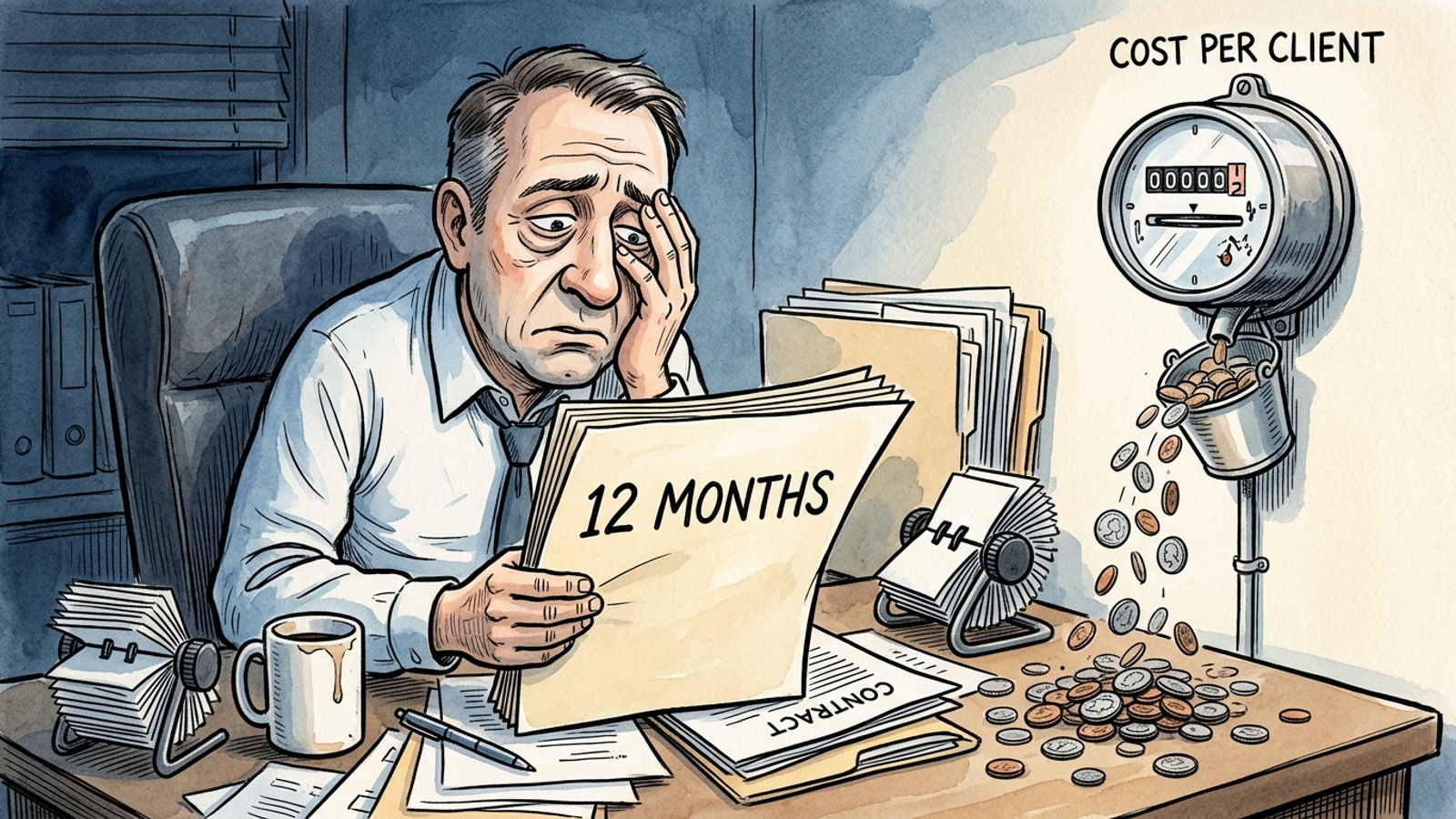
If you are the one who keeps the client roster in your head at 11pm, do not sign a 12-month white-label Google Ads contract until you know how many minutes it removes from each account. If it needs a year to be worth the price, it has not saved your team enough time to earn month-to-month.
Say you have 14 Google Ads clients, one media buyer stretched thin, two more accounts about to close, and a demo still open in a tab. The vendor promised to take fulfillment off your plate. You want to believe it because you can already picture the alternative: another hire, another round of training, another person finding out on Tuesday that a client changed the budget on Monday.
I get the appeal. I used to tell clients that weekly optimizations justified the retainer. I was wrong about how much of that work actually needed a person. But replacing those hours with a platform only helps if the hours leave your payroll, not just the vendor’s presentation. Do the per-client math on your roster before the sales call does it for you.
The demo showed you a build in 20 minutes. Campaigns structured, ad copy drafted, keywords grouped, a branded report with your logo on page one. That speed is real, and it is worth something. It is also the easiest part of fulfillment to show while someone watches.
What the demo did not show you is week three. Search terms have piled up. Two clients changed budgets without telling you. One landing page broke. Someone has to notice, decide what matters, and act in each account. If that someone is still your specialist, the fast build has not solved the problem that made you take the call.
Ask the vendor what happens after launch, when no one on your team opens the account for a week. Does the work continue? Which decisions does the platform make? Which ones come back to your buyer as approvals, alerts, or a cheerful little queue labeled recommended actions? A recommendation your employee must investigate is not a minute saved just because it arrived in a nicer dashboard.
Get the remaining work in minutes per account per week. If the answer is your specialist plus their checklist plus their optimizer tool, you did not buy fulfillment. You bought a faster starting line for the same race.
Total first: an SMB client presented with a $300 to $600 monthly wholesale fee can carry $650 to $1,100 in all-in costs once you count the labor and tools that remain. That is a working estimate, not a universal vendor price. Your number depends on how often your team still touches the account, what your specialist’s time costs, and which tools the vendor replaces rather than stacks on top. Pull last month’s accounts and calculate it yourself.
Here are the line items to put on the sheet. Keep the vendor’s listed charges separate from costs you already carry; otherwise, you will mistake a new invoice for a reduction in work.
| Line item | Figure to check | When you pay it | Source |
|---|---|---|---|
| Wholesale fulfillment | $300–$600 per month for SMB accounts; $700–$1,500 for mid-market | Recurring, per account | ROIMinds benchmark |
| Spend-tier pricing | One menu lists $400 per account up to $3,000 in spend, then $600 from $3,001 to $5,000 | Recurring; the fee rises with the tier | Mavlers example |
| Specialist time | 1–2 hours a week at $75–$125 an hour represents $300–$1,000 a month in labor value | Recurring, if the work stays with your team | PPC rate benchmarks |
| Reporting labor | 3–5 hours a month manually, or 0.5–1 hour with a reporting tool | Recurring, whether assigned to you or the vendor | Swydo reporting data |
| Optimizer tool | About $208 a month on an annual plan, or $249 monthly, for up to 25 accounts | Recurring, if you still need the seat | Optmyzr pricing |
| Onboarding or setup | $500–$3,000 | One-off per setup, when charged separately | Setup benchmark |
The first two rows are prices you may see on a vendor’s menu. Do not add both to the same account: the spend tiers are an example of how a wholesale fee can change, not a second charge on top of it. Volume deals can fall to around $200 per client for large books, but do not build your margin around a rate you have not been offered.
The next three rows are where a cheap-looking quote gets expensive. Specialist time and reporting are not automatically extra invoices. They are work your team may continue doing after you hire the vendor. The optimizer is only an added cost if the new service does not replace it. That is why I would ask which tools you can cancel and which recurring tasks disappear, rather than accept a promise that the platform makes everyone more efficient.
Start with specialist minutes. I used to budget 45 minutes per account per week for checks, search terms, bid tweaks, and client Slack. It sounded lean until I multiplied it across a roster. At 14 accounts, that is 10.5 hours a week of delivery work before reporting or meetings. At $75 to $125 an hour for specialist work, each account carries $225 to $375 a month in labor value at that pace. Your payroll may be structured differently; the time still has to come from somewhere.
Then count reporting. Manual reports can take 3 to 5 hours per client per month, versus 30 to 60 minutes with a tool. Across 10 clients, that gap is 20 to 40 hours a month. If you already have the tool, do not credit the white-label vendor for those saved hours. If the vendor handles reporting, find out whether your team still checks figures, rewrites explanations, and fields the client questions afterward. Report generated and reporting work gone are different claims.
Finally, keep setup out of the monthly column. A $500 to $3,000 setup fee may sit alongside management charges, and the draft timeline you are evaluating runs one to three weeks to the first live ad. Ask whether the fee applies to every new account. If it does, replacing a departing client means paying it again. Separate one-off charges from recurring work, then price the work that stays.
Now try the math on a slice of your roster. Say you charge $2,500 per client. At 10 clients on a $500 average wholesale fee, you pay $5,000 in wholesale charges, roughly $3,000 for 30 hours of specialist time, and $250 in tools: about $8,250 against $25,000 in retainers. That is before you decide what reporting, revisions, and the rest of your overhead consume. The loaded-cost approach counts provider fees, tool allocation, account-management time, reporting and revisions, processing, and extras. Use your own figures in those columns.
There may still be a good margin. A $700 wholesale fee can look attractive beside an in-house model carrying $1,200 in labor and $400 in overhead per account. But the comparison fails if your buyer keeps doing the same weekly work on top of the wholesale fee. At 25 clients, a $500 fee alone is $12,500 a month. If each account also needs 60 to 90 minutes a week from your team, you are buying another capacity problem as you grow.
A platform that genuinely removes weekly specialist touches has a reason to let you pay month-to-month: the work stays off your team’s desk, so you have a reason to stay. A 12-month term with a kill fee tells me to look harder at the minutes, not merely at the legal wording. Long lock-ins and early termination fees are flagged as agency red flags; a three-month initial term rolling to month-to-month is offered as an alternative.
Ask for month-to-month on the next call. If the per-account price changes, put the new number in your sheet. If the onboarding fee changes, put that in too. The point is not to win a negotiation by saying flexibility a lot. It is to see whether the service still makes sense when you are free to leave after a month.
A year-long discount cannot pay you back for weekly labor the platform never removed. If a vendor needs the contract to make the deal appealing, ask why the account work alone will not keep you there.

You do not need a 40-point RFP. You need answers in writing that you can enter against your own clients. Ask the same questions for a small account and a growing one. That keeps the conversation on delivery and margin instead of another tour of the report template.
If the rep cannot give you minutes per account, they are asking you to buy software while calling it fulfillment. That may be useful software. It is not the same promise.

If the answers show a flat per-account fee that holds as spend grows, no required weekly work from your team, month-to-month terms, reports under your brand, and no client contact, sign on those terms. You are looking for bids, budgets, search terms, ads, and landing pages to keep moving without a ticket assigned to your buyer, with actions logged and a named strategist answerable for the outcome. Then adding client 15 or client 25 does not require the same increase in specialist hours. That is the build-or-buy math behind agency margin at scale.
If the vendor cannot give you those answers, do not sign a year to “get the better rate.” I used to talk myself into annual deals for the discount and then keep paying in labor each month. Park the contract. Run a three-account trial for 30 days instead, and measure two things: minutes your team touches each account per week, and CPA or ROAS against the prior 30 days. Keep the team’s client-facing work separate from the account work the vendor said it would absorb. A web design agency that added Google Ads without hiring a specialist kept its team client-facing while the engine carried delivery. That is the distinction you are testing, not the polish of the weekly email.
This is the bar I use now. groas runs white-label delivery under your name: one connection per client, then bids, budgets, ads, and landing pages move continuously; actions are logged with their reasoning, weekly reports carry your brand, and there is no client-facing contact. Because the engine carries the weekly account work, another client does not add the same hours to your buyer’s calendar. Because the fee is flat per account, growing spend does not reprice that client’s margin. Those are the claims to put against your own roster, not reasons to skip the trial.
Keep the sheet when the call ends. The cheapest mistake is paying setup twice. The most expensive is signing a year-long contract while every new logo still brings more weekly tickets.
Alexander