
The AEO Retainer Swipe File: Tiers, Scope Clauses and Client Scripts
October 6, 2026
•
11
min read



One strategist, zero developers, five client domains, 30 days. If your AEO launch needs a dev ticket before it can change a page, you do not have a launch plan. You have a visibility report waiting in someone else’s queue.
Most agencies launch AEO backwards. They sell the audit, show the client where they are invisible in ChatGPT and AI Overviews, then stall because every fix needs CMS access, a developer, or a content writer they have not hired. I used to run that version. I sent the PDF, waited for approvals, and watched the tracking chart sit flat while the client asked what they were paying for.
Under this constraint, the order flips: execution infrastructure first, baseline second, report last. All five domains should show a shipped change before the first client report leaves your inbox. Here is the sequence, what each step costs in strategist hours, and what gets cut on purpose.
The seven steps below add up to 28 strategist hours across five domains. No dev tickets. No freelance writers. No new tool stack that takes two weeks to learn. This only works if the strategist can get edge deployment access and a working route into each client CMS for approved content. If either remains stuck with a developer, that client does not enter the first cohort.
Three cuts follow from that budget:
Cost: 4 hours. Buys: a cohort that can ship. Choose clients whose domains are already on Cloudflare with Workers enabled, or whose owner can give you the needed access promptly. Confirm the CMS publishing route, too. A DNS login solves the edge work; it does not publish an answer block into WordPress or Webflow.
Favour one domain per brand, a service page that already ranks somewhere, and an owner who answers email within a day. Leave regulated clients who require legal review on every word, and franchise or corporate-owned domains where you will never get DNS access, for a later cohort. They may be profitable clients. They will kill this 30-day launch.
The week-one cut list is blunt:
The test is access, not enthusiasm. A client can love the pitch and still be the wrong client for this month.
Cost: 3 hours plus a roughly $5/month Workers Paid plan. Buys: a route to ship recurring technical fixes without waiting on a developer. With the domain on Cloudflare and Workers enabled, the strategist can deploy schema and metadata fixes at the edge, keep a changelog, and roll back individual rules. That is what an edge proxy lets an agency ship without origin-CMS access. A self-contained Workers approach covers redirect maps, canonical rewrites, robots overrides, schema injection, and bot logging. I show that to owners who assume every metadata change needs a sprint.

I used to tell clients we would file the tickets and follow up weekly. I was wrong. That queue is where AEO retainers go to die: the audit looks finished while nothing on the site changes.
Start by checking the edge layer without changing live responses. Then scope each rule to the URLs it should touch, check what users and crawlers receive, and keep rollback available. Never serve Googlebot different content from users; cloaking rules apply to edge-served content. Deeper structural changes still need CMS access later. Ongoing edge fixes do not require a WordPress login, so the CMS does not have to be the critical path for this part of the work.
If a domain cannot get onto the edge path by Friday, swap it out. Do not spend the rest of the month explaining its status.
Cost: 5 hours across all five clients. Buys: a before picture you can compare with later runs. Pick 20 to 30 buyer prompts per client across ChatGPT, Gemini, Perplexity, Claude, and Copilot. Sort them by intent: best, cost, near me, versus, and problems. Do not turn this into a 100-prompt research project.
Run prompts more than once because identical prompts can return different sources. For each one, record the prompt, whether the client was cited, and who was cited instead. Use those entries to calculate Citation Rate. Keep the raw responses behind the number; a single percentage with no cited sources is decoration.
Pair the prompt sheet with available search and AI visibility reporting and a GA4 channel for AI Search Referrals. That gives referrals a place outside the prompt tracker without pretending every discovery will arrive as a measurable click. Freeze this prompt set before you start judging progress. If you keep swapping questions, you are changing the test along with the site.
Cost: 4 hours. Buys: a changed URL for every client before content week. Use the edge layer to add LocalBusiness schema where it fits and FAQPage schema where the questions and answers appear on the page. Clean up duplicate titles and descriptions, set canonicals on relevant filtered or paginated URLs, and fix robots rules where they need correction. Record each rule and the URLs it affects.
Cap the sweep at five fix types per domain. That is a ceiling, not a quota to fill with unnecessary changes. Check the rendered result and keep the rollback log. Define the pages and templates covered, along with how you verified the work; otherwise you risk selling a report instead of a fix.
Navigation rebuilds, new templates, and other structural work wait for CMS access in month two. The technical sweep is done when you can point to shipped URLs for all five clients, not when a dashboard score moves.
Content week is where the one-strategist constraint bites. You do not commission articles. You prepare short answer blocks, send them through the agreed CMS publishing route with a client approval step, and spend the remaining human time on third-party presence.
Cost: 5 hours total. Buys: useful, citable copy on client pages without a writer. Add a short factual block beneath existing service copy: what it costs, who it fits, and what to ask before buying. Where the page shows questions and answers, match the visible copy with FAQPage schema through the edge layer.
Give the client a preview link and a simple approval request by email or Slack. After approval, publish through the CMS route you secured in week one. A block awaiting approval is not live. Keep it on the pending list rather than counting it as shipped work.
Cap the work at five pages per client in week three. Anything needing original photography, case numbers, or legal sign-off waits for month two. That cap is the difference between working across five domains and spending Friday debating one paragraph on one domain. If a client does not approve in time, the edge fixes still give you a shipped change to report; do not manufacture a content win.
Cost: 4 hours total. Buys: citation opportunities beyond the client’s own site. Start with existing roundups, comparisons, reviews, and profiles before writing another on-site post. Third-party sources account for a large share of the citations described in this AEO analysis. Another finding in that analysis puts listicles, comparisons, and reviews at the centre of those third-party citations. That is a reason to inspect existing category pages, not a promise that outreach will earn a citation this month.
Build a list of 20 to 30 relevant category publications per client, then prioritise the ones that already appear in your prompt baseline. The same analysis argues that a relatively small set of outlets drives many brand citations and that brand mentions matter even without a backlink. Use that to choose targets, not to claim an outcome you have not earned.
With four hours across five clients, triage beats mass outreach. Update listings you control, claim relevant profiles, and pitch corrections to roundups that omit or misdescribe a client. Log each move. Do not count a pitch as a published mention.
Cost: 3 hours across all five clients. Buys: a conversation about work done and work next, rather than a defence of a tracking fee. Give each client four blocks:
Show raw queries and cited sources, not just a proprietary score. Judge monthly trends rather than daily drops, because the answers can vary from one run to the next. Leave out guaranteed citation promises and vague claims of “full optimisation” with no page count. I learned that last one the hard way when a client asked which pages the fee covered and I had no answer.
By day 30, each client should have an edge layer with a rollback log, a bounded technical sweep with changed URLs, and a 20-to-30-prompt baseline. List answer blocks as live only when approved and published; show pending ones separately. Do the same for citation moves: completed listing updates are work shipped, while pitches remain in motion. If the report cannot point to a URL that changed, you sold tracking. Tracking alone does not retain.
Price the repeatable service as a flat fee per domain or the math eats you by month two. Monitoring tools can run $29 to $489 a month depending on prompts and engines. The same breakdown lists Profound Starter at $99 for ChatGPT-only tracking and Growth at $399 for multiple engines, alongside a mid-range done-for-you option near $1,497 a month covering schema and three to five pages.
I would sell cohort one as a $1,500 add-on to existing SEO and state the scope plainly: edge deployment, up to five relevant fix types, up to five answer blocks, and citation outreach. Account for the Workers plan and tracker seat before promising margin. No mystery score. No pretending an unapproved page is part of the live deliverable.
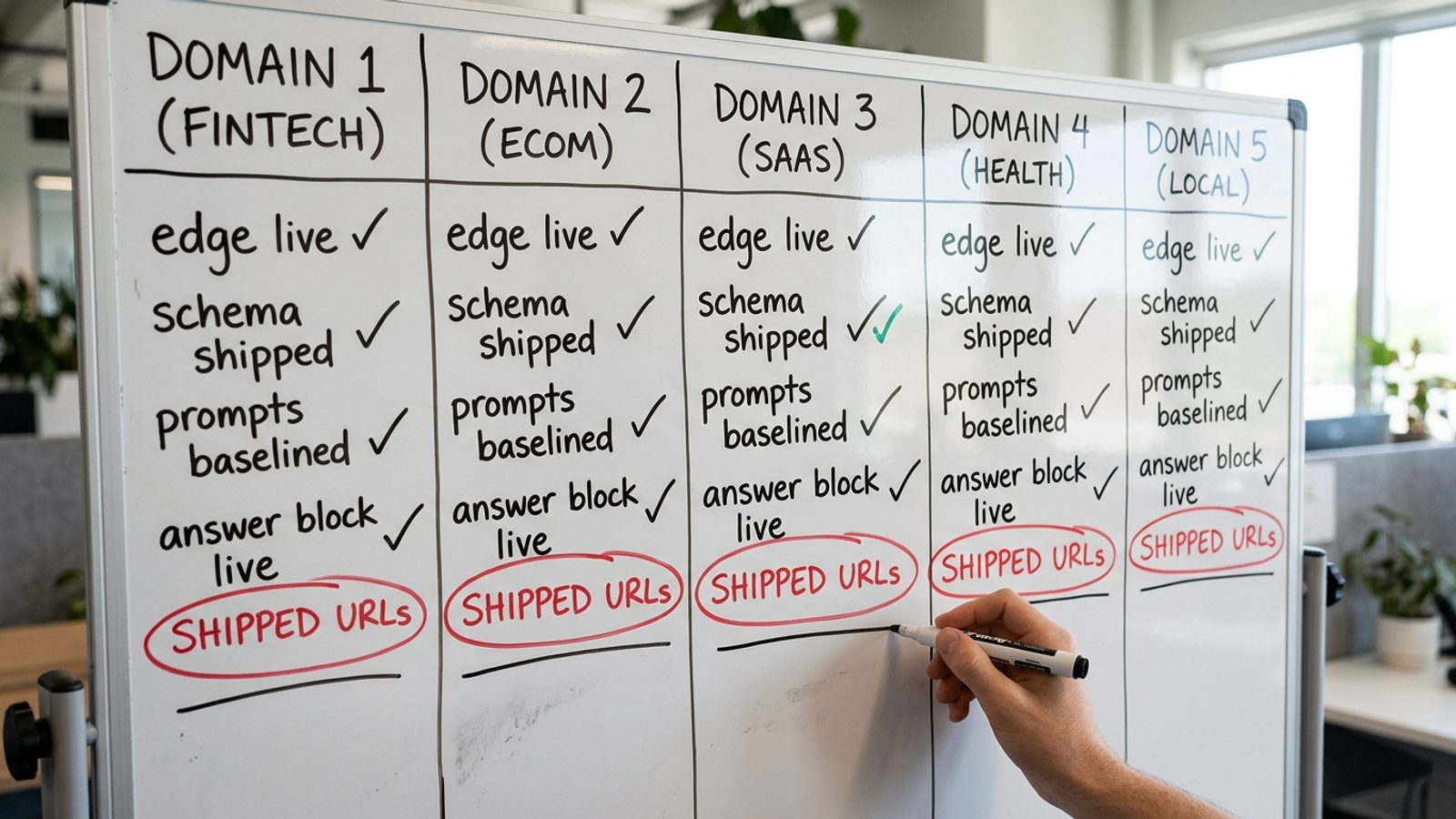
At domain six, the strategist runs out of Thursdays. Approval follow-ups pile up, citation outreach slips, and an edge changelog nobody reviewed starts to feel risky. Stop adding domains until execution capacity catches up. Keep the prompt set, fix categories, answer-block template, approval status, and action log consistent so another execution layer can pick up the work without turning every client into a custom project.
That is the setup groas for agencies is built for: connect-once access, continuous execution, and branded weekly reports listing actions taken while the strategist remains client-facing. Prepare for it in week four, while the cohort is still small. Standard work scales. Custom work does not.
When developer access and writer hours arrive, keep the order and widen the work: deeper site changes, more pages, larger citation campaigns, and day-60 and day-90 trend reads against the week-two baseline. Do not use the extra capacity to go back to selling screenshots first. Ship the change, measure what follows, then send the report.
La secuencia recomendada es infraestructura de ejecución primero, línea base después e informe al final. Los cinco dominios deben mostrar al menos un cambio publicado antes de enviar el primer informe al cliente. Si un lanzamiento depende de un ticket de desarrollo para poder cambiar una página, no es un plan de lanzamiento sino un informe de visibilidad esperando en la cola de otra persona.
Los siete pasos del plan suman unas 28 horas de estratega repartidas en cinco dominios. El presupuesto no incluye tickets de desarrollo, redactores freelance ni una nueva pila de herramientas. Solo funciona si el estratega consigue acceso de despliegue en el edge y una vía de publicación en el CMS de cada cliente antes de empezar.
Conviene elegir clientes cuyo dominio ya esté en Cloudflare con Workers habilitado, o cuyo propietario pueda dar acceso rápidamente, además de una vía de publicación confirmada en el CMS. Se favorece un dominio por marca, una página de servicio que ya posicione en alguna parte y un propietario que responda en un día. Los clientes regulados con revisión legal de cada palabra o los dominios franquicia deben dejarse para una cohorte posterior.
Sí. Con el dominio en Cloudflare y Workers habilitado, el estratega puede desplegar arreglos de schema y metadata en el edge, mantener un registro de cambios y revertir reglas individuales, sin esperar a un desarrollador ni tener acceso al CMS de origen. Los cambios estructurales más profundos sí requieren acceso al CMS más adelante, y nunca se debe servir a Googlebot contenido distinto del que reciben los usuarios, porque las reglas de cloaking también aplican al contenido servido en el edge.
Se eligen entre 20 y 30 prompts de compra por cliente y se congelan antes de empezar a juzgar el progreso. Cada prompt se ejecuta más de una vez, porque prompts idénticos pueden devolver fuentes distintas, y se registra si el cliente fue citado y quién fue citado en su lugar. Con esas entradas se calcula la tasa de citas (Citation Rate), conservando siempre las respuestas crudas detrás del porcentaje.
El barrido técnico se limita a cinco tipos de arreglos por dominio, un techo y no una cuota, y la semana de contenido se limita a cinco páginas de bloques de respuesta por cliente. Todo lo que requiera fotografía original, números de caso o aprobación legal espera al mes dos. Un bloque de contenido pendiente de aprobación no cuenta como trabajo publicado.
Se empieza por las fuentes de terceros existentes: rondeos o listas de recomendaciones, comparativas, reseñas y perfiles, antes de escribir otro post en el sitio propio. Las fuentes de terceros concentran gran parte de las citas en AEO, y un conjunto relativamente pequeño de medios impulsa muchas menciones de marca. Con solo cuatro horas repartidas en cinco clientes, se priorizan las publicaciones que ya aparecen en la línea base de prompts, se actualizan listados controlados y se corrigen comparativas, registrando cada movimiento.
El informe de una página incluye cuatro bloques: URLs cambiadas con el registro de reversión del edge, la línea base con tasa de citas y prompts crudos, la lista de trabajos a publicar el próximo mes y una petición concreta al cliente, como una aprobación o acceso pendiente. Se muestran consultas crudas y fuentes citadas, no solo una puntuación propietaria, y se listan como publicados únicamente los bloques aprobados y enviados.