

 LinkedIn

A cheap Google Ads audit should give you three repairs you can defend, not an 82 out of 100. Most people make the mistake of asking ChatGPT to find wasted spend before checking whether the conversion numbers mean anything.
I used to send versions of those score-heavy reports myself. They look thorough. They rarely tell you which changes are safe to make this week.
On a tight budget, the deliverable is a repair order, not a grade. Say you spend $8k a month. The audit below starts with measurement, works through the account with exports or live access, and ends with three fixes ranked by evidence, spend exposed and implementation effort. No campaign rebuild required.
1. How do I get ChatGPT into the account cheaply?
There are two routes:
- Manual exports: Export reports from Google Ads and upload or paste them into ChatGPT. This costs nothing extra for the account connection.
- Live access: Connect groas over MCP for $19 a month flat, with unlimited teammates, ad accounts and websites. That buys live account access and requested changes; your paid ChatGPT plan is separate.
Custom MCP servers require a paid ChatGPT plan, with Plus, Pro, Business, Enterprise and Edu listed as eligible in Teamwork’s setup walkthrough.
Exports are fine for narrow questions: search terms by spend over the last 30 days, a conversion action list, campaign settings. The limitation is follow-up. ChatGPT can inspect the history you supply, but a question that needs different or fresher data sends you back for another export.
A live connection lets it interrogate the account instead of waiting for another spreadsheet. Still, I would skip that connection if monthly spend is under $2k and stable. Manual review takes an hour; a live pipe can be overkill. Above that, repeated exports get expensive in your time fast.
Pick the route that can answer the question, then stop shopping for tools.
2. What should I tell ChatGPT before the audit starts?
Free graders like LocaliQ assess a connected account against 10 metrics, including Quality Score, impression share and wasted spend, then return a score and action steps. That gives you a broad overview. It does not establish a repair order.
I start with a less impressive prompt:
Confirm the account, currency, reporting dates and available data. Audit only; make no changes.
If ChatGPT cannot name those four back to you, stop. Anything after that risks becoming fiction with formatting.
Then set the evidence standard:
No generic checklist or unsupported score. Every finding needs a campaign name, a date range and a number I can check in Google Ads. Separate missing evidence from confirmed problems.
With exports, identify exactly which reports you supplied. With groas over MCP, keep the session audit-only until you approve a specific change. Account access is not permission to start tidying things up.
The first job is to establish what ChatGPT knows, not how confidently it can write.
3. Can I trust the conversion numbers?
Ask ChatGPT to list every conversion action, its status, when it last recorded a conversion, and relevant changes in the last 30 days. If the supplied data cannot answer something, it should say so.
I look for three failures:
- Nothing firing: Recorded conversions disappear or an expected action has no recent activity.
- Everything firing: Duplicate or low-value actions inflate the apparent results.
- The wrong thing driving bids: An action such as a pageview is treated as the outcome the campaign should pursue.
This comes first because Smart Bidding strategies such as Maximize Conversions, tCPA and tROAS optimize toward the outcomes you specify. Give bidding the wrong signal and the later waste analysis starts from the wrong answer.
Check which primary conversion actions belong to the goals used for bidding. Do not assume everything in All conversions is something you want the campaign to pursue.
Then compare Google Ads conversions with your shop or CRM for the same period. If orders hold while ad conversions fall overnight, investigate measurement before blaming performance. An attribution gap alone does not prove tracking is broken.
Account data also cannot establish whether your thank-you page, consent banner or tag installation works correctly. Those belong on a website-check list, not a list of account edits ChatGPT claims it has already verified.
Do not rank performance fixes while the measurement they depend on is unresolved.
4. Which search terms deserve a cut?
Start with search terms sorted by spend, highest first, over the last 30 days. Search terms are what people typed; keywords are what you bid on. Look for patterns, not individual clicks that offend you.
Ask ChatGPT for a table with:
- Search term.
- Spend and clicks.
- Recorded conversions.
- Evidence of irrelevant intent.
- What remains uncertain.
Before it proposes exclusions, make it check the conversion column and the reporting window. A $140 term with zero conversions over seven days is not established waste if the sales cycle runs 21 days.
I used to tell clients to negative everything without a conversion in 30 days. I was wrong. On low-volume accounts, that rule can starve the exact terms Smart Bidding needs to learn from.
WordStream’s grader writeup connects wasted spend with missing negatives, weak relevance and neglected accounts. That is a useful starting point, not permission to label every nonconverting query a mistake. Google hides some queries for privacy, so the visible report is not the whole account either.
For clear irrelevance, ask for the exact negative strings and where to add them: ad group for routing, campaign or shared list for true waste. Remember that negative keywords do not expand to close variants like positive keywords do: blocking “job” does not block “jobs.”
Spend without proof of irrelevance is a question, not a cut.
5. Did a setting or recent change move the money?
Ask ChatGPT to put targeting, budgets, bid strategy and changes from the last 30 days beside performance for the same dates.
The point is to connect a finding to money, not assemble a museum of settings you dislike. Look for:
- Location targeting that exposes spend outside the intended market.
- A budget cap throttling the campaign that converts.
- A bid strategy switch just before performance drops.
Timing gives you something to investigate; it is not proof by itself. Make ChatGPT explain what changed, which campaign it affected and how much spend sits behind the concern.
Do not let it flag broad match or automated bidding as wrong on principle. On a small account, those approaches are often how you get volume. The repair may be guardrails and negatives, not nostalgia for exact match.
A setting belongs in the repair queue only when the evidence connects it to money.
6. Do the ad and landing page promise the same thing?
Ask ChatGPT to compare the ad’s offer, price claim and call to action with the destination content it can actually open. I want quotes on both sides, not polished summaries.
If the ad says “free quote in 24 hours” and the page says “contact us for pricing,” there is a mismatch worth investigating. Record the ad group and the spend behind it.
Be equally strict about what ChatGPT cannot see. A login-walled page, a broken redirect or a form that loads only after consent should be marked inaccessible to the audit, not automatically declared a failed customer experience. Ask what it tried to open and what it actually read.
A mismatch is not proof of a conversion problem. It is a suspect with motive. I keep it on the list, but I do not rewrite the page while measurement is still broken. That produces a better story and the same blind bidding.
Match the message after you trust the meter.

7. How do I turn the findings into three ranked fixes?
This is where the audit either becomes useful or turns into another document nobody opens.
Give ChatGPT this instruction:
Return up to three fixes, ranked by evidence, spend exposed and implementation effort. Put measurement repairs first. For each fix, show the evidence, spend exposed, uncertainty, effort and exact proposed change. Put unresolved questions in a separate list. Do not invent fixes to fill the queue.
Those fields have specific jobs:
| Field | What I expect |
|---|---|
| Evidence | A named campaign or entity, reporting dates and numbers I can check. |
| Spend exposed | Dollars touched by the problem over the last 30 days, not promised savings. |
| Uncertainty | What could make the finding wrong or what still needs checking. |
| Effort | Five minutes in the interface or a developer ticket. |
| Exact change | What gets changed, where, and what stays untouched. |
If ChatGPT cannot fill those fields, it has a question, not an approval-ready repair. The full audit checklist is useful background reading. Your deliverable is the short queue.
The usual order is:
- Repair measurement. A duplicate purchase event or a primary pageview used for bidding can corrupt the CPA you use to judge everything else.
- Remove clear waste. Prioritize terms with real spend, no recorded outcomes after the conversion-lag window, and no plausible buyer intent.
- Make one supported targeting, budget or message repair. Pick the finding with evidence and meaningful spend behind it.
That is a ranking principle, not a requirement to find one problem in every category. If tracking remains unresolved, the next step may be a website check rather than another account edit.
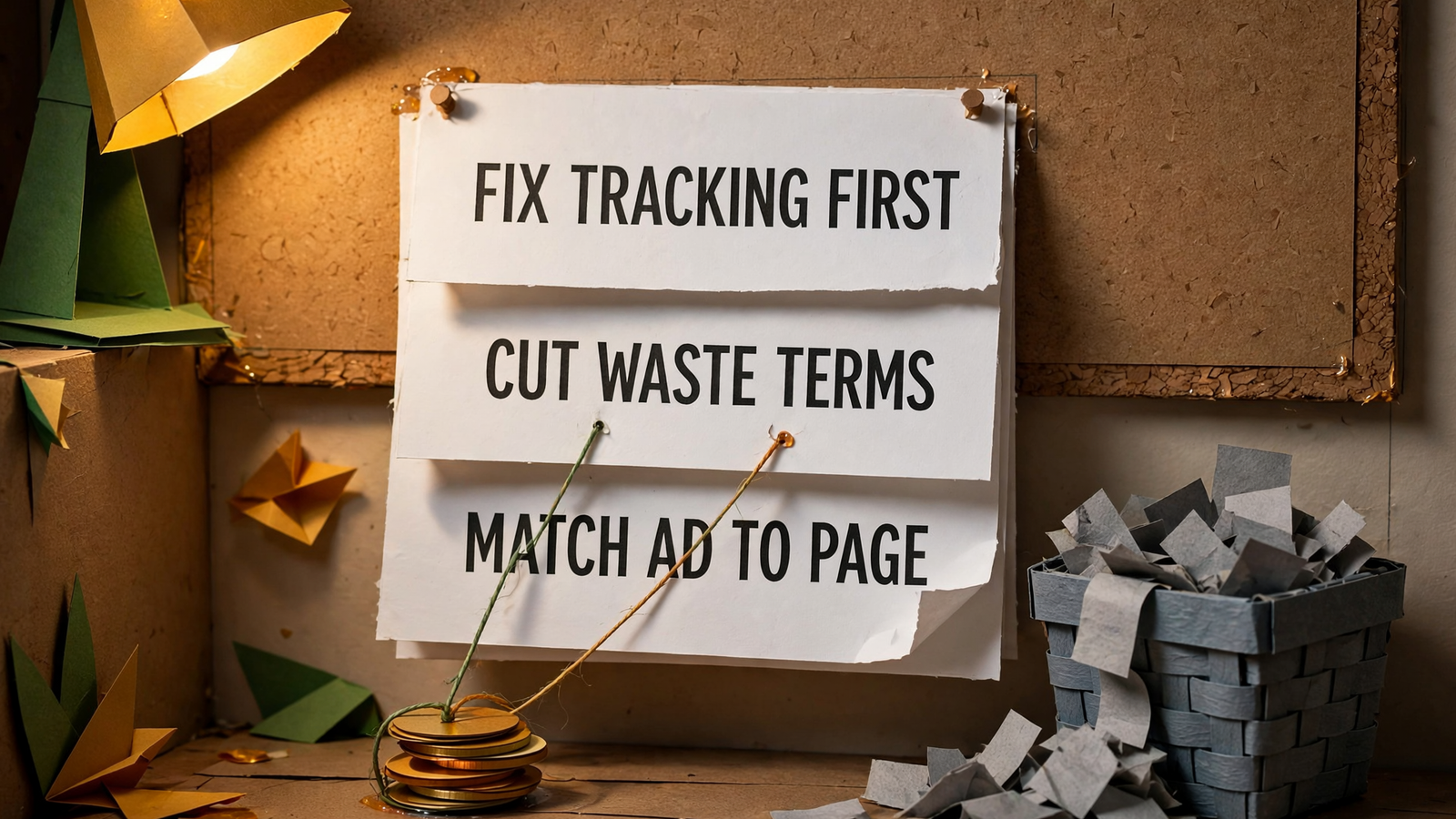
Three repairs you can approve beat thirty recommendations you will ignore.
8. What exactly am I approving?
Before authorizing anything through groas, make ChatGPT read back the entity, scope and limit of the change:
- Campaign and ad group names.
- Exact keyword or setting being changed.
- Where the change applies.
- What stays untouched.
No bundled edits. No silent expansion to similar terms. “Add these negatives to this campaign” is an instruction. “Clean up waste across the account” is an invitation to improvise.
I approve one repair at a time, starting with measurement. A bad negative can be undone in seconds; a bad conversion change can poison bidding for weeks. Every groas change is logged with its reason, and an approved change can be reversed in one step. If the log shows the edit itself was wrong, undo it first and argue about the theory later.
Approve the exact change, not the general intention.
9. How will I know whether the repair worked?
Set a review window that respects the sales cycle, then stop auditing. If conversions lag 14 days, a three-day check proves nothing. Give it 14 to 21 days, compare the same conversion actions, and inspect spend on the fixed terms rather than account CPA alone.
Do not promise yourself recovered spend. Say you identify $600 in 30-day spend behind irrelevant terms. The defensible claim is that $600 was exposed to that pattern, which the repair addresses. It is not $600 saved.
Make the follow-up answer three questions:
- Did the approved change happen as specified?
- Did the problem it targeted stop or change?
- Has enough time passed to judge the recorded outcomes?
An audit earns trust when the next numbers can prove it wrong.
What should I skip—and do first today?
Skip the campaign rebuild this week. Do not chase Quality Score from 7 to 10 or add twenty keywords ChatGPT suggests from memory. Those projects burn hours and can reset learning without a proven return. Structure can wait while measurement is unresolved and clear waste remains.
Today, open ChatGPT with your exports loaded or groas connected. If you choose live access, budget $19 for groas plus your ChatGPT plan; groas has no free tier.
Paste this first:
Confirm the account, currency, reporting dates and available data. Audit only; make no changes.
Then ask for conversion actions, their status and their last conversion date. Start by deciding whether the numbers deserve your trust. Only then ask ChatGPT where the money is leaking, and stop when you have a short repair order you can defend.


