

 LinkedIn
More changes are the wrong reason to buy an AI ad tool before Black Friday. If it executes an obsolete pause rule faster, you have bought a faster way to throttle your winners.
Take an ordinary rule: if cost per acquisition runs 30% over target for three days, pause the ad group and move the budget. It looks disciplined in July. In late November, auction prices spike and conversions arrive late. The same rule can mistake unfinished reporting for failure. The instruction still works. The assumption behind it has expired.
Buyers shopping for the best AI ad management tools that work with ChatGPT tend to start with one question: does it actually change the account, or just write recommendations? I understand the impatience. A handsome report that leaves all the clicking to me is a backseat driver with better typography.
But execution is table stakes, not judgment. Windsor.ai lists 36 Google Ads actions inside ChatGPT, 35 of them writes such as pausing, budgets and bids, while noting that ChatGPT only runs a write when asked and cannot watch and react on its own. That action count does not answer the buying question. Neither does a promise to run everything unattended.
I want an assistant that can read the account, examine the rule I supply and recommend parking it. Anything that cannot challenge the instruction is just a faster yes.
Three kinds of execution—and one dangerous assumption
Three different mechanisms get sold under the same label:
- Auction bidding: Google’s Smart Bidding adjusts bids against a target.
- External account rules: logic such as an Optmyzr-style Rule Engine instruction that pauses ad groups when CPA rises.
- Account autopilot: something like groas autopilot, which runs around the clock under rules I set, with every change logged and undoable in one step.
These are not interchangeable. An external pause rule can overrule the opportunity that auction bidding is trying to capture. And putting that instruction inside an autopilot does not make its assumptions any better. Control over execution matters only if I also challenge what gets executed.
Here is the failure in plain English. CPA spikes on Thursday. The rule pauses the ad group on Friday. Conversions from earlier clicks report on Monday, after weekend buyers check out. By then, the account has already stopped buying traffic from the ad group.
Auction inflation and conversion lag can make performance look worse before the full result arrives. The pause can turn that temporary picture into a real revenue miss.
That is my buying test: can the assistant identify when the evidence no longer supports the instruction? Counting writes tells me nothing about that.
A holiday CPA spike is not a verdict
The ordinary pause rule treats a CPA spike as evidence that something broke. During Black Friday, higher click prices and delayed conversions can produce the same signal without the same underlying problem.
The holiday guide recommending automated pausing also supplies reasons to question it. Triple Whale data cited there shows Google CPCs rising 22.22% month over month through the mid-November to mid-December window, reaching $1.87 in Pet Supplies. Reported CPAs range from about $13 in Toys to more than $21 in Sporting Goods. Orders bunch into two windows: 10 a.m. to 2 p.m. on Black Friday and 8 to 10 p.m. on Cyber Monday.
A flat threshold does not explain any of that. It sees a number above a line and reaches for the switch.
The question is not whether CPA is high. It is whether the comparison is fair and the conversions are sufficiently reported. Without those checks, “pause losers” is an instruction to label campaigns before the evidence is in.
The three-year Optmyzr study is another reason not to equate intervention with improvement. Across roughly 6,000 accounts a year from 2022 to 2024, accounts using seasonality adjustments saw CPCs rise about 34%, versus about 17% for accounts without them. In 2024, ROAS rose 5.7% for the no-adjustment group and fell 15.7% for the adjusted group, although adjusted accounts grew revenue faster.
That is not a test of pause rules, and it does not establish that the adjustments caused the difference. It does show why “we intervened more” is not a performance argument. More revenue and better efficiency are not the same result.
Before I approve an intervention, I want the objective and the tradeoff written down. Activity is not an objective.
Give ChatGPT the rule—not just the performance report
The prompt I want before Black Friday is not “pause losers.” It is:
Read these rule definitions and live results. State the assumption behind each proposed pause. Check matched periods and conversion lag, then recommend whether to retain, change or suspend the rule. Do not execute changes yet.
Then I supply the rule text. ChatGPT with groas can read live performance once the accounts are connected. It does not magically discover an Optmyzr Rule Engine setup or the spreadsheet logic a freelancer left behind.
For every rule, I provide:
- Threshold: the result that triggers it, such as CPA 30% above target.
- Lookback window: how much performance it evaluates.
- Action: exactly what it pauses or changes.
- Scope: which campaigns or ad groups it covers.
Without those details, I am asking the model to guess the policy it is supposed to audit.
That distinction matters when comparing AI tools that actually make changes in ad accounts, not just recommendations. A write-capable assistant can carry out the pause. The stronger test is whether it can explain why the pause may be premature.
I ask for matched periods: the same weekdays last year or the last non-holiday spike, not last Tuesday versus Black Friday week. I also require a conversion-delay check. Google attributes conversions to the click date rather than the purchase date, with most arriving within days and the tail stretching for two weeks. Recent click dates can therefore look worse until more conversions report.
Google’s own guidance reinforces the distinction between a change and its consequences. Product manager Tal Akabas says changing tCPA, tROAS or budgets on a steady campaign does not trigger Learning status or erase history, although performance can still shift. The same guidance says to skip seasonality adjustments for standard BFCM spikes because year-over-year models already anticipate them, reserving adjustments for surprises such as an off-cycle flash sale.
My instruction is simple: challenge the ordinary rule before applying it to an extraordinary week. Make the assistant show its reasoning before it touches the account.
Replace automatic punishment with explicit exceptions
The fix I want is a policy, not another pause. Before the holiday, each ordinary CPA rule gets one of three proposed outcomes:
- Suspend it for the holiday week. The ordinary trigger no longer governs that period.
- Raise it to an approved holiday threshold. The rule stays active, but its trigger changes deliberately.
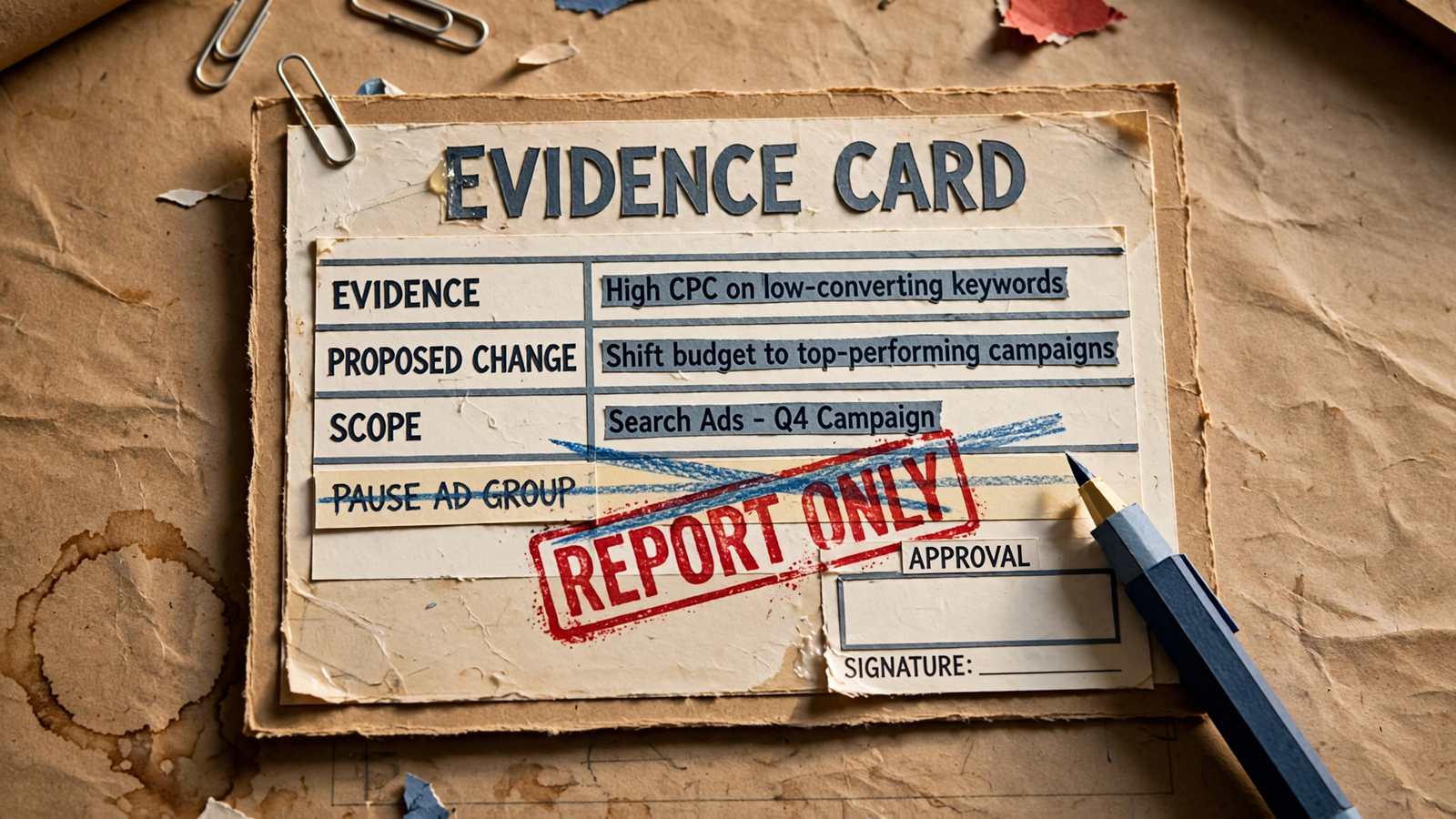
- Switch it to report-only. It flags performance for review without changing the account.
That last option looks unimpressive in a demo. No settings move. No activity counter spins. It is also the option that lets me see a spike without immediately punishing it.
Report-only separates detection from permission to act. It does not require pretending that every expensive ad group is healthy. It requires investigating before a threshold makes the decision.
Supermetrics makes the same operational point: a campaign can appear above target CPA because conversions have not reported yet, so investigate before pausing. The report identifies what needs attention. The review decides whether the problem is delayed reporting, expensive traffic or a genuinely failing ad group.
There is a cost. Someone still has to review the flags and approve the exceptions. Report-only does not remove the decision; it refuses to disguise that decision as arithmetic.
That is work worth keeping. I am buying relief from repetitive execution, not an excuse to stop thinking during the most volatile week on the calendar.
Freeze the structure, not the rescue work
Restraint does not mean leaving a broken account alone. I would freeze bid strategies, conversion goals and campaign structure from about November 19, while keeping necessary fixes available. Smart Bidding Learning can run up to seven days; budget changes do not themselves trigger it.
That is the freeze logic in the pre-Black Friday checklist: stop structural edits, not inventory, disapproval and budget fixes.
In the final 48 hours, I want the account to become more boring, not more active. The intervention list stays concrete:
- Fix a broken feed.
- Unblock a disapproved ad.
- Raise a cap on a proven winner.
- Pull budget from a product that has sold out.
Preserve necessary interventions without treating every CPA spike as permission to act. Rebuilding the account on Thursday night and hoping the algorithm forgives it by Saturday is not holiday preparation.
I also reject any assistant that claims it can repair feeds or external rules without access to the systems that own them. Without the feed connection, account access and appropriate tool, it cannot execute that fix. It can flag the break, draft a correction and wait for approval.
That honesty is a buying signal. A tool should know where its hands stop.

Demand a decision brief, not an action count
If I were defending this purchase upstairs, I would show a four-part brief for every proposed intervention:
- Evidence: matched periods, with conversion lag accounted for.
- Proposed change: the exact ad group, budget or bid adjustment, not “optimise campaigns.”
- Scope: the accounts and dates covered.
- Approval requirement: who must authorise execution.
groas supports controlled execution because autopilot stays off until I switch it on under my rules. Every executed change is logged with its reason and can be undone in one step. That is an audit trail, not just a dashboard full of movement.
The distinction matters. An assistant that acts only when asked and an autopilot running under standing rules are different operating modes. I need to choose the mode deliberately, not assume that connecting an account settles the approval policy.
I wrote the longer argument in a piece on whether AI should change Google Ads without asking first. My position hardens during Black Friday week: report-only flagging can run unattended because it does not change spend. For this holiday policy, a pause, budget increase or structural edit requires explicit approval, especially in the final 48 hours.
With ChatGPT and groas, I can keep autopilot off and use the assistant to inspect live performance, challenge supplied rules and propose changes for approval. If I enable autopilot, its rules need the same scrutiny. “Autonomous” does not absolve me of writing a sensible policy.
A vendor asking me to approve blanket execution of October thresholds for the whole holiday week has failed the test, however busy the demo looks. Speed without a stop button is exposure.
Undo is not recovery
Undo reverses a setting. It does not recover money already spent, clicks already lost or weekend buyers who already bought from a rival.
That is why I care about the reason in the log, not merely the presence of a log. Compare these two illustrative entries:
Paused ad group. CPA 42% over target.
Paused ad group. Compared with the same weekend last year; conversion lag checked; approval recorded; change reversible.
The first supplies a trigger. The second supplies a decision someone can examine. Neither guarantees a good result, but only one explains why the intervention was authorised.
Reversibility limits the cost of correcting a setting; it does not erase the cost of making the wrong decision. I want that distinction settled before peak week, not explained during the postmortem.
An AI ad optimisation tool that only executes will always look busy. One that recommends no change, identifies an obsolete rule and explains why may look quieter on Black Friday. That is not a defect when January’s reconciliation arrives.
The verdict to take upstairs
Take this line upstairs: buy controlled execution, including the ability to recommend no change. If an AI tool cannot explain the assumption behind a pause, compare matched periods, check conversion lag and propose report-only operation, it is not protecting the Black Friday budget. It is automating October.
ChatGPT with groas provides the workflow I want: live account access for analysis, supplied rules to challenge, proposed interventions to review and logged execution with reasons. Autopilot stays off until deliberately enabled under defined rules. The value is not merely that the assistant can act. It is that I can make the evidence and permission come first.
Ignore that distinction and the failure is predictable. CPCs spike, recent conversions remain incomplete, and an obedient assistant pauses ad groups just as late buyers are moving toward checkout. The activity log looks impressive. Spend falls. The postmortem blames the market.
The rule did not need to be stupid to do damage. It only needed to be obsolete. Before Black Friday, ask ChatGPT to retire bad rules, not make more changes. The assistant that can say no is the one worth paying for.


