

 LinkedIn

Before peak season, you want ChatGPT to put your business on a buyer’s shortlist with a reason attached. Buying 30 or 50 new pages is the wrong place to start.
I used to tell clients volume was the constraint. I was wrong. The constraint is whether you have given the models clear evidence for the buying decisions your customers will make next season. Start with the buying decision, not the publishing quota.
There is another distinction to settle before you spend anything. OpenAI’s September 16, 2026 update on Sponsored Agents describes clearly labeled, business-sponsored conversations, separate from ChatGPT’s independent answers. Buying access to one does not mean earning a place in the other.
This is a backward plan for the organic shortlist work: the questions to answer, the evidence to publish, the access problems to fix, and the measurements that tell you whether any of it matters.
Am I buying a sponsored conversation or earning a recommendation?
OpenAI’s Sponsored Agents test lets someone who sees an ad start a labeled conversation with a business-sponsored agent. The test is limited to select advertisers in the United States.
The business supplies the material behind that conversation. As a September report on the format explains, that can include a product feed or help center. The agent then talks from that material. Useful if you can buy it, but a sponsored conversation is not an independent recommendation.
I would keep two lines in the plan, even if only one gets a budget:
- Sponsored conversations: labeled, paid interactions using business-supplied material.
- Independent visibility: organic mentions, source citations, and website referrals from ChatGPT’s own answers.
Do not combine them into one impressive-looking visibility number. Give each its own measurement plan. A paid interaction cannot prove that your business appears in an independent shortlist answer.
For the broader organic playbook, see How to Get Your Brand Recommended by AI Chatbots. For this season, the job starts with your calendar.
When do my buyers start choosing?
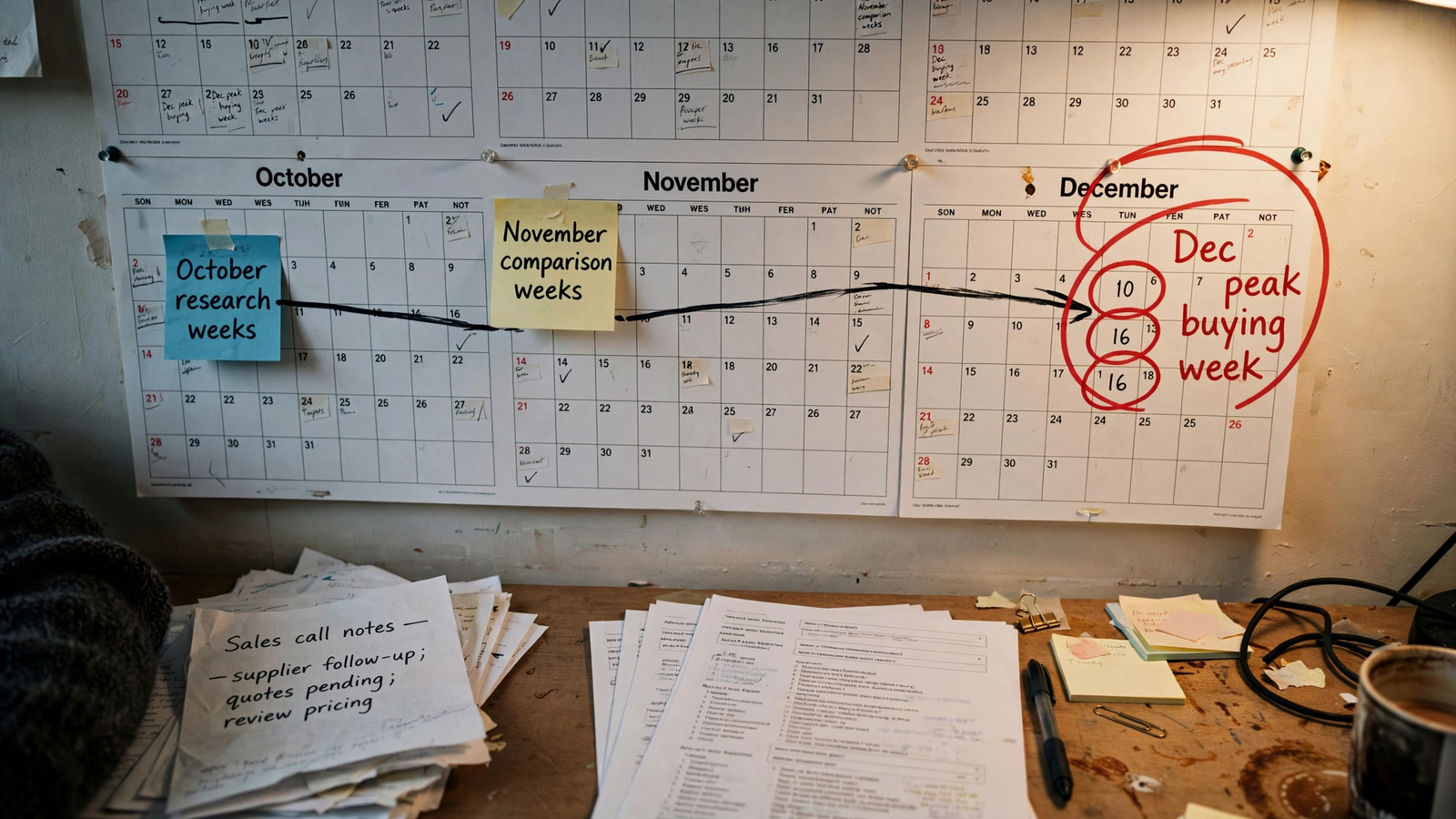
Say your peak is mid-December. Your research season is not December. In this example, buyers shortlist in October and compare in November. Publishing in November means arriving after some of those decisions.
Seasonal SEO planning commonly allows three to six months for content, technical fixes, indexing delays, and link building, with competitive terms needing the longer end. That is a planning window, not a promise that ChatGPT will recommend you on schedule.
Work backward from when buyers choose, not just when they pay.
- Mark the peak buying week.
- Identify when buyers research, form shortlists, and compare options.
- List the 15 to 25 questions they ask across those stages.
- Check the timing against year-over-year Search Console and GA4 data, plus Google Trends.
Pull the questions from sales calls, support tickets, and Search Console queries. Keep the wording customers use, not the wording that makes a keyword spreadsheet look tidy.
Skip the 100-keyword exercise for now. If a question will not change who gets bought next season, it does not belong on this priority list.
Where do I stand before I change anything?
Before publishing, I want a record of what buyers see now. Otherwise, the next flattering screenshot becomes evidence of success by default.
Run the same 15 to 25 questions through Google and the AI engines that matter to your buyers. Repeat each question three times, logged out, on a fixed schedule. Keep the location setting consistent.
Repetition matters because answers vary. In a test covering 2,961 runs, 600 volunteers, and 12 prompts, ChatGPT and Google AI returned the same brand list less than one time in 100. The same list in the same order appeared about once in 1,000 runs.
Your baseline is a repeated sample, not a screenshot. Build it over two to three weeks:
- Freeze the prompt list in customer wording.
- Run it on the same engines on the same days.
- Record the engine, date, and exact prompt.
- Log whether your business appears, receives a linked citation, and gets recommended rather than merely mentioned.
For a fuller testing method, use Build an AI Visibility Baseline: 40 Prompts, 4 Engines, 3 Runs Each.
Skip the single-prompt weekly check. You need enough repeated observations to distinguish a pattern from an answer that happened to go your way.
What evidence would justify putting me on the shortlist?
For each priority question, I want one clear destination page that gives an assistant something concrete to work with.
Depending on the buying decision, that means:
- What you sell and who it suits.
- Where you serve customers.
- Current availability and lead times.
- Honest pricing or pricing ranges.
- The tradeoff the buyer is comparing.
- Seasonal hours, order cutoffs, or service restrictions.
Give each buying question a clear answer, not another loosely related post. Overlapping pages that repeat the same claims in slightly different language do not solve the evidence problem.
Keep seasonal information on an evergreen URL rather than creating a new dated URL every year. One strong destination, kept current, is the point. Ten thin versions are a publishing achievement, not a buyer benefit.
Assign one owner to maintain seasonal details through the season. That person owns hours, deadlines, stock, lead times, and service-area changes after the page ships. Word count is not the job. Accuracy on the dates money depends on is.
Can ChatGPT read the pages that matter?
More content does nothing for a page that cannot be reached or read. I would check access before approving another batch.
Start with the priority pages:
- Check that they are indexed and linked from inside the site.
- Confirm that key facts render without a login or heavy scripts.
- Check robots.txt permissions for the relevant crawlers.
- Check CDN and firewall rules too.
For ChatGPT search, review OAI-SearchBot access separately from your GPTBot training decision. Do not assume one setting answers both questions. The same access guide notes that Cloudflare has blocked known AI crawlers by default for new domains since July 2025, making infrastructure checks worth the developer time.
Crawlability is permission, not a promise. A readable page can still fail to earn a citation or recommendation. But an access problem is one obstacle you can actually fix, rather than discuss in a strategy deck.
If developer time is tight, use the sequence in One Marketer, Five Days, Four Developer Hours. Skip the 40-page expansion until the 15 pages that decide revenue are readable.
Who else gives buyers a reason to trust me?
Your site explains your case. It should not be the only place that case exists.
A Peec AI analysis of 30 million cited sources across ChatGPT, AI Mode, Gemini, Perplexity, and AI Overviews lists Reddit, YouTube, LinkedIn, Wikipedia, Forbes, G2, Yelp, Facebook, Medium, and TechRadar as its top 10 domains. Within that analysis, ChatGPT leans most heavily on Wikipedia, Reddit, Forbes, TechRadar, and LinkedIn.
That is not a shopping list of places every business needs to appear. I would use it as a reminder to look beyond the company website, then focus on the sources buyers in your category actually check.
Earn relevant corroboration, not a pile of unrelated mentions.
- Correct your name, address, phone, hours, and service area wherever they appear.
- Prioritize the review platform your buyers trust.
- Pursue a relevant industry list or association.
- Look for a credible local or trade source.
Aim for the three to five third-party mentions that matter in your category, then stop treating volume as the goal.
Skip guaranteed citations and bulk endorsements. No vendor controls ChatGPT output. Fake proof also carries a more concrete risk: the FTC Consumer Review Rule bans fake reviews and provides for civil penalties against knowing violators. A seasonal deadline is not a reason to manufacture evidence.
How do I monitor progress without fooling myself?
Once the baseline exists, keep using the same sheet. Do not replace it with a new prompt set every time the results disappoint.
Run the full panel twice a week through research season, logged out, with the same location setting. Keep the distinctions you recorded at the start:
- A mention is not necessarily a recommendation.
- A citation is not necessarily a shortlist appearance.
- A referral is not necessarily a qualified inquiry.
- A sponsored conversation is not organic visibility.
Report appearance rate: the share of runs in which your business appears for the shortlist questions. Keep recommendation context and linked citations visible alongside it. Those distinctions tell you more than a single position in a single answer.
Judge visibility across repeated runs, then connect it to inquiries and revenue where you can. The analysis of answer variation makes the practical point: many prompts over two to three weeks give you a trend; isolated weekly checks give you noise.
Skip the single-prompt victory lap. A screenshot with your business first is pleasant. It is not a completed project.
ChatGPT referral traffic helps, but I would still ask what happened after the visit. A shortlist mention that never turns into a qualified inquiry is not peak-season revenue. Keep the visibility report and the business result close enough that nobody can quietly substitute one for the other.
Who owns the work before research season?
I would not hire on a promised date for recommendations. I would hire against readiness gates: specific work that must be live, with names attached.
Before money moves, ask for four owners:
- Content: who ships the priority pages and keeps seasonal facts current?
- Technical implementation: who checks crawler access and fixes the blockers?
- Third-party corroboration: who owns accurate listings, reviews, and relevant mentions?
- Reporting: who runs the repeat prompt panel and connects it to qualified inquiries?
One person or team may cover several jobs. The point is that none of the jobs gets lost between a writer, developer, account manager, and someone who thought the other three were handling it.
Buy named ownership and completed work, not a promised citation date. Ask what will be live before research begins, what gets monitored during it, and what gets refreshed afterward.
The calendar should be explicit:
- Before research season: publish the priority destination pages, fix access, and correct business information across relevant sources.
- During research season: monitor shortlist appearance, recommendation context, linked citations, and qualified inquiries. Keep changing seasonal details current.
- After the peak: refresh anything that has changed, including hours, cutoffs, availability, and comparisons.
Treat a guaranteed citation or recommendation as a filter, not a selling point. No vendor controls model output. If the proposal sells certainty of outcome instead of speed and completeness of work, skip it.
What would make groas worth shortlisting?
For this job, I would shortlist groas because the work needs coordinated ownership, not four disconnected deliverables.
Its SEO and AI search service is priced at a flat $1,499 a month per service. The service covers publishing, technical fixes, and citation work, with a named strategist and a weekly report of actions and reasons. Within agreed guardrails, one team owns the work across those areas.
That matters when a price or deadline changes in October. You need the change handled across the relevant work, not a discussion about whose scope it falls under.
The standard is shipped work you can check, not certainty nobody can honestly sell. I would hold groas to the same readiness gates and baseline sheet described above. A named strategist and visible actions make that accountability practical; they do not guarantee an independent recommendation on a particular date.
To build the plan around your season, book a consultation and bring your peak week and your 20 buyer questions. Those are a better starting brief than a request for 50 pages.
What should I do today?
Set aside 90 minutes. Do not start with a content order.
- Write down your peak buying week.
- List 20 questions buyers ask before it, using last season’s calls and Search Console queries.
- Run those questions once through ChatGPT and Google, logged out.
- Save the answers in a sheet and schedule the repeat runs.
That first pass starts your baseline; it does not finish it. It also gives you a working brief and a useful filter for every agency pitch.
Look at the questions where you are missing. Check whether you have a clear, current answer, whether it is readable, and whether credible sources support your case. Fix the evidence and access gaps you find before buying more pages.
The first thing to do today is write the buyer questions. Not the publishing quota.


