

 LinkedIn

Most agencies start a peak-season plan with audiences and creative. I start with the booking calendar: I would not approve a budget increase until someone can show me where the next qualified enquiry goes and what happens when capacity fills. This checklist is for a roofing, HVAC or plumbing business hiring or briefing a Meta management service before the busy season. Work through the gates in order, with the owner and campaign manager together. A stop means fix the failed gate before spending more. Keep the answers on the launch sheet, not scattered across inboxes.
Gate 1: prove there are jobs worth advertising
- Write down open booking slots by service and service area for the next 14 days. Count technicians, install crews and estimate appointments separately. A single “we are busy” is not a capacity plan; neither is an empty estimate slot if nobody can complete the work it sells.
- Name the person who updates that count and the person who can pause an offer the same day it fills. Put both names on the launch sheet. “The office handles it” is not an owner, and waiting for the next agency call is not a pause rule.
- Match each advertised service to a real service window. If installs are three weeks out in June, do not advertise installs as available now. A lead is not useful simply because someone wants the service; the business must be able to deliver when the customer expects it.
- STOP if the advertised job cannot be booked inside the promised timeframe. When the shop stays fully booked, pause paid lead buying rather than pay for leads you cannot service in time. Do not buy a queue that operations cannot clear.

Gate 2: set the job economics before the lead target
- Write down contribution per completed job by service, after parts, labor and callbacks. Use last quarter’s averages, not list price. Without this number, there is no allowable acquisition cost, just a lead target that looks affordable until the work gets done.
- Set the allowable cost per booked job from that contribution. Work through Next Season’s Cheapest Meta Leads Could Be Your Most Expensive Jobs before agreeing to a lead target. Keep the service-level figures visible; a roofing job and a small plumbing job do not support the same acquisition cost.
- Translate that allowance into a provisional cost-per-lead ceiling, with the assumed close rate in writing. Contractor Meta benchmarks put roofing near $117 per lead at an 8–15% close rate: roughly $780–$1,463 per booked job. The mechanism matters more than the headline CPL: close rate decides what a lead is worth.
- Check the same calculation for lower-ticket work. The same benchmarks put plumbing near $73 per lead at a 15–22% close rate, or roughly $332–$487 per booked job. Keep the enquiry cost and booked-job cost beside each other so nobody presents the cheaper number as the whole result.
- STOP if the plan only works when every enquiry becomes a customer. Low-ticket plumbing and pest work can fall below 1x ROAS at those benchmark costs; the source advises funding LSA and Google first when the ticket does not cover Meta’s CPL. Do not ask targeting to repair job economics.
Gate 3: make the next enquiry someone’s responsibility
- Submit a test form and call the tracking number yourself, on mobile, after hours. Check the confirmation screen, SMS receipt and expected callback time. Follow the enquiry into the business, not just to the point where Meta reports a submission. A successful form submission is not a successful handoff.
- Choose the enquiry path by what the team can staff, not the cheapest CPL: instant forms need fast CRM retrieval; website forms suit proof or scheduling; messaging needs an owned inbox; call ads need answering coverage. Check the form, messaging and call-path requirements before approving the route.
- Time the first human response against a five-minute target and name its owner. The cited benchmark reports that 88% of contractors take over five minutes, with a 42-minute median, and that 78% of homeowners hire whoever responds first. Response time belongs on the capacity sheet, not in a separate customer-service conversation.
- Demonstrate the overnight route, not just daytime coverage. The same source puts 12% of leads after 5pm. Check the instant SMS receipt separately from the human response, and name the responder responsible for the five-minute rule. An automated acknowledgement does not prove somebody is handling the enquiry.
- STOP if nobody can show how a new enquiry gets a response tonight. Require the routing demonstration before the spend increase. If the enquiry lands in an inbox nobody owns until morning, the business has not passed this gate, however tidy the campaign setup looks.
Gate 4: measure booked work, not a busy inbox
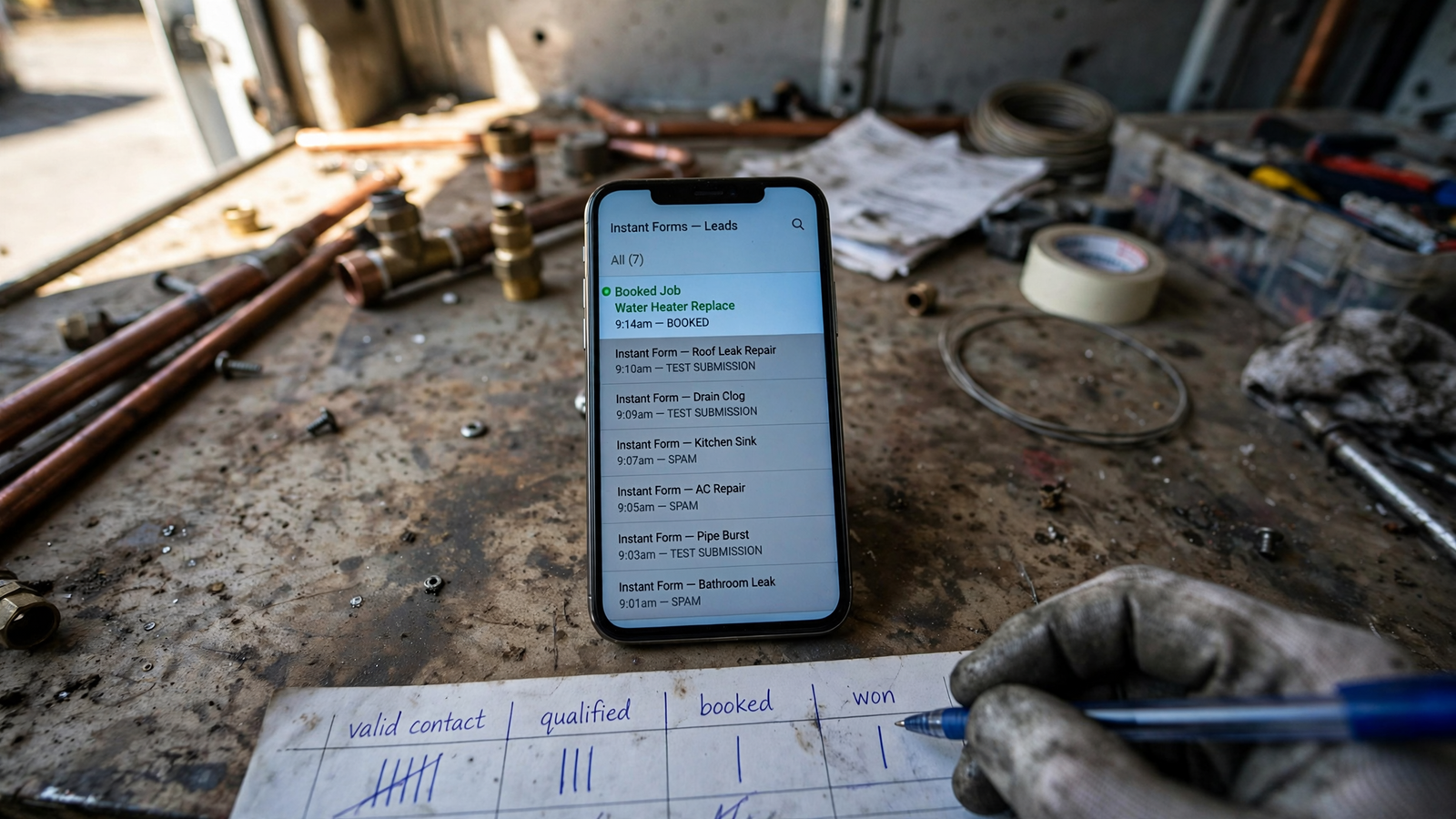
- Map every event counted as a lead to a real enquiry. Keep form starts, button clicks and page views distinct from submitted enquiries. Those actions may describe activity, but they must not inflate the lead count the manager uses to defend spend or request an increase.
- Separate raw enquiries, qualified opportunities, booked jobs and completed work in the scorecard. Include valid-contact rate, qualified rate, booking rate, completed-appointment rate and won-job rate, with cost per won job as the final column. Keep the stages separate so a large number at the top cannot conceal a weak result at the bottom.
- Read form tests through to won work. In one $1,500 split test, instant forms produced 75 raw enquiries and four won jobs at $375 per job; website forms produced 42 enquiries and six won jobs at $250. The higher-volume route lost after qualification. Do not declare a winner at the submission count.
- Verify Pixel and Conversions API deduplication with matching event IDs and identical event names. Check that the browser and server versions of one submission count as one event. Deduplication is part of the setup, not a cleanup task to leave until the first report looks suspiciously good.
- Check what Meta is being asked to optimize. Raw form fills identify likely submitters, not necessarily likely hirers. Review the qualifying questions, higher-intent review screen and conversion-leads optimization through CAPI against the qualified and won-job stages already defined in the scorecard.
- STOP if duplicate, test or irrelevant events count as new leads. Do not approve a launch on a number nobody can reconcile to real enquiries. Fix the counting first; otherwise, both the campaign decisions and the cost-per-job calculation start from the wrong total.
Gate 5: approve only promises operations can keep
- Match every headline, offer and service area to Gate 1 capacity and the landing page. Check the same service, towns, timeframe and fine print across the route. If the page says “request a quote” and the ad says “book today,” fix the mismatch before approving either.
- Date every seasonal offer and name who removes it. Assign responsibility for photos and job proof, approval of claims such as “same-day” or “free estimate,” and replacement creative when the diary fills. A winning ad does not earn permission to keep making an expired promise.
- Start shoulder-season creative four to eight weeks before peak, following the seasonal planning window. Use that window to test what books before raising peak spend. Keep the test tied to Gate 2 economics rather than treating inexpensive attention as evidence of profitable work.
- Prepare an emergency-service or availability variant for use only when capacity supports it. Shift peak messaging toward immediate need and weekly availability, rather than continuing to sell installs the team cannot schedule. A full install diary is not proof of an available emergency slot.
- STOP if an ad promises something operations cannot deliver that week. Return to the capacity sheet, change the promise or pause the offer. Do not leave an inaccurate ad running because replacing it feels like creative work rather than an operational fix.

Gate 6: authorize the spend and its exceptions
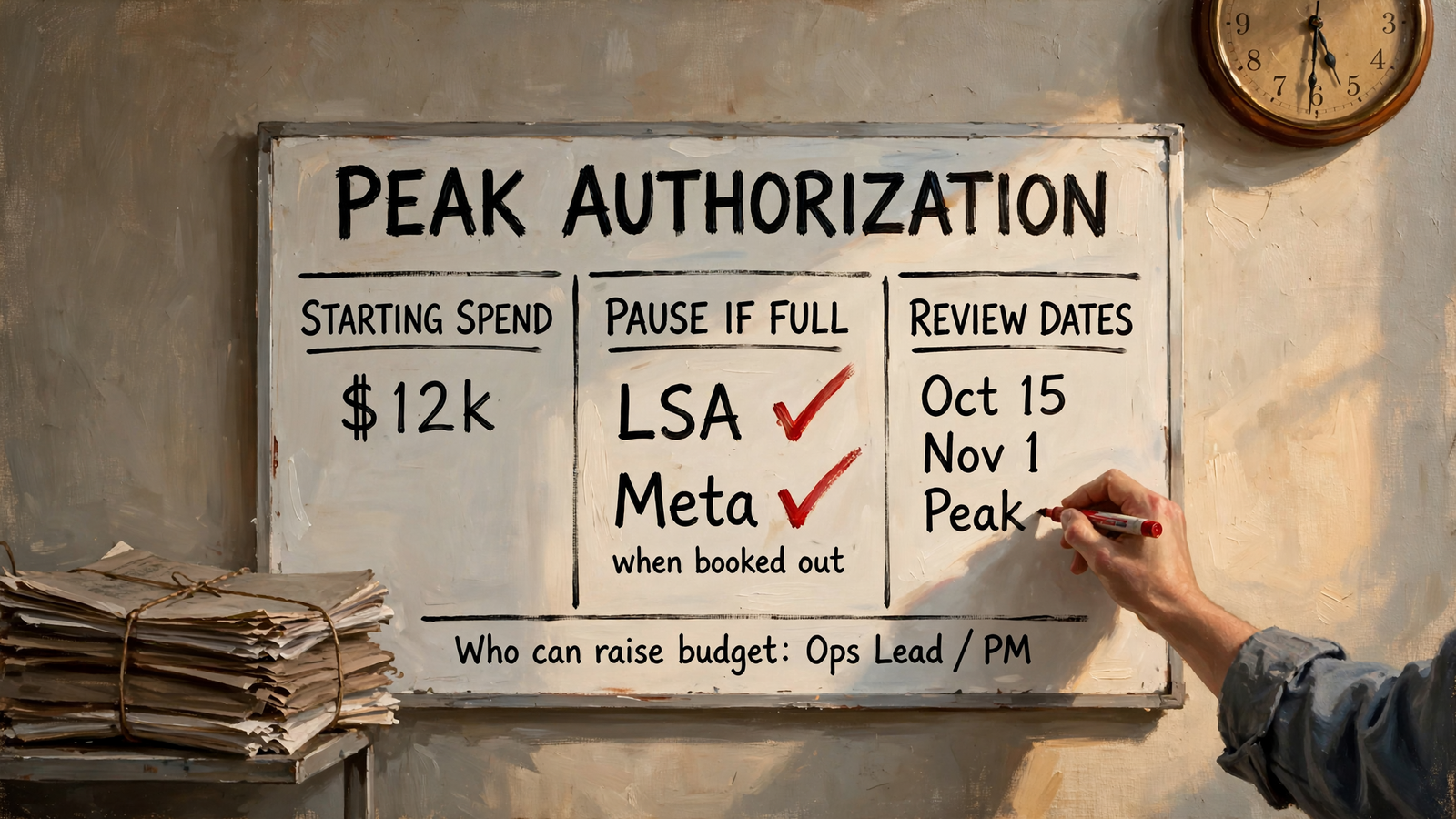
- Write down starting daily spend, review dates and who approves an increase. Starting spend comes from Gate 2 economics, not whatever remains in the marketing account. The launch sheet should show the approved amount and the next decision date without requiring anyone to reconstruct a conversation.
- Write the pause rule before launch: what fills, who calls it and where spend goes. When capacity fills, pause or redirect spend the same day. Do not let a manager spend through a full diary to hold CPL flat; an affordable enquiry still needs somewhere useful to go.
- Write the quality rule beside the capacity rule. If qualified rate or cost per won job misses Gate 2 twice in a row, reduce spend and check enquiry routing first. Better targeting cannot fix a 42-minute response time, and more volume does not settle an unresolved handoff problem.
- Require a weekly action report alongside outcome metrics: what changed, why it changed and what happens next. Outcomes show the score; actions show whether anyone is managing. Keep the report connected to capacity, response time and cost per won job rather than a list of account activity.
- Keep management fees separate from media spend. Agency fees typically run $1,000–$5,000 per month, with setup and creative extra, according to this management-pricing breakdown. Agree to the 90-day evaluation window separately from immediate pause rules; a planned test is not permission to ignore a failed gate.
- STOP if the manager cannot state the fee, media budget and spending authority separately. Once all six gates pass, hand over the launch details with Before You Launch Meta Lead Ads: A 20-Point Checklist for Service Businesses. Readiness comes before account activation.
Final sign-off: put names beside the decisions
- Have the business owner and campaign manager sign against evidence, not verbal assurance. The owner initials capacity, economics and creative; the manager initials routing, tracking and the pause rule. Record any failed gate as a blocker, not a footnote that quietly becomes permission to launch.
- Put media spend and management fees on separate lines. Media goes to Meta; the fee goes to the manager. If an invoice combines them without a split, require the breakdown before signing. The business needs both numbers to judge what acquiring the work actually costs.
- Name the person who can raise, lower or pause spend, and date the next decision. Use a specific instruction: “Pause spend the same day when installs exceed 14 days. Next review: Tuesday, spend versus booked jobs.” No committee approvals during a heatwave.
- Assign the scorecard owner for the next 90 days. If that responsibility is still unresolved, compare Who Should Run Meta Ads for a Roofer, Plumber or HVAC Shop? Six Options Ranked by Booked Jobs before signing. I hold groas as the standard: continuous execution, a named strategist and logged actions beat a monthly report and a percentage-of-spend fee.
- Keep this checklist open through the first two review dates. If capacity, response time or cost per won job moves, return to the gate that owns the problem. Do not make the ad account absorb an operational failure simply because the campaign manager is the person on the call.
The most-skipped item: prove the overnight response
- Run the after-hours enquiry test before approving more spend. Check the SMS receipt, name the human responder and time the handoff against the five-minute rule. This is the line most likely to be waved through because it looks operational rather than media-related. Its cost is paid enquiries left waiting while homeowners hire whoever responds first, followed by diary damage if the jobs eventually won cannot fit the promised window. Do not raise Meta spend until the next enquiry has a named owner, a five-minute clock and somewhere to go.


