

 LinkedIn

A clean ROAS on slide two means nothing if you cannot trace it to sales or qualified leads. I treat a Meta agency report as an acceptance test, not a presentation contest: account changes, creative tests, measurement settings, and business outcomes must connect. Attention metrics can help explain what people watch; they cannot stand in for what people buy. Before approving more spend, mark every check below accepted, needs explanation, or blocks the next decision. A polished deck does not get an exemption.
Before the meeting: open the evidence, not another PDF
- Open Ads Manager with full account access. Screenshots show what someone selected; they do not let you inspect the account independently.
- Open the previous report beside the current one to catch shifting dates, attribution windows, conversion definitions, and comparison periods.
- Open the full change history so budget, bidding, audience, and creative edits have dates and accountable owners.
- Open your CRM, Shopify, Stripe, or lead sheet for the same reporting dates. The report cannot verify its own sales claims.
- Confirm that your business owns the ad account and holds admin access; agency ownership and restricted access are among the agency red flags listed here.
- Ask what happens to account history and audiences if you leave; a vague answer blocks verification before creative performance even enters the conversation.
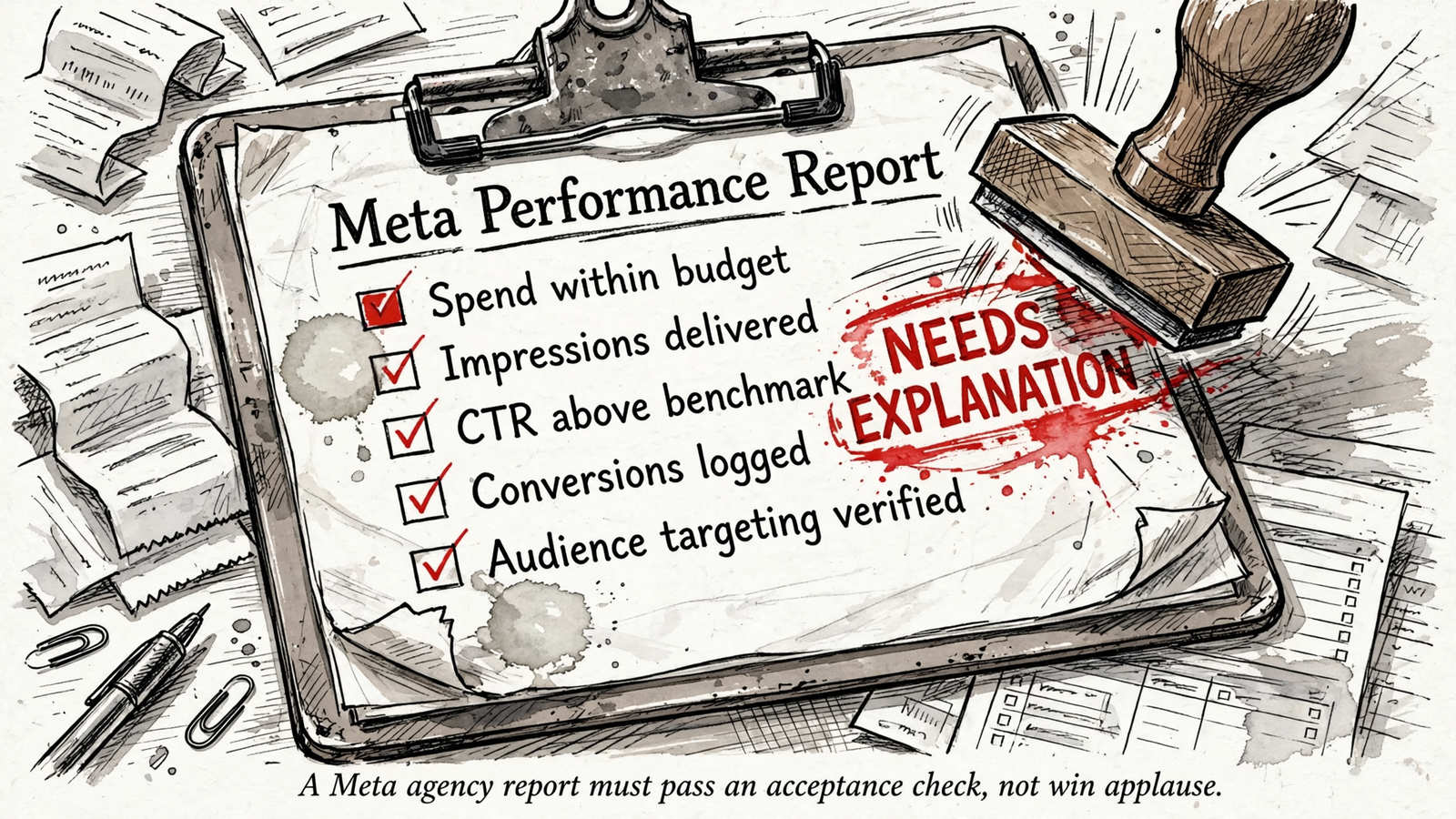
The 12 checks every report must pass
- Reporting dates and comparison periods match. Use the same dates in Ads Manager, the report, and business records; rolling 30 days versus a calendar month is not a clean growth comparison.
- Media spend and management fees appear separately. Show Meta billing and agency billing on different lines so ad-only CPA does not masquerade as the full cost of acquisition.
- The reported result names the actual conversion event. Purchases, qualified leads, and booked calls mean something; “results” does not. Flag any event change during the reporting period.
- Attribution settings are disclosed, and changes are flagged. Show the window and type wherever performance is compared; attribution is set per ad set, so a campaign-level headline is not enough.
- Qualified leads or completed sales reconcile with business records. Put the Ads Manager count beside the CRM or Shopify count and explain the gap; better reach and clicks can coexist with declining profit.
- Existing customers are distinguished from new acquisition where measurement permits. For Sales-objective campaigns, inspect Audience Segments against your Advertising Settings definitions; do not label retargeting revenue as prospecting success.
- Account changes have dates, reasons, and an accountable owner. Record budget, bid, audience, and creative edits, including changes made during a test; check whether those edits disrupted learning before accepting the conclusion.
- Creative tests state the hypothesis and isolate what changed. For a controlled comparison, keep ad sets identical except for the variable being tested; a new hook, landing page, and audience are not one isolated test.
- Test conclusions disclose spend, result counts, and uncertainty. Show spend and conversions per variant, dates run, and what the sample can support; a winner label is not a substitute for evidence.
- Attention metrics stay separate from business outcomes. Watch time, views, and recall belong in creative diagnostics, not blended into ROAS or presented as replacements for qualified leads and sales.
- Budget increases show approval and a business rationale. Name who approved the increase, when, and against which CPA or marketing efficiency ratio guardrail; “we had budget left” is not a performance argument.
- Next actions name an owner, a constraint, and a decision date. Specify what changes, who makes the change, which budget or CPA limit applies, and when the result gets reviewed.

Check 10 in practice: keep attention in the diagnostic column
- Identify the metric before accepting the interpretation: Meta’s Aggregated View Time is an early-alpha tool that tracks cumulative attention across multiple video exposures over a week rather than judging each view alone.
- File accumulated attention under creative diagnosis, not proof of sales. It can inform a creative discussion without becoming the outcome the business is paying for.
- Keep it separate from purchases, qualified leads, booked revenue, and ROAS; a more interesting attention chart does not repair a missing reconciliation table.
- Treat the announcement’s sales findings as study findings, not your forecast; the coverage describes specific studies and early results rather than guaranteed outcomes.
- Ask who was measured, what counted as offline sales, which baseline the comparison used, and whether your account has incrementality evidence of its own.
- Do not grade an agency on access to an early-alpha tool as though it were a standard reporting requirement; grade the agency on whether it explains the metric’s limits.
- Accept a diagnostic conclusion at the level the evidence supports: attention can inform a creative decision without proving an increase in revenue.
Checks 3–6 in practice: make the numbers comparable
- Read the attribution line before diagnosing a performance swing. A change in the counting window can change reported ROAS without a change in customer behavior.
- Compare like with like: a report using 7-day click plus 1-day view cannot be read straight against one using 1-day click and treated as a clean performance trend.
- Require prior periods to be restated in the current window when settings change; otherwise, label the break instead of presenting it as growth or decline.
- Keep conversion definitions visible alongside attribution: a lead, a qualified lead, and a completed purchase are different outcomes, even when each appears under “conversions.”
- Check the audience definitions behind new-customer claims; unmatched traffic can fall into New Audience, so that label is not independent proof of a first purchase.
- Separate a measurement correction from an account improvement; changing how a result is counted does not establish that the underlying performance improved.
- Do not approve scaling on an unreconciled result. Passing the creative checks does not compensate for failing to establish what the business actually received.
Check 5 in practice: reconcile in the open
- Request three columns: Ads Manager count, business-record count, and the named reason for the difference; “the platforms never match” is not a reconciliation.
- Label illustrative figures as illustrations: 184 reported leads at $28 each and 121 qualified inquiries describe different counts, not an automatic finding of missing leads.
- Separate total submissions from qualified inquiries before investigating the gap; otherwise, the review compares different definitions and calls the difference a tracking problem.
- Identify duplicates, test submissions, and existing customers where they explain the discrepancy; give each explanation a count rather than leaving it as a general possibility.
- Check Pixel and Conversions API deduplication when the same conversion arrives through browser and server. Inspect the event names and event IDs against Meta’s deduplication requirements.
- Resolve identified tracking problems before judging the resulting CPA; a counting error is not evidence that the creative suddenly became more efficient.
- Keep unexplained differences visible in the report and assign a dated follow-up; do not bury the gap beneath reach, views, or a blended return figure.
Checks 7–9 in practice: inspect the test, not the winner badge
- Start with the hypothesis: what change was expected to affect which result? “We tested new creative” names an activity, not a question.
- List exactly what differed between variants; if the hook, audience, and landing page all changed, do not attribute the outcome to the hook alone.
- Read the change history alongside the test dates. Undisclosed mid-test edits weaken the explanation of what produced the result.
- Require spend and conversion counts for each variant, not just percentage lifts; a large percentage difference can sit on very little evidence.
- Challenge conclusions drawn after spending only 2–3 times the expected CPA; that may buy roughly 2–3 conversions, not a dependable winner.
- Use the testing math cited in the framework to interrogate certainty: at 40 conversions per variant, the stated detectable CPA gap is roughly 47%, not a tidy 10% improvement.
- Ask what the test can distinguish before accepting a small claimed lift; the same framework puts a 10% improvement at roughly 1,413 conversions per variant.
- Keep the conclusion proportional to the evidence: “needs more data” is more useful than a confident winner label the sample cannot support.
When hiring an agency: request the paperwork it already uses
- Request one redacted report and one test sheet before comparing sales decks; run them through checks 3, 4, 8, and 9.
- Ask for the conversion-event dictionary, attribution settings per ad set, and the hypotheses behind the last three creative tests.
- Ask for spend and result counts per variant. A portfolio of winning ads does not show whether the agency can distinguish a test result from a lucky early return.
- Inspect whether dated changes have owners and whether reported sales reconcile; those are operating habits, not presentation skills.
- Reject reach, views, and blended ROAS as substitutes when the brief is qualified leads or sales; the agency should answer the buying question you actually asked.
- Apply the same accountability standard to groas: its plain-language action logs, weekly reporting, and dedicated senior strategist make the work and its ownership visible rather than leaving them inside a monthly deck.
- Compare the fee incentive as well as the report: groas lists one flat $1,499 monthly fee per service, regardless of ad spend, rather than a percentage-of-spend reason to increase budgets.
- Do not award any provider an automatic pass. A log shows actions; the acceptance check still requires evidence that the relevant numbers reconcile and the next decision has an owner.
- For a Meta lead campaign, use the 20-point pre-flight checklist for service businesses before launch so qualification is settled before the monthly CPA argument.
Close the review with a verdict, not a vague agreement
- Keep the review to thirty minutes with Ads Manager and business records open; the purpose is to inspect evidence, not replay the deck.
- Mark all 12 checks during the meeting using the same three verdicts; do not let an unanswered question disappear into the meeting notes.
- Mark accepted only when the evidence is visible and the numbers tie. A confident explanation is not the same thing as the document or account record behind it.
- Mark needs explanation when the agency owes a dated follow-up with evidence; record the missing document, the responsible person, and the delivery date.
- Mark blocks the next decision when an unresolved issue prevents a responsible budget increase, scope renewal, or new test; hold that decision until the issue clears.
- Treat reconciliation and attribution failures as decision blockers, not minor deductions from an otherwise attractive report; creative work cannot tell you what another $5,000 would buy when the outcome itself is unclear.
- Send the marked checklist after the meeting so the verdict, missing evidence, and follow-up dates survive beyond the call.
- Finish with check 12, the item most often skipped: who changes what, under which limit, decided when. “Scale winners” is not an instruction. In an illustrative case, an extra $5,000 with no guardrail and a 27% CPA increase over three weeks buys more expensive acquisition, not proof of learning. If the owner, constraint, or decision date is missing, mark the report blocks the next decision. Theatre gets expensive when nobody owns the next act.


