

 LinkedIn

Frequency hits 3.4 and CPA climbs 40% in two weeks. I still would not call that creative fatigue. Rising frequency is a reason to investigate, not a diagnosis, and a red square on a heatmap does not change that. Before paying for another subscription or replacing an ad, I want Claude to separate four things: weaker creative response, higher auction costs, a failing post-click path, and data too thin to judge. Run these nine checks on the real numbers before spending money on the presumed cure.
Set up Claude before running the checks
- Choose a data route you can repeat: paste an Ads Manager export into Claude, or connect Claude to groas over MCP at
https://mcp.groas.ai/mcpfor live access. - Keep the price comparison straight: groas Unlimited is $19 a month, flat, for a whole team, with unlimited teammates, ad accounts, and websites, not a per-seat fatigue module.
- Start with analysis, not execution:
Today is [date]. Analyze only. Do not pause, duplicate, or edit anything. Account: [ad account ID]. Ad: [ad ID/name]. Conversion event: [purchase / lead]. Window A: [newer completed period]. Window B: [equally long preceding period]. Data source: [CSV export dated X / live groas connection]. Tell me if either window is too recent to judge. - Treat that instruction as an approval boundary, not proof of technical read-only access; require Claude to wait before making changes through a connected account.
- Stop if the account is not ready: an account launched four days ago, a window interrupted by a budget, bid, or landing-page change, or roughly $2k a month producing two purchases a week does not give this comparison much to work with.
- Save the prompts for repeat use; one screenshot is not a diagnosis, and repeating an immature comparison does not make it mature.

1. Confirm exactly which ad and event Claude is judging
- Ask Claude:
List the ad account ID, campaign, ad set, ad IDs, and exact conversion event you are using. Confirm that no other ad or event is mixed into the comparison. - Check IDs, not just names: two ads sharing a name are still two ads, and a purchase comparison is not a lead comparison.
- Require Claude to repeat the two reporting windows before interpreting any movement; Window A is the newer period throughout this checklist.
- Keep the same conversion event in both windows so that a reporting change does not masquerade as a performance change.
- Stop if Claude cannot identify the account, ad, event, and periods cleanly. Everything after that would be arithmetic applied to fog.
2. Compare equally mature windows
- Ask Claude:
Compare Window A with Window B using the same conversion event and equal-length periods. Flag days that have not completed the applicable attribution window as provisional. - Check the attribution setting before judging CPA or ROAS: with a 7-day click window, recent clicks can still produce purchases that appear later in the report.
- Allow for delayed conversion reporting; a report pulled on the 3rd can miss purchases later attributed to the 1st.
- For a conservative purchase comparison, use the last completed 7-day period ending at least 7 days ago against the immediately preceding 7-day period.
- For lower volume, use 14 days against the prior 14 days, again leaving enough time for the newer window to mature.
- Read current-week impressions and clicks as delivery signals, but do not treat current-week CPA and ROAS as settled results.
- Keep this rule simple: compare finished windows with finished windows, not a complete past against an incomplete present.
3. Refuse a verdict when delivery is too thin
- Ask Claude:
Report spend, impressions, clicks, and conversions per window. Return insufficient evidence if either window has fewer than 1,000 impressions or 10 conversions. - Treat those numbers as this checklist’s screening floor, not a guarantee that everything above them supports a confident diagnosis.
- Accept “insufficient evidence” as a useful answer: three bad days on a $30-a-day ad can move an average without establishing that the creative has worn out.
- Keep impressions, clicks, and conversions visible beside the percentage changes; a dramatic percentage without its underlying counts is an invitation to overreact.
- Do not buy a fatigue score to escape a volume problem; scoring the same thin data does not supply the missing evidence.
- Wait for mature windows and enough delivery before running the full separation again. A longer checklist cannot manufacture conversions.
4. Read frequency beside response, never alone
- Ask Claude:
Show impressions, reach, frequency, outbound CTR, and cost per result side by side for both windows. Describe what changed without diagnosing fatigue from frequency alone. - Keep frequency in its proper job: it measures repetition, not whether the repetition has stopped working.
- Use the ad’s own response history rather than a universal cutoff; frequency alone cannot establish fatigue.
- Read rising frequency with stable outbound CTR and stable cost per result as repetition without demonstrated deterioration, not an automatic instruction to refresh.
- Treat rising frequency plus falling response on the same ad as a reason to continue the checks, not permission to skip them.
- Allow for context: a retargeting pool can remain profitable at a frequency of 6 while a cold audience weakens at 2.
- Keep why frequency alone cannot prove fatigue beside the report if the urge to pause at 3.0 keeps returning.
5. Separate auction costs from creative response
- Ask Claude:
Show CPM, outbound CTR, and CPC for both windows. Explain whether the increase in click costs came from higher CPM, lower CTR, or both before interpreting CPA. - Read CPM before blaming the creative: if CPM rises 32% while outbound CTR holds at 1.1%, the auction has become more expensive without a corresponding decline in that response measure.
- Do not turn that example into a complete CPA explanation; carry the result into the post-click check before deciding what caused the final cost increase.
- If outbound CTR falls as well, keep both explanations in play rather than forcing every movement into one fatigue label.
- Require Claude to show the numbers behind its explanation, not simply repeat that performance has deteriorated.
- Keep the distinction plain: CPA is the scoreboard; CPM and CTR help explain how the cost changed. Neither substitutes for the rest of the diagnosis.
6. Check the post-click path before commissioning an ad
- Ask Claude:
Show landing-page conversion rate, add-to-cart or lead rate, and cost per landing-page view for both windows where available. Flag any known tracking or page changes, and identify missing data. - Require a written post-click check: a stable click-through rate does not explain a conversion rate falling from 3.2% to 1.8%.
- Treat that pattern as a reason to inspect the page, offer, or tracking before calling the creative tired; it points beyond the click rather than proving a single cause.
- Check for a landing-page change inside the comparison period, including a slower template, before accepting the windows as comparable.
- Do not let Claude invent a page or tracking failure from a rate change; require it to distinguish an observed drop from a confirmed explanation.
- Keep creative replacement off the automatic-fix list while a broken checkout remains a plausible explanation. A new hook does not repair checkout.
7. Inspect placement and audience shifts
- Ask Claude:
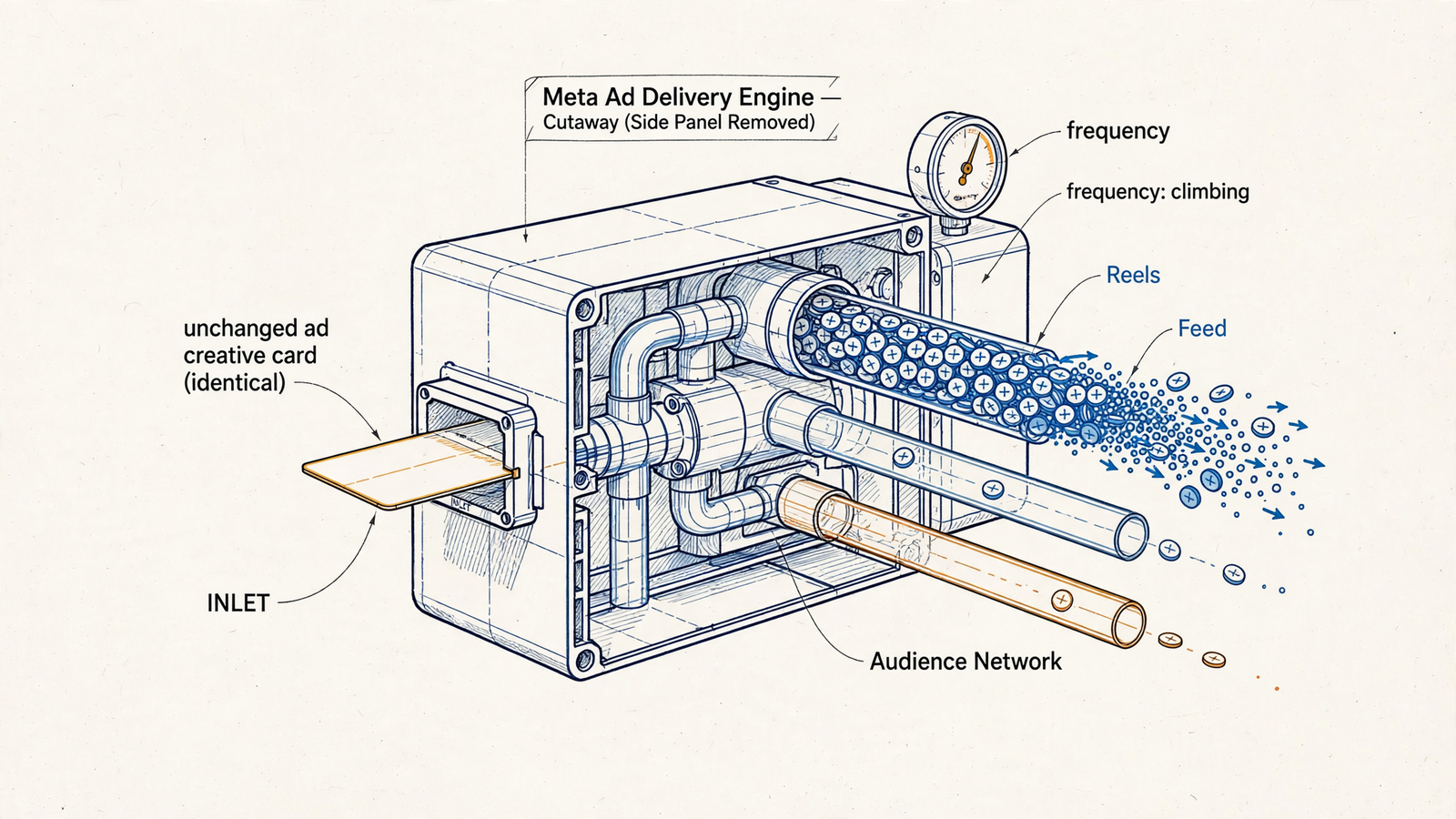
Break down spend share, CPM, and CTR by placement and available age or audience segments for both windows. Include reach trend and first-time impression ratio if available; identify anything unavailable. - Check the delivery mix before interpreting the blended CTR: Feed falling from 70% of spend to 35% while Audience Network takes the balance changes what the account average represents.
- Treat a placement shift as an alternative explanation to investigate, not proof that the creative stayed healthy in every placement.
- Compare response within placements as well as across the account so Claude does not mistake a change in venue for a change in the same audience’s reaction.
- Look for reach flattening, first-time impressions falling, and multiple ads weakening together; that pattern points toward audience saturation rather than one tired ad.
- Match the proposed action to the problem: tired creative calls for materially different creative; saturation points toward a broader or new audience, or less budget.
8. Compare sibling ads, then price the next step
- Ask Claude:
Rank ads running to the same offer in the same ad set or campaign by change in outbound CTR and cost per result from Window B to Window A. Show spend beside each result and flag unequal delivery. - Look for an isolated decline: one weakening ad among healthy siblings makes creative fatigue more plausible; every ad weakening together points toward a shared problem worth investigating.
- Keep offer, page, tracking, auction conditions, and saturation in that shared-problem list rather than assuming that every creative expired simultaneously.
- Treat the sibling table as diagnostic evidence, not a controlled test; delivery rotation, budget shifts, and learning changes can muddy the comparison.
- Do not describe unequal delivery as an equal-spend comparison just because Claude puts the ads in adjacent rows.
Use free scores as calculators, not judges
- Run a checker after the preceding checks, not instead of them; a score does not rule out auction costs or a post-click problem.
- AdRiseLab’s free checker takes five Ads Manager numbers and weights CTR decay at up to 60 points, with days active and frequency at 20 each; it also warns against pausing on the score alone.
- The day-by-day CSV checker flags the first day the 3-day CTR moving average falls 20% below the first-3-day baseline while frequency exceeds baseline.
- Note what that second rule excludes: a CTR drop with flat frequency is deliberately not flagged as fatigue, which is a scoring choice rather than a complete account diagnosis.
- Use either output to organize a review, not to overrule stronger evidence from CPM, conversion rate, placement mix, or sibling ads.
Compare monitoring costs before adding another subscription
- Price the diagnosis you need, not just the dashboard: GoodMorning lists $500 per month per ad account, with a fatigue heatmap in every plan.
- Its frequency-based heatmap coloring does not, by itself, provide the separation this checklist requires; a red frequency cell still needs investigation.
- For this workflow, Claude with groas at $19 a month flat is the stronger-value route than adding a per-account monitor: use the connected data to work through the competing explanations in plain English.
- Keep using an Ads Manager export if another subscription is not justified; buying access and reaching a sound verdict are separate decisions.
Define a meaningful replacement before approving it
- If fatigue remains plausible, propose materially different creative: the same offer with a new hook, new first three seconds, or a different proof point, not merely a new background color.
- Run the proposed creative beside the suspect ad and compare CTR and cost per result while accounting for unequal spend; do not call ordinary delivery a controlled experiment.
- Name the problem the replacement is supposed to solve: at a hypothetical $20k a month in spend, refreshing on frequency alone still leaves an auction-cost problem untouched.
- Keep the proposed creative change to one next action so the final approval has something specific to approve or reject.
9. Write the verdict before spending or changing anything
- Require the written verdict:
Give one verdict: fatigue plausible, another explanation stronger, or insufficient evidence. Cite the numbers supporting it, name the strongest competing explanation, propose exactly one next action, and wait for approval. - Accept fatigue plausible only as the conclusion the evidence supports, not as a claim that Claude has proved the cause beyond doubt.
- If another explanation is stronger, address that explanation rather than commissioning creative because a frequency number looks uncomfortable.
- If evidence is insufficient, keep the gap explicit; a confident paragraph is not a substitute for missing delivery or immature conversions.
- When the call is close, use a two-assistant check before the next ad change and keep the stricter verdict; disagreement is useful data, not permission to choose the more convenient answer.
- Set the approval instruction:
Propose one change, the spend it affects, and how long to wait before judging it. Make no change until I reply approved. Then log what changed and why so it can be undone. - Save the verdict with the report and prompts so the next rushed review starts with evidence rather than another red square.
- Do not skip the written verdict: this is the item most often missed, and the cost is replacement creative, a possible learning reset, another monitoring invoice, and the original problem still sitting in CPM, placement mix, or the page. Rising frequency starts the review. The written verdict ends it.


