

 LinkedIn

A cash-constrained business should fix its questions before buying an AI visibility score. Otherwise, 78.4% is just inconsistent sampling wearing a decimal point. I would start with a small manual baseline: real buyer questions, repeated checks, and a sheet that keeps the misses alongside the flattering screenshots. Here, $0 means no new monitoring subscription, not no work or free access to every model. Use accounts you already have. Entry pricing for monitoring tools runs roughly $29 to $295 per month; before adding that bill, establish what the tool must measure and which manual work it must replace.
Lock the buyer questions before collecting answers
-
Choose 15 to 30 real buyer questions across brand-direct, category-discovery and scenario/comparison queries. The panel needs questions that could lead to a buying decision, not just questions guaranteed to produce your name. This three-part prompt structure gives the baseline a useful spread without turning it into a research department.
-
Save the exact wording of every prompt before the first run. Keep the market, language and relevant product context fixed, too. Rewriting a question halfway through the test changes what you are measuring. A better answer to a more flattering prompt is not evidence that your visibility improved.
-
Keep brand-direct questions separate from discovery questions. Asking an assistant about your company and asking it to recommend a company are different tests. Both belong in the sheet; neither should quietly stand in for the other. Otherwise, the easiest prompts can make the whole panel look healthier than it is.
-
Record the engine, interface, account state and visible model information for every run. Include the date, location, logged-in status, and memory or custom-instruction settings where relevant. Session context and personalization can change answers. The point is not to eliminate every difference. It is to stop hiding differences inside one number.
-
Distinguish live prompt checks from mentions-index results before comparing them. An archive reflects the prompts it already contains; a live check answers the prompts you choose. They can produce very different pictures of the same domain. A frozen prompt set makes before-and-after comparisons interpretable. Changing the questions does not.
Save the answer, not just the flattering part
-
Save the exact prompt, full answer text and timestamp for every run. Keep a screenshot plus pasted text. A cropped brand mention is not a record of the answer: it can lose the surrounding recommendation, qualification or source link. Save enough evidence to check your interpretation later without relying on memory.
-
Give brand mentions, explicit recommendations and linked citations separate columns. An assistant can name your business without recommending it, or cite your page without naming the business. These are different outcomes. The distinction between mentions and citations matters more than a blended score that treats every appearance as the same win.
-
Keep the exact cited URL, not merely the source domain. A homepage citation and a citation to a buried help article point to different work. Record the page that actually appeared so whoever owns the fix can inspect it. “The assistant cited our site” is a starting point, not a useful task brief.
-
Repeat each prompt three times per engine, retaining misses as well as appearances. A single answer is a sample, not a stable verdict. Alongside mention and citation status, log position, sentiment and competitors that appeared instead. Do not stop collecting because the first run gave you a screenshot worth sharing.
-
Record what the answer actually says rather than upgrading it in the sheet. A name in a list stays a mention unless the answer explicitly recommends it. A linked source stays a citation even if the prose never names the brand. Keep those distinctions visible; interpretation should not manufacture a stronger result than the evidence supports.
Make the baseline comparable for two weeks
-
Keep the panel and sampling schedule stable for at least two weeks. Run the same questions on the same engines, with the same three repetitions per prompt. Complete one collection round in week one and repeat it in week two. Keep the rounds identifiable rather than folding everything immediately into a single score.
-
Use fresh or no-memory sessions where possible, and record the limitations where standardization is not possible. Keep different regions or account states separate rather than pretending they are interchangeable. Prompt selection, repeat runs and engine coverage determine what a tracker can tell you. A manual sheet needs the same discipline.
-
Report appearances against observations, not an unexplained percentage. Write “4 mentions in 45 ChatGPT observations,” with the interface, visible model information, location and dates attached. That tells the reader what happened and how much evidence sits behind it. A percentage can accompany those counts; it should not replace them.
-
Fix the competitor list before using share of voice. Adding or removing competitors changes the comparison, even if your own appearances do not move. Share-of-voice scores depend on that list, so do not compare numbers across tools as though they use the same denominator. First compare what each tool counts.
-
Keep answer visibility separate from attributable visits and revenue. A citation you observed is not a website visit you earned, and a visit is not qualified pipeline. Track those outcomes separately. Use the baseline to describe the sampled answers, not to claim revenue that the sheet cannot connect to them.
-
Put limitations beside the results, not in your head. If account state, interface or model information differs, say so. Manual checks become misleading when phrasing, session context and retrieval conditions shift unnoticed. Honest boundaries make the baseline usable; pretending the sample covers everything does not.
Make a paid tool prove what it replaces
-
Measure the collection workload before comparing subscriptions. A panel of 30 prompts, run three times across three engines, can take three to four hours per week to collect, before sheet maintenance and interpretation. Record your actual time. The purchase decision needs your workload, not somebody else’s promise of effortless monitoring.
-
Require evidence exports before paying. Ask whether you can export every prompt, full answer, timestamp and cited URL. A chart without its underlying observations makes the vendor’s interpretation difficult to check. If the trial cannot produce the evidence your manual baseline already contains, a prettier interface is not enough reason to switch.
-
Ask how many repeat runs sit behind each score and which engines receive live checks rather than index estimates. Get specific answers for the tier you would buy. A blended visibility score can hide these choices. “We cover AI search” is a category label, not a sampling method.
-
Compare the subscription with the same job you performed manually. Match prompt capacity, engine coverage, repetitions, cadence and exports. A cheaper tier covering fewer prompts is not automatically a replacement for your baseline. Price the work it actually removes, including whatever collection or checking you would still need to do yourself.
-
Keep answer-reading time in the calculation. Automated collection does not remove the need to distinguish a recommendation from a passing mention or inspect the page a competitor earned a citation for. Compare the fee plus remaining work with the manual workload you measured. Buy back work, not merely access to another dashboard.
-
Reject the idea that monitoring itself earns recommendations. Tracking tells you where you stand. It does not publish a stronger page, remove a technical block or build authority. Buy monitoring when collection is the bottleneck. Do not buy it as a substitute for the changes the answers already show you need.
Assign the fixes before buying more measurement
-
Name the person who will publish pages, fix technical issues and build authority. If that person is you, block the hours now. If nobody owns the work, additional monitoring will document the same unfinished jobs more neatly. That is an execution problem, not a shortage of visibility scores.
-
Turn a recurring miss into a concrete task before expanding the panel. If the answers cite a competitor’s comparison page while yours lacks pricing, specifications or an FAQ, identify who will rewrite and ship it. The sheet should lead to inspectable work. “Improve AI visibility” is still too vague to assign.
-
Compare DIY monitoring plus DIY fixes with a managed scope that does both. This spreadsheet, monitoring tool and done-for-you comparison turns on who handles the second half. A spreadsheet holds the baseline; a monitoring tool automates collection. Neither, by itself, gives an unpublished fix an owner or a deadline.
-
Compare costs on that same scope. Managed SEO and AI Search work costs more because it must cover execution: publishing pages, fixing crawl and index issues, improving catalogue data, and tracking whether citations lead to enquiries. Do not price a dashboard against all of that work. Price the dashboard plus the work still left on your desk.
-
Keep rankings, citations and leads outside any guaranteed outcome. No vendor controls ChatGPT’s retrieval, Gemini’s grounding or Perplexity’s source selection week to week. Buy inspectable work: pages shipped, issues fixed, evidence exported. Judge observed visibility on the fixed panel, then examine assisted visits and qualified pipeline you can actually see in analytics.
Run the two-week version before signing anything
-
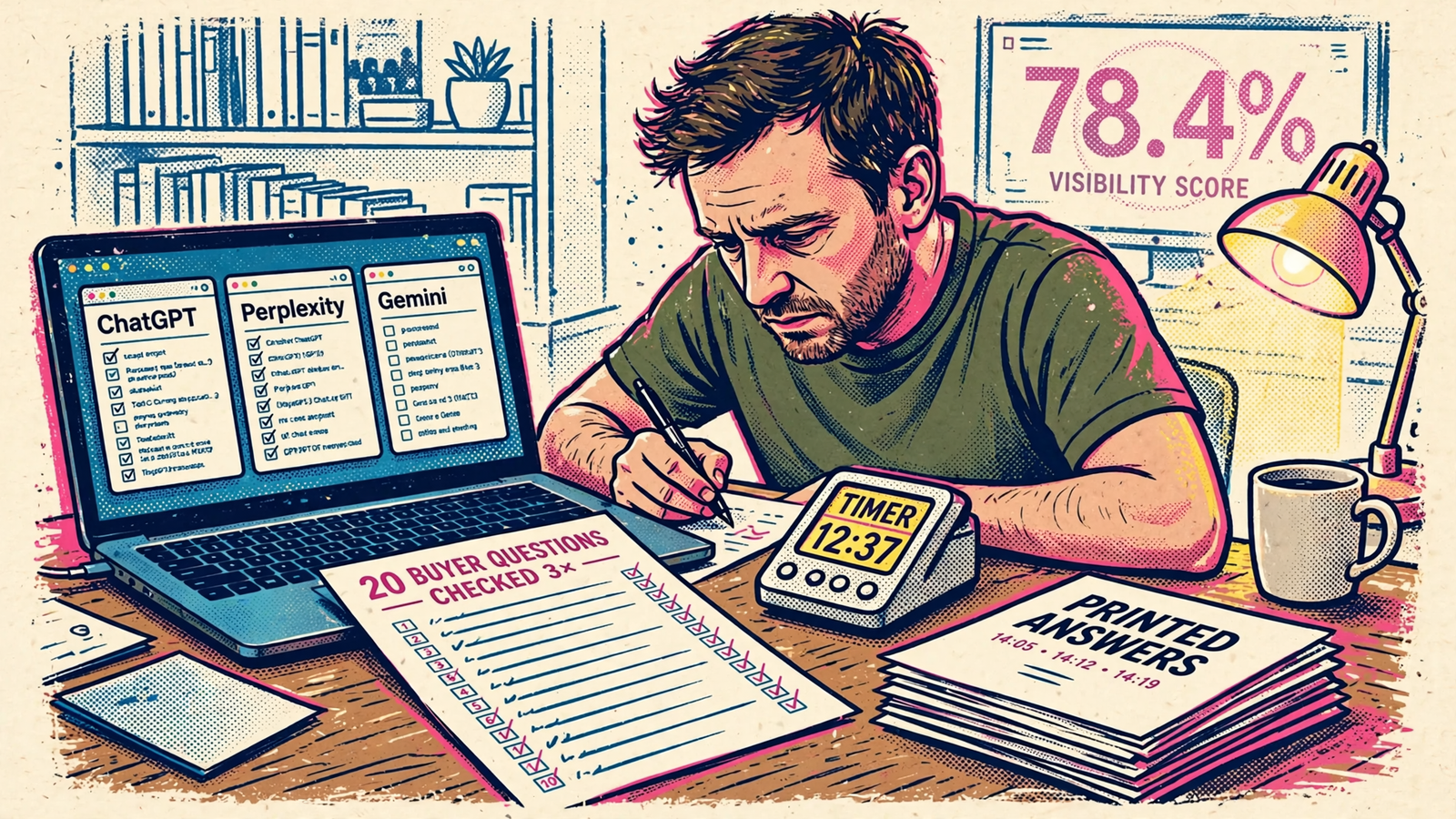
Start with the same 20 buyer questions on ChatGPT, Perplexity and Gemini, three runs each. Collect once in week one and repeat in week two without changing the questions in between. You do not need perfect coverage to begin. You need a small test that remains the same long enough to compare its results.
-
Set up the sheet before collecting: date, engine, interface, visible model information, account state, exact prompt, answer text, mention yes/no, recommendation yes/no, cited URL and competitors named. Use the same columns for both rounds. Do not make the second week’s record more detailed and then mistake that extra detail for a change in visibility.

-
Bring the completed sheet to the demo. Ask which of your 20 prompts the tool would track, how many repeat runs support its score, and whether its Perplexity number comes from a live check or an index lookup. A useful answer names the sampling method and export format. A score alone does not answer the question.
-
Keep the core panel stable if you continue manually. Re-run it every two weeks using the same engines, account state and columns. Add a question when a real buyer exposes a gap, but give that new prompt its own two-week baseline. Keep the original panel identifiable so additions do not erase the comparison you already built.
-
Apply the same standard to groas: bring the sheet, ask what evidence supports the measurement, and buy execution where the misses point to work nobody owns. Pay for publishing and fixes you can inspect, not a prettier score. The baseline should make a vendor’s job clearer, not disappear as soon as a sales presentation starts.
-
Keep every miss and report appearances against observations. This is the item most often skipped: everyone saves the screenshot where they get named, while the empty runs disappear. Skip it and you enter a trial with no denominator. The vendor supplies one, and you pay $29 to $295 per month to watch a number you cannot audit. Without the misses, you are not buying a defensible measurement. You are renting a score that can move when somebody changes the questions.


