

 LinkedIn

A cheap booked demo is not permission to scale ChatGPT Ads. For a business with a 90-day sales cycle, it is permission to start waiting. I would not approve a launch until the team can trace ad interaction to booking, attended meeting, qualified opportunity and eventual revenue, with written rules for what stays unmeasurable. Otherwise, marketing celebrates cost per demo while sales ignores the bookings. Use these six gates to approve a bounded test, fix the gaps or decline it. A booking is an intermediate signal, not the business result. Every gate needs an owner and evidence, not reassurance on a sales call.
Gate 1: Prove access and record the limits
- Confirm who can actually see the ads, in writing. Ads serve logged-in adults on Free and Go tiers; Plus, Pro, Business, Enterprise and Edu see no ads. For B2B, that audience restriction belongs in the launch decision, not a footnote discovered after spend starts.
- Verify current advertiser eligibility inside Ads Manager. Ask the provider to show the account in a screen-share; a service page saying “we run ChatGPT Ads” does not prove that your campaign can launch.
- Confirm that you own the ad account access. Put that confirmation beside the eligibility evidence so approval does not depend entirely on what an agency says it can see or do.
- Record the targeting that does not exist before signing. Targeting uses ad-group context hints, not keywords or firmographics, and hints do not guarantee delivery. In beta, do not plan around job titles, company size, ABM lists, retargeting or lookalikes.
- Ask for delivery expectations specific to your niche. Early pilots report thin delivery, irrelevant placements and limited reporting. Treat a promise of precise B2B reach as a claim to prove, not a capability to assume.
- File the eligibility evidence, audience restrictions and missing-targeting list together. The approval needs to reflect the channel available now, not the version described in a pitch deck or promised on a roadmap.
Gate 2: Define the demo sales will accept
- Write the definition before choosing the conversion event. A booked demo is not yet a customer; optimizing toward whoever completes a form fastest does not resolve whether sales should work that booking.
- List the qualifying criteria: employee band, titles, geography, technology fit and explicit exclusions. Keep the criteria concrete enough that marketing and sales can apply the same rule to the same record.
- Get sales to sign the acceptance rule and rejection reasons. The common failure is simple: marketing counts the demo, sales discards it, and nobody records why. A shared definition has to survive contact with an actual booking.
- Track four stages separately: booked demos, attended meetings, qualified opportunities and closed-won. Do not collapse them into “demos” in the approval document, dashboard or agency report. Each stage answers a different question about the test.
- Identify the earliest predictive signal available now. The timeline can run from a qualified form on Day 0 to attendance in 3–14 days, sales acceptance in 5–21 days, opportunity in 10–45 days and closed-won in 45–120 days or more.
- Separate the signal used for optimization from the outcome used to approve scale. Do not make the platform wait 90 days for its only signal, but do not let an early form submission stand in for eventual revenue either.
Gate 3: Prove the measurement chain with a test booking
- Run one test booking from the landing page through the CRM before funding the campaign. Check the actual record at each step; a pixel firing does not prove that source information reaches the people judging lead quality.
- Verify the exact event names and matching data objects. The pixel requires names such as
lead_createdandappointment_scheduled, rather than GA4 names such asleadorpurchase. Check the Ads Manager Warnings panel rather than relying on the browser console alone. - Confirm that the intended conversion stack is live. The described setup combines the pixel, Conversions API and image fallback. Record what the test submission actually sends instead of treating an installed script as completed measurement.
- Pass source information into the CRM on the test lead. Native reporting does not provide a pipeline view, and CRM integration is described as roadmap rather than live. Use UTMs and an explicit CRM goal; do not assume a native connection fills the gap.
- Deduplicate the test lead against existing contacts and check the surviving record. Confirm that the source remains visible to sales and can stay attached as the record progresses to opportunity and closed-won.
- Capture the share that click tracking misses without pretending to make it precise. Add an optional, open-text “How did you hear about us?” question after commitment, and have sales ask on the first call. Store the raw response in the CRM.
- Write down what remains unmeasurable. Keep self-reported attribution identifiable as self-reported, and state where there is no traceable connection. The approval needs an honest boundary, not a report that quietly turns every unknown into channel credit.
- Verify which downstream events can actually return to the platform. Do not assume that a closed-won stage in the CRM can be imported back simply because the team already does something similar in Google Ads.
- Check import timing separately for existing Google workflows. GCLID-based offline conversions generally need uploading within 90 days of the click; enhanced conversions for leads have a 63-day window. A deal closing on day 95 needs an earlier-stage signal for that workflow.
- Keep CRM measurement distinct from platform optimization. A familiar Google Ads offline-conversion workflow does not prove the equivalent path exists here. Prove this channel’s path on its own test record before approving spend.
Gate 4: Test the page, scheduler and sales handoff
- Match the ad promise to the page headline, offer and booking step. If the ad promises a demo, the page should book a demo, not route the visitor into a newsletter subscription with a different expectation.
- Put instant scheduling on the thank-you step. Qualified-to-booked rates are reported around 30% without a scheduler versus 66.7% with instant scheduling. Fix that handoff before spending the test debating button color while leads wait for a reply.
- Assign response ownership and a response window. Write down who calls, how quickly they act and what happens after hours. “Sales follows up” is not a handoff rule; it is a place for bookings to disappear.
- Check how far out the calendar pushes meetings. Reported no-show rates rise to 24.5% for bookings seven or more days away, compared with 6.9% for same-day meetings. Include that delay when reviewing attendance, not just booking volume.
- Require sales to log a rejection reason. An average of 14.1% of demo forms are disqualified. Record why each rejected lead fails the agreed criteria; a discarded form with no reason teaches the next decision nothing.
- Complete the handoff using the test booking. Confirm that the scheduler works, the right person receives the record, the source is visible and the acceptance or rejection rule can actually be applied.
Gate 5: Sign the loss limit before the first click
- Set the test budget and maximum acceptable loss in writing. If the media plan is, say, $20k per month, approve the boundary before launch rather than deciding how much patience to buy after the money starts leaving.
- Separate management fees from media spend in the order. groas charges a flat monthly fee, not a percentage of spend, so increasing the budget does not increase its pay. If a provider charges a percentage, put that incentive on paper.
- Verify the current minimum inside the Ads Manager signup flow. Published figures conflict, ranging from large pilot commitments to daily budgets, while documentation indicates no minimum. Do not build the financial approval around an agency’s unverified minimum-spend claim.
- Require written approval before any budget increase. A test budget is not an opening bid. Keep the person accountable for the loss limit attached to the decision to spend more, even when cost per booked demo looks attractive.
- Agree the pause conditions before launch: cost per qualified meeting above target for two weeks, zero attended meetings after a specified spend, or broken tracking. Fill in the thresholds before the campaign gives everyone a reason to argue.
- Set the review window to the sales cycle. A 90-day close cannot be judged on 14 days of clicks, but that does not excuse ignoring attendance or qualification while waiting for revenue. Review the stage that has had time to mature.
- Put finance’s approval beside the loss limit, pause rules and review date. If finance will not sign the boundary, do not sign the insertion order. An open-ended test is an open wallet, not a learning plan.
Gate 6: Specify the report and the next decision
- Show spend, bookings, attendance, qualification and opportunity progression on separate lines. Do not accept one blended demo number that hides the gap between submitting a form, showing up and becoming a deal sales will pursue.
- Review cohorts on matching timelines. Use daily checks for execution, 30 days for qualification and meeting rate, 60 days for opportunities, and 90–120 days for revenue and CAC. Keep the review dates in the report itself.
- Label immature cohorts as immature. A 21-day-old cohort with no closed-won revenue is 21 days old; do not compare its seven-day revenue with the 120-day revenue of a mature campaign and call that a performance verdict.
- Require an action log with reasoning and outcomes. Every change should be recorded in plain language. What the deck calls full-funnel visibility should not turn out to mean a PDF of observations with no record of what changed.
- Name the owner of the next decision. groas pairs continuous execution with a human strategist who owns the outcome; the report should make that accountability visible rather than leaving the next move somewhere between agency, marketing and sales.
- Judge scale against pipeline, not cheaper clicks or bookings alone. Keep demo-request optimization separate from winning pipeline. An attractive top-of-funnel number cannot overrule the qualification and opportunity evidence the test exists to collect.
- Recheck the measurement path after launch. If Gate 3 breaks, pause spend until a test lead flows cleanly again. A report cannot establish the demo-to-revenue connection when the source has stopped surviving the handoff.
Final sign-off: launch, fix first or decline
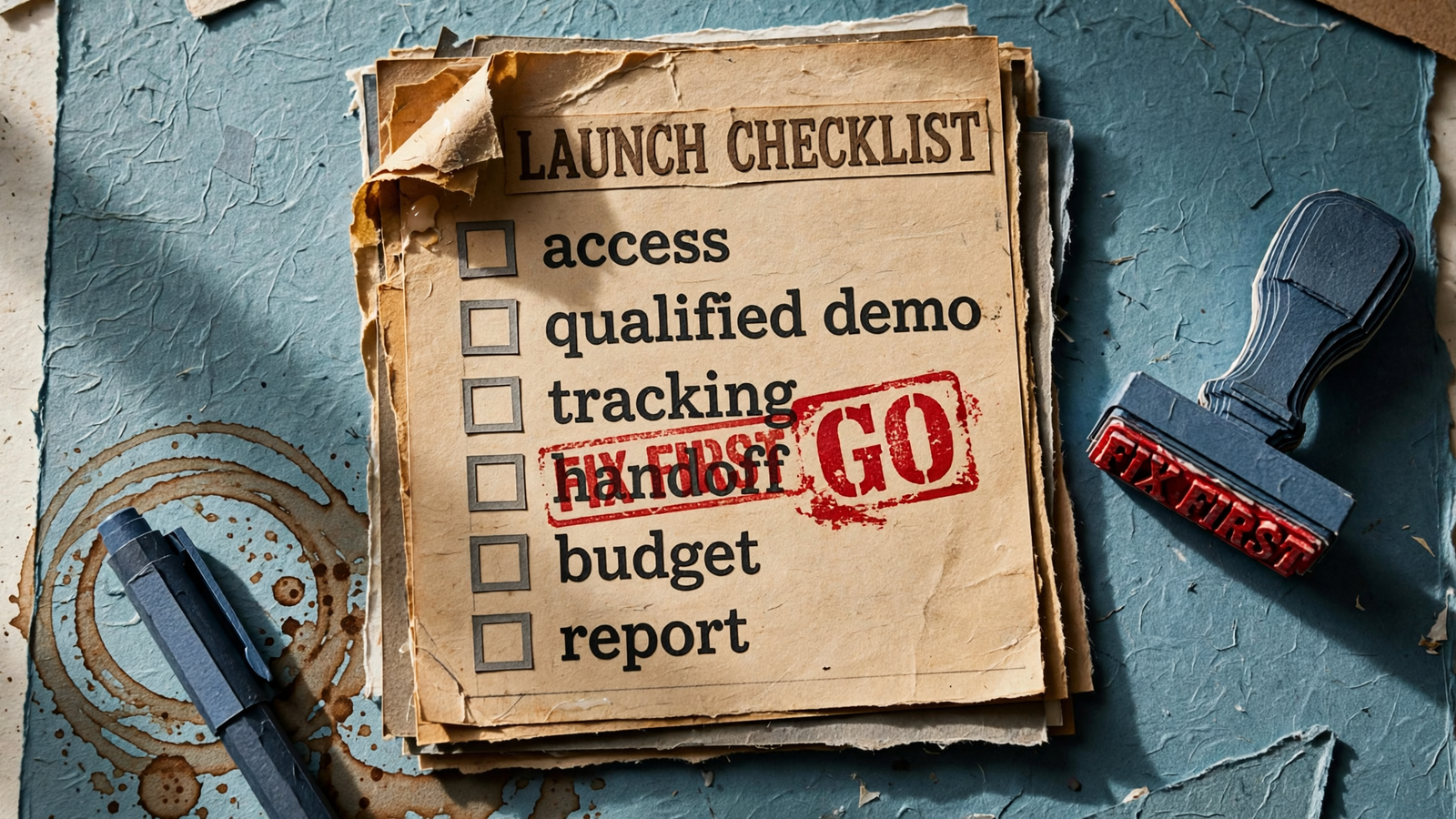
- Give every gate an owner and evidence. Copy this sheet into the approval document; a “Go” needs the record, screenshot or signed rule named in its row.
| Gate | Owner | Evidence to file | Decision |
|---|---|---|---|
| 1. Access and limits verified | Paid lead | Ads Manager screenshot, eligibility note, missing-targeting list | Go / Fix first / Decline |
| 2. Qualified demo defined | Sales + marketing | Qualification criteria, exclusions, acceptance rule, four-stage tracker | Go / Fix first / Decline |
| 3. Measurement proven | Marketing ops | Test booking with source, event checks, deduplication rule, measurement limits | Go / Fix first / Decline |
| 4. Page and handoff tested | Demand + SDR lead | Working scheduler, response window, routing, rejection reasons | Go / Fix first / Decline |
| 5. Guardrails signed | Finance + paid lead | Fee/media split, maximum loss, pause rules, review date | Go / Fix first / Decline |
| 6. Report and owner agreed | Agency / groas strategist | Report mock-up, cohort labels, action log, named decision owner | Go / Fix first / Decline |
- Fund a bounded test only when every gate has evidence. Fix an unresolved gap before launch; decline the test when the traceable path or agreed loss limit is missing. A promising channel does not get an exemption from the approval rules.
- Bring these six gates to groas if you want the pre-flight run for you. You set the goals and budget; a named strategist owns the outcome, with a flat fee and actions logged with reasoning. Book a consultation and make approval depend on a test record, not a sales-call promise.
- Finish with the item most often skipped: preserve source through to closed-won and label what cannot be measured. Do not stop at “the pixel fired.” Check that source survives deduplication, reaches sales and remains attached to the opportunity. Skip this, and the cost is familiar: scale the cheapest bookings, starve the meetings and opportunities that need 60 days to appear, then report a low cost per demo while pipeline misses. No source in the CRM, no scale.


