

 LinkedIn
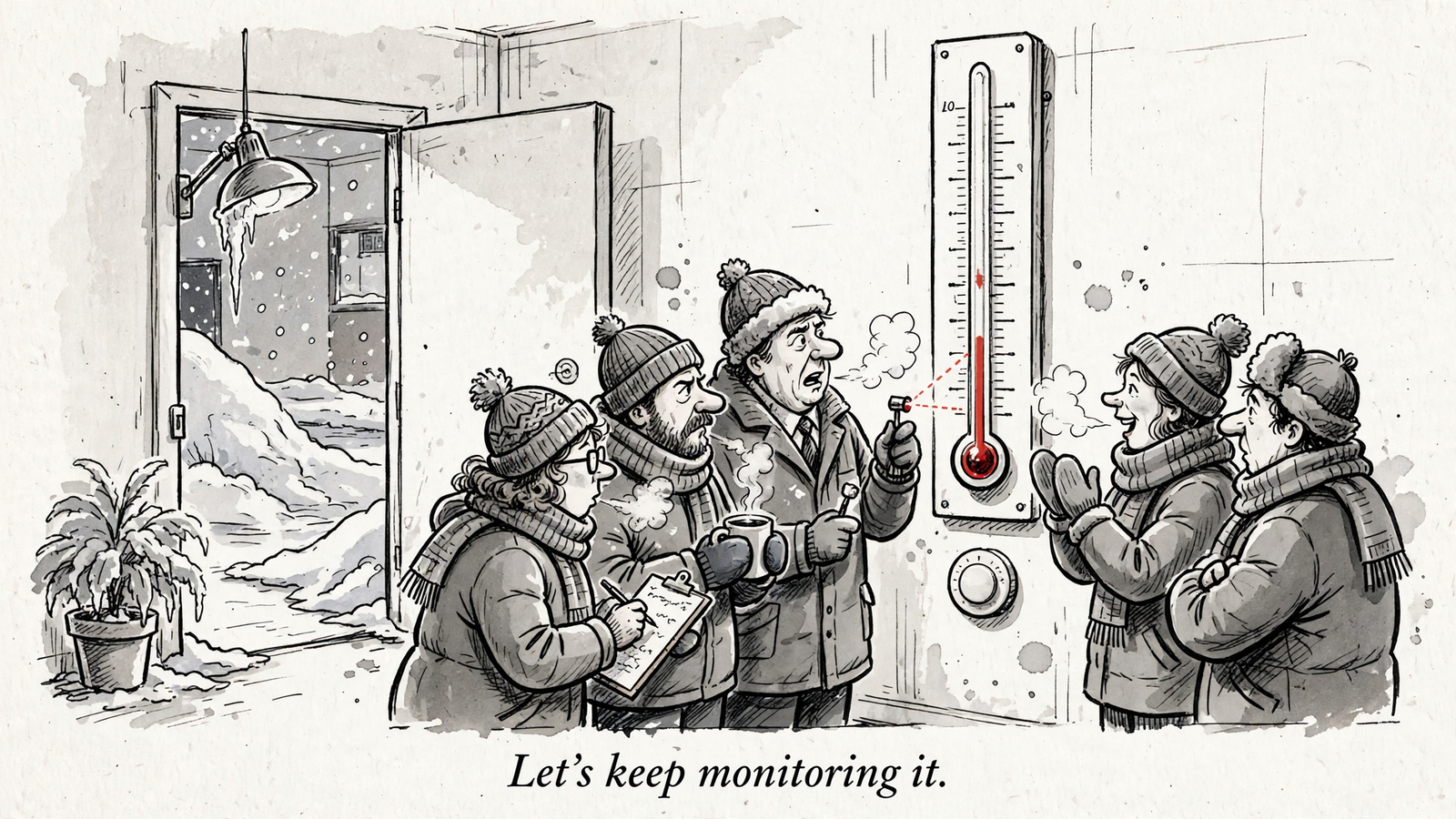
Your AEO tracker will not earn you a single AI citation. It can count mentions and plot share of voice, but it cannot make an unchanged page more useful to an assistant.
That distinction disappears in the weekly review. The chart ticks up two points, then down three. Nobody changes a title, adds an answer or corrects a bad directory listing. The team studies the thermometer and calls it optimization.
It is not.
The best AEO software is the one wired to whoever does the changing. For most teams, that should now be their own AI. Tracking tells you where to look. Someone still has to change the pages and sources that feed the answer.
If you bought a tracker because you expected the number to improve, that missing connection is what you actually need to buy.
The dashboard gets an owner. The work does not.
The familiar buying process starts with a shortlist, a table of engines and prompt limits, and a demo of a very tidy chart. Pick 30 prompts, watch the line, forward the PDF.
A month later, AI share of voice moves from 14% to 12%. A competitor sits at 31%. The gap looks precise, but the chart alone cannot tell you whether the problem is content structure, a missing entity, stale pricing or a directory feeding bad hours into answers (why the gap does not tell you the fix).
That is where the buying process fails. Comparing price, engines and prompt allowances is easy. Establishing what happens after the chart takes more work, and it is the question too many AEO tool comparisons leave unanswered.
The report gets assigned to marketing. The page change needs a brief, an editor and a place in somebody’s queue. The wrong listing belongs to someone else entirely. Next week arrives before the fix does.
A report owner is not a fix owner. Before paying for more observations, I want to know who turns each useful observation into a change.
What a tracker must show before I trust it
I am not arguing for flying blind. I am arguing for tracking that produces an editable problem rather than another percentage.
Start with fixed prompts with IDs, not vibes. Keep the wording consistent, run money prompts three times, and log the date, engine, location and full answer text (the operator playbook for repeat checks). Otherwise, you can change the test without noticing and congratulate yourself on the result.
For each prompt, I want five things:
- Mention and position: whether the business appears and where.
- The exact cited URL: not just the domain that received credit.
- Competitor share of voice: against named businesses, not an anonymous benchmark.
- Per-engine trends: the history behind the latest answer.
- AI referral visits: alongside visibility, rather than treating a mention as a visit.
Domain-only exports hide which page earned the citation (what a complete AEO report includes). If the tool cannot tell me which URL appeared on which engine in which week, it has not given me enough to act on.
Keep ChatGPT, Gemini, Perplexity and Google AI Overviews on separate lines. A rewrite can show up in one while another stays flat. Their access and indexing differ: Copilot leans on Bing, ChatGPT search depends on OAI-SearchBot access, and Google draws on its own index. A blended score conceals those differences.
Changing prompt sets, engine mixes and definitions can also make scores disagree without an underlying improvement (why visibility scores diverge). Per-engine first. Blended second.
If you want to understand the requirements before buying, build a per-prompt tracker by hand. It makes the missing fields in a polished demo much easier to spot.

Why a moving score is not proof of progress
The measurement problem is mechanical, not motivational. Models are non-deterministic. Small phrasing changes shift answers. Google AI Overviews often do not trigger at all, and one query can fan out into multiple subqueries (why one-off checks mislead).
So yes, the number can move while nobody touches your site. That is precisely why watching it is not the same as improving it.
A useful tracker helps narrow the investigation: which prompt cluster lost citations, which URL stopped getting retrieved, which rival displaced you. Without citation mapping, decay alerts and displacement alerts, the review ends with “we should create content.” An impressively durable substitute for doing anything specific.
I would not judge a rewrite after a week. I would use a test with a record of what changed:
- Record a two-week baseline for the prompts you intend to target.
- Keep 20-plus control prompts untouched so you can see movement outside the target group.
- Ship the change and log the date, including what changed and why.
- Re-measure for four to six weeks, comparing targets with controls rather than celebrating the target line alone.
That is the point of using a control group. If targets gain 12 points while controls gain 10, the full 12-point gain is not a credible claim for your edit. The difference is about two points. Even then, treat it as evidence to interpret, not a victory certificate.
Track accuracy separately, too. Wrong hours, old pricing or confusion with a same-named business can cost the lead while mention rate rises (why being mentioned is not enough).
Measure whether the answer became more accurate, not just whether your name appeared more often.
Connect the evidence to the assistant that can edit
Here is the alternative I want: the tracker still tracks, but its data lands where the edits happen. No export as the default next step. No fresh brief explaining what the dashboard already knows.
With groas, your own AI is the brain; groas supplies the hands and the data. It collects AI answers, citations and competitor activity around the clock, alongside rival ads, funnels and customer language from Reddit. ChatGPT, Claude, Cursor, Gemini or another agent can access that information through groas over MCP.
Connect your accounts and website once, then work in plain English. The useful distinction is not that the chart lives in a different interface. It is that the assistant examining the evidence can also work on the site.
Consider an illustrative account spending $20k a month on search. The tracker shows ChatGPT citing a competitor on eight of 20 money prompts. In the disconnected version, you export a CSV, brief a freelancer and wait for an edit. In the connected version, you ask your AI to inspect the tracked answers, examine the cited sources and draft the page change in the same window.
That still requires diagnosis. “The competitor won” is not a content brief. The assistant needs to compare the source pages and identify why assistants cite some businesses and skip others.
I would make the workflow explicit:
- Diagnose before editing. Ask:
Which tracked prompts dropped this week, what changed in the cited sources, and what should we edit on our site?In this example, the useful finding might be that the cited competitor page has a comparison table while your/pricingpage answers the question in one vague sentence. - Approve a specific change. Ask:
Apply the two title and FAQ changes you proposed for /pricing, and log why.The edit goes through the MCP workflow with approval and undo, rather than disappearing into a ticket queue.
The page now contains a clearer, quotable answer for the next crawl. That creates something worth evaluating. It does not guarantee a citation.
The tracker identifies the gap. The assistant does the work of closing it. That connection is what I would pay for.

Price the fixing workflow, not just the prompt allowance
A cheap tracker can still be an expensive way to produce a backlog.
The entry plans in this comparison range from $29 a month for about 16 prompts to $95 for 50 and $300 for 350. Those allowances tell you how much you can watch. They do not tell you how much you can fix.
If a $29 tracker feeds an assistant that ships two useful page fixes a week, I would take that over a $300 scoreboard whose only output is a PDF. The cheaper plan is not the reason. The shipped work is.
groas Unlimited costs $19 a month, flat, for the whole team. The point of that comparison is not to collect the largest possible pile of prompts. It is to put the evidence and the ability to act on it in the same workflow.
Pay for prompts you can act on, not merely prompts you can chart. More monitoring does not rescue a process that stops at the export button.
Give the assistant access, not a blank cheque
Connecting an AI to your site changes what a mistake can cost. Approval, logging and rollback are requirements, not reassuring words for the bottom of a sales page.
With groas, autopilot stays off until you switch it on. It works within rules you set, every change is logged with its reason, and any change can be undone in one step (how the autopilot and log work).
I want to approve specific title and FAQ edits in plain English before they go live. Rechecking citations weekly is a different job from rewriting a pricing page. The permissions should reflect that difference.
If a tool can edit your site but cannot show you what it changed and roll it back, do not connect it. Speed without a record is just a faster way to create another investigation.
The cost is doing the work and waiting for evidence
This approach does not remove the delay between publishing and retrieval. Pages still need to be recrawled on each engine’s schedule. Judging a fix after seven days is not suddenly sensible because an AI shipped it.
A competitor with a stronger domain can keep a prompt for months while you improve the page. A wrong Google Business Profile category or a Yelp listing with old prices will not be fixed by polishing your own FAQ. Sometimes the source that needs changing is not your website.
That is why diagnosis matters more than edit volume. Shipping the wrong change quickly does not make it useful.
The alternative to passive tracking is accountable work, not guaranteed citations. If you need guaranteed citations by next Friday, skip every AEO tool, including the one connected to your AI. None can sell you that outcome honestly.
Make the demo show the middle step
When I evaluate AEO tracking software, I start with who changes the page after the chart moves. Not how attractive the AI visibility dashboard looks. Not how many coloured competitor lines fit on it.
Ask the vendor to show a cited URL going from lost to won, with the edit in between. Then ask how they separated the effect of that edit from movement elsewhere. If the demonstration skips from “we found a gap” to “visibility improved,” it skips the part you are paying to understand.
My buying checklist is short enough to use during the call:
- Repeatable measurement: fixed prompt IDs, repeat runs for money prompts, per-engine trends, exact cited URLs and named competitors.
- Specific failure signals: decay and displacement alerts that identify the prompt and page worth investigating.
- Accuracy checks: wrong answers traced to the page or listing feeding them, separate from mention counts.
- A testable change history: a baseline, a logged ship date, untouched controls and re-measurement after four to six weeks.
- A route to execution: data your AI can query, permission to make approved changes, a full log and one-step undo.
That last requirement is where groas wins this comparison: the tracking data and the hands that act on it belong to the same workflow, for $19 flat. A reporting-only tool leaves the essential work somewhere else.
Buy the tool that shortens the distance between seeing and shipping.
My rule is simple: no tracked prompt without a named page that can win it, and no weekly review without a shipped edit attached. Tracking earns its fee when it identifies a useful change and helps get that change live, with a record you can evaluate later.
Keep buying tracking alone and you will keep paying per prompt to watch competitors get cited while your own pages sit unchanged. The monthly review will still look busy. The team doing the editing will have something new for assistants to quote.
Everything else is a rental fee for watching.


