

 LinkedIn

Splitting a tight SEO budget between content and citations can leave you with two unfinished jobs. Should your first dollar fix your buyer pages or earn third-party mentions? Smart operators disagree because useful pages give search engines something to cite, while outside references give them reasons to recommend you. My argument: fund whichever constraint makes the other work pointless.
Say you have $1,500 to $2,000 a month. That is enough for one real job done well, not two jobs done thin. One camp says spend it where you have control: answer buyer questions, state prices and service areas, and make the site readable for machines. The other says control is the problem: your own claims are not independent evidence.
I will argue both sides at full strength before ruling. The distinction matters whether your immediate concern is Google visibility or getting named in a ChatGPT recommendation. Buying an equal amount of each workstream is an allocation. It is not a diagnosis.
Position one: give search engines a buyer page worth citing
The case for owned pages is simple and unglamorous. A search engine cannot quote facts it cannot find. A page that blocks crawlers, buries the answer, or never states the basics gives it very little to work with. Opting out of OpenAI’s search crawler affects inclusion in ChatGPT search answers. Access comes before clever wording.
I used to tell clients content volume was the lever. I was wrong. Think of a plumber with three clear buyer pages covering price, service area, and emergency callouts, versus a competitor with 40 thin blog posts. The first gives an answer engine something useful to lift. The second gives it a reading assignment.
The citation data supports taking owned pages seriously. In one BrightLocal study of roughly 200,000 non-branded local prompts, business websites supplied 42% of citations, ahead of Google Business Profile at around 29% and Yelp near 9.5%. In page-level rewrite tests, adding direct quotations lifted visibility 41%, statistics added 31%, and citing sources added 27%, while keyword stuffing hurt by 8%.
The mechanism is straightforward: specific, checkable facts make a page citable. Before paying for more content, make the pages that matter accessible and useful. I start with:
- One reachable page for each money question.
- Hours, service areas, and prices or price ranges stated clearly.
- A phone number in text a crawler can copy.
- Consistent business facts across the site and listings.
- Checks on
robots.txt, search-crawler access, and clean HTML on key pages.
It is boring work. It is also the work that matters when your best page is blocked or your Google Business Profile says closed while Yelp says open. Publishing more on top of that mess gives models more pages to ignore.
Position two: give search engines independent reasons to choose you
The strongest case for mentions starts with the difference between finding a fact and making a recommendation. An answer about which plumber or software to choose draws on more than your homepage. Your page makes your case. A review site, local news piece, or trade list supplies an outside reference.
An AirOps study of 21,311 brand mentions found brands were 6.5 times more likely to be mentioned through third-party sources than through their own websites. Outside corroboration gives an answer engine more than a business repeating its own claims. That is the mentions-first argument: you can be readable and quotable without becoming the recommendation.
Relevance and repeated presence matter more than a placement count. Across 75,000 brands, Ahrefs found that branded web mentions correlated with AI Overview visibility at r=0.664, against r=0.218 for backlinks. Another analysis found a brand present in six or more cited pages was six times more likely to be recommended than one present in a single page, while 96% of brands appearing for the first time were not recommended.
I read that as a warning against quota thinking, not a shopping list for six placements. Buy relevant corroboration, not a pile of miscellaneous listings. A detailed mention on a page buyers already use for your category serves a different purpose from another directory entry containing little more than your name.
For a business with strong buyer pages and little outside recognition, another self-published article may address the wrong problem. The facts are already there. What is missing is someone else repeating them.
Where each argument breaks
The honest objection to pages-first is that another good page rarely fixes a trust gap. If ten competitors all claim same-day service and five-star quality, a clearer paragraph does not settle the choice. AuthorityTech’s read of a Muck Rack sample of 25M+ cited links found 84% came from earned third-party media the brand neither owns nor pays for.
That sample and the local-query study above cover different territory. I would not turn either into a universal spending rule. Together, they expose the ceiling of the owned-page argument: making yourself readable does not automatically make you the preferred answer.
The objection to mentions-first is just as blunt: mentions cannot repair a site that wastes the click. A local write-up cannot fix a page with no prices, a contact form that errors on mobile, or three different business names across the website, Google profile, and Yelp.
Nor does appearing in a citation guarantee a recommendation. One sample found 62% of AI citations produced no brand mention at all, and only 13.2% of brands were both cited and mentioned. If your pages offer no substantive answer, an outside reference can point at an empty chair.

So I do not ask which workstream sounds more persuasive in a sales deck. I ask which failure is stopping the other one from doing its job.
Test for the bottleneck before buying the work
I start with a small, repeatable check rather than one flattering screenshot:
- Choose five buyer questions relevant to the business.
- Run each in ChatGPT and Google AI Mode.
- Repeat the same questions on a different day.
- Record whether the business is cited for facts, named as an option, or absent.
- Compare that pattern with the actual condition of the buyer pages and outside references.
One answer is not a measurement. When the same ChatGPT prompt was run twice in one day, only 41% of cited domains repeated. I look for a pattern across runs, not a single result that happens to support the service someone wants to sell.
Absence alone does not prove the website is the problem. It tells me where to start checking. Being cited but not recommended is a reason to inspect corroboration, not proof that the model has issued a private verdict on the brand’s trustworthiness.
Fund pages first when the source is missing or muddled
The evidence for owned-page work is concrete:
- No page directly answers the buyer’s money question.
- Prices or service areas live only in images or PDFs.
- Key pages are blocked or difficult to read.
- The website contradicts business listings.
- Every page promises quality service you can trust without numbers, a process, or a named guarantee.
That last one is weak differentiation wearing a clean shirt. If the page gives a buyer nothing specific to compare, publishing more of the same does not help.
Small-business retainers for this kind of managed work cluster at $1,500 to $5,000 a month. At the bottom of that range, spreading the budget across unrelated deliverables is expensive indecision. Fix the source before renting more signals.
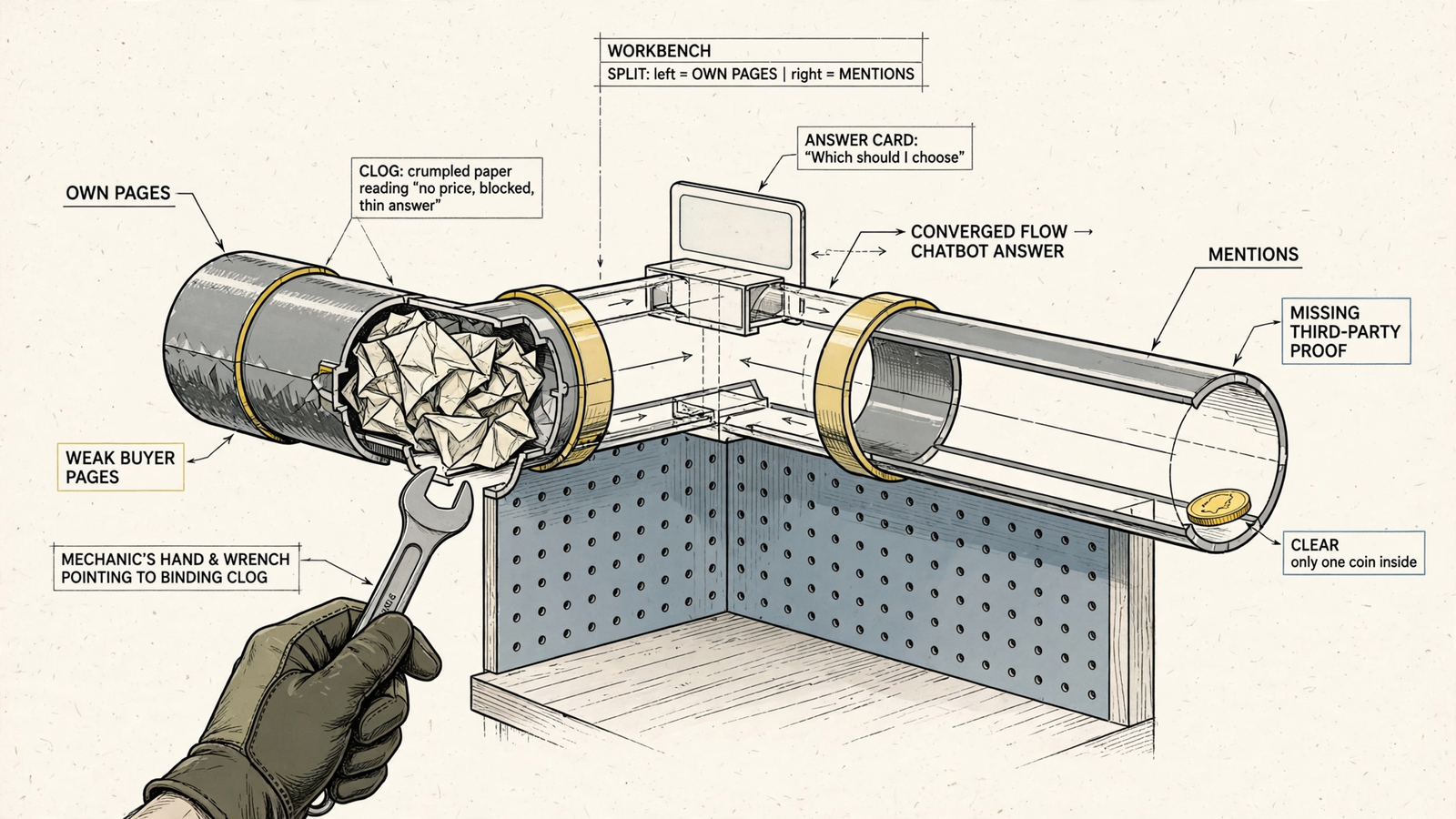
Fund mentions first when useful pages lack outside support
The opposite case starts with two or three genuinely useful buyer pages. They load cleanly, state concrete facts, and answer the questions customers ask. Repeated prompt tests cite those facts but skip the business when the question becomes which should I choose? Outside references are sparse.
That combination makes mentions the stronger next investment. The pages already do their basic job; another ten blog posts do not address the missing corroboration.
The citation-versus-recommendation gap appears elsewhere, too. One analysis found Google AI Overviews cited brand sources in 87% of cases but named a brand in only 20.7% of responses. Being the source of a statistic is not being the answer.
Neither fix guarantees a recommendation. Models also pull from pages covering follow-up questions, not just the main query. A correct page and one useful mention can still leave gaps in the evidence available for a comparison. Budget for becoming a credible choice, not merely appearing in a footnote.
My verdict: fund the constraint, not a 50/50 bundle
If I had $1,500 to spend for a client tomorrow, I would not automatically split it between content and citations. Splitting feels balanced. When both jobs need concentrated work, it buys diluted effort on two fronts.
The deciding consideration is which failure makes the other spend pointless. For a business without useful, accessible buyer pages, I take the pages-first side. For a business with strong pages, repeated factual citations, and little relevant outside support, I take the mentions-first side.
That is a spending decision, not a diplomatic draw. One workstream gets funded properly. The other stays on maintenance until the evidence changes.
Here is the allocation sheet I use:
| What the checks show | Fund first | Keep on maintenance | Reassess when |
|---|---|---|---|
| Missing buyer answers, blocked pages, or contradictory business facts | Buyer pages and access fixes | Basic listings accuracy | Pages are readable, useful, and begin appearing in repeated tests |
| Useful pages get cited, but the business is skipped in recommendations and lacks outside references | Relevant third-party mentions | Keep page facts current | Repeated tests show whether recommendations are changing |
| Both pages and outside support are weak | Access plus one or two money pages, then mentions | Defer unrelated production | The source is useful enough for outside references to support |
I do not use six mentions or two successful test runs as a magic graduation threshold. The research describes patterns; it does not hand every small business the same switch date. The practical rule is simpler: fix the obvious source failure first, then reassess whether outside support is the remaining constraint.
Make the provider defend that allocation
A pitch that starts with deliverable counts is selling production before diagnosis. I ask for four things in writing before signing:
- The test questions. Which five buyer questions will they check, on which engines, and how often will they rerun them?
- The page changes. Which pages need work, and what useful fact will each change add?
- The mention targets. Which publications, lists, or review pages matter for this category, and why?
- Separate reporting. What work shipped, and what visibility actually appeared?
Eight pages published cannot substitute for named in three of ten runs. One measures production. The other records what happened in the tests. If a provider cannot name the questions or explain the sources, they are guessing with your $1,500.
That is why I point tight-budget owners toward either a narrow fix or a fixed-fee service able to address the actual constraint. groas offers SEO and AI search work at a flat $1,499 a month per service. Its scope includes new pages, technical fixes, and authority building, with work tracked in a weekly report. That is a better fit for this problem than buying a quota of pages or miscellaneous citations regardless of what is broken. The allocation still needs a defense; a flat fee is not the diagnosis.
If the bottleneck is one missing service page, do the cheaper thing first: run the 30-day owner-led test to fix access and answer structure before buying ongoing mentions. If the pages already do their job and outside support is missing, do not buy another ten blog posts.
My verdict for the tight-budget owner is not equal spending. It is concentrated spending on the failure that makes the rest useless. Buy the bottleneck.


