

 LinkedIn
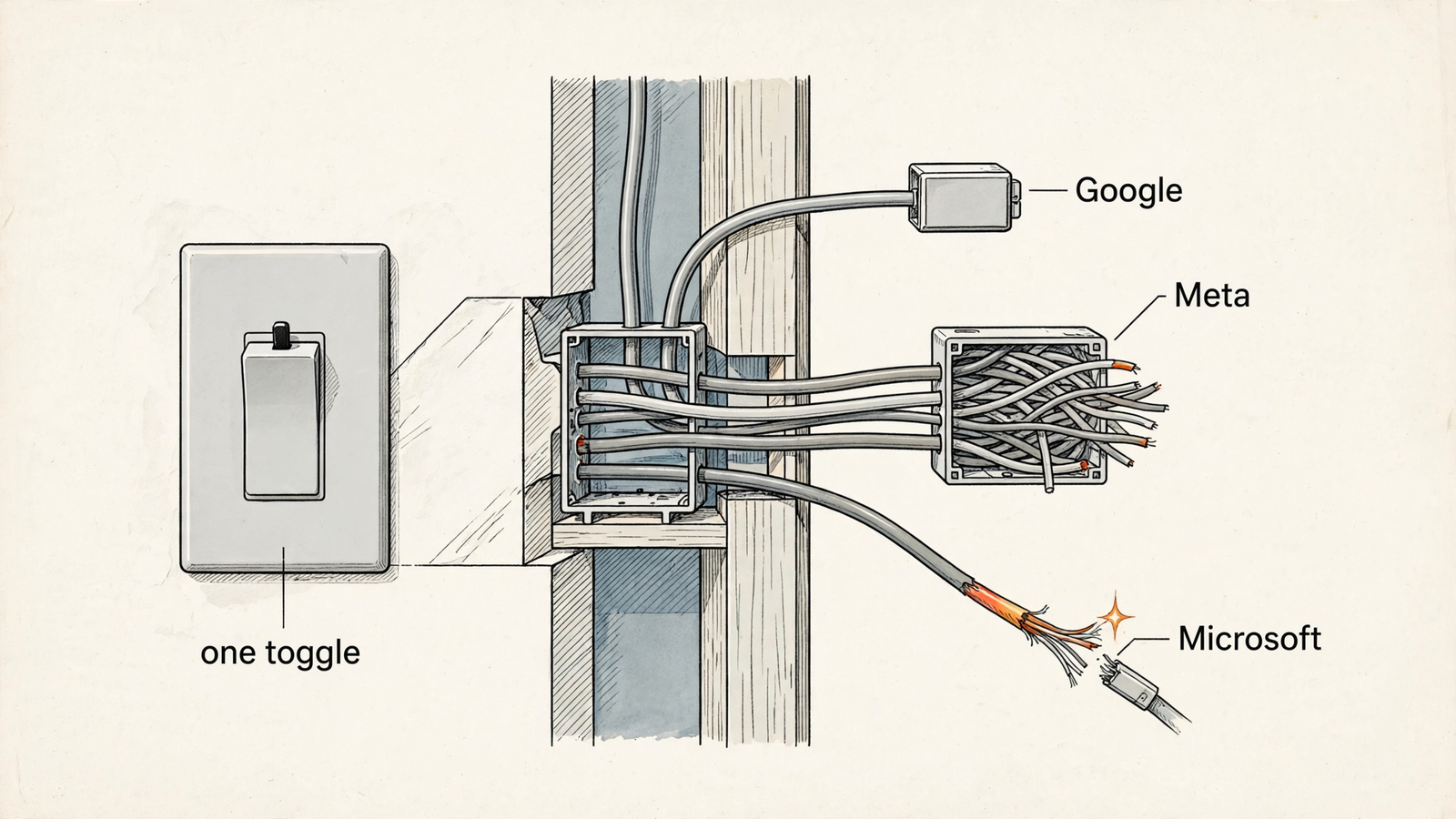
By 31 December 2027, at least three multi-platform marketing providers in my ten-name scorecard will publicly document how they reach Google Ads: through their own dedicated Google Cloud project and a direct connection. That’s when I expect the argument over one marketing MCP versus separate connectors to stop being about how many connections you set up and start being about what you can verify behind them.
I spent years mining negative keywords at 1 a.m. for small ecommerce accounts. I like a shortcut as much as anyone who’s had to pull four exports to answer one question. One toggle in Claude or ChatGPT is a good shortcut. It isn’t one route. Behind it sit separate routes to Google, Meta and Microsoft, each with its own permissions and its own way of breaking. I’d rather set up one interface than juggle separate connectors. I’d also rather not learn how that interface works from a support ticket.
Google gave buyers a concrete reason to ask what’s behind the toggle. Its 31 August 2026 announcement requires a dedicated Cloud project and direct access to Google Ads services. That’s a specific architecture requirement, not a preference about how many buttons a customer clicks. I’m making three calls about what providers will put in writing as that distinction starts to matter in buying decisions. All three can be checked without a sales call.
Prediction one: three providers will show how they reach Google Ads
By 31 December 2027, at least three multi-platform providers in the cohort will publicly document their dedicated Google Cloud project setup and direct route to Google Ads. The mechanism is procurement pressure. Once Google requires both, “we connect to Google Ads” stops being a useful answer in a security review. I want to know whose Cloud project carries the calls and whether they go directly to Google Ads services. Neither answer is visible in the assistant’s connector menu.
Google’s reasoning is more useful than the usual security boilerplate. Put many advertisers behind one proxy and you risk data leaking between customers or someone gaining access to an account they shouldn’t. Push high volumes through that same route and throttling can hit advertisers who weren’t responsible for the spike. The point isn’t that a single interface is risky by definition. It’s that a single interface tells me nothing about whether the route underneath is shared.
PPC Land’s reading of the updated developer policies says the ban on programmatic proxies covers MCP servers that re-expose Google Ads capabilities, alongside hosted interfaces and wrapper services that do the same. It also describes carve-outs for using the API yourself and for downloading an open-source tool and connecting it with your own credentials. None of that tells me whether a named vendor complies. It doesn’t tell me how Meta or Microsoft handle access, either. I can use Google’s rule to ask a better question. I can’t use it to grade a provider I haven’t inspected.
The gap is visible in what providers already publish. Dataslayer’s MCP page explains the convenience pitch: one read-only connection, underlying connectors it maintains, OAuth 2.1, and control over which accounts you connect or revoke. What that page doesn’t explain is whose dedicated Cloud project carries the Google calls or whether the route is direct. That’s a gap in the page, not proof of a gap in the architecture.
There’s a reason I don’t just point every buyer to the official Google connector and call it a day. The rundown of Google’s official MCP server v0.0.6 lists seven tools registered by default: three read tools and four with limited write capabilities. No budget changes, bid changes, pauses or negative-keyword moves. I want one place to work across platforms, not a different tool every time I move from reading an account to proposing a change. That makes the access story behind the broader interface worth asking for.
I’m wrong if fewer than three qualifying providers publish both parts by the deadline. A page that says direct but doesn’t explain the dedicated project setup doesn’t count. I’d ask for the page before I shortlist the product, not after I connect the account.
Prediction two: three providers will say what still works during an outage
By 31 December 2027, at least three multi-platform providers in the cohort will document what stays working when one platform connection fails. Support tickets will drive this one. A single toggle trains buyers to ask, “Can you see my ads?” It doesn’t train them to ask what the assistant does on Sunday when the Meta token expires halfway through a cross-platform request.
A report that needs Google and Meta isn’t the same as a request to read Microsoft on its own. If Meta is down, I want the first request to show what’s missing. I don’t want the second to stop just because it came through the same interface. And if I’ve asked for an action rather than a report, I want to know whether it stops outright or sits in a queue. “Some functionality may be unavailable” doesn’t help me decide what to do about spend.
The MCP failure-modes rundown already describes the sort of fallback a provider can spell out: return a cached answer, use a narrower tool, hand the request to a human, or say it can’t be done. Those are different outcomes. I might accept a cached answer to get my bearings. I don’t want the assistant treating that same answer as current when it proposes a budget move. The useful documentation says which fallback applies, not just that there is one.
There’s already an example of a boundary worth seeing in writing. Meta’s hosted server supports per-account rules that can block an action such as a budget increase above a threshold. A blocked action isn’t an outage, but the distinction matters to the operator: did the account rule stop the change, or did the connection fail? From the buying side, I want the interface to tell me which happened, not leave me wondering whether to try the same request again.
I’m wrong if fewer than three qualifying providers publish a concrete cross-platform failure example by the deadline. I’d start with one question: If Google goes down, what can I still do in Meta? I’d want separate answers for reading data and making changes.
Prediction three: three providers will document platform-by-platform consent
By 31 December 2027, at least three multi-platform providers in the cohort will document how to authorize or revoke one platform independently of the others. The mechanism is least privilege. I can want one place to ask about three ad platforms without wanting a single permission decision for all three. The useful control is the one that lets me say yes to one route and no to another without rebuilding the whole setup.
Dataslayer already documents account selection and revocation with OAuth 2.1. That shows what documentation about granular consent can look like. It isn’t, by itself, proof that I can remove one platform and leave another running. The assistant side points to a different constraint: Meta’s server is added to Claude by URL as a custom connector and takes the Free plan’s single custom-connector slot. The slot limit makes one interface attractive. It doesn’t make one blanket permission attractive.
My buying test is simple: show me where I remove Meta and keep Google live. If the answer is a full disconnect, the product is still selling me a smaller connector count. If the answer is a named settings page with separate controls, I keep it on the shortlist. I’m wrong if fewer than three qualifying providers document independent authorization or revocation by the deadline. For my own shortlist, I’m asking to see revocation. That’s the control I don’t want to hunt for when I need it.
The ten-name scorecard
Count public documentation, not what a vendor says on a call. My fixed list is Google’s official Ads MCP, Meta’s hosted Ads MCP, Dataslayer, Windsor.ai, Supermetrics, Funnel, Coupler, Improvado, Adverity and groas. The two official servers are single-platform benchmarks, not multi-platform providers. They stay on the list for comparison; their platform-specific docs don’t count toward the three-provider threshold.
The baseline is what each publishes when this post goes live. I’ll score the same list again on 31 December 2027, with a separate tally for each prediction:
- Google access: Public docs explain both the dedicated Cloud project setup and the direct route to Google Ads.
- Partial failure: Public docs show what continues and what stops when one platform connection fails.
- Consent: Public docs show how to authorize or revoke one platform without changing access to the others.
The same three providers don’t have to pass all three tests. A provider can be clear about Google access and tell me nothing about an outage. I’ll score it accordingly. No credit for a demo answer in Claude, a salesperson’s promise or a reviewer guessing how the connection works from how fast it responds. I want a page the security team can save and the operator can find again. For the policy detail behind the first test, see Google’s Ads Integration Policy: What I’d Check Before Connecting Claude.

What I’d connect now in Claude or ChatGPT
I’d connect one interface and inspect the routes behind it. That’s how I use groas: one MCP in Claude or ChatGPT for Google Ads, Meta, Microsoft and the site, plus competitor and Reddit data. I’d take that setup over separate native connectors for cross-channel work. I want the accounts and the surrounding research in the same place, without having to join everything myself. For the longer version of that tradeoff, see All-in-One Marketing MCP vs Separate Connectors: Stop Being the Join Key.
For a cross-channel request, I start with this:
List the connected platforms and which ones this request needs. If a required source is unavailable, stop rather than substitute another account or platform.
Then I ask for a scoped read. If I’m considering a change, I ask for the proposal and review it before anything executes. The mistake I’m trying to catch isn’t a number that looks obviously wrong. It’s a plausible number pulled from the wrong account or last week’s cache and used to justify a budget move. The prompt gives me something to check. It doesn’t enforce permissions or prove the connection is secure.
The line I’d take to the budget owner
We’re buying one working interface and requiring evidence about the connections underneath. On an account spending, say, $20k a month, I don’t want a weekly report to mean four exports and a lookup sheet. I also don’t want the time I save on the report back in the form of a support thread about which account the assistant read.
I’d put three questions in the business case: Whose Cloud project carries the Google calls? What stays live when one platform fails? Where do I revoke Meta without touching Google? Google’s rule gives me a reason to insist on the first answer. It doesn’t supply the other two, and it doesn’t tell me how any particular provider built its connection. That’s the provider’s job to show. If the pages exist, convenience is a feature. If they don’t, convenience is opacity with a nicer name.
I don’t need to wait until December 2027 to buy that way. I’d connect once, make the assistant name its sources on every spend question, and bookmark the revoke page. Before renewal, I’d screenshot the three pages that matter: access, partial failure and revocation. If a provider updates them without being asked, that tells me where the market is moving. If they’re still blank two quarters later, I plan spend reviews as though that single toggle could be a single point of failure.





