

 LinkedIn
By November 2027, at least three AI advertising tools will ship a savings ledger separating platform filtering, platform credits and spend avoided by the tool’s own changes. Tools that claim credit for money Google already filtered or refunded will face a credibility problem.
The trigger shipped on 12 November 2026, when Google announced the Invalid Traffic Overview Card for Google Ads. The interface puts two figures side by side: Estimated savings, covering invalid activity stopped before billing, and Credited cost, covering invalid activity found after you were charged. Google’s own help page adds the important distinction: filtered-click columns and credit amounts are not directly related.
The platform is telling buyers, in writing, that money never billed and money refunded belong in separate ledgers.
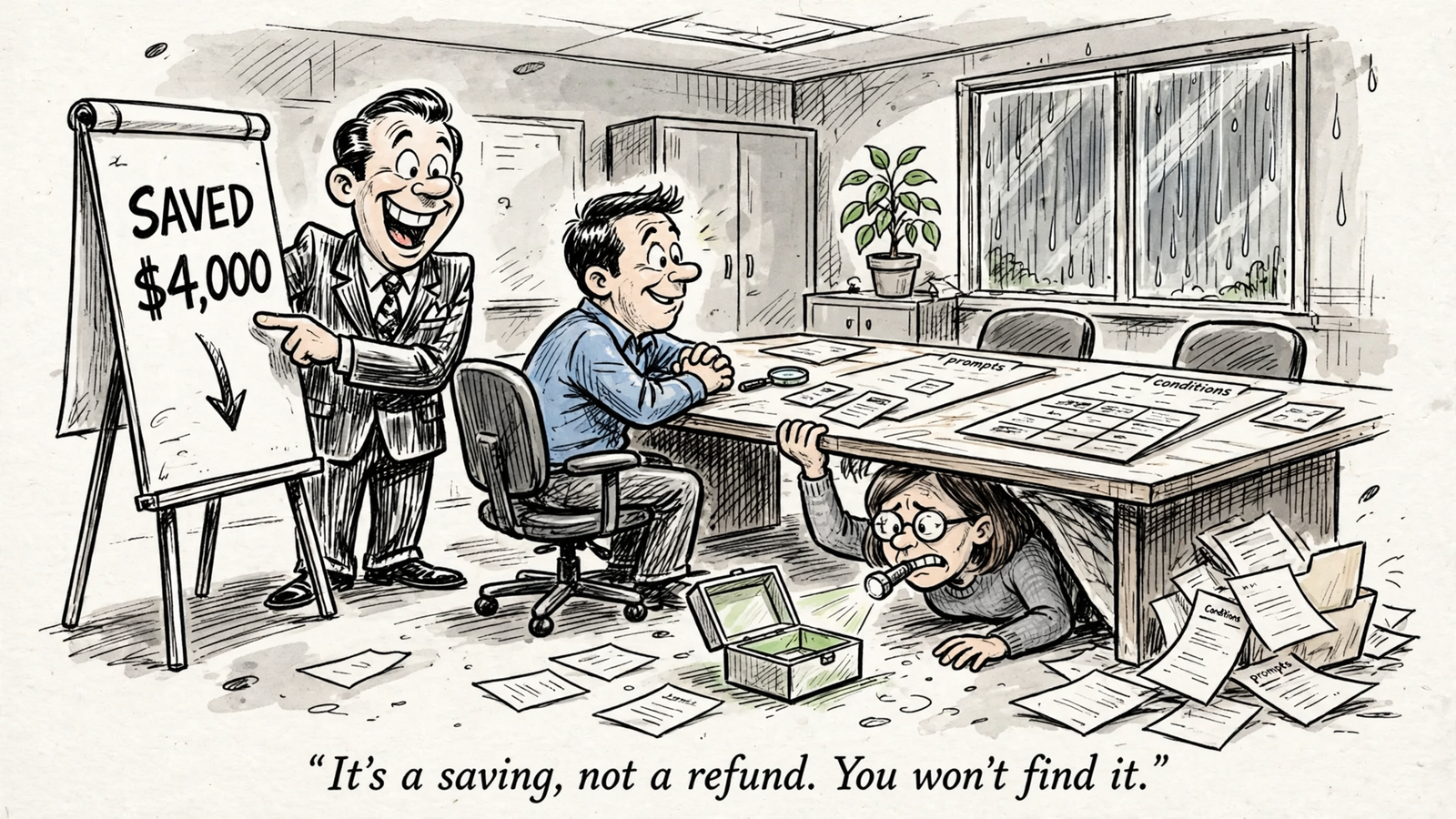
What happens next is familiar to anyone who has faced a client with an invoice open. The tool’s quarterly slide says $4,000 saved. The client hears “refund.” Finance hunts for the credit. It is not there, because it never was one: the figure estimated activity Google chose not to charge for, using a valuation method Google has not published.
As PPC Land noted when the card launched, that is Google’s accounting in Google’s interface, not an independent measure of invalid traffic. An AI tool cannot turn it into its own achievement by putting a logo above it.
Google’s 30% figure is not your account’s savings
Google’s announcement includes a number destined for sales decks: “so far in 2026, we’ve reduced advertiser exposure to invalid leads by an average of 30%.” That measures exposure to invalid leads, not dollars. It is an average, not an account-level result.
When a tool or agency presents that 30% as evidence of what it saved a particular client, it converts a platform statistic into a personal claim. A platform-wide percentage is not proof of your account’s savings.
The reporting discipline that survives this predates the card. Pathmonk’s guidance for agencies amounts to three rules:
- Keep spend exactly as the invoice shows it.
- Publish a human-only CPA beside reported CPA.
- Label each recovery claim
pending,creditedwith the invoice date, ornot granted.
Never book a credit before the billing adjustment appears. And never blend these three quantities:
- Filtered before billing: money the platform never charged.
- Credited after billing: money returned on a statement.
- Avoided through intervention: spend prevented by a change you or your tool made.
That last category still needs evidence. A lower run rate is not automatically better business performance, and pausing traffic does not establish what would have happened without the pause. The ledger must keep estimates, transactions and measured outcomes apart.
Prediction 1: By November 2027, three AI ad products will offer evidence-linked savings records
A qualifying savings record needs four parts. I will hold every vendor to all four:
- Source: the platform report or invoice line behind the figure.
- Period: the exact dates it covers.
- Intervention: what the tool changed, logged with its reason.
- Calculation: the arithmetic, visible to the buyer.
Not “saved $4,000,” but an illustrative record like this:
Paused these 11 search terms on 3 March after they spent $1,840 at 0 conversions over 60 days. Estimated monthly run-rate reduction: about $920 at last month’s spend pattern.
The first number is a mood. The second is an estimate someone can inspect. It does not prove incremental improvement, but it gives the buyer something more useful than confidence.
The mechanism is competitive pressure. Once one vendor exposes the arithmetic, the next vendor’s unsupported headline becomes harder to defend. Buyers can ask the same question in every demo: “Show me the record behind that number.”
The action record already exists
This prediction does not require vendors to invent an entirely new category of evidence. It starts with recording what changed and why.
With groas, every change is logged with its reason, any change can be undone in one step, and autopilot stays off until you switch it on. Those controls supply an auditable action record. They do not, by themselves, prove a savings claim. That requires the other three parts: source, period and calculation.
That distinction matters. A product feature available today is evidence of what can be audited today. A promised reporting feature is still a promise.
Buyers are already questioning the label
In one r/DigitalMarketing discussion of AI ad-management tools, practitioners describe many tools at this price point as rules engines wearing an AI label. The thread’s practical advice is less glamorous: cap automated budget shifts at 10–15%, keep one north-star metric per client, and put guardrails ahead of faith.
It also names a pricing conflict the ledger will make harder to ignore: percentage-of-spend fees that rise with the budget. When the vendor’s invoice scales with spend, a promise to reduce spend deserves particularly clear arithmetic.
What proves this prediction wrong: fewer than three AI ad products offer savings records containing source, period, intervention and calculation by November 2027. An action log alone does not count. Neither does a dashboard with “saved” in large type.
Prediction 2: By November 2027, one product will reconcile savings claims with platform credits
The ledger’s second job is to stop three different quantities becoming one impressive total.
A platform filters activity before billing. A credit arrives after billing. A tool changes where the budget goes. Each event has a different source, timing and claim on the word saved.
Credits also create a reporting mismatch. Google’s campaign metrics freeze at month-end; a later credit does not retroactively rewrite the Cost or CPA already reported. That is why the walkthrough on reconciling clicks, analytics and card charges keeps three source documents open rather than trusting one dashboard to merge them.
The useful feature is reconciliation, not a bigger savings total. The report must show which amount came from platform protection, which appeared as a credit and which followed a tool-executed change. Otherwise, the buyer cannot tell whether two claims describe the same dollar.
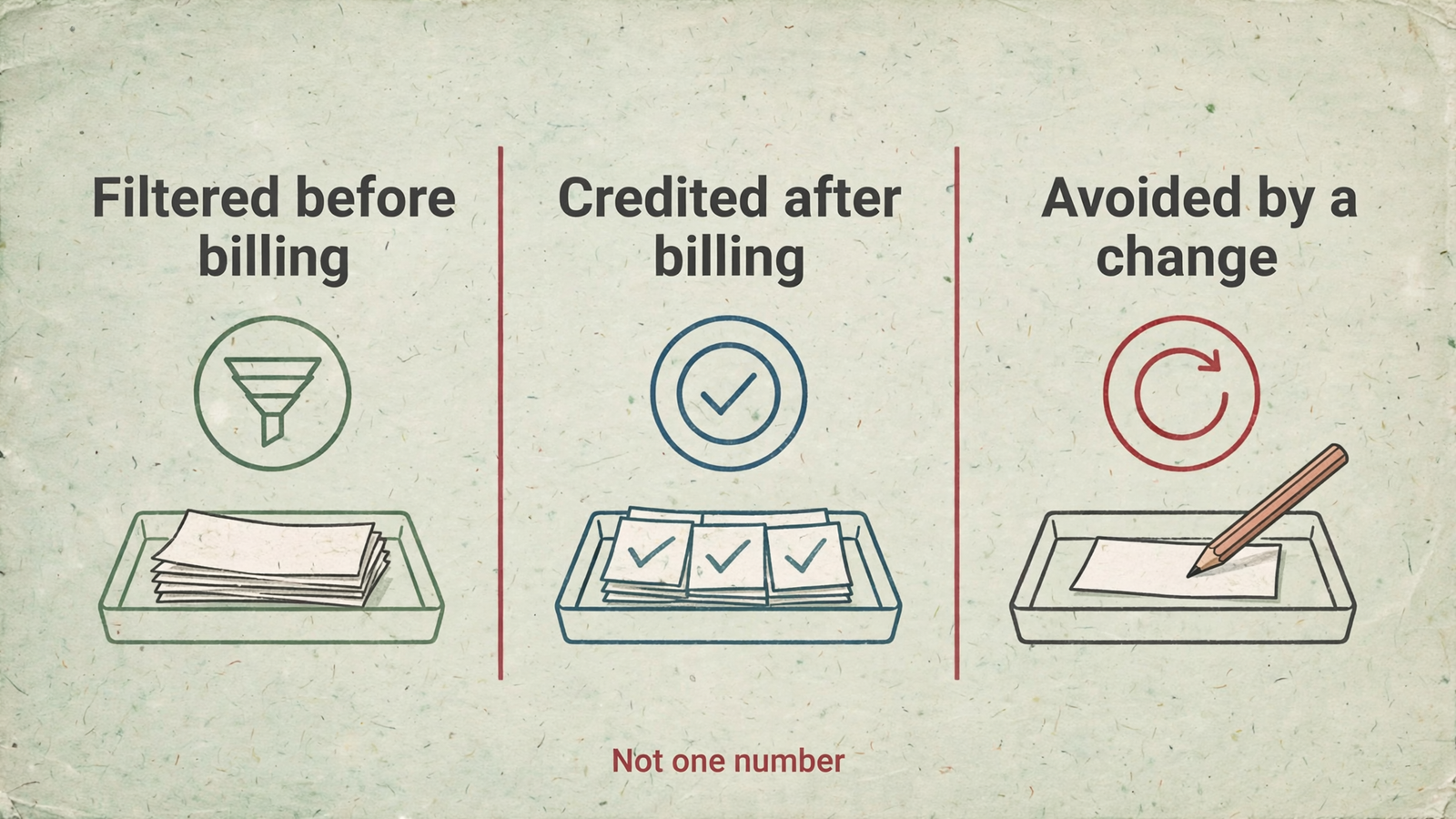
The evidence today is the gap between the platform’s separate metrics and the blended savings story vendors want to tell. Finance eventually has to reconcile that story with a bill. A product that performs the reconciliation gives the buyer a record they can actually use.
My forecast is deliberately modest: one product, not universal adoption. The first useful implementation need not make the accounting look glamorous. It needs to make double-counting visible.
What proves this prediction wrong: by November 2027, no AI ad product explicitly separates filtered-before-billing, credited-after-billing and intervention-linked avoided spend in its savings reporting. Three labels wrapped around one unexplained total will not qualify.
Prediction 3: By November 2027, two vendors will lead with measured lift rather than action counts
The action log is not going anywhere. “We made 340 changes this month” is easy to produce and easy to defend in a meeting. What loses credibility is the leap from we acted to it worked.
The mechanism is measurement literacy, acquired one painful quarter at a time. Pixis’s research puts the gap at 91% of marketing teams using AI but only 41% confident they can prove its ROI. It also names the failure mode: dashboards can credit conversions that would have happened anyway.
The defensible response is old and boring: a baseline, a holdout group and incremental lift as the causal test. Report which outcomes are supported by incrementality and which are merely attributed. Once a buyer asks for that distinction, the vendor comparison changes.
The counter-evidence is worth naming. DoubleVerify’s 2026 report says 98% of marketers using AI bidding reported performance improvements. But the quoted question asks, “How did AI bidding solutions improve campaign performance last year?” It presumes improvement, and the responses are self-reported rather than measured lift.
The same report puts transparency into optimization decisions among the top concerns at 60%, alongside data quality and brand suitability. Buyers can like the results they report and still want to know how those results were produced. That is the opening for outcome-linked reporting.
In one r/googleads discussion of AI Max, a commenter describes the concern plainly: AI Max “siphons variant and broad matches that search would have already picked up on,” then presents those conversions as its own lift. The commenter’s verdict: “the reported impact on metrics seems disingenuous.”
That is a practitioner’s account, not a controlled test. But it captures the question a controlled test should answer: did the change create an outcome, or acquire credit for one?
A savings claim must say where the money went
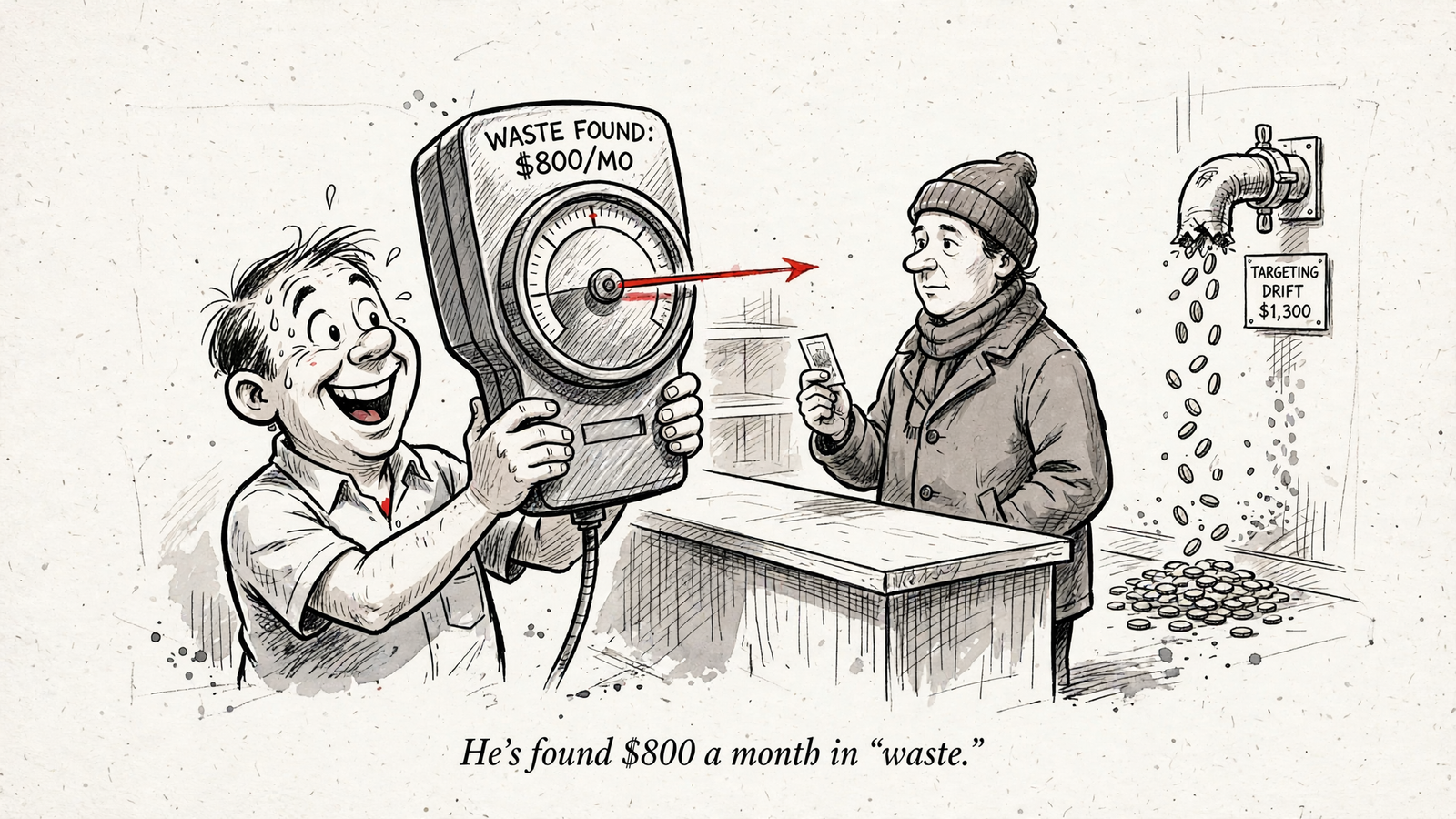
The “we found $X a month in waste” screenshot has the same problem. Cascader’s teardown follows an $800-a-month waste flag that counted brand traffic when nothing was wrong, while a $1,300 flag reflected real targeting drift. Similar-looking flags, opposite verdicts. The headline cannot tell the buyer which one they have.
The teardown also shows a “12-month” waste projection that simply multiplies the 90-day figure by four. And it includes a line worth pinning above an agency desk:
Blocking terms “does not refund your budget, it moves it.”
Say an account spends $20k a month and a tool blocks 10% of it. That $2,000 either stays unspent or buys different clicks. Only the unspent amount reduces the bill; redirected spend needs its own performance test.
My prediction is that at least two vendors will make holdout-tested incremental lift a lead selling point by November 2027, rather than relying on action counts as their primary proof.
What proves this prediction wrong: fewer than two vendors meet that test by the deadline. More charts about attributed conversions do not count.
What I would demand before next season
These forecasts only matter if buyers ask for the evidence. Before next season’s budget goes live, I would paste this into ChatGPT with groas connected:
List our changes and their reasons. Separate observed outcomes, estimated savings and platform-issued credits. Identify any platform-filtered amounts separately. Mark unavailable evidence.
Each instruction does a different job: retrieve the action record, separate the claims, keep platform protection distinct and expose the gaps. “Evidence unavailable” is a useful answer. An invented reconciliation is not.
Supply billing evidence when the connection cannot retrieve it
An ad-account connection is not a substitute for the invoice, card statement or credit memo. If the connection cannot retrieve those documents, keep them beside the chat and supply them separately.
For billing questions, the invoice wins. For causal performance questions, the invoice is not enough. It can confirm what was charged or credited; it cannot prove whether a campaign change created incremental conversions.
I would run the billing reconciliation walkthrough before sending a quarterly savings number to finance. Match the evidence to the claim: billing documents for charges and credits, action records for interventions, and a causal test for incremental lift.
Keep autopilot off until the rules are explicit
The operating order remains simple:
- Name the goals.
- Set the budget limits.
- Define approval rules.
- Only then enable autonomous changes.
In one r/PPC post-mortem, a solo advertiser with about 50 purchase conversions a month describes following ChatGPT’s bidding advice, changing a previously profitable setup and watching campaigns stop serving. The account spent under half its planned monthly budget. The closing line: “maybe experience does matter.”
It does. That is why groas keeps autopilot off until you switch it on, logs every change with its reason and lets any change be undone in one step. The machine handles the clicking. The guardrails come first.
Revisit in November 2027: the scorecard
A prediction without a falsifier is a horoscope. Here is the scorecard I expect to be held to, with November 2027 as the deadline for all three.
| Prediction | Confirmed if | Falsified if |
|---|---|---|
| Three AI ad products offer evidence-linked savings records | At least three provide source, period, intervention and calculation | Fewer than three meet all four requirements |
| One product reconciles savings with platform credits | At least one separates platform filtering, credits and intervention-linked avoided spend | No product provides that separation |
| Two vendors lead with measured lift | At least two lead with holdout-tested incremental lift rather than action counts | Fewer than two meet that test |
If the results land mostly in the right-hand column, tell me. I will write the correction myself: here is what I predicted, here is what happened, here is why I was wrong. The tools worth trusting are the ones whose claims can fail in public.
What to do now is straightforward. Run the prompt against the AI setup already on the payroll. If it separates outcomes, estimates, filtering and credits, inspect the supporting records. If it returns one confident number without arithmetic, ask again before treating that number as money saved.
If I am right, that reporting habit will matter more than another dashboard badge by November 2027. For an action log with reasons behind every change, groas is $19 a month, with one-step undo. Start with what can be audited today. Make the savings claim earn its place.


