

 LinkedIn

By December 31, 2027, I expect managed SEO reports to separate traffic loss from business loss instead of treating every missing click as a recovery target. Providers who keep selling “more content to replace the traffic” without explaining which visits mattered will get fired first.
I spent years watching this confusion in Google Ads accounts before I saw it in SEO. A client would lose 20% of clicks, panic, then admit qualified calls had not moved. Now the same split shows up in search: in the State of Search 2027 survey, 39% of professionals said traffic stayed flat or declined while leads and conversions held or improved, against only 15% who lost both.
The missing click is not automatically a missing customer. If your DIY publishing has stalled and you are shopping for done-for-you help, that distinction should decide who gets hired. Diagnose the loss before buying the recovery.
Falling traffic needs a diagnosis, not another content brief
I used to tell clients traffic was the early warning and leads were the lagging confirmation. I was wrong to treat that as a rule. The sequence breaks when answers resolve on the results page. In early 2026, 68.01% of US Google searches ended without a visit, up from 60.45% in 2024. The opportunity to earn a click can shrink even when you do nothing wrong.
Publishing more posts without asking which pages lost what is how owners burn six months and call it SEO.
The loss is not even across intent, which is why a total-sessions chart cannot give you the diagnosis. Across 300,000 keywords, the top result saw about 58% lower click-through when an AI Overview appeared. One 53-brand study found AI Overviews on 36% of informational queries but only 8% of commercial and 5% of transactional ones.
A lost how-to visit and a lost buyer visit do not belong in the same recovery bucket. Some informational questions get answered on Google. Buyer pages can still earn the visit. Your provider needs to show the difference page by page, not guess from the sitewide trend.
That same survey warns against the lazy interpretation. The clicks that remain can carry stronger intent, but not every lost visit is harmless. You need a page-level and pipeline check to know which is which. A broken template, a consent banner eating measurement, or three buyer pages slipping from position two to position nine can all sit behind a traffic drop. Blaming AI for everything leaves the real fault untouched for another quarter.
Attribution adds another complication. One estimate puts AI influence as underattributed by about 10x, while brands cited by AI saw direct visits rise as search visits ran about 15% lower. That does not make every direct visit an AI win. It means the channel labels alone cannot settle the argument.
Start with the pages and the business outcomes. Then decide what needs rescuing.
Prediction 1: Buyer pages will get their own reporting
By December 31, 2027, I expect managed SEO reports to split the site into two ledgers:
- The informational ledger: visits that inform but rarely buy.
- The buyer ledger: buyer visits, qualified leads, and revenue by page.
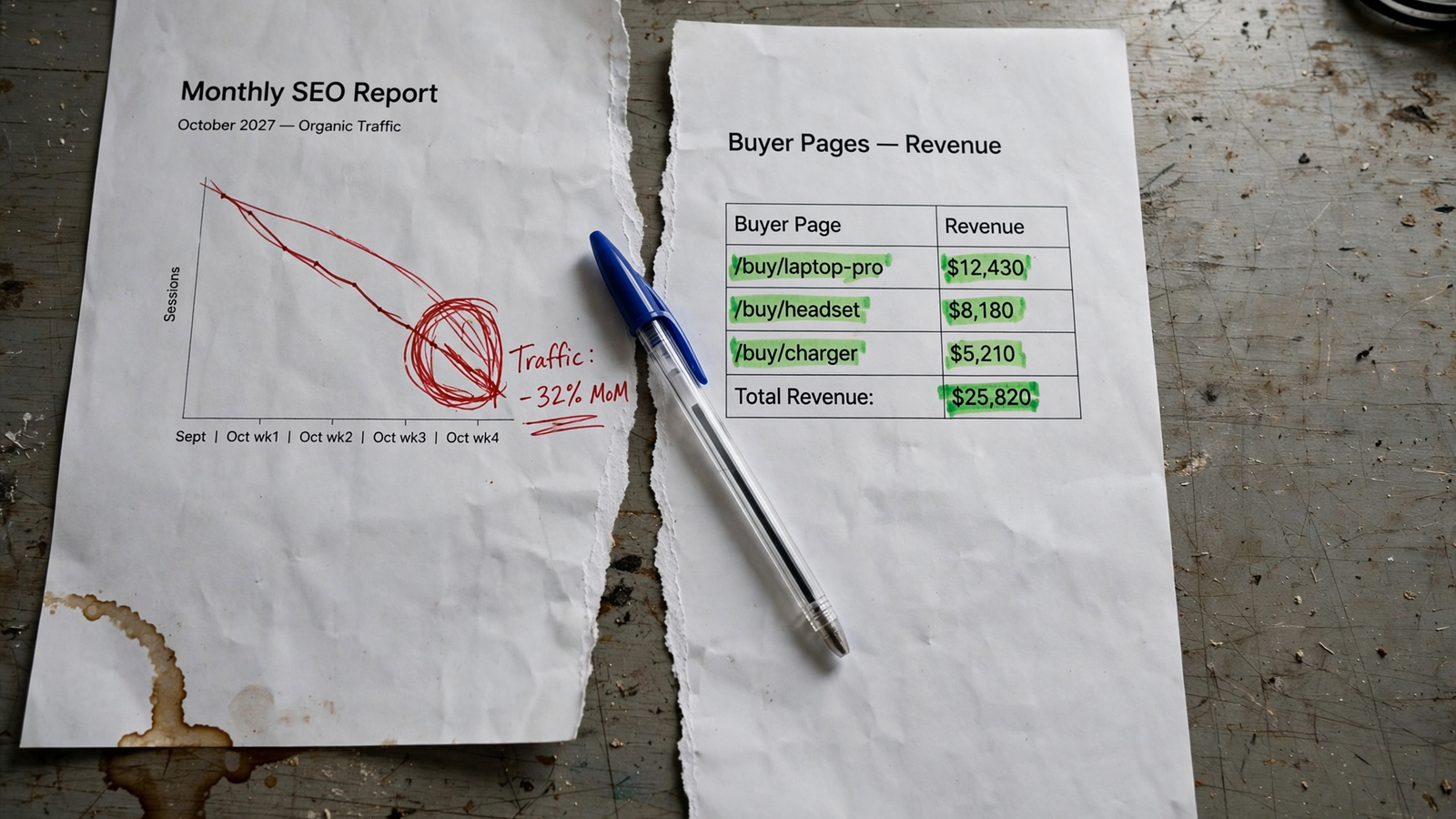
The mechanism is simple. When total clicks fall but buyer clicks hold, the blended chart punishes the provider for a mix shift they did not cause. It also rewards them for recovering traffic nobody misses. Separating informational visits, buyer visits, qualified leads, and revenue changes the incentive.
I ran accounts where 40% of traffic came from two guides that never produced a call. Losing half that traffic cut total sessions by 20% and changed pipeline by zero. A report that cannot show the split will keep selling rewrites of the guides instead of fixes to the money pages.
The evidence for separating the report is already messy in a useful way. AI-referred visitors have been measured converting at 4.4 times organic rates in one dataset and 23 times for signups in another. That sounds like a reason to chase AI traffic until you look at scale. A Conductor benchmark puts AI referrals at about 1.08% of traffic, while a 973-site ecommerce study found Google organic converted about 13% better than ChatGPT traffic.
Those results do not establish one universal channel winner. They show why a striking conversion rate needs a denominator, and why your own buyer pages matter more than somebody else’s average. Ask for page-level revenue, not just a blended conversion rate.
What would prove me wrong: on December 31, 2027, pull ten reports from retained managed SEO engagements. If most still lead with total sessions and blended conversion rate, with no separate buyer-page reporting, I missed.
If I am right, four lines become routine: informational visits, buyer visits, qualified leads, and revenue. Before handing over your stalled site, request that split for the last 90 days, by page. Ask what the existing analytics and CRM can establish, and where tracking gaps prevent an answer.
The provider who identifies both the pipeline and the gaps gets the next question. The one who sends only a traffic chart gets skipped.
Prediction 2: AI visibility and website acquisition will stay on separate scorecards
A mention, a referral, and a customer are different events. By the end of 2027, I expect reports that add them together to read as padding.
The mechanism is measurement, not modesty. Providers are selling AI visibility while confidence in measuring it remains thin: only 14% named AI-answer optimization a top result driver, yet 43% plan to invest in it next year. Only 9% feel very confident measuring AI visibility.
That gap is how a monthly PDF ends up with a big green screenshot of a ChatGPT mention and no referral line underneath. I have done the paid-search version: reporting impression share growth while sales stayed flat. Clients notice by month three.
The available traffic checks keep the denominator honest. One 100-site study found ChatGPT drove just 0.62% of Google organic traffic. Another put organic at 39 times AI-assistant traffic. One example client logged 297 AI referrals and $2,000 in revenue against much larger organic traffic.
That is why I expect the scorecard separating visibility, positioning, authority, buyer influence, and traffic with business outcomes into five distinct layers to win. The layers can inform one another. They cannot substitute for one another.
A citation is not a visit. A visit is not pipeline. Reporting them separately lets you see what happened without pretending the whole journey is measured.
What would prove me wrong: by December 31, 2027, most retained reports use one blended “search visibility” score where a ChatGPT mention counts the same as a booked call, and clients accept it. If that becomes standard, I missed.
My bet is the opposite. Today, I would ask a provider for three separate lines from a current client report:
- AI mentions, with the prompts shown.
- AI referrals, with source tags.
- Pipeline tied to those referrals.
If they can show only the first line, they have demonstrated visibility, not acquisition. Budget for the distinction. Do not let a screenshot borrow the credit for a sale.
Prediction 3: SEO roadmaps will name the clicks they will not recover
By December 31, 2027, I expect a serious roadmap to contain a section owners rarely see today: traffic we will not chase.
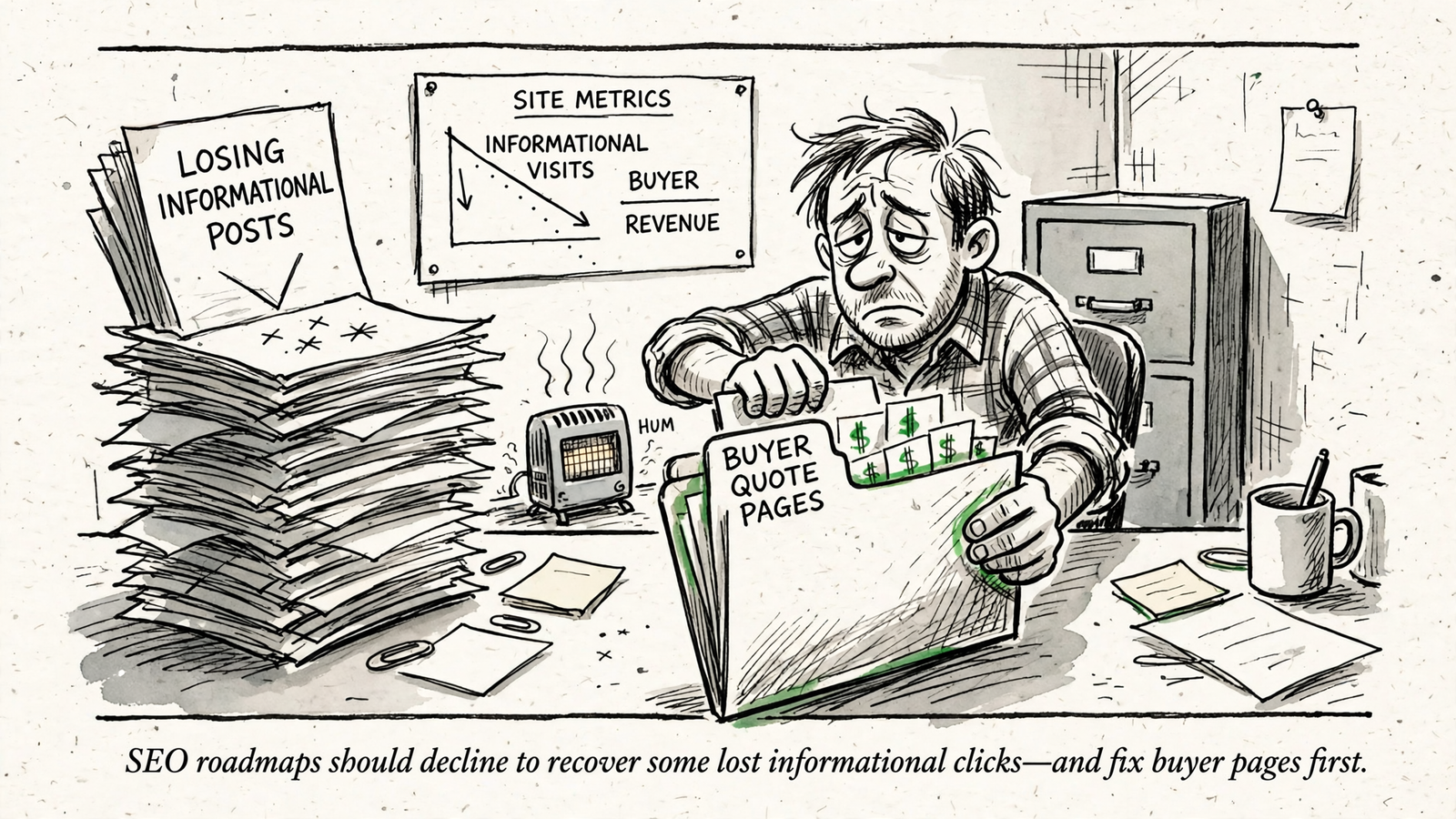
The mechanism is triage. When an informational question gets answered on the results page, restoring a definitions glossary to its 2021 traffic peak can consume work better spent fixing a buyer journey.
Say you run a service business on $20k a month in marketing. Your how-to library loses 8,000 visits while your three quote pages lose 400. The first number looks bigger in a chart. The second deserves a closer look before anyone commissions another batch of articles.
I used to rebuild the library first because it was easy to report. That was waste dressed as diligence. Good management names the loss it will leave alone, and explains why.
My priority order would be:
- Fix technical faults affecting buyer pages. Check the canonical error on the pricing page or the form that stops firing in analytics before treating the decline as a content problem.
- Recover valuable buyer journeys that slipped. Pages where intent still warrants a visit deserve the rewrite, the internal links, and the proof.
- Make everything else earn its place. Do not rebuild a definitions post merely because it used to be your top page. Show what recovering those visits would contribute.
That last conversation is uncomfortable after two years of DIY publishing. Leaving a page alone feels like abandoning work. I see it differently: refusing to pay twice for traffic that no longer earns its keep.
This is not permission to declare all informational content worthless. It is a demand to stop treating its former traffic peak as a business case.
What would prove me wrong: by December 31, 2027, most retained roadmaps still list every lost keyword cluster as a recovery target, with no decline list, and clients renew anyway. If blank-check recovery remains normal, I missed.
My bet is owners will demand the exclusions in writing: these 40 pages we will fix; these 200 we will leave. Ask any prospective provider which traffic they would not try to win back, and why. A shrug is your answer.
What I would demand before handing over a stalled DIY site
If I were handing over my own stalled site this month, I would ask for three things, in order. I would not sign until I saw them in writing.
- A tracking check. Does the form fire? Can revenue be tied to the page? Are visibility impressions kept separate from visits? What can the current setup measure, and what needs fixing?
- A page-level diagnosis. Which drops look like informational mix shift? Which point to technical faults? Which buyer pages slipped and still deserve a fight?
- A prioritized execution plan. What gets fixed, what gets left alone, and what does the work cost in time?
For context, local managed SEO typically runs $300 to $1,500 a month, with $500 to $1,000 most common. The same overview puts initial movement at 3 to 6 months and stable results at 6 to 12 months, and describes time-poor owners judging it on calls and direction requests, not vanity traffic.
That is long enough to spend real money on the wrong diagnosis. Do not accept a content calendar as a substitute for explaining the loss. If the provider cannot show buyer pipeline by page yet, the plan should name that measurement gap, not hide it behind a promise of more traffic.
That is also how I would use groas if I were buying. The team runs paid ads, SEO, and visibility in ChatGPT and Google answers under one roof with the same context. That matters here because the buyer journey crosses all three, while the reporting still needs to distinguish what each contributes.
I would ask for the diagnosis above on a booked consultation, then judge the roadmap by what it refuses to do. A promise of rankings or leads would not satisfy me, and it should not satisfy you.
What should: every action logged with reasoning, a named strategist who owns the numbers, and a report held to the same standard I argued for on the paid side, where Meta agencies will have to explain rejected leads rather than simply report cost per lead.
If my three predictions hold, start changing the buying brief now: diagnose the lost visits, protect the buyer journeys, and make the recovery work justify its cost. By the end of 2027, that is the only kind of SEO report I expect to be worth paying for.
If I am wrong, pull this piece up on December 31 and tell me which line I missed. I keep score.


