LinkedIn

Your agency reports 40 ChatGPT Ads conversions. Your own system shows 16. I have sat through that meeting on the Google side enough times to know the pattern: nobody lied, but two people used conversion to mean two different things.
That is the ambiguity I would settle before targeting jargon. Peak season makes it expensive. You approve a small test before the rush, then the rush arrives and the test keeps running with no agreed counting rules and no cap anyone wrote down.
These twelve terms follow the order you meet them, from the placement you buy to the number that stops spend. Agree on what counts before you pay to count it.
Sponsored placement
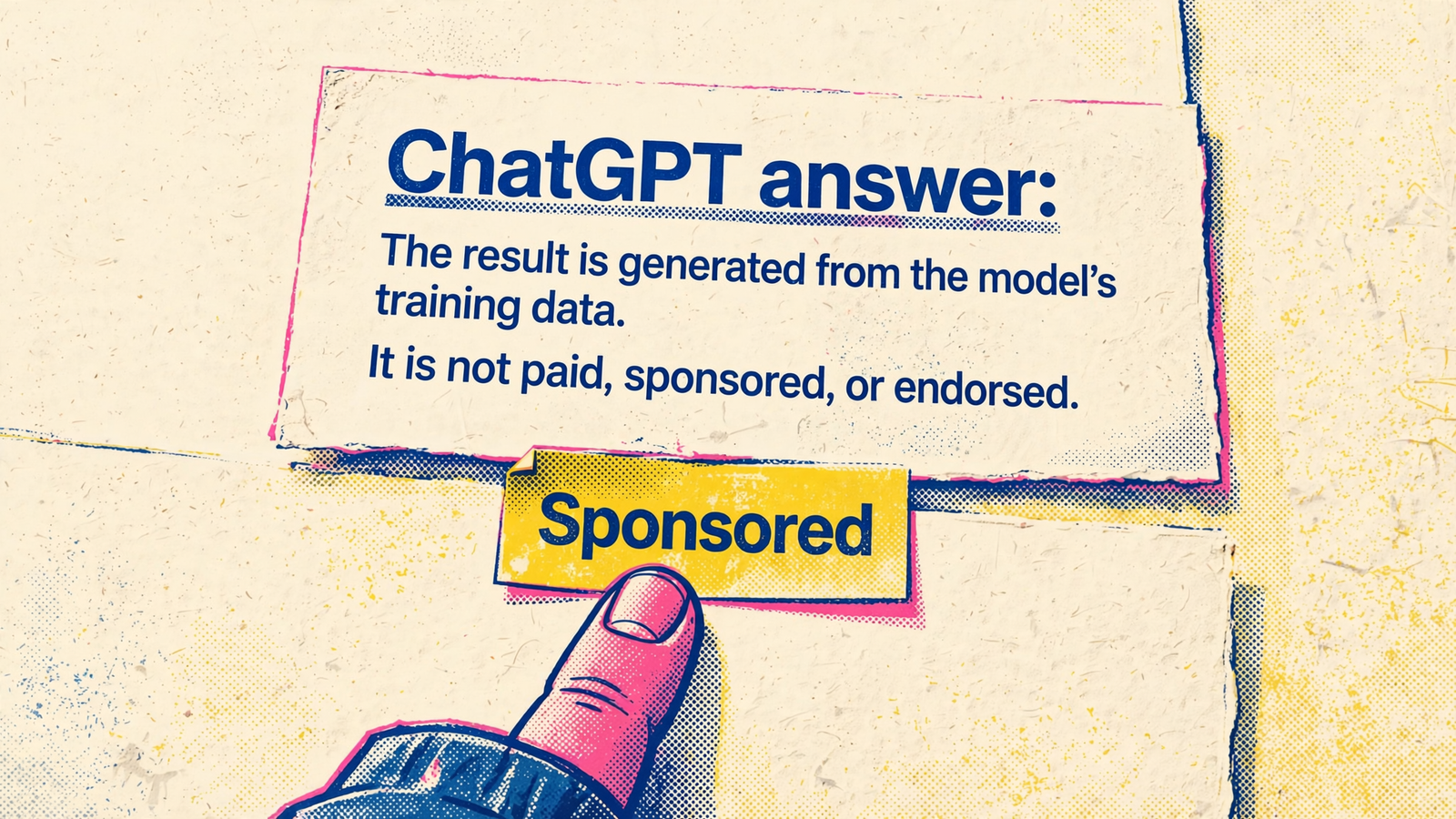
A sponsored placement is a paid listing shown below the assistant answer, labeled Sponsored and kept separate from the answer itself.
It is inventory, not a recommendation. OpenAI says ads do not influence answers and run on separate systems. Only logged-in adults on Free and Go plans see them, while Plus, Pro and Business tiers stay ad-free.
The misuse I hear already: “We’re ranking in ChatGPT.” You are not. You rented space under the answer. That distinction belongs in the brief, not in a footnote after someone presents paid placement as organic visibility.
Before spending, I ask: where exactly did the ad appear relative to the answer, and can the agency show the Sponsored label?
Context Hints
Context Hints are short ad-group-level descriptions of the conversations where your product might fit, used to guide matching.
Think input, not a delivery instruction. The confusion is treating hints like keywords. OpenAI’s wording is that hints help guide ad matching but are not exact-match keywords and do not guarantee delivery in specific conversations. Matching also weighs conversation intent, the landing page, title and copy, plus personalization signals.
Hints alone will not force delivery. I want to see what the agency wrote for each ad group and what it changed on the page and in the copy. “We added more hints” is not much of an explanation if the rest of the ad still says something different.
Landing-page relevance
Landing-page relevance is how closely the page behind the click delivers what the ad promises, in its content as well as its copy.
In ChatGPT Ads, the landing page helps determine matching; it is not just the destination. OpenAI may use landing-page content to decide when an ad is relevant enough to show. Page content therefore matters before anyone arrives.
The mechanical checks matter too. The same reporting notes that the dedicated OAI-AdsBot crawler must be allowed for validation and review, OAI-SearchBot is recommended, and unreachable product-image URLs can break feed processing.
My prelaunch check is short:
- Can the required crawler reach the page?
- Has the team checked product-image URLs for 403 errors?
- Does the page deliver the promise in the ad?
A clever hint cannot rescue a page that fails those checks.
Ad click
An ad click records someone clicking your Sponsored listing inside ChatGPT.
A click is an interaction, not proof that a page loaded. The gap lives between the ad and your site. Ads Manager counts clicks, while page views are observed on site and measured sessions depend on analytics collection.
Back-outs, blockers, consent denial and redirects that strip tracking all sit in that gap. Treating 100 clicks as 100 measured visitors skips the part where measurement can fail.
I ask two separate questions: are we buying on CPC or CPM, and which clicks were billed as valid? The buying model and the reporting count are not interchangeable.
Landing-page view
A landing-page view is a load of the landing page observed by your own server or measurement tag.
For this pilot, the useful definition is more specific: the landing path loads with the campaign parameters intact. The oppref click ID and UTMs need to survive redirects; tag-based measurement also depends on the tag firing and the applicable consent settings.
Write down what qualifies as a measured view. A server observation and a browser-tag event are not the same observation. Practitioners use the server or CDN log for the landing path as a tie-breaker when counts split.
I want the brief to name the exact landing path, required parameters and measurement source. Otherwise, “the page loaded” becomes another phrase everyone agrees with until the numbers arrive.
Conversion event
A conversion event is the exact action you agree to count, such as a purchase or signup.
Define the action before choosing the implementation. The tracking stack can include a JavaScript pixel from bzrcdn.openai.com, server-side Conversions API and a no-JavaScript image tag feeding one Pixel ID. The oppref click ID is appended to the landing URL and stored in a 30-day first-party __oppref cookie.
When browser and server both send the same action, deduplicate them with the same event_id. Two reports of one order should not become two orders.
I learned the underlying lesson on Google years ago: let the event definition drift until after launch, and purchases, signups and stray page views blur together in the recap.
Before spend, I want three answers: what is the event name, what URL or backend trigger fires it, and who owns the event_id logic?
Platform-reported conversion
A platform-reported conversion is a conversion event the ad platform credits under its own counting rules.
That qualifier does work. OpenAI totals are events from the Pixel or Conversions API attributed within the chosen window. The available settings include 7-, 14- or 30-day click windows and an optional 1-day view-through window, with last-touch logic and reporting that may include modeled conversions.
A view-through total can include people who never clicked. Platform-reported conversions are not automatically purchases, qualified leads or cash in the bank. They are whatever event and attribution rules the account uses.
I ask: which pixel, which event, which click window, and is view-through on or off? If the agency cannot answer those four, the report is not ready for a performance verdict.
GA4 key event
A GA4 key event is an event you mark as important in GA4, such as generate_lead, counted under GA4’s rules.
It need not match the platform total. Google distinguishes key events from conversions shared to Google Ads for bidding. Different windows, counting methods and sharing settings can produce different totals.
I have rebuilt enough GA4 properties to know that comparing two unlabeled definitions ends in an argument about nothing. Ask which GA4 event is marked as a key event, whether it is shared to Google Ads, and which lookback applies. That is the discipline behind a B2B GA4 conversion-tracking rebuild: name the event before touching bidding.
One early ChatGPT Ads buyer report shows why this matters. About 70% of clicks were recorded as a page-view conversion by the OpenAI pixel. Across three ad groups, GA4 then captured 97%, 63% and 39% of the platform-reported total, despite the campaign using the same UTMs.
That 39% is a capture ratio from one setup, not a benchmark or proof of fraud. The spread does not establish its own cause. It gives the operator something to investigate: consent, blockers, redirects, tag timing and window settings, one ad group at a time.
The buyer retained oppref IDs, server logs and window settings. Those are useful materials for reconciliation, not permission to declare every discrepancy solved. If an agency cites 39% as what everyone should expect, it has missed the point. Settle the definitions, then measure the gap.

Attribution window
An attribution window is the period after an interaction during which that interaction can receive credit for a conversion.
Same action, different window, different total. OpenAI offers 7-, 14- or 30-day click windows plus an optional 1-day view-through window. A purchase on day 20 can count under one setting and fall outside another. Neither total needs to be fabricated for them to disagree.
Match the windows before comparing the totals. Calling the difference “lost conversions” assumes both systems were trying to count the same thing.
In the brief, I specify the click window and whether view-through is on. Any comparison needs those settings beside it. For another example of two honest numbers disagreeing, see how Meta and Shopify can both be right about ROAS.
Qualified lead
A qualified lead is a contact your business agrees is worth sales follow-up, not merely someone who submits a form.
A raw lead is what the form catches. A qualified lead is what sales agrees to work.
I used to report raw leads because the number looked better. I was wrong, and clients paid for it in wasted follow-up. The business defines quality, not the platform or the agency. A ChatGPT click can produce a form fill that never becomes pipeline and still count as a platform conversion.
Before the pilot, I want qualification in one sentence, an owner who marks it, and a shared place where that decision is logged. If both sides cannot inspect the same list, the recap will drift back toward whichever number looks nicest.
Test budget
The test budget is the media money paid to OpenAI, separate from the fee paid to whoever runs the pilot.
The channel’s early entry requirements make old budget advice easy to repeat long after it stops being useful. With self-serve Ads Manager, the cited pricing guidance lists no lifetime minimum and a $25-per-day campaign minimum in the US: about $750 for a continuous 30-day run.
That tells me the entry cost, not what a useful test will prove. It also does not tell me the management fee.
A blended quote is not a media budget. If someone quotes $2,499 without splitting media from management, the total does not tell me how much buys delivery. I want three separate lines:
- Media spend.
- Management fee.
- The daily cap set in the account.
Keep those lines separate when approving the pilot and when reviewing it. Otherwise, the same word, budget, can mean the account’s spend limit to one person and the entire invoice to another.
Budget guardrail
A budget guardrail is a written spend limit with a named person who must approve going beyond it.
This is the term I would retire: not the limit itself, but guardrail as comforting shorthand for a rule nobody has written down. A real limit names the daily cap, the pilot’s lifetime cap, who can raise bids, and what happens when the cap is reached.
The buying model makes that necessary. Views bill on CPM, clicks bill on CPC, and conversion bidding optimizes toward the chosen event while still billing on valid clicks, not conversions. “Optimizing for conversions” does not mean “only paying when one happens.”
Before approving anything, I make the provider put four things on one page:
- The conversion event: its exact name and what fires it.
- The reporting source: which system supplies each number.
- The attribution window: including whether view-through is on or off.
- The spend limit: the pause number and whose written approval restarts spending.
I also ask for read access to the ad account, the pixel and GA4, plus the landing-path server log for the first week. Access makes those definitions inspectable rather than decorative.
If an agency will not name the event, the window and the pause number in writing, you do not have a test. You have an open expense.
With groas, media stays separate from the management fee. A $1,000 media test plus the $1,499 flat management fee is $2,499 all-in for the pilot month. The daily cap, event name and window go in the brief before launch so the recap compares like with like.
Peak season is the worst time to argue about what a conversion was supposed to mean. Settle the twelve terms first. Then the pilot can answer whether ChatGPT demand becomes qualified pipeline at a CPA the business can live with. That is the only answer worth paying for.