

 LinkedIn

Most agencies won’t tell you this before you sign: if buyers feel the problem months before they learn your category name, your ChatGPT Ads manager has to choose which conversation to buy first. For a B2B company with a long sales cycle, the contenders are operational pain-point campaigns, aimed at frustrated workflow questions, and vendor-comparison campaigns, aimed at buyers building a shortlist.
I would give the first test budget to operational pain. Not because it wins clicks, though it may, but because it reaches buyers while the category is still unfamiliar. Vendor comparisons remain a credible challenger: they can meet a buyer closer to a decision. Neither side earns a larger budget until it produces qualified pipeline. A busy click report is not a sales strategy.
Why the buyer’s first question matters
Say you sell operations software and your best buyers spend three months diagnosing a broken workflow before they ever type your category into a box. The median B2B SaaS cycle sits at 84 days, up 22% since 2022, with mid-market deals running 30 to 90 days and enterprise deals running 90 to 180 days or more. In ChatGPT, that early diagnosis happens inside a conversation. Your ad appears beside an answer about missed handoffs, spreadsheet reconciliation or audit prep taking two weeks. The buyer is not shopping yet. They are trying to name what keeps breaking.
That gap between feeling a problem and naming a category is the reason this choice matters. A vendor-comparison campaign cannot reach someone who has no vendors to compare. A pain campaign can reach them, but it must do more work to establish whether the problem belongs to a real buyer or someone merely curious about the answer. The two campaigns do not start with the same audience or ask for the same next step.
Define a qualified opportunity before either campaign starts. A demo booking means little until sales agrees on what counts as an SQL and what counts as pipeline. Cross-industry MQL-to-SQL rates sit around 13%, rising to 20 to 40% only when the ICP is strict, so identical lead volumes can represent very different outcomes (benchmark breakdown). Write down the job titles with buying authority, minimum company size, pain that must be confirmed on the call, and what moves a meeting into an opportunity. Both contenders answer to that definition, not CTR.
Contender one: buy the operational pain
This approach meets the diagnostic moment. Someone asks ChatGPT how to stop missed follow-ups between sales and ops, or why month-end close takes nine days, and your hint appears beside the answer. The mechanism is simple: match the language of the workflow failure, not the language of your software category. Agencies using this approach structure hints around TOFU pain content tied to problem conversations, then offer a concrete way to scope the fix.
I used to build tight keyword clusters for this sort of intent in Google. In ChatGPT, the inventory is a conversation. The useful skill is reading the prompt behind the prompt: what failed, what the buyer has tried, and what they would need to understand before a software demo makes sense. That does not make the ad a substitute for qualification. It tells you what the next page has to do.
The landing page should continue the diagnosis rather than pitch the platform. A calculator, assessment or short guide can name the failure and offer one credible next step toward a demo. If the page jumps straight from “why is this workflow broken?” to “book a call,” it skips the part the buyer came to resolve. If the page fits, early volume can look encouraging. If it does not, you collect the skeptics’ favorite audience: researchers, students and curious free-plan users with neither authority nor urgency.
Pain campaigns find demand where vendor terms find silence. The price of that reach is harder qualification, on the page and again on the call. Make the agency show you how it will separate a buyer diagnosing an expensive workflow from a person gathering ideas.
Contender two: buy the vendor shortlist
This approach meets the comparison moment. Someone asks for alternatives to a named competitor or the best tool in a defined category, and your hint appears with one sharp differentiator. The buyer has already done much of the diagnosis. Now they want to know whether you beat the incumbent on price, implementation or a specific integration. That is why agencies running this approach point competitor-comparison hints at comparison landing pages, not a homepage. The click arrives with intent you do not have to manufacture.
The page still has a job. It must answer switching questions in order: what changes, what it costs to move, and what evidence you have from a similar team. Skip those questions and a high-intent visitor has no reason to stay. A differentiator in the ad is a promise; the page has to make it credible.
The harder limit is available demand. A buyer who does not yet know the category will not ask for alternatives to a vendor. ChatGPT narrows that audience further: ads serve logged-in adults on Free and Go plans, while Plus, Pro, Team, Enterprise and company seats do not see them (audience breakdown). That can pull reach away from the work buyers a B2B advertiser wants. Vendor comparisons offer a clearer signal of readiness, but they assume most of your market has reached a shortlist. For this reader, that makes them the challenger, not the opening bet.
Head-to-head: three axes that decide the budget
First, demand availability and buyer maturity. Pain prompts reach people working through a problem; comparison prompts reach people who can name possible solutions. I expect pain campaigns to use their test allocation more readily, while comparison campaigns may struggle to spend unless the category already has shortlist demand. That is not a verdict against comparison. A campaign that barely reaches buyers has not had a fair chance to prove what its leads are worth.
Second, creative and landing-page work. Pain creative is easier to start and harder to finish well. You can write in the buyer’s workflow language, but the diagnosis page must then deliver something useful before it asks for a meeting. Comparison creative takes more preparation: one specific differentiator per competitor, backed by a page that handles switching costs, integration questions and proof from a similar team. Neither approach belongs on a generic demo page. If an agency proposes sending both audiences to the homepage and calling it a test, stop there. The pages need different answers because the buyers are asking different questions.

Third, qualified meetings and opportunities. This is the only axis that can move the budget, and the slowest one to read. About 40% of attributable conversions happen in the click session, with 60% arriving later via direct or branded search without a traceable path. A two-week read can therefore tell you which ad drew attention without telling you which one created pipeline. I expect pain campaigns to bring more raw demos at a lower SQL rate, and comparison campaigns to bring fewer demos at a higher SQL rate. The opportunities that follow decide whether that expectation matters.
Projected B2B SaaS conversion on ChatGPT Ads sits around 1.8%, inside a 0.3% to 6.1% range. That spread is a reason to plan around your own pipeline rather than a borrowed CTR target. Read early engagement separately from mature opportunity cohorts. Do not promote a campaign because its clicks arrived first.
| Decision axis | Operational pain | Vendor comparison |
|---|---|---|
| Demand and maturity | Earlier, broader problem conversations; more qualification needed. | Narrower shortlist conversations; buyer readiness is clearer. |
| Creative and page work | Cover workflow failures; the diagnosis page must earn the demo. | Show a specific difference; the comparison page must address switching. |
| Evidence that earns more budget | SQLs and opportunities from its reach, read after the conversion tail. | SQLs and opportunities from a smaller pool, with enough exposure for a fair read. |
The table is a hiring filter as much as a campaign plan. Ask a prospective manager how each page will differ, how sales will mark an SQL, and when the team will revisit an apparent winner. If the answers are “same form,” “all demos” and “after two weeks,” you already know what the report will optimize for.
What the available results can and cannot settle
The honest record is messier than a sales deck. InterTeam reports 150-plus qualified leads across three B2B SaaS clients at less than half the CPL of Google, with pain content, competitor comparisons and booked-demo plays running together. Workshop Digital reported around 700 clicks with zero qualified leads. Grow My Ads spent around $1,000 to $1,200 over two weeks for 92 clicks at about $13 CPC and zero conversions.
I read those as evidence that the channel can work and that it can eat budget with nothing to show, not as a clean verdict between our contenders. The offers, accounts and tracking differ, and InterTeam’s approaches ran together. None of those results tells this B2B team to move its next dollar from pain to comparisons or back again. A click is evidence of a conversation, not evidence of pipeline.
Measurement can make the wrong winner look convincing. Accuracast saw form fills arrive while the platform still showed zero conversions two weeks later, with roughly 100 reported clicks against 20 found in its own tracking. I have lived a version of that gap on Google too. When someone encounters your ad and returns later through branded search, a platform report may miss the path. Treat tracked ROAS as a floor, watch branded-search lift, and use CRM pipeline as the source of truth. That is the discipline I use when I judge ChatGPT Ads on pipeline rather than cost per lead.
The test brief to hand the agency
Question: For buyers who feel the pain before they know the category, which conversation produces qualified pipeline: operational diagnosis or vendor comparison? Write that question at the top of the brief. Otherwise the campaign with the easiest clicks will quietly become the campaign everyone calls a success.
Run the test prospectively, with the setup and decision rules agreed before launch:
- Set the loss limit and split. Say you can afford to lose $5,000 learning. I start 70/30 toward pain because that side is more likely to spend. Record the split before either campaign runs; do not rewrite the plan to flatter whichever side gets early engagement.
- Set the clock. Use a realistic minimum of 4 to 6 weeks plus a 2-week tail. Two weeks can reveal delivery and page problems, but it is too early to crown a pipeline winner when many conversions arrive later. Self-serve Ads Manager removed the old $50k to $250k minimums, making a bounded test practical for smaller teams. There are still no official cross-advertiser benchmarks; use your CRM, not somebody else’s headline, as the benchmark.
- Freeze the controls. Give both contenders the same SQL definition and opportunity stages. Wire the same demo and trial events to pipeline. Keep separate landing pages for diagnosis and comparison, because equal treatment does not mean forcing different buyers through identical copy.
- Read both the early and mature signals. At week two, inspect delivery, clicks and whether each page is attracting the intended audience. After the tail, compare cost per conversion, SQL rate and ACV, branded-search lift, blended CAC and geo-holdout lift alongside CRM opportunities. Do not turn the early check into a budget verdict.
My expectation is that pain spends more readily and wins clicks, while comparison spends slowly and looks weak at first. The mechanism is reach, not magic: more buyers can describe a broken workflow than name a shortlist. An underexposed comparison campaign is inconclusive, not inferior. If it gets sufficient exposure and produces stronger qualified opportunities, move budget toward it. If pain produces the opportunities and comparison cannot justify its share after a fair run, keep the first-budget winner. That is the pipeline structure I require for B2B SaaS on long cycles.
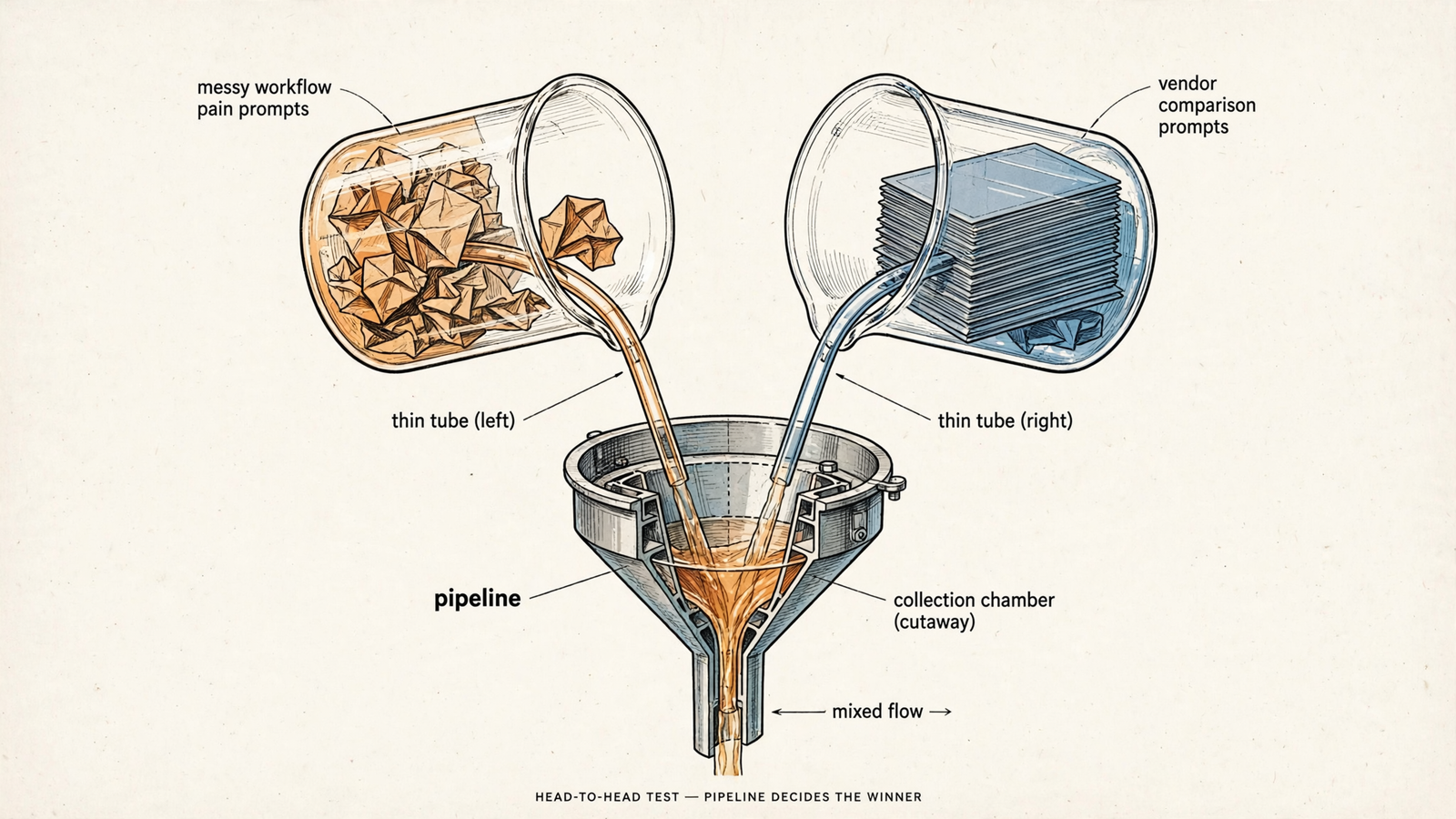
Verdict: start with the problem, not the shortlist
For the B2B team hiring ChatGPT Ads management into a long cycle where buyers diagnose before they shortlist, operational pain wins the first budget. It meets buyers where the conversation starts and gives sales a chance to learn which problems belong to qualified buyers. I keep vendor comparisons live as the smaller challenger because those buyers may arrive closer to a decision. The rule for scale stays fixed: neither side gets more money for winning clicks. The side that creates SQLs and opportunities at a defensible CAC earns it.
Pick the loser first only if you already have category demand. If branded and competitor prompts already produce steady demo volume and your sales team closes those buyers, skip the pain-first bet and defend the shortlist. Everyone else should hire the provider that acts as though pipeline owns the budget: daily work on prompts, pages and qualification, not a monthly CTR report. That is how groas runs it: continuous execution across Google, Bing and ChatGPT inside one service, judged on pipeline instead of demo volume, with one owner explaining what the next dollar should do.


