

 LinkedIn

Exact-match keywords do not guarantee your Microsoft Ads budget stays on search results. If you run B2B with a sales cycle longer than a reporting month, that is one problem to solve before choosing your next test budget. The other contender, ChatGPT Ads, offers a new conversational placement but limits who can see an ad. I would fund Microsoft first when I can audit delivery and measure qualified pipeline. ChatGPT earns a smaller, capped test only after access and reporting are verified.
I manage search for a living, and I judge a new channel by two questions: Can I prove what delivered, and can I tie it to qualified pipeline? Cheap clicks and novelty lose if the answer is no. Microsoft has an established search channel and a placement problem you can inspect. ChatGPT has interesting context and more to verify before a long-cycle B2B team trusts it with budget.
The test budget has to outlast the reporting month
Say you spend $20k a month on Google Search and have one extra test budget. Your sales cycle runs 90 to 180 days. A demo today becomes pipeline next quarter and revenue the quarter after that. Meanwhile, the ad platform reports a conversion in week one. Your CRM takes much longer to tell you whether that conversion mattered.
I used to tell clients to chase intent wherever it looked cheapest. I was wrong. Cheap form fills from the wrong context cost more in sales time than they save in CPC. For this reader, the winning test is the one you can explain to finance: where ads showed, what became qualified pipeline, what eventually closed, and when you will decide to scale or kill the test.

Microsoft Ads vs ChatGPT Ads: four decisions that matter
I compare these channels the way I would spend my own test budget. Not on hype or CPC screenshots, but on four questions: Are you reaching someone with a work problem? Can you inspect delivery? Can you connect the response to a qualified opportunity? Can you control spend without creating a part-time job?
| Decision axis | Microsoft Ads | ChatGPT Ads |
|---|---|---|
| Buyer context | Bing search, with a LinkedIn layer for job function, industry and company | Conversation context below the answer for eligible Free and Go plans; paid workspace plans see no ads |
| Delivery proof | Exact match does not guarantee Search-only delivery; Search campaigns have no off switch for Audience Network | Contextual selection using the conversation, landing page and hints, with aggregated reporting |
| Pipeline tracking | Offline conversions tied to msclkid, with one goal per CRM stage where the conversion window permits | Pixel plus Conversions API with a shared event ID; a CRM join is still needed to prove qualification |
| Test control | Publisher reporting, exclusions and a possible support-assisted opt-out | Self-serve access depends on billing country; US tests have a $25/day minimum |
Microsoft is my first candidate, not my automatic winner. Its flaws show up in reports I can inspect. ChatGPT needs an access, delivery and measurement check before I can decide whether its conversational context is worth paying for.
Buyer context: a typed work question or a research conversation
Microsoft starts with a typed query on Bing. For B2B, that question can be explicit: pricing, vendor comparison, implementation. You can then layer LinkedIn attributes for job function, industry and company name, up to 1,000 companies per ad group, using Bid Only or Target and Bid with modifiers from -90% to +900%. Practitioners cite 30–50% lower CPCs than Google for the same B2B keywords. The appeal is a thinner auction for work-related queries, plus a way to bid differently for the titles you want. A lower CPC is useful only if those clicks become opportunities.
ChatGPT starts with a conversation, not a keyword. Ads appear below the answer for eligible Free and Go users. Plus, Pro, Business, Enterprise and Edu see no ads; under-18 accounts and Temporary Chats are excluded too. For a long sales cycle, that fence matters. Buyers using paid workspace plans will not see your paid placement there, so an organic answer has to do work alongside any ad test if you want to reach them.
The choice here is explicit search intent versus an eligible research moment. I would start with the work question I can target, then test the conversation if it offers a distinct hypothesis.
Delivery proof: inspect the publisher, not just the keyword
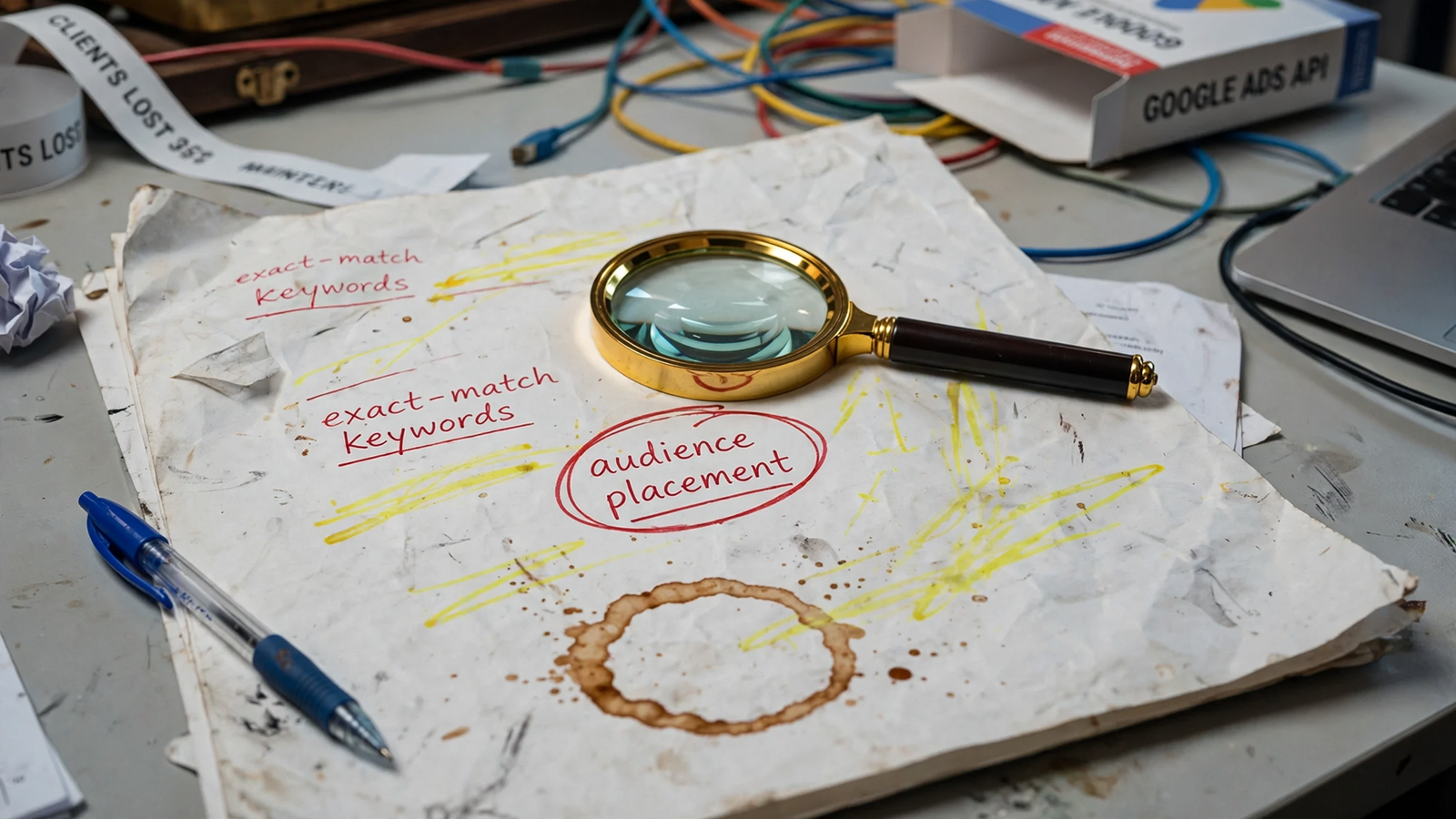
Here is where Microsoft tests your process. Search campaigns have no off switch for Audience Network. Microsoft removed the old -100% audience bid adjustment in February 2023, so the bid trick that used to block it no longer does the job. One practitioner audit found 27.5% of lifetime spend going to audience placements with zero conversions, mostly Outlook, MSN and casual games. In a separate software-company case after mandatory expansion, 26.81% of budget went to Audience Network expansion at $2.49 CPC, $0.71 above Search. CTR was 0.14% against 0.49% for standalone Audience Ads, with zero direct conversions and no lift to Search conversion rate.
Those are warnings, not a forecast for your account. They show why exact match is not placement control. Pull the publisher report before you approve scale. Otherwise, a search test can quietly become a test of inventory your brief never meant to buy.
ChatGPT is narrower in who can see an ad, but less proven as a delivery test. Targeting is contextual rather than keyword bidding. OpenAI selects an ad using the current conversation plus your landing page, title and copy, context hints and campaign settings. Hints are natural phrases added at ad-group level; they do not control geography, schedule or exclusions. Before launch, ask what the available report will actually show you. Contextual selection without enough delivery evidence is a trust exercise. I do not fund trust exercises with pipeline money.
Pipeline tracking: form fills are not the finish line
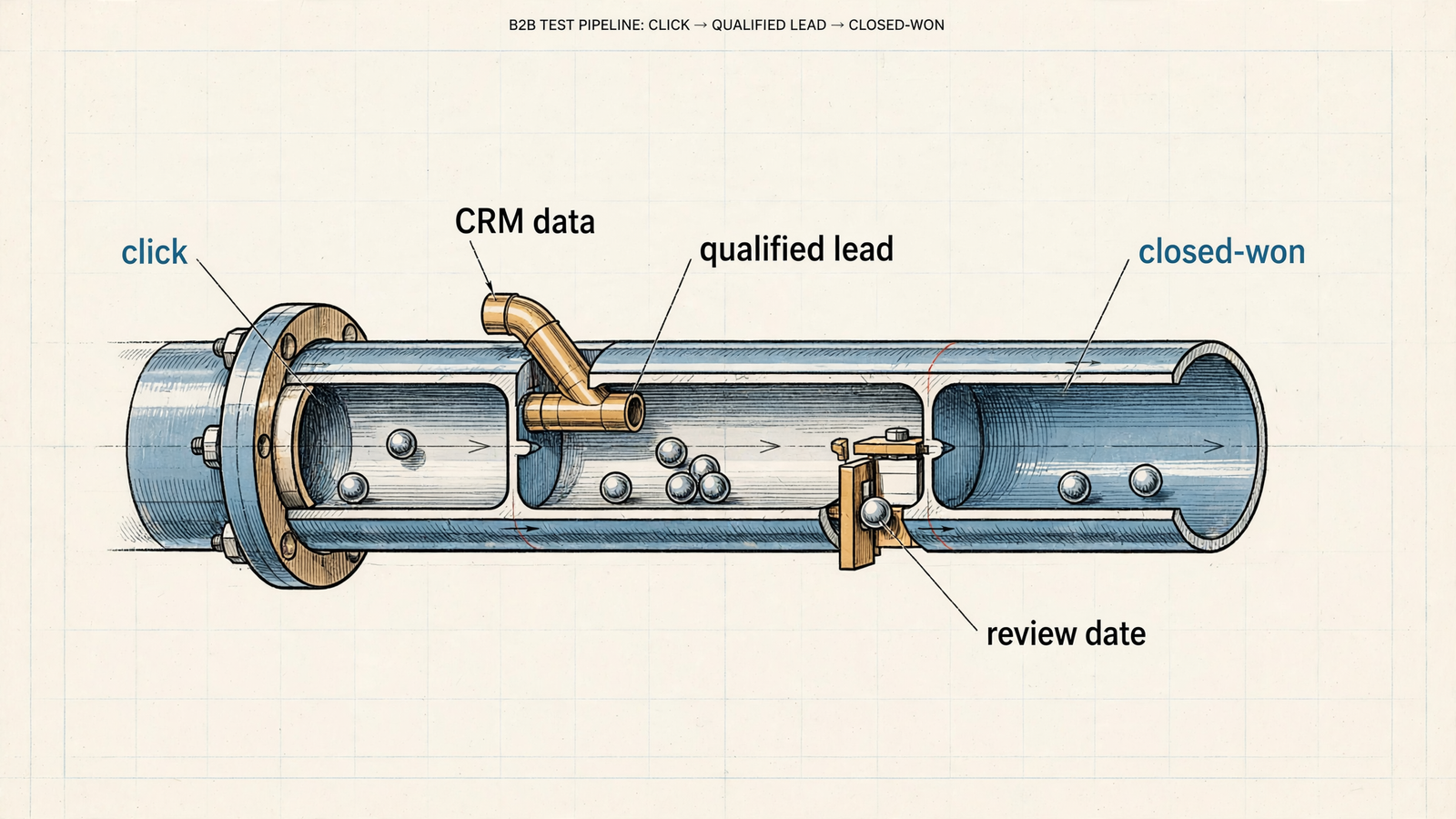
Form fills lie to B2B teams. Microsoft gives you a way to check them if you set it up before spending: tie the click ID to CRM stages with one offline goal per stage, and keep qualified and closed-won separate. Run uploads daily for eligible conversions. The default conversion window is 30 days, with a 90-day maximum; the click must be within the last 90 days, and you wait two hours after creating a goal before uploading.
That window matters when a deal takes 90 to 180 days. Upload an earlier qualifying stage while it is still eligible, so the platform has a useful signal. Then use your CRM to judge eventual closed-won revenue, including deals that close too late for the platform’s conversion window. Do not call a week-one form fill a pipeline result.
ChatGPT measurement is cleaner on paper and thinner for this decision. You can run the OpenAI Pixel plus Conversions API with a shared event ID for deduplication, and the platform reports impressions, clicks, CTR and conversions. That can tell you an ad got a response. It cannot, by itself, tell you the lead was qualified. Someone still has to join the response to CRM stages and keep qualified opportunities distinct from closed-won revenue.
For either channel, I would agree on the qualified-lead definition before launch. If nobody can report it separately from raw leads, the test cannot answer the budget question.
Budget control: cap the media and the work it creates
A B2B test dies when both spend and labor drift. On Microsoft, the partial fix is unglamorous: pull the Website URL publisher report, apply website and app ID exclusions, rerun the report biweekly and then monthly, and ask a rep or escalated support ticket about an opt-out where your account qualifies. Staff replies since 2024 say there is no universal opt-out. Treat any support-assisted answer as account-specific, not a switch you already own.
On ChatGPT, verify access before making a plan around the inventory. Self-serve depends on billing entity country and is open in 89 countries after the October 2026 expansion; country and currency lock at creation. US tests carry a $25-per-day minimum averaged over seven days, and single-day spend can reach 2x. Set the cap in writing before launch: one budget, one review date and kill rules tied to qualified cost, not CTR.

Microsoft Ads: established does not mean unattended
I know how this ticket starts. You build tight exact match, think “search only,” and then see spend on Outlook, MSN and games. The audits above put numbers on the risk. If 26.81% of a $3,000 test went to expansion, roughly $800 would buy inventory the original brief might never have approved. That is worth checking before anyone celebrates a cheap CPC.
But the complaint proves one thing, not everything: exact match controls the query, not the placement. It does not prove every Microsoft account has the same delivery mix. Campaign types, publisher exclusions and account-specific support all matter. Pull delivery by network and publisher before judging CPA. If you seek a support-assisted opt-out, get the answer for your own account in writing rather than treating someone else’s reply as policy.
That inspection is why Microsoft remains my first pick. I can see the failure mode, put exclusions and reviews around it, and decide whether the remaining delivery produces qualified pipeline. Unattended is the expensive version of this test.
ChatGPT Ads: verify the channel before buying the promise
Before a dollar moves, I want three answers in writing:
- Access: Is your billing country supported, and can your account actually serve ads?
- Delivery: Which eligible inventory can the ads enter, and what will the available reporting show?
- Pipeline: How will a response join qualified and closed-won stages in your CRM?
Do not forecast on assumed keyword controls, workspace reach or impression quality. If those checks pass and the hypothesis is distinct, run a capped side test. Reaching early researchers asking comparison questions before they type a vendor query on Bing is one such hypothesis. Give it its own budget, tracking and review date. That makes ChatGPT the test you choose after it earns entry, not the test you buy because the placement sounds new.

Make your provider show the work for either test
Whoever runs the campaign owes you four things before spend starts:
- A baseline from current search.
- A written definition of qualified versus raw lead.
- An action log you can read without a translation call.
- A pipeline review date that respects your sales cycle.
I want separate channel reporting inside one coordinated plan. A blended CPA lets the loser hide behind the winner. That is also how I judge managed scope. groas bundles Google, Bing and ChatGPT Ads in one Search Ads service for $1,499 a month, with ad spend separate. A flat fee avoids making a percentage of spend the reason to keep a weak test running. If your provider cannot show how a click becomes a qualified opportunity, borrow the structure in how one SaaS team rebuilt offline tracking to double pipeline and require that discipline for both channels.
My verdict: fund Microsoft first, with conditions
Start with Microsoft if you can say yes to three things: LinkedIn filters map to titles you actually close, publisher reporting and exclusions are scheduled before scale, and offline goals distinguish qualified leads from closed-won where the conversion window allows. Check later revenue in the CRM. That gives you a B2B search test whose delivery and pipeline you can audit. For most long-cycle teams with those pieces in place, Microsoft earns the first test budget.
Pick ChatGPT first only if your access and reporting are verified, the CRM join works, and you have a distinct research-stage hypothesis that Microsoft search will not test. Keep it smaller and capped. Defer either channel if you cannot separate qualified pipeline from form fills; sales will pay for that gap in wasted follow-up.
If you already run managed search, keep the tests in one plan but report them separately. That is how I run it inside groas: one Search Ads scope covers the test, one log shows what changed, and pipeline decides what scales. Fund the test you can explain to finance. Let novelty earn its place after proof.


