

 LinkedIn

You get 13 weeks, $3k a month in media, a 120-day sales cycle, and 30 minutes a week from sales. If you judge this ChatGPT ads pilot on closed revenue, you have failed it before the first click.
The test needs two later verdicts: sales-accepted meetings by week six and opportunity value by week twelve. Lead volume gets no vote. Lead quality can kill the pilot in week four.
1. Fix the constraint before anyone promises ROI
Three months at $3k buys $9,000 in media. A deal that takes 120 days to close will probably outlast a 13-week test, even if its first click produces a meeting quickly. Median B2B SaaS cycles run 84 days and mean cycles cluster around 134 days; deals over $50k ACV sit in a 60-to-120-day band or longer. Anyone promising a clean closed-won ROI verdict from this pilot is selling you a report, not a test.
That constraint buys clarity if you respect it. You cannot spend your way into a shorter sales cycle, and you cannot quietly assume sales will do hours of qualification for you. The $9,000 buys three answers, in order:
- Week four: Are the leads people sales could plausibly work?
- Week six: Are those people becoming meetings sales accepts?
- Week twelve: Is credible opportunity value building behind those meetings?
Cost against the constraint: $0 in week zero, plus one of sales’ 30-minute slots to agree on the rules. Skip that conversation and every later number becomes negotiable when someone dislikes it.
2. Week 0: define a meeting and tag its source
ChatGPT clicks need their own CRM source from day one, not a place in the paid-search bucket. The ads reach logged-in adults on Free and Go plans, while Plus, Pro, and Enterprise remain ad-free. The unit sits below an answer and matches conversation context rather than keywords. Treating that visit as an ordinary Google search click obscures what you are testing.
Create chatgpt_ads as a source. Use UTMs to distinguish the two conversation themes you will run, and install the OpenAI Pixel alongside your CRM tracking. Keep the lifecycle stages visible so you can judge cost per qualified lead and opportunity, not CPC. Cost: $0 media and about two hours of ops work. What it buys is a source trail you can follow from click to meeting to opportunity.
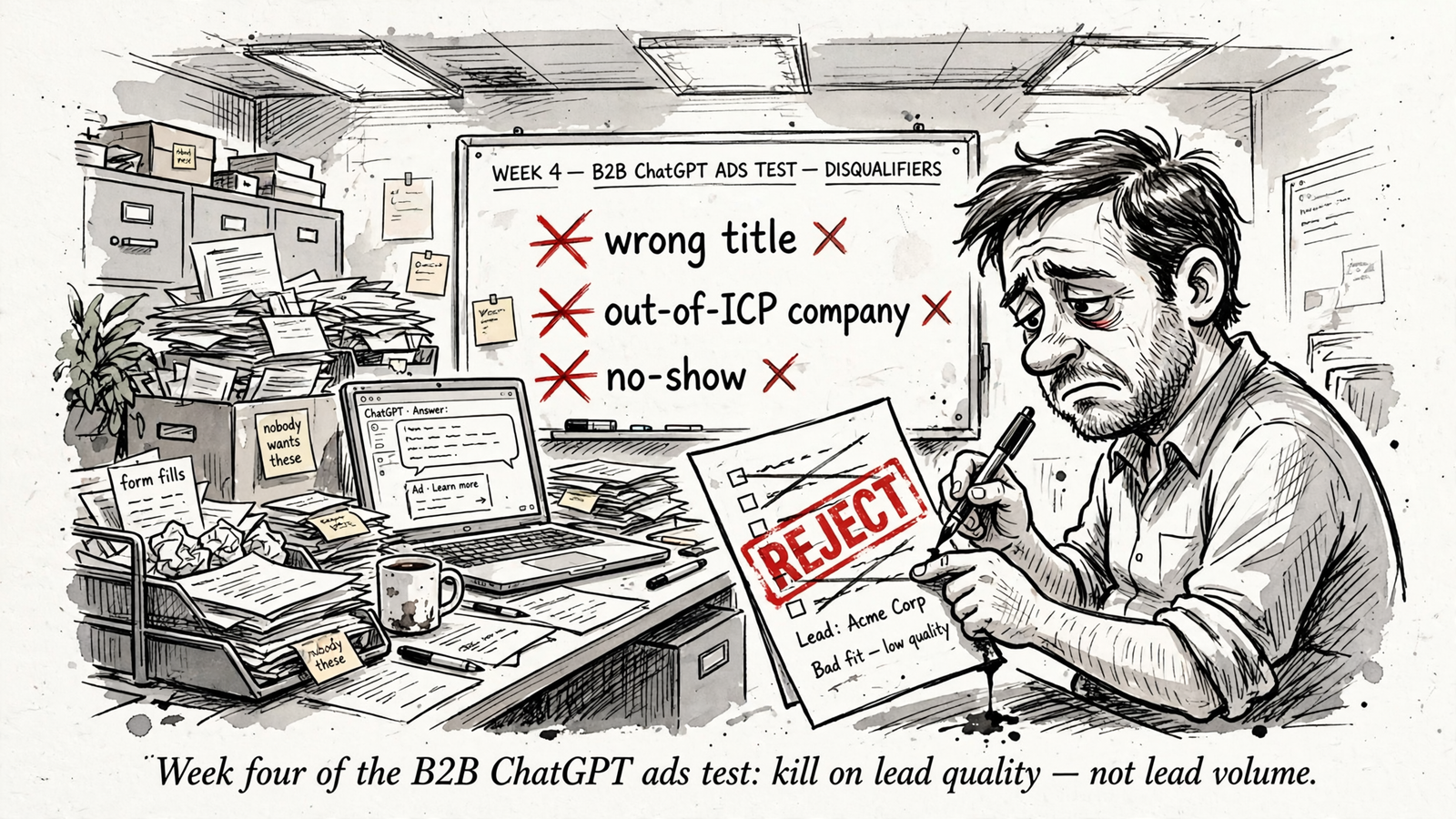
Then ask sales for one sentence defining a sales-accepted meeting, or SAM. I used to tell clients any booked demo counted. I was wrong. Here, a SAM means the person has the right title, the company fits your ideal customer profile, and the person shows up. Agree on the disqualifiers now: wrong title, out-of-ICP company, and no-show or unreachable after two touches. Sales does not have to love every lead. It does have to use the same rules each week.
No agreed SAM definition, no paid test. Walk away until sales gives you the 30 minutes.
3. Weeks 1–2: build one offer for a research-stage visitor
Do not lead with Book a Demo. A ChatGPT ad click can come from the middle of a research conversation, not a high-intent search. Ask for a work calendar too soon and the visit ends there. Offer one useful diagnostic instead, on a dedicated comparison or use-case page. Follow it with one email sequence. That is the whole offer, not the first branch of a five-offer funnel.
The difference in asks matters. Demo-request pages convert 2–4% of paid traffic, while gated assets convert 15–25%; the cited top-performer ranges are 6–10% and 30–45%, respectively. More form fills are not the goal, though. I have watched demo pages starve while comparison pages gave sales something to discuss. The form still has to filter for fit.
Gate the diagnostic behind work email, company, and employee band. Those fields give sales a first pass at title and company fit without pretending a download is a meeting. Send the visitor to that page, not the homepage. Cost: one page, one email sequence, and $0 media before launch. What it buys is a chance to see enough qualified interest to make the week-four decision.
If sales insists that every first touch must be a demo request, cut the pilot. Spending $3,000 to prove a research-stage visitor will not book a vendor they met 90 seconds ago is not a useful experiment.
4. Weeks 1–4: spend the first $3k on two themes, not five offers
Cap month one at $3,000, released in small weekly portions rather than dumped into week one. Run two conversation themes: question-based prompts, such as what is best X for [use case], and a tight comparison theme around your category. Send both to the same offer, with separate UTMs. Keep the page and qualification fields steady so a change in lead quality means something.
There is a reason to give questions the first slot. In side-by-side B2B tests, question-based prompts beat scenario prompts by more than 4× on CTR and 3× on-site engagement. You do not get a prompt or search-term report to mine afterward. Set up the themes deliberately in Ads Manager, then use the Pixel, UTMs, and CRM stages to see what each sends through the door.
Keep Google and Bing running as your baseline. Early B2B ChatGPT figures cluster around $3 CPC, about $13 CPM, and nearly 1.5% CTR, with visitors spending 25–35% more time on site than paid-search visitors. Interesting. Not pipeline. An engaged visit still has to become a person sales will meet.
Cost: up to $3,000 in month one. What it buys is a clean quality read, not permission to declare a new channel. If you want the fuller logic behind the cap, read $3,000 a Month, 90 Days: A ChatGPT Ads Test for a 120-Day B2B Sales Cycle before you raise it.
5. Week 4: kill poor-fit leads, never low lead volume
By this gate, month one has cost up to $3,000. You may have few SAMs. That is not a reason to stop. A pile of people sales cannot work is.
One B2B test drove about 700 clicks and zero qualified leads. The warning is not that every account will repeat it. It is that free-plan reach can miss work-plan buyers, while ChatGPT CPC can run about 6× Google’s for some brands. A cheap-looking cost per lead will not rescue another $6,000 spent on the wrong people.
Pull every ChatGPT lead into a short review with sales. Mark each against the week-zero disqualifiers:
- Wrong title: no plausible buying role.
- Out-of-ICP company: wrong size or sector.
- No-show or unreachable: the contact does not engage after two touches.
If more than half fail, stop spending. Fix the conversation themes and the form gate before dollar 3,001 goes out. If at least half pass the title and company checks and remain reachable, approve month two. Quality is the kill rule; volume is not. What the first $3,000 bought is permission, or a refusal, to keep testing.
6. Week 6: judge sales-accepted meetings per $1k
This is the meeting gate, not week eight. With month two underway, you have spent roughly $4,500 if delivery follows the $3k monthly cap. Divide SAMs by thousands spent for each source. If Google search has 6 SAMs on $4,500, it produces about 1.3 SAMs per $1k. If ChatGPT has 3 on the same spend, it produces about 0.7. ChatGPT trails, but the comparison tells you more than CPL does.
Ask whether the ChatGPT SAM rate reaches at least half of Google search’s rate, and whether meetings are improving as the offer and qualification settle. A channel that reaches half and is moving up gets the rest of month two. If it sits below a third, or sales still rejects most meetings for fit, pause it. Do not buy more clicks to improve the look of the chart.
The fix, if there is one, costs attention before it costs media: narrow the conversation themes, tighten the form, and use a 15-minute qualification call before a meeting counts as a SAM. Charge that call against the sales time you actually have. If sales cannot spare it, do not quietly redefine SAM to make the pilot pass.
Cost at this gate: roughly $4,500 spent, with the remaining month-two budget contingent on quality. What it buys is an answer about meetings sales will take, while there is still time to stop the third $3,000. For this gate, use the same weeks and the same metric for Google. A prettier ChatGPT engagement report is not the control group.
7. Week 12: weigh opportunity value, not raw pipeline
By week twelve, the three monthly allocations have put up to $9,000 into media. Do not move the goalposts to closed-won revenue because someone wants a final ROI slide. For a 120-day sales cycle, the verdict is the opportunity value created and the stages those opportunities have reached.
Calculate weighted value as deal amount × stage probability. The starting probabilities in this model are Lead 5%, Qualification 10%, Discovery 20%, Solution 40%, Proposal 60%, Negotiation 80%, and Verbal 90%. A $60,000 deal in Solution counts as $24,000; the same amount sitting at Lead counts as $3,000. That haircut matters. Raw pipeline gives a curious visitor the same headline value as an opportunity sales has advanced.

Say ChatGPT sources four $50,000 opportunities: two in Discovery, one in Solution, and one at Lead. Weighted value is (2 × $50,000 × 20%) + ($50,000 × 40%) + ($50,000 × 5%): $42,500 on $9,000 of media. Compare weighted value per $1k with Google search over the same period. Then look at movement. Opportunities advancing through stages support a channel case; four names stranded at Lead and Qualification do not.
This is a pipeline gate, not a claim that $42,500 has been earned. For the costs beyond media, including ops and sales time, see The Real Cost of a ChatGPT Ads Test With a 90-Day B2B Sales Cycle. Keep value weighted and revenue separate until deals close.

8. If the budget halves, cut variety before measurement
If the cap falls from $3k to $1.5k a month, keep only the question-based theme and the one offer. Cut the comparison theme and any plan for another landing page. Run roughly $375 a week, while keeping the monthly cap and the same quality, meeting, and opportunity gates.
Do not cut the CRM source tag, the SAM definition, or the 30 minutes with sales. They decide whether the smaller test says anything useful. A narrower pilot can still tell you whether meetings are accepted and opportunities advance. A wider one without measurement can only tell you that money left the account.
What gets cut is variety. The kill rules stay.
9. Week 13: scale, hold, or stop without extending the test
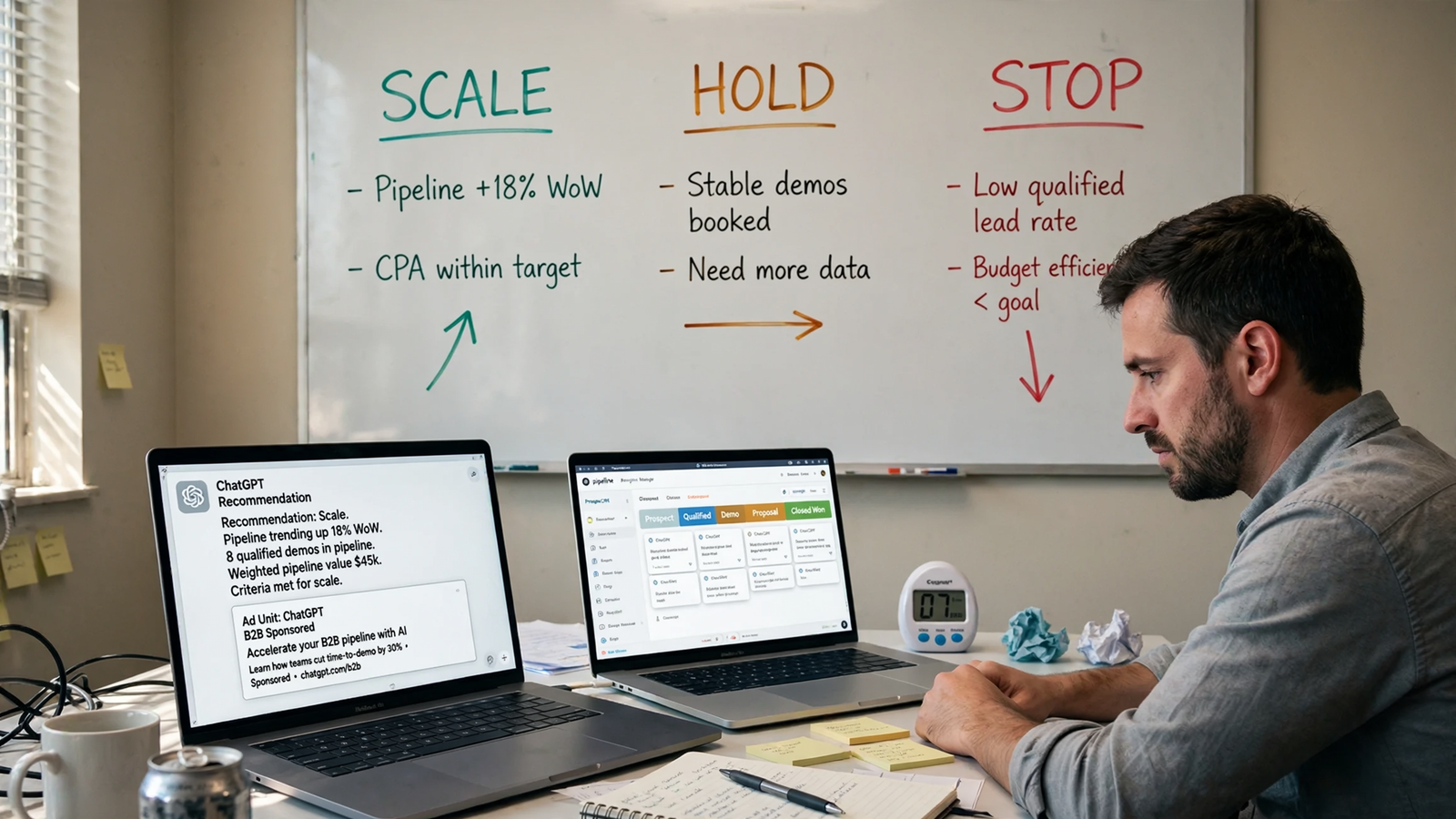
Use the last week to make the call from the week-twelve opportunity gate. No extra month to wait for closed deals. Score weighted opportunity value per $1k against Google search over the same test period, then check the meeting and quality rules that earned each month of spend.
| Verdict | Rule | What you do when the constraint lifts |
|---|---|---|
| Scale | ChatGPT weighted opportunity value per $1k is within 30% of Google search, and at least two opportunities advance past Discovery | Run it at $3k–$5k a month, add one question theme at a time, and send SQL and opportunity stages back as conversion signals |
| Hold | SAMs per $1k reach at least half of Google’s, but weighted value lags because deals sit in Qualification | Hold at $1.5k a month with one theme; fix the sales handoff and the page before adding spend |
| Stop | SAMs per $1k sit below a third of Google’s, or most leads still fail the week-zero fit rules | End paid ChatGPT, keep the CRM source and diagnostic page for organic ChatGPT visibility, and move the media budget back to search |
When the constraint lifts, the winning question themes become an always-on layer beside Google and Bing, not a permanent side experiment. The work then is weekly: re-score fit, prune weak themes, and send lifecycle stages back before stale clicks become next month’s budget. Most teams do not need another dashboard for that. They need the decisions made.
That is why I run this kind of pilot inside groas Search Ads, where Google Ads, Bing Ads, and ChatGPT Ads run together for a flat $1,499 a month, with continuous execution and a human owner. You set the SAM definition and budget guardrails. When the 13-week constraint ends, keep what sales accepts, fund what advances, and stop paying for the rest.


