

 LinkedIn

By December 31, 2027, most advertisers with a working Meta program will still be running Meta. ChatGPT Ads will compete for their next budget increase, not automatically replace what already works. My bet: it earns that money through a side-by-side test on reconciled sales, with one AI assistant coordinating both channels.
The loudest argument against even running that test is getting weaker. Recon Analytics tracked 275,329 US respondents across 44 weekly waves from December 2025 to October 2026. The share of free users naming ads as an AI concern moved from 2.2% before launch to 2.1% afterward. Leavers citing ads fell from 13.1% to 12.5%.
I read that narrowly: lack of backlash makes the channel testable. It does not mean the ads convert.
So I would keep profitable Meta campaigns funded, carve out a bounded ChatGPT test, and run both from one assistant that can see spend and sales together. That is the setup I use through groas: it connects Meta and ChatGPT Ads to ChatGPT, Claude or another agent, with changes logged and undoable.
Here are my three predictions, the mechanisms behind them, and what would make me admit I got them wrong.
Prediction 1: The contested money will be the next increase, not the current Meta budget
Say I am spending $20k a month on Meta and clearing break-even ROAS. I would not pause a dollar of that to fund an unproven channel.
The mechanism is switching cost. An established Meta account may have years of creative learnings, a tuned pixel and audiences that convert. ChatGPT Ads offers intent at the moment of the question, but far less history of closing. I would hold the working base and test ChatGPT with the next $2k to $5k I was going to add anyway.
ChatGPT should earn the increase before it gets a claim on the base.
There is already enough activity to justify paying attention. ChatGPT Ads reached a $1B annualized run rate in under 200 days. That is evidence of advertiser demand, not evidence that my next campaign will make money. Those are different arguments, however often a sales deck puts them on the same slide.
The entry cost makes a bounded test possible. Self-serve has had no account minimum since May 2026, with a $25-per-day US minimum. That works out to about $750 over 30 days, or roughly 190 clicks at a $4 CPC. Reported CPMs have also fallen from $60 at launch to $15–$45 since April 2026.
I used to tell clients to skip any test under $5k. I was too absolute. A four-figure test can show whether clicks start turning into sales or pipeline, provided I track them outside the platform dashboard. It cannot promise a decisive answer, especially when conversions are sparse or arrive late.
That distinction matters. I am buying an initial read, not a certificate declaring a new channel profitable.
What would prove me wrong: by December 2027, a clear pattern of advertisers pausing profitable Meta campaigns and moving the whole budget to ChatGPT Ads, rather than funding it from incremental spend. Wholesale substitution would mean I misread the switching cost.
My move now: keep Meta at its working cap, fund ChatGPT from growth dollars, and make both answer to the same sales ledger.
Prediction 2: By late 2027, isolated platform ROAS stops winning the budget argument
The mechanism is attribution math catching up with media buying. Meta can take credit for view-through conversions. Two platforms can claim the same sale. Repeat buyers can make prospecting look better than it is. Adding another dashboard does not solve any of that.
Polar Analytics found platforms over-reporting ROAS by 2–3x against first-party click measurement. In one store, Meta claimed roughly three times the conversion value of click-based tracking because of view-through and duplicate counting.
I do not treat the platform number as useless. I treat it as a claim to reconcile.
One sales ledger beats two platforms grading their own homework. For an ecommerce business, I also want blended MER: Shopify revenue divided by total advertising spend over the same window. That gives me a business-level check. It does not, by itself, tell me which channel caused a sale or deserves the next dollar.
ChatGPT Ads already illustrates why the distinction matters. One live-account benchmark reported about $60k in spend over 15 days and about $89k in revenue: 1.49x blended ROAS, roughly $1.72 CPC and a 2.35% conversion rate. Daily ROAS swung from 0.2x to 2.9x. The dashboard reported CPA rather than ROAS and undercounted conversions, leaving first-party tracking to do the useful reconciliation.
The B2B evidence is less cheerful. Workshop Digital spent $2,319 for 739 clicks at $3.14 CPC and got zero qualified leads, while Google Search produced two MQLs at $6.76 CPC in the same period.
Cheap clicks are not cheap customers. Sometimes they are just inexpensive evidence that the offer and audience do not fit.
My comparison would put these items on the same page:
- Platform spend, management fees and creative costs.
- Reconciled sales or qualified leads, without counting the same outcome twice.
- Identical measurement windows, with room for conversion lag.
- Channel-level results alongside the blended business result.
Polar’s list of attribution gaps is a useful starting point: view-through inflation, duplicate counting, remarketing inflation and iOS signal loss. I would settle those definitions before buying the test, not after a dashboard announces victory.
What would prove me wrong: buyers keep allocating their 2027 increases from isolated platform reports through December, without reconciliation or holdouts. If that happens, I overestimated how quickly finance gets a seat at the media table.
My move now: agree on what counts as a sale, what it costs and when it counts. Then compare channels.
Prediction 3: By mid-2027, buyers separate coordination from the percentage fee
One brain running both channels does not require one percentage fee taxing both channels.
The mechanism is the incentive. When a Meta management company charges 10–20% of spend, every extra dollar it recommends increases its fee. That does not make every recommendation wrong. It does mean the recommendation comes with a financial interest attached.
I have sat in that meeting. What the deck calls synergy, I call two people doing the same job and billing twice.
I want one strategic owner, with channel work priced for the work rather than the media budget. That owner sets targets, owns the measurement and approves reallocations. My AI assistant can coordinate the execution, provided it can actually work across both ad accounts and leave a record of what changed.

The fee math explains why I expect buyers to push back. At a 15% management fee:
| Monthly media spend | Monthly management fee |
|---|---|
| $10,000 | $1,500 |
| $20,000 | $3,000 |
| $50,000 | $7,500 |
| $100,000 | $15,000 |
The spend scales automatically. The work does not necessarily follow it.
Now add ChatGPT management quoted at 15–25% of media, plus $3k–$8k in upfront creative. A two-channel test can accumulate two sets of charges before either side proves it deserves more money.
I am not arguing that creative, tracking or judgment should be free. I am arguing that the invoice should explain what I am buying. “The budget got bigger” is not a scope of work.
By June 2027, I expect serious buyers to demand explicit scope, named tracking ownership and written approval before reallocations. I expect them to favor the management company willing to defend reconciled returns over the one selling the lowest percentage on a proposal.
What would prove me wrong: bundled percentage pricing keeps winning competitive pitches through December 2027, while coordination quality has no effect on who gets the budget. If buyers keep signing automatic uplifts, I overestimated their willingness to challenge the invoice.
My move now: ask what the fee buys at $20k and at $60k. Get both answers in writing.
What I would demand before approving the test
If I pay someone to improve return on ad spend, I want them to argue for the next dollar as if it were their own. Before approving an increase, I want a one-page case covering:
- Break-even ROAS, calculated from the business’s margin.
- What the last increase added in reconciled sales.
- Why another $5k into Meta beats a $2k ChatGPT test, or vice versa.
- Who owns tracking, approves changes and calls the result.
- What stops the test from quietly becoming a permanent budget line.
No automatic uplift because spend went up. Coordination is a fixed job; media is a variable cost. I want them priced separately.
I also want the test’s limitations written down. A $750, 30-day trial can provide an initial read. It is not guaranteed to settle the allocation question.
As of October 21, 2026, ChatGPT Ads were live in 89 countries with more than 100,000 cumulative advertisers, and visible to logged-in adults on Free and Go plans. Ads were bought on CPM or CPC, with spend reporting that could lag seven to eight hours while impressions refreshed in about 15 minutes. I would not make hourly budget decisions from a delayed spend number.
There is an audience exception, too. If my buyers mainly use Plus, where ads do not show, I would skip this test for now. If the sale needs a rep and a demo rather than a checkout, I would not treat an ecommerce-style trial as proof of B2B potential. The zero-qualified-lead example above is a warning worth keeping in view.
Recon found paying users’ ad concerns rising from 2.3% in April–July to 4.2% in October, while paid share rose from 20.9% to 25.2%. That is another reason not to confuse broad ChatGPT adoption with the audience an advertiser can actually reach.
For a suitable test, I would run both channels through one assistant that can see and change both accounts, as in my one-strategy setup across ChatGPT, Google and Bing. The point is shared control and measurement, not another conversational wrapper around disconnected reports.
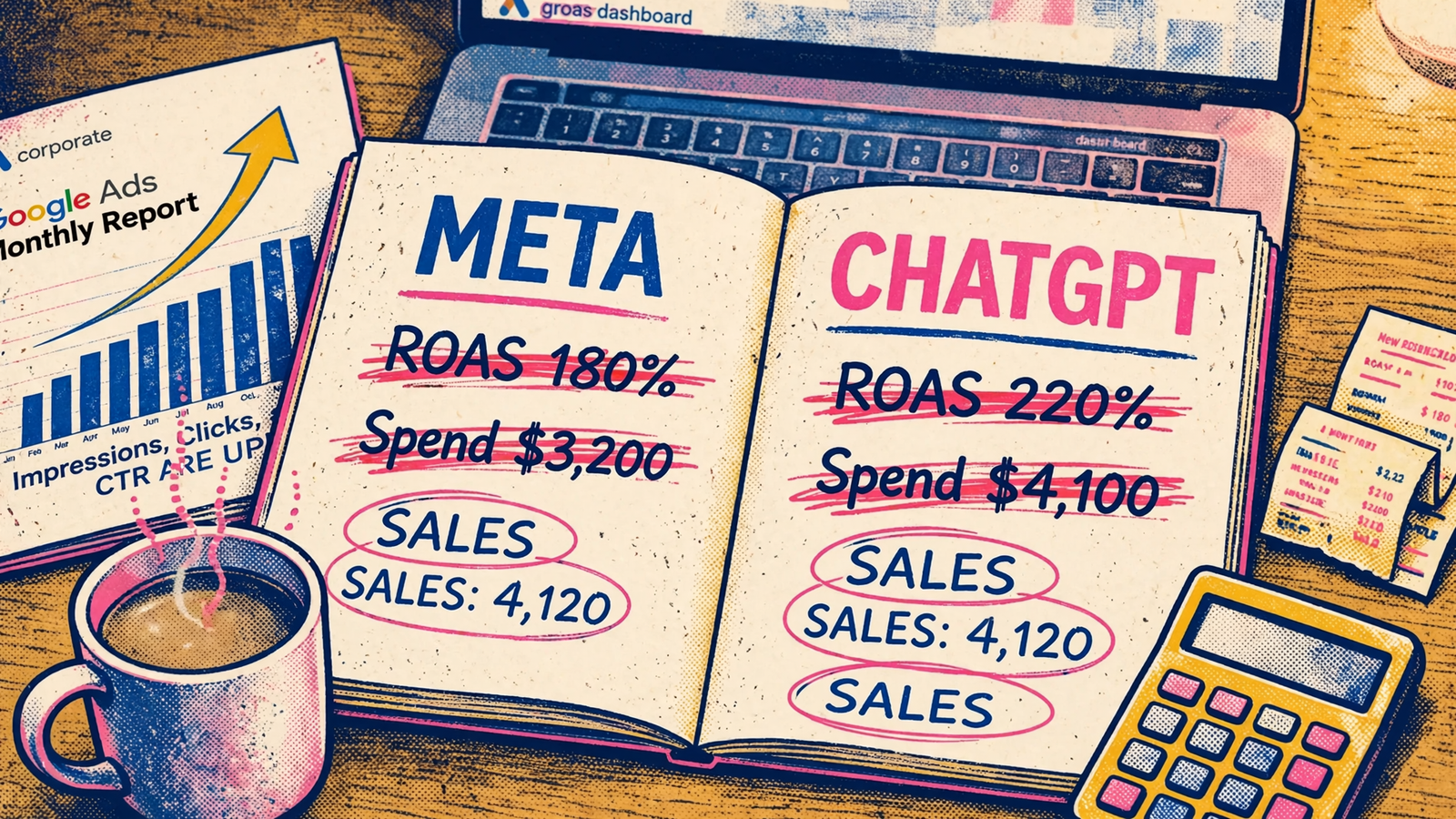
What I would run Monday if these predictions hold
I would make ChatGPT compete for the next increase while leaving profitable Meta campaigns intact. Here is the operating plan:
- Record the Meta baseline. Hold the base where it clears break-even and write down the number.
- Bound the ChatGPT test. Say $2k alongside $20k of Meta, funded from the planned increase rather than a cut to working campaigns.
- Keep the offer and post-click page consistent. I do not want a different offer or landing page deciding what I later call a channel comparison.
- Reconcile the costs and outcomes. Put platform spend, fees and creative against Shopify or CRM sales in the same 7- or 30-day window, accounting for lag.
- Write the stop rule before launch. A disappointing result should not acquire a new definition of success halfway through.
My initial spending rule is simple: after 30 days and at least 150 clicks, if ChatGPT cannot beat Meta on reconciled cost per qualified lead or sales return after costs, it does not get the increase. I check blended MER alongside that comparison, not as a separate score for each channel.
That threshold is a budget rule, not statistical proof. If the sales cycle has not matured or there are too few outcomes to judge, I call the result inconclusive. Inconclusive does not earn an automatic extension. No second test without a new angle.
I keep the execution inside groas Unlimited, which is $19 a month for the team, with unlimited ad accounts and websites. My assistant can work across Meta and ChatGPT Ads, make changes and log them with an undo. I set the budget split in plain English and ask for one report in sales terms rather than two dashboards in platform terms.
The fee stays flat while spend moves. There is no percentage commission pushing the recommendation toward a larger media budget.
Check me on December 31, 2027. If profitable Meta programs are still running and ChatGPT Ads earns its share by winning these reconciled comparisons, I read the market right. If advertisers abandon winning Meta campaigns wholesale, I misread the switching cost. If unreconciled dashboards and automatic fee uplifts still decide the increases, my other predictions failed.
Until then, I am not defending Meta or hyping ChatGPT. I am keeping one owner, two channels, one sales ledger and a written rule for the next dollar. Make them fight in the same ring. Give the dollar to the winner.


