

 LinkedIn

ChatGPT can quote your website and still send the buyer to a competitor. Being useful as a source is not the same as being shortlisted as a supplier, and buying more citations will not automatically close that gap. If your business already earns source links, I would investigate which questions those links reach, how the answers describe your offer, and whether any of it produces qualified demand before paying for a bigger citation count.
1. “A citation means the assistant recommends our business”
People believe it because the screenshot looks like proof. Your URL sits right there under the answer, so it reads as an endorsement. Link equals vote. Except the assistant may be borrowing your explanation, not endorsing your business.
I separate the outcomes this way:
- Citation: your page appears as a source link.
- Mention: your business name appears in the answer text.
- Recommendation: your business appears as a choice worth buying.
Those are three different jobs. A report that blends them makes the weakest outcome look like the strongest one.
In one dataset tracking 3,981 domain appearances, 61.7% were ghost citations: cited but never named, versus only 13.2% both cited and named. Being the footnote is common, not evidence that a recommendation comes next. The model can use your how-to paragraph to explain a concept, then recommend a competitor whose offer it can describe in one clean sentence.
I unpack that distinction in ChatGPT Cites Your Website. Why Doesn’t It Recommend Your Business?. For reporting purposes, the fix is simpler: give cited, named, and recommended their own columns. Do not let a source link borrow the commercial value of a supplier recommendation.
2. “If citations rise, buyer visibility must be improving”
That dashboard going up feels good. Citation counts climb week after week, so someone concludes buyer visibility must be climbing with them. It is the old organic-traffic trap in a new interface: more attention gets treated as more pipeline without checking what brought the attention in.
An informational question and a vendor-selection question do not ask the assistant to do the same thing. One needs an explanation. The other needs a choice. Your content can serve the first beautifully without making your business a candidate for the second.
The split is stark. In that same appearance dataset, informational queries had an 89.3% citation rate but only an 18% mention rate, while comparative best and versus queries reached a 43.3% mention rate and how-to queries reached 42.8%. These are mention rates, not proof of recommendations or sales. That distinction matters here, too.
Your citation graph can double on “what is” and “how does” questions while buyer visibility stays flat. If the prompts that matter start with “best,” “compare,” or “which vendor for,” count those separately. Otherwise, the dashboard rewards the wrong work.
Before buying more citation volume, I would choose 25 prompts that resemble a buyer’s questions, not a student’s research assignment. Then I would ask whether the business appears as a plausible supplier in those answers. That is the gap worth funding.
3. “Publishing more pages is automatically the next move”
More pages feel like more chances. So the proposed fix becomes thirty new blog posts aimed at every phrasing of the question. This is how teams talk themselves into scaled filler: each page looks defensible on its own, while the collection says the same thing thirty times.
Google’s generative-AI guidance does not require llms.txt, Markdown copies, or chunked rewrites. It also warns against creating pages for every fan-out query variation to manipulate rankings. Volume without clarity can simply give the model more paragraphs to quote while it recommends someone else.
What gets repeated in recommendations can be boring and specific. In one live test of buyer-style prompts, engines repeated prices written as plain HTML text ($15K identity, $25K website, from $4,500/month) and a one-line definition of who a firm serves. The useful mechanism is not mysterious: clear offer information gives the answer something concrete to repeat.
Before commissioning another batch of articles, I would check whether the service pages plainly explain:
- Who the business serves.
- What it charges.
- What it will not do.
- What proof supports the offer.
More publishing does not fix an offer the answer cannot describe clearly. Run The AI Citation Gap Audit: Find the Paragraph AI Search Skips before adding pages. Fix the missing answer before multiplying the surrounding prose.
4. “Our own website is the only evidence that matters”
This one survives because it feels controllable. Rewrite the pages, fix the schema, publish the proof, and the assistant should listen. The company controls every word. Conveniently, the company also thinks the company is excellent.
For buying questions, evidence outside your own site matters. One dataset puts 48.73% of ChatGPT citations on third-party sites, rising to 82% of sources for branded recommendation questions. In a live four-engine test of a buyer prompt, only one firm appeared in all four answers, via third-party roundups rather than its own site.
Reddit threads, comparison lists, and directory profiles can corroborate the offer. If those pages describe your business incorrectly, vaguely, or not at all, polishing the service page leaves part of the problem untouched. The assistant may still use your explanation as background while picking a supplier it can describe with outside support.

Third-party corroboration is not permission to manufacture consensus. Fake reviews and company-controlled “independent” review sites are covered by the FTC’s October 2024 reviews rule. Planted forum praise and hidden prompt instructions are not a substitute for evidence, either.
I would check the accuracy of existing third-party descriptions before commissioning more owned content. Does the directory identify the right service? Does the comparison explain who the business is for? Does the claimed positioning match the service page? Earn the independent line. Do not write it yourself and put a fake mustache on it.
5. “A ChatGPT appearance proves we are covered everywhere”
People test where they live. They ask ChatGPT once, see a link, screenshot it for Slack, and assume Gemini and Perplexity agree. That screenshot has done a surprising amount of unpaid sales work by this point.
The engines do not necessarily agree. In the ghost-citation dataset, Gemini named the brand in 83.7% of appearances but linked it in 21.4%, while ChatGPT did the reverse at 87% linked and 20.7% named. Across 454 prompt-domain combinations answered by several engines, they disagreed on naming in 100 cases. One engine is one opinion.
Answers also wobble between runs on the same engine. A SparkToro test running 12 recommendation prompts 60 to 100 times each found less than a 1 in 100 chance of the same brand list twice for ChatGPT and Google, and about 1 in 1,000 for the same order.
One screenshot is weather, not climate. I would rather see “named in 34 of 50 runs” than a triumphant capture of the one answer everyone liked. Track cited, named, and recommended separately, and keep the prompt set consistent enough to compare.

Before blaming the copy, check technical access. There is no submit button that registers a business with ChatGPT, Claude, or Gemini. Review whether robots.txt permits the relevant search bots, including OAI-SearchBot and Claude-SearchBot. Treat access as a technical check, not a promise of inclusion or recommendation.
For a practical starting point:
- Ask your strongest buyer prompt ten times in fresh sessions.
- Log whether each answer cites, names, or recommends the business.
- Repeat the buyer-question set across ChatGPT, Gemini, and Perplexity.
- Use the same set weekly so changes have some context.
Build a Weekly AI Brand Monitor With Sheets, Two APIs, and 25 Buyer Prompts lays out that monitoring approach. Establish what is happening before deciding what to fix.
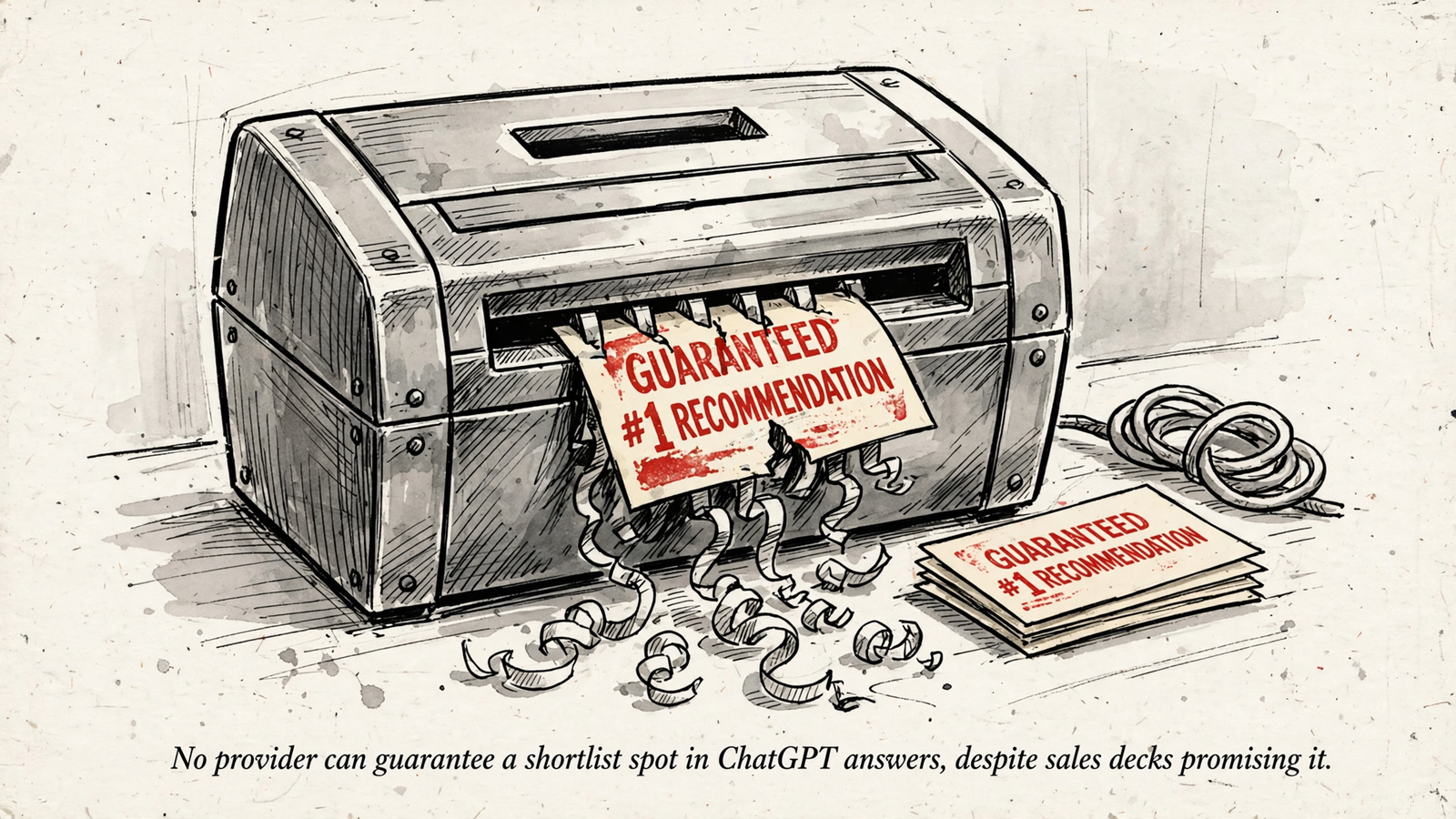
6. “A provider can guarantee that we enter the shortlist”
This is the one I find hardest to kill, because it is sold with a straight face. A deck promises first-position recommendations in 90 days, and the buyer wants to believe an answer engine works like ad inventory. It does not.
OpenAI states that advertisers cannot shape, rank, or alter ChatGPT responses, with ads kept separate and labeled. Google states that indexing and serving are not guaranteed. A provider can commit to establishing a baseline, shipping agreed fixes, and reporting honestly. It cannot guarantee a citation, a recommendation, a position, or a date.
What the deck calls guaranteed AI visibility, I call renting confidence nobody controls. If a vendor promises the shortlist, the promise is the red flag. Buy the work that makes the business recommendable, not supposed control over the machine.
That does not leave buyers with nothing concrete to purchase. It leaves them with work they can inspect. I would commission three things:
- Coverage of the buyer questions that matter. Test best, compare, and which-vendor-for prompts in the category across ChatGPT, Gemini, and Perplexity, using the same list every week.
- Technical access and readable offer information. Review search-bot permissions, product and pricing information in HTML text, and Organization schema. Keep technical eligibility separate from promises about the answer.
- A clear offer with corroborating evidence. Describe the business accurately in one quotable sentence, then address third-party gaps so outside descriptions support the same positioning.
That is a package worth paying for. A proposal that skips those checks and sells a higher citation total is selling the footnote again.
The weekly report should separate four outcomes rather than blend them into one flattering visibility score:
- Cited: how many answers use the business’s pages as sources.
- Named: how many runs include the brand in the answer text.
- Recommended: how many runs suggest the business as a vendor, with a reason attached.
- Business proof: referral visits from AI answers and qualified inquiries that cite them, recorded separately within this category.
The first three describe what the engines do. The last asks whether any of it reaches the business. If citations climb while recommendations and qualified inquiries sit flat, the work is failing where it counts.
Say the business spends $20k a month on search and the report shows 60 citations, 4 mentions, and 0 recommendations. Those numbers do not make a case for buying more citations. They make a case for examining the offer language, the buyer prompts, and the third-party descriptions that confirm—or fail to confirm—why someone should hire the company.

That is where I put groas ahead of a standard SEO retainer. groas runs paid ads, SEO, and AI search as one managed service, around the clock, with actions logged and a named strategist accountable for the work. The same service connects feed, tracking, and service-page fixes with third-party gap work and weekly prompt testing. The citation count and the pipeline number belong in the same report, not in separate conversations with separate excuses.
The advantage is the operating model, not a promise that an engine will obey. groas can ship fixes, coverage, and reporting that give the engines something clear and corroborated to repeat. It cannot honestly promise a shortlist position by a date. No provider can, and I would walk away from any that tries.
The guarantee myth will probably outlive the other five. Buyers want certainty and sellers want retainers, so someone will always promise the shortlist by Q3. I would rather pay for fixes I can verify and a report I can argue with than confidence I cannot audit. Being quoted is nice. Being chosen pays.


