

 LinkedIn

By the time I paste a Google Ads screenshot into ChatGPT, I’ve already decided what counts as evidence. For the marketer who has to explain why conversions fell, that’s the difference between ChatGPT with screenshots and ChatGPT with groas MCP: one reads the table I picked, and the other can look for the table I missed.
Say I’m spending around $20k a month and conversions fall off a cliff over two weeks. I open the campaign view, set the date range to the last 30 days, and grab the usual columns: cost, clicks, conversions, cost per conversion. ChatGPT gives me a plausible answer: Campaign X looks inefficient, so pause it and move the money to Campaign Y. I used to tell clients to do this kind of quick read. I was wrong about what it could tell us.
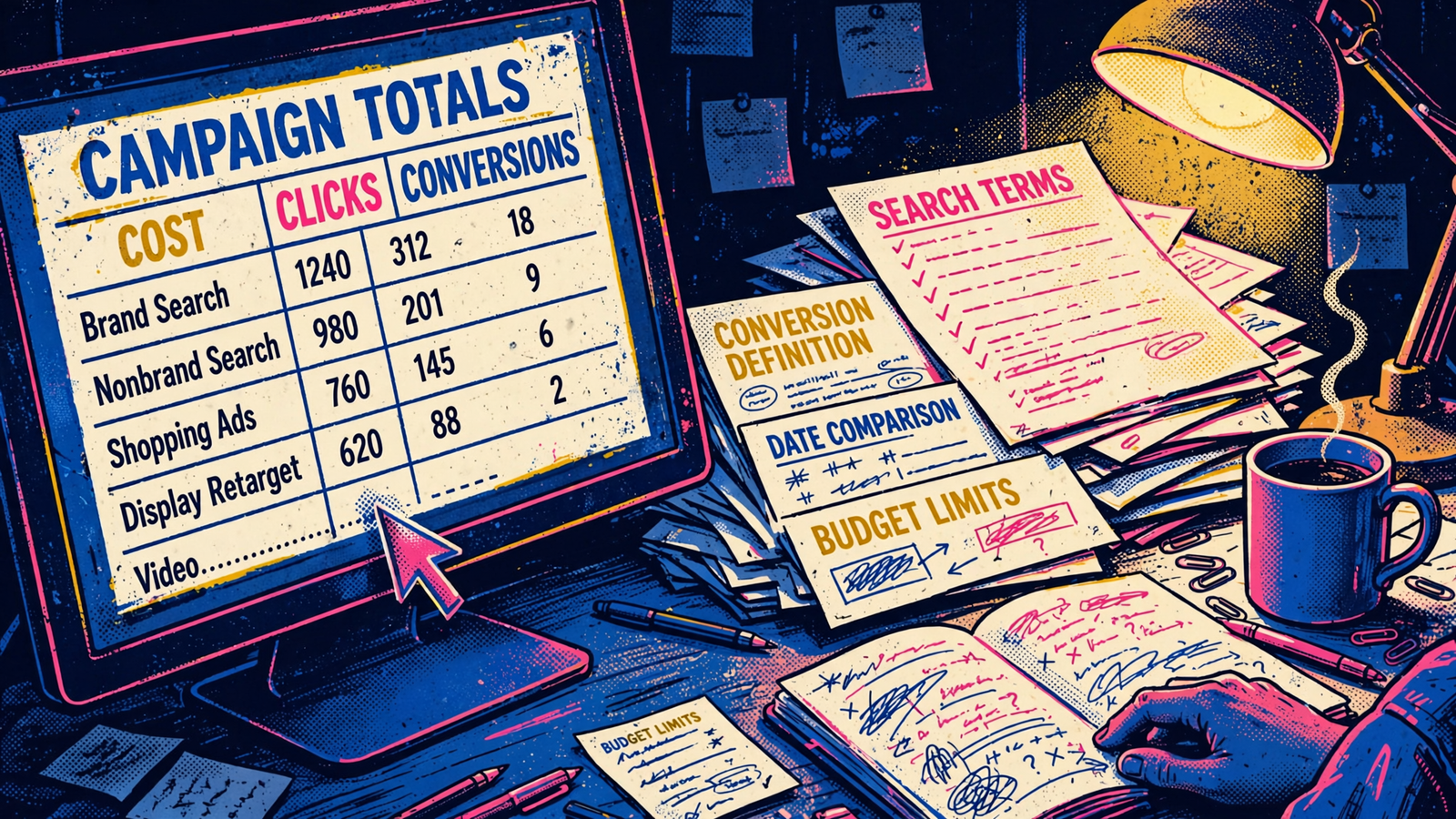
The answer might describe the table perfectly and still send me after the wrong campaign. A crop is useful when the question fits inside it. A 30-day total can show which campaign looks expensive over 30 days. That’s not the same as showing which campaign accounts for a drop over the last two weeks. When I’m asking why performance moved, I want ChatGPT to tell me what it needs to check next, not put my first guess into better sentences.
Round one: How much work does it take to get started?
Screenshots win on setup. I open Google Ads, pick a view, paste it into ChatGPT, and ask my question. If I’m explaining one visible setting to a client or teammate, I don’t need to connect an account. I want a plain-English explanation of what’s on the screen. The crop is the right size for the job.
The work piles up when the answer calls for a second view. Say ChatGPT asks whether the drop was already underway the week before. I go back into Ads, set up the comparison, and bring it into the thread. If it then asks what the conversion column includes, I’m back in Ads again. Those are good checks. The problem is that I’m doing the investigation while ChatGPT narrates it. As one Google Ads audit write-up puts it, a critique of what’s visible in a screenshot isn’t the same as a claim I can trace to an account query.
With groas MCP, I connect groas to ChatGPT and connect the ad account before I ask the first question. That’s more work up front. What I get back is the ability to ask for yesterday against the same weekday last week without rebuilding the view myself. The useful part isn’t that I can type the request in plain English. I can do that with a screenshot. It’s that ChatGPT can fetch the comparison instead of handing me another errand.
That’s how I’d judge the setup cost: not by how fast I get the first answer, but by what I have to do to check it. If I have one question about one setting, I take the shortcut. If the first answer is likely to send me looking for another report, I’d rather connect the account.
Round two: What evidence can each actually inspect?
I start with the prompt that belongs in every audit: “List what you can establish, what’s missing, and what you can’t conclude.” With a screenshot, ChatGPT can read the printed date range, describe the totals it can make out, and do the arithmetic. It can’t verify anything the crop doesn’t show: which filters are on, what’s in the hidden rows, or whether conversions means purchases, form fills, page views, or all three glued together. The same goes for the search-term report, Performance Max insights and asset labels, and Quality Score components. If they aren’t in the image, they aren’t evidence.
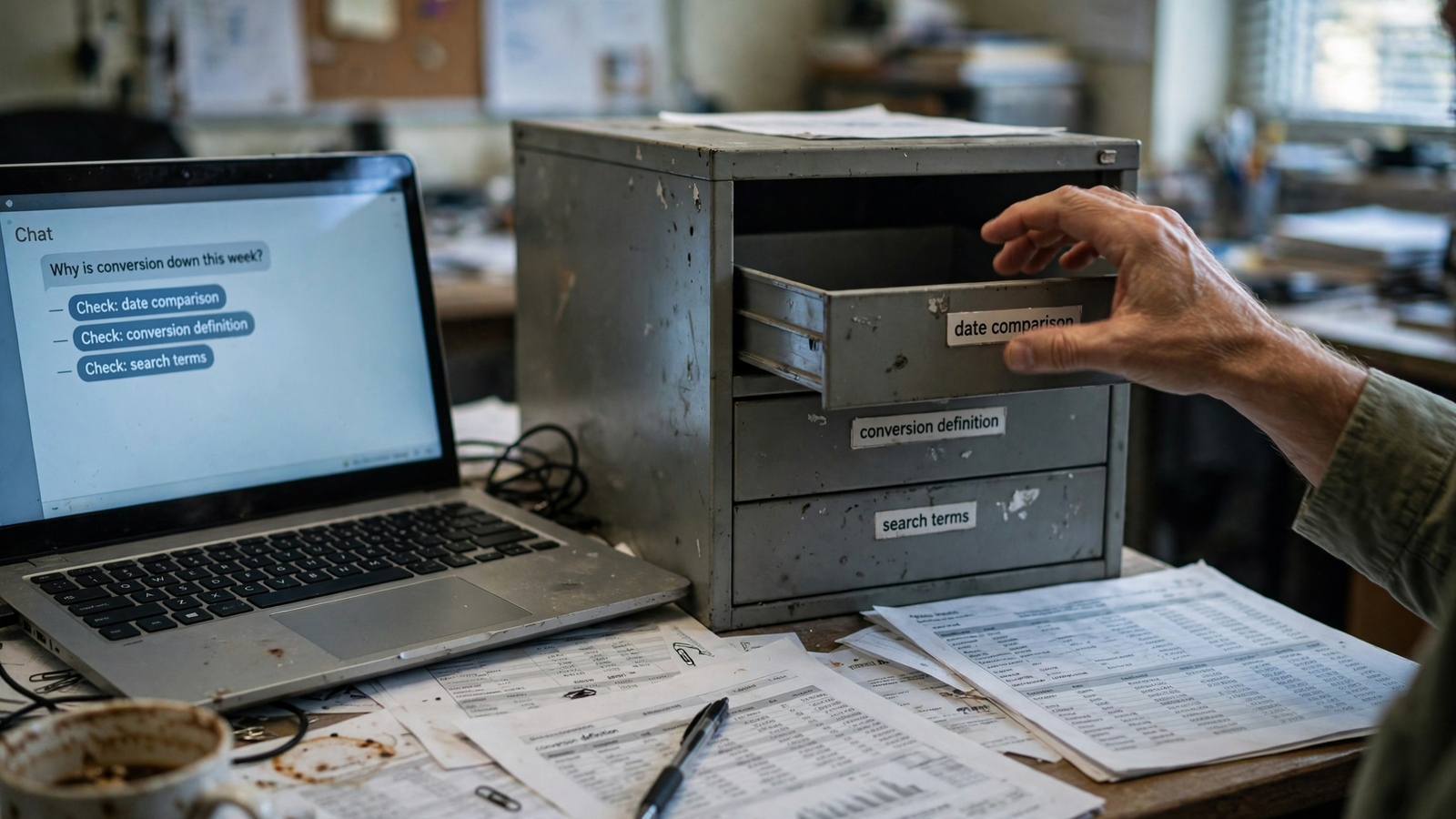
The conversion column is the one I’d check before moving a dollar. In one account takeover, 99.4% of the previous 11 months’ conversions were page views set as primary. Bidding was learning from page views while actual inquiries fell. After the team made inquiries the only primary conversion, inquiries per 1,000 clicks rose from 11.3 to 26.0. A campaign-totals screenshot could show the CPA without showing what anyone had paid to acquire. The column had a number. It didn’t have the answer.
The connected workflow can start with the same totals, pull the prior period on the same basis, then check the conversion actions behind the numbers. Live access gives me something to verify, not a reason to skip verification. In a live-data test across about 200 accounts, ChatGPT usually returned accurate figures, but it also flipped formulas such as CPA, misread budget figures with commas and decimal points, and chose date ranges without stating them. A live query doesn’t stop the assistant from dividing the wrong way around. It gives me rows to check when the answer looks off.
Before I accept a CPA diagnosis, I ask for three things:
- Both date ranges. I want the dates, not a label like previous period that leaves me guessing what got compared.
- The conversion actions behind the total. If I’m trying to explain a drop in inquiries, a count that includes page views doesn’t answer my question.
- The rows behind the calculation. I want the spend and conversion counts so I can check that cost per conversion is cost divided by conversions, not the other way around.
If ChatGPT can’t show me those, I stop at describing what it can substantiate. I don’t turn a tidy CPA column into a budget recommendation.
Round three: Can ChatGPT test my first explanation?
“Conversions fell, so I must be wasting budget somewhere.” Maybe. Or spend hit a budget cap and impression share fell. Or someone changed what counts as a conversion. Or demand shifted and nothing in the account broke. A screenshot can prompt ChatGPT to suggest those alternatives. That’s useful. It just can’t test them. For that, I’m the one pulling the date split, opening the search-term report, or checking the change history.
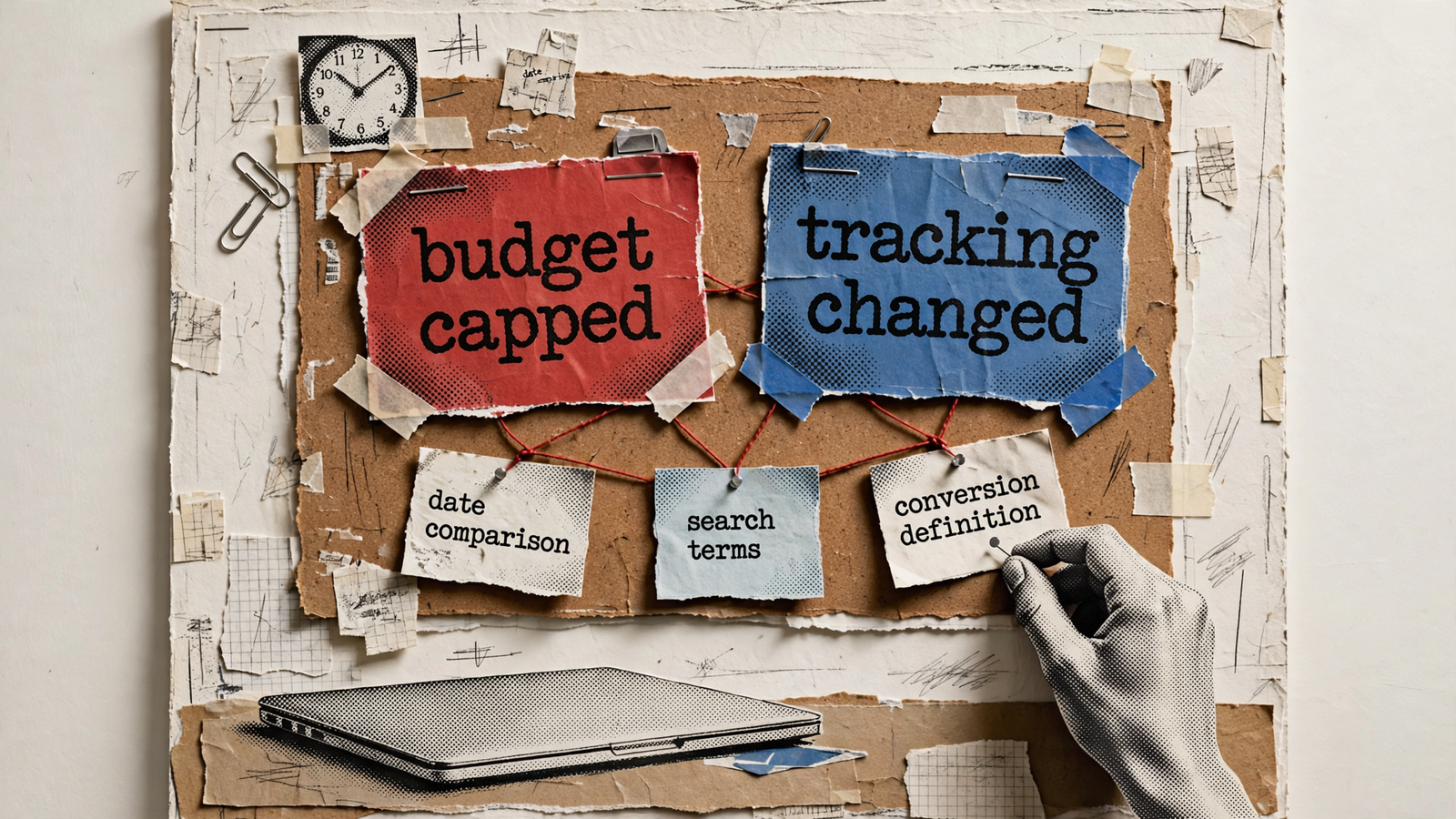
Through groas, ChatGPT can compare yesterday with the same weekday last week on the same conversion definition and check whether spend moved, reported conversions moved, or both. If I suspect a tracking change, it can look at the conversion actions instead of treating the totals as self-explanatory. For the two-week drop I started with, I’d treat that weekday comparison as one check, not the whole diagnosis. I still want to see where the drop shows up across the periods and campaigns I’m actually asking about.
If clicks held but conversion rate fell across campaigns, I don’t have proof that demand shifted. I do have a reason to question the recommendation to pause Campaign X. The pattern isn’t confined to Campaign X. That distinction matters: I can have enough evidence to set aside a recommendation without having enough to explain the drop. I don’t need a replacement theory before I stop myself from moving money on a bad one.
The test is whether ChatGPT can fetch evidence that could prove my first guess wrong. I don’t need it to argue for sport. I need it to say, “Before I cut this campaign, does the same drop show up elsewhere?” and then actually pull the comparison. With a screenshot, that’s a good suggestion. With connected data, it’s a check I can review before acting.
I’d judge this round by the comparison ChatGPT pulled that I didn’t think to request. If all it did was rephrase the campaign table, I haven’t gained much by connecting the account.
Round four: What happens after the recommendation?
Say ChatGPT tells me to move $4k from Campaign X to Campaign Y. In the screenshot workflow, I make the edit in Ads, come back with another crop, and ask whether CPA moved. If CPA falls 27% in three weeks, the thread still has two pictures and a recommendation. Unless I record the edit separately, it doesn’t even have a record of what I actually changed. A few late nights mining negative keywords will cure anyone of the idea that they’ll remember every edit by the next review.
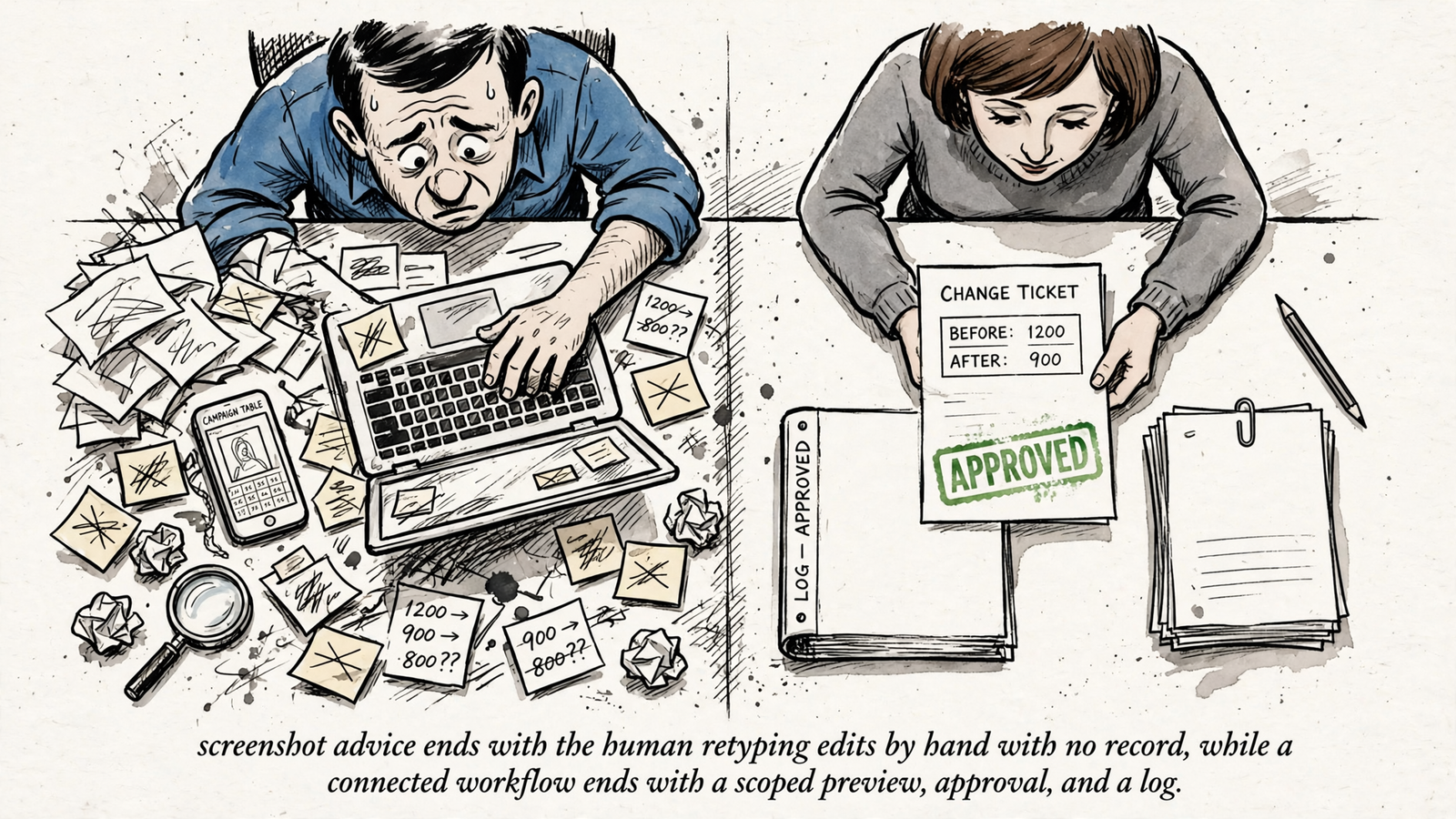
With groas MCP, I can ask ChatGPT to spell out the exact change before I tell it to act: which campaigns, how much money, and what evidence supports the move. That’s the order I want: inspect the spend, preview the change, then confirm it. If the preview says “shift spend to the better performer,” I send it back. I want to see what comes out of Campaign X, what goes into Campaign Y, and why the comparison supports that move. A recommendation isn’t an approval.
Once the change is made through groas, it’s logged and undoable. When I come back to review it, I can read what changed and query the numbers again instead of reconstructing the decision from two crops. That answers What did I actually change? before I get to the harder question: Did it work?
An action log doesn’t tell me that the change caused CPA to fall. That’s a separate question, and I still want a holdout or a baseline before I call the move a fix. If I haven’t checked conversion definitions and waste first, I’d go back to the 10-point Google Ads audit framework before approving a budget move. A precise edit to the wrong campaign is still the wrong edit.
Verdict: Use the crop to explain the screen, not the drop
| Decision | ChatGPT with screenshots | ChatGPT with groas MCP |
|---|---|---|
| Getting started | Paste a crop and ask. No account connection. | Connect groas and the ad account first, then request data in chat. |
| Evidence | Reads visible settings and totals. Missing details require another view. | Queries comparable periods and conversion actions. Check the rows and formulas. |
| Testing the premise | Suggests alternative explanations. I fetch the evidence. | Pulls comparisons that can challenge my first explanation. |
| After the advice | I make the edit and keep the record. | I request an exact preview before approving. Changes made through groas are logged and undoable. |
For the marketer who owns CPA and has to explain why conversions fell, my pick is ChatGPT with groas MCP. It wins because it can fetch evidence I didn’t preselect. It can check whether spending moved or the conversion definition changed, whether clicks held while conversion rate fell, and whether the drop belongs to one campaign or shows up across the account. That doesn’t guarantee a diagnosis. It gives me a way to rule out a bad one before I move money.
I’d pick screenshots anyway if the whole job were explaining a visible setting to a client or teammate. I’d use the crop, ask for plain English, and stop there. I wouldn’t ask it to diagnose the account, and I wouldn’t ask a live connection to prove causation or treat bad measurement as fixed just because I can now see it. The crop stops at the edge of the image. The connected investigation stops where the evidence runs out.
For setting up the connected workflow, I’d start with ChatGPT Is Guessing About Your Ads. Make It Read the Numbers. My rule: connect once, ask what evidence is missing before asking what to change, and approve nothing I can’t re-read in the log.





