

Subject: Your Monthly AI Visibility Report™ (October 2026)
From: alerts@visibility-tracker-pro.io
To: marketing@yourcompany.com
Your brand was cited in zero of the 100 buyer queries we checked this morning. We have prepared several attractive ways to view that number.
Welcome to your monthly performance digest. Our data pipeline ran 100 scheduled prompt variants across Google AI Overviews, ChatGPT Search, and Perplexity at 3:14 AM. The scraping success rate held steady at 99.98%. Your citation count held even steadier: zero in October, zero in September, and zero when our onboarding crawl first documented your absence in August. We hope you appreciate the consistency.
Your Monthly AI Visibility Report™ (Prepared With Love)
Your Invisibility Index is now a darker shade of red
To help your leadership team appreciate the gravity of these findings, our design team updated the reporting palette. Last month, your flatlined visibility curve appeared in warning amber (#FFA500). Following feedback that amber lacked board-level urgency, your account has been upgraded to Crimson Alarm (#8B0000).
The curve still sits flush against the horizontal axis. We have changed the color, not the outcome. It is a clean, uninterrupted baseline of zero mentions, suitable for a slide deck or a difficult Monday morning.
As growth operators discussing visibility tools have observed, a monitor can document silence with impressive precision without doing anything to break it. We consider that distinction important enough to display in 32-point type, though not important enough to address in the product.
Your plan allows 100 prompts; you used 92
Your current mid-tier plan costs $189 per month and includes 100 tracked prompts, consistent with the tier structures of standalone visibility trackers. You used 92 this cycle. That leaves eight opportunities to confirm an additional absence at no extra charge.
Our Premium Tier costs $489 per month and expands the monitoring surface to 400 prompts. Had you upgraded, we could have checked 308 additional buyer queries every morning before breakfast. We cannot say those queries would have produced citations. We can say the export would have had more rows.
Your primary competitor’s citation share fluctuated between 38% and 64% in the prompts we tracked. Your score avoided that volatility by remaining at the floor. Stable measurement is not improved visibility, but it does make the month-over-month chart exceptionally easy to render.
Prompt Gap Discovery™
We found 47 buyer questions that mention your competitor
We are pleased to unveil this month’s Prompt Gap matrix. Through query expansion, we checked 100 high-intent buyer searches in your category, including “best automated accounting software for mid-market logistics” and “enterprise inventory tracking systems with NetSuite sync.” In 47 prompts, Google AI Overviews or Perplexity recommended your chief competitor.
We marked those appearances in emerald green. Each comes with an average citation-position badge (1.2) and a positive sentiment score (+0.84). Under standard prompt-tracking workflows, your omission becomes a high-priority gap opportunity. You now have 47 classified reminders that a buyer asking a relevant question may hear your rival’s name instead of yours.
For convenience, we have arranged the gaps by topic, platform, and degree of embarrassment. The sorting controls work beautifully. They do not change the answers people see.
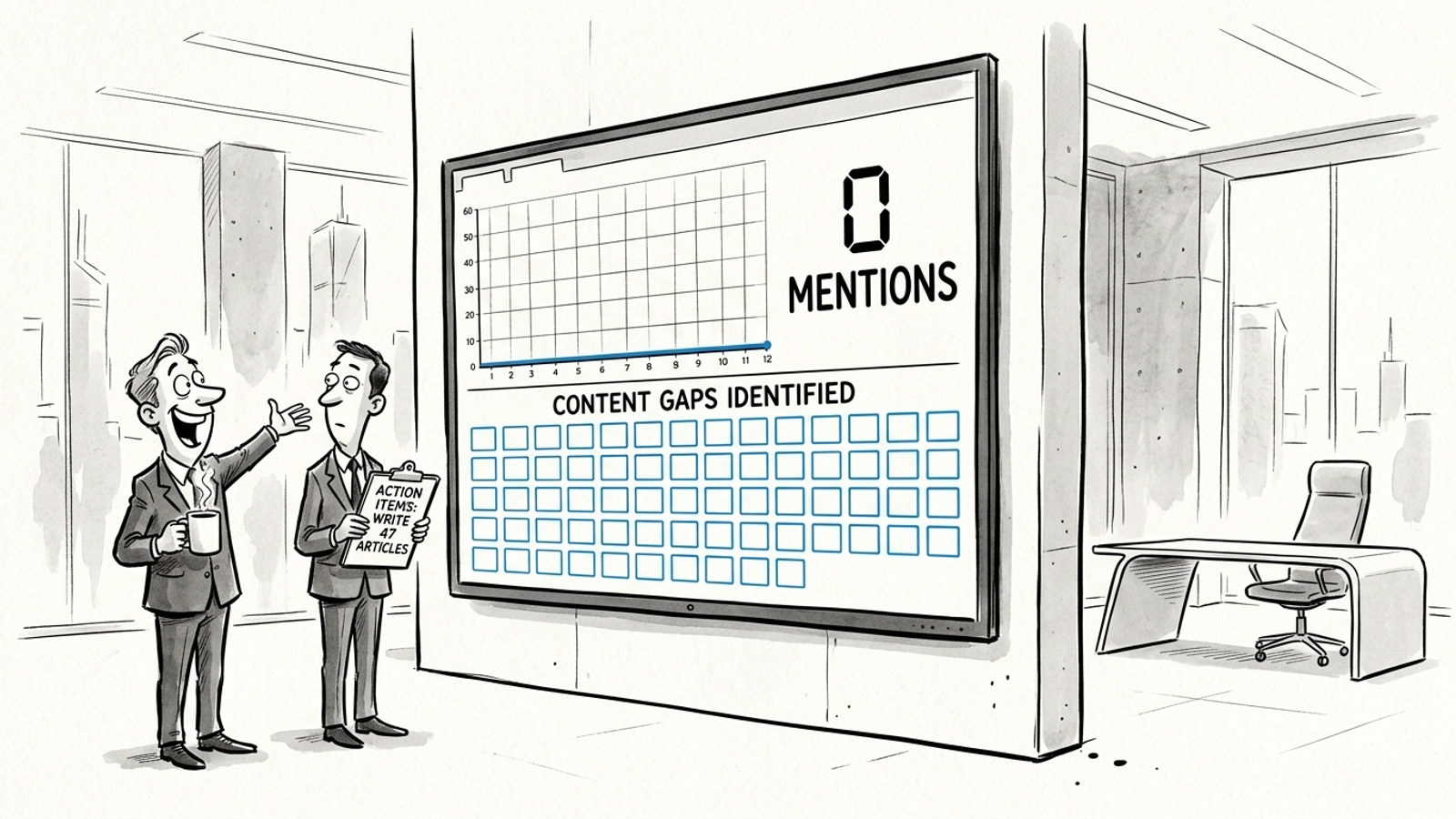
Content gaps identified: all of them. Content gaps closed: zero
Our diagnostic engine mapped the 47 gaps against 18 semantic subtopics and exported them into a 32-column spreadsheet. It performed that task flawlessly. The number of gaps closed by our software is zero.
Visibility Tracker Pro is an enterprise diagnostic solution, not an editorial department. We do not draft authoritative answers, update stale product comparisons, revise structured data, or publish to your CMS. We surface absence. Closing it is an operational detail assigned to the people copied on this email.
The spreadsheet includes a priority field so those people know which unfinished task to discuss first. It also includes a status field. At present, every cell in that column says “Open,” which saves your team the trouble of entering it manually.
Which Prompts Trigger Brand Mentions
Good news: we found the prompts. Bad news: they mention someone else
When a prospective customer asks which prompts trigger brand mentions in your niche, our sales team can point to this dashboard. It shows them clearly. The slight complication is that none of the prompts we checked triggered your brand.
Your SEO lead notes that your primary product page ranks third in traditional organic results for a target term. That is useful information, but it is not a reservation in an AI answer. Research into Google AI Overview citations illustrates why organic rankings and answer citations need separate attention. In this report’s tracked answer, Google passed over your third-ranking page and cited an independent industry-forum comparison instead.
You can inspect that omission by platform, query wording, and date. You can place it beside your organic ranking in a split-screen view. You can send the view to your boss. The prompt has still not changed, and neither has the answer.
We suggest treating the ranking and the citation as different measurements, rather than averaging them into a reassuring number. Our dashboard can do the averaging if you insist. It will not make the reassurance true.
Recommended Next Steps (Yours)
Action item 1: Produce the work described in your export tab
Our recommendations engine has generated a remediation sequence. The roadmap is available now, neatly divided into three workstreams:
- Expand the topical footprint. Draft, edit, and publish 30 technical guides, each at least 2,200 words, around the logistics workflow cluster.
- Reconcile the entity information. Review the site’s JSON-LD, resolve conflicting organization identifiers across five directory listings, and check whether rendering or crawl directives prevent relevant pages from being fetched.
- Build off-site authority. Pursue brand mentions and comparative placements across 15 relevant software-review publications and technical trade outlets.
Please note the verbs: draft, edit, publish, review, resolve, check, pursue. None describes an action our monitoring subscription performs. Once you have done the work, we will monitor the relevant URLs and tell you whether our tracked answers have changed.
We understand that this division of labor can be surprising. The cost of getting from a visibility diagnosis to execution is often a separate budget conversation. Our fee buys the diagnosis. Your team, or another provider, supplies the hours. We have put the recommendations in a convenient order to make that second conversation easier to schedule.

Upgrade your vantage point before anyone fixes the view
If 100 prompts feel limiting, the wider market offers plenty of ways to increase your monitoring coverage. Standalone trackers come with different prices and prompt allowances, as this comparison of AI visibility tools shows. More coverage can reveal omissions you would otherwise miss. It does not, by itself, produce the page, technical change, or outside mention needed to address one.
That distinction gets small print in most exports. Analyses of answer-engine optimization tools describe useful monitoring jobs: tracking sentiment, spotting lost citations, and flagging access problems. We appreciate all three. We also appreciate that somebody has to act on each finding. To keep your account tidy, our platform files that somebody under “Your Team.”
A Note From Your Customer Success Manager
Have you tried logging in more often?
Hi Team, Chloe here from Client Happiness. I noticed fewer visits to the portal last week. You opened the diagnostic digest, reviewed the Crimson Alarm graph, and did not return to the prompt comparison tool. We want to make sure you extract maximum value from your subscription, even while your team works through the recommendations.
I have scheduled a complimentary 30-minute portal enablement session. I will demonstrate our newest feature: exporting your prompt gaps as a slide deck with your brand colors applied to every empty graph. You can use it to show stakeholders which questions still favor your competitor, who owns each workstream, and how much progress remains to be made. If the owner column is blank, the slides will preserve that detail.
Our virtual session, Embracing the Gap: How to Present Flatline AI Visibility to Your Board, also has open seats. The presentation template puts the 47 missing prompts before the 30 proposed articles, so the story has a clear beginning and a very long middle. There is no automatic publishing step after the final slide.
In discussions about search-tool utility, marketers raise a familiar concern: a reporting tool can become one more subscription to review rather than a way to change daily work. We have addressed that concern by making the review experience easier. The daily work remains available in the export tab.
Procurement Appendix: Questions We Recommend Asking Quietly
What happens after the gap appears?
If your team is evaluating tools intended to improve Google AI Overview visibility, not only monitor it, you may wish to ask what the vendor actually does after finding a missing mention. For this subscription, the answer is: we show you the gap, assign it a priority, and check again later. Your team handles the intervening work.
A useful procurement exercise is to follow one prompt from detection to the next reporting cycle. Who checks whether relevant pages can be fetched? Who rewrites an answer buried beneath introductory copy? Who publishes the revision, pursues corroborating mentions, and records what changed? If the answers are spread across three teams and a shared spreadsheet, please allow time for a coordination meeting. Our dashboard can export the agenda.
What a completed task looks like outside this dashboard
For clients who ask what they would need to arrange elsewhere, our export groups the work into four operational checks:
- Crawler access: Check whether relevant pages expose their underlying content to the crawlers that need it, and whether rendering or outdated directives create obstacles.
- Direct answers: Put useful definitions, pricing information, or operational details where a reader can find them quickly, rather than burying them beneath introductory marketing copy.
- Corroboration: Publish material worth referencing and pursue relevant third-party mentions where buyers compare options.
- A record of changes: Track live queries, note what was edited, and check whether subsequent answers cite the revised page. Keep the reasoning alongside the result.
Our software can help observe the last check. It cannot complete the first three on your behalf. This is not a defect in the export function; it is the boundary of the product you purchased.
The distinction matters when comparing a tracker with an execution service. groas for businesses, for example, is built around continuous search work under client guardrails, with specialized AI models handling execution and a named strategist responsible for direction and accountability. Its flat monthly fee is for a different operating model from paying for a list of omissions and separately arranging the work to address them. We would prefer that you compare the two on dashboard aesthetics, where our Crimson Alarm palette is particularly strong.
Who can make good use of this report?
A team with writers, developers, and an organic search lead who have time to act on the findings may find a standalone tracker useful. Give them the prompt list, agree on priorities, make changes, and use the next report to see what happened. In that setup, our spreadsheet has somewhere productive to go.
If those people are already fully booked, the same spreadsheet becomes a recurring account of work nobody owns. Your subscription will continue to produce fresh charts. Your competitor’s mentions may continue to occupy the green cells. We can promise to make the contrast legible.
I would not pay for another chart of my absence when the work to change it is still waiting on my desk.