

 LinkedIn

“Daily management” should not mean someone touched your Meta account so it looks busy. I am tearing down groas’s own published Meta Ads service commitments because daily accountability, not daily edits, is what customers should be buying.
The offer promises daily management of audiences, budgets and bids, continuous testing of new ads, pixel and conversion setup focused on leads and sales, and a weekly report. The management fee is $1,499 per month, with Meta spend separate. That is the artefact worth dissecting: a set of promises sold to businesses trying to lower their Facebook and Instagram cost per lead.
Watching an account every day is work. Changing it every day is not proof of good work. I want the constraint named, the hypothesis written down, and a record connecting the decision to the observed result. Sometimes that decision should be to leave the account alone.
Here is how I would hold groas to that standard, one commitment at a time.
The price: what $1,499 does—and does not—establish
The published offer separates management from media: $1,499 per month goes to groas, and ad spend goes to Meta. That matters because the management bill does not automatically rise with the advertising budget.
A survey of Meta agency pricing models puts percentage-based fees at 10–20% of spend, with Meta accounts often at 10–15%, or flat fees of $500–$5,000 per month, plus separate setup and creative fees. Say you spend $20k per month: a shop charging 10–15% takes $2,000–$3,000. The groas fee stays $1,499 if that budget scales to $30k.
My verdict: the flat fee removes the incentive to increase spend just to increase the management bill. That is worth keeping. It makes the economics easier to inspect before anyone opens a performance dashboard.
But the price does not establish how many accounts, ads or creative concepts the fee covers. “Continuous testing” is not a production allowance. Before signing, I would want a number attached to the creative scope and a clear boundary around what is included.
A predictable fee is a good start. The work underneath still has to earn it.
“Daily management of audiences, budgets, and bids”: watching is not tweaking
This sounds like someone adjusts bids every morning. That is not the standard I would use.
Daily monitoring should catch immediate problems: spend spikes or stalls, zero results, and disapprovals. Routine budget and creative decisions can then be batched around a weekly review rather than made in response to every daily wobble. A weekly Meta optimization routine makes that distinction: scan daily, use seven days of data for the larger calls, and avoid edits that keep disrupting learning.
That is a working cadence, not an instruction to watch an obvious problem burn money until Friday. The point is to separate an intervention from a reflex.
Before I ask what changed, I want the limiting factor:
- Is audience saturation pushing frequency up?
- Is a budget cap holding back the winner?
- Is a tight bid preventing delivery?
- Is signal quality making the reported result hard to trust?
The answer should name the constraint and show where it appeared. Then the proposed change has something to answer for.
My verdict: keep the daily watch, but judge the decisions and their reasons. I would put this question directly to the strategist: “What is limiting this campaign, and where did you see it?”
A week with no changes and a written reason beats a week with four tweaks and no reason. Restraint belongs in the work log too.
“Continuous testing of new ads”: count concepts, not exports
The next promise needs a definition of new.
A 2026 creative testing protocol calls for three to five genuinely different concepts per round, no more than 20% of campaign budget allocated to testing, and two to seven test ads inside the scaling campaign so winners keep their learnings. Its useful distinction is between a different idea and another version of the same idea.
Five headline swaps on the same image do not establish five different creative concepts. If a report lists twelve new ads and eleven are the same video with different first lines, I would count one concept, not twelve. The exports may be real. The breadth of testing is not.
For brands spending $30k or more per month, a DTC creative-cadence survey describes six to ten new concepts per month, tested in batches of three to four against a control. That is a useful reference point for a scope conversation, not a concept allowance stated in the groas offer.
The test also needs a decision rule. Killing an ad after three days at $50 per day can mean grading noise before it has enough signal. For purchase campaigns, I would look at purchases and cost per purchase over a full week rather than crown a winner on CTR. The testing protocol gives an example kill threshold: spend twice the break-even CPA with zero purchases, and stop the idea.
My verdict: keep continuous testing, but put its meaning in writing. Each concept should arrive with:
- A hypothesis: what is this idea testing?
- A kill rule: what evidence makes us stop?
- A scale rule: what evidence earns more budget?
No hypothesis, no test. Just output.
“Pixel and conversion event setup focused on leads and sales”: define the conversion
Tracking setup is where a reassuring CPL can start telling the wrong story.
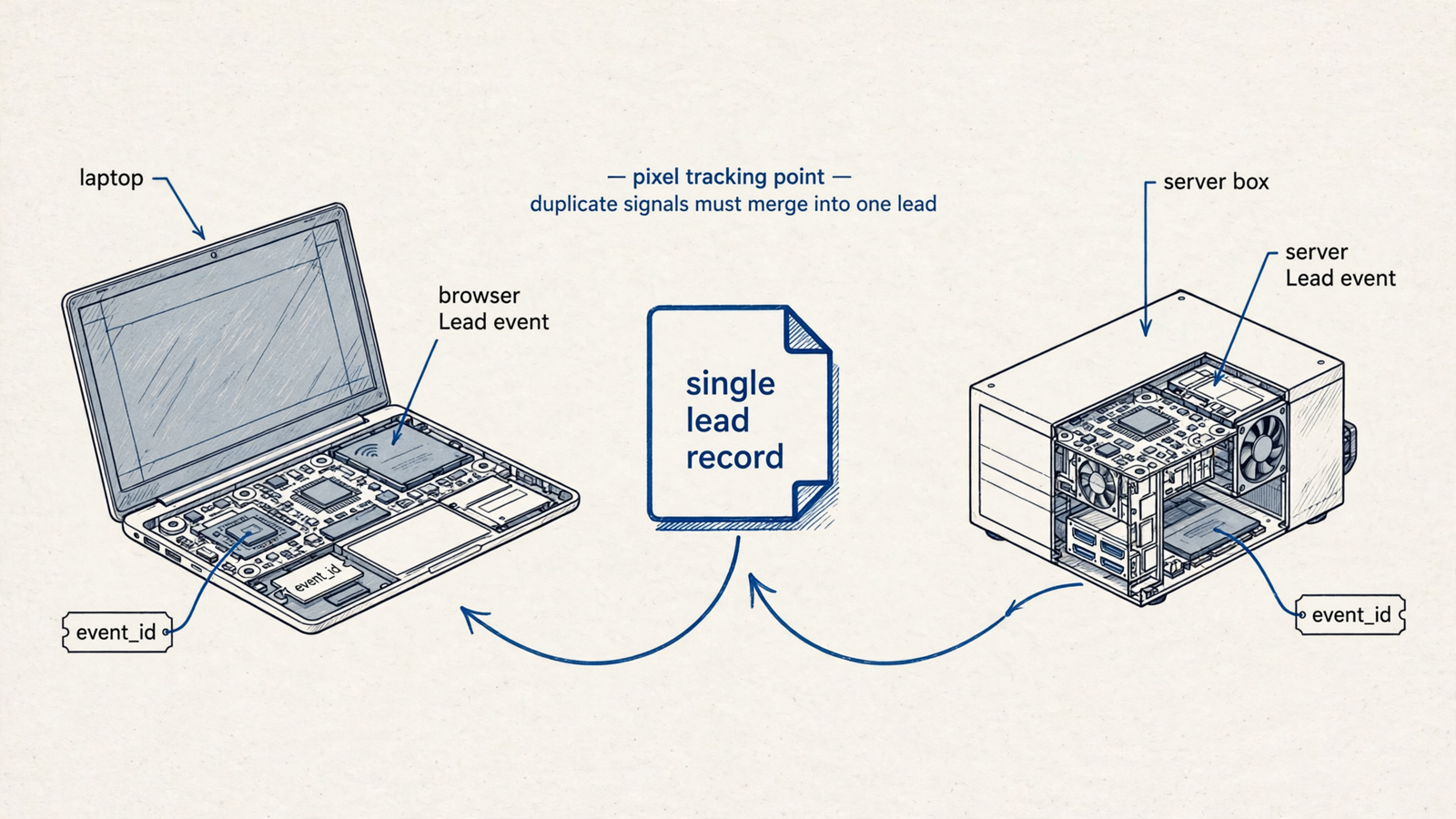
For lead tracking, browser pixel and Conversions API events are redundant by design. A pixel and Conversions API setup guide describes sending the standard Lead event from browser and server with the same event name and event ID within 48 hours so they can be deduplicated. It also recommends checking Event Match Quality in Events Manager and aiming for at least 6 out of 10, using hashed email or phone alongside fbp and fbc parameters.
Those are inspectable checks. “Tracking is set up” is not.
I would ask to see the Event Match Quality score, the browser and server event setup, and how duplicates are handled. An audience adjustment is not a substitute for checking whether the conversion signal is usable.
Then comes the harder question: what does the event actually mean?
A Lead event firing on every form submission does not prove customer acquisition if half those forms come from spam, students or job seekers. The pixel can accurately count an outcome the business does not want. A falling CPL does not rescue that arrangement.
The conversion event needs to connect to a lead the sales team would actually want. I would hold groas to a written qualified-lead definition and evidence of CRM sync so the discussion reaches pipeline rather than stopping at Events Manager.
My verdict: keep the setup promise, but require proof of both the signal and its business meaning. A technical check and a qualified-lead definition answer different questions. Customers need both.
“Weekly report covering account changes and metrics”: separate actions from explanations
A weekly report should make the account easier to understand, not make the week look more productive.
A Meta ads reporting template lays out the useful core: spend, purchases or leads, cost per result and ROAS, plus CPM, link CTR, conversion rate and frequency. Put those against last week, the four-week average and the target. Add the biggest change and its likely cause.
That last phrase needs care. A report can list an edit and a performance improvement from the same week without establishing that the edit caused the improvement. Proximity is not an explanation, however neatly the chart is formatted.
Require three columns: action, reason, observed result. I would include checks that deliberately led to no action as well. Otherwise, the report rewards intervention and makes restraint disappear.
The attribution window belongs on the page too. The breakdown of 7-day click versus 1-day click attribution explains why the window changes what a report credits. It also describes purchases being credited to the click date rather than the order date, with recent days continuing to rise as late conversions arrive.
That matters when a weekly report compares a settled period with one still collecting conversions. It also matters when reported purchases fall but actual sales do not: a window change can look like a performance change.
My verdict: keep the weekly report, but make its comparisons interpretable. Print the attribution window, identify numbers still accumulating conversions, and distinguish what happened from what the team thinks caused it.
If the report does not state the window, I would treat the week-over-week comparison as a draft.
Five questions I would bring to the strategy call
The commitments above become useful when customers can ask for specific evidence. I would skip the debate about whether someone “worked on the account” and bring these five questions instead.
For the creative portion, the creative-testing acceptance checklist is a useful companion before approving the next round of concepts.
- What is limiting performance right now, and where did you see it? Frequency, budget cap, signal quality, offer: name the constraint rather than reciting every available lever.
- What did you check daily and deliberately leave alone, and why? I want the no-change log, not just a list of edits.
- What hypothesis is each active test testing? Show the kill rule and scale rule alongside it.
- What is our Event Match Quality score, and how does the tracked lead connect to a qualified lead in the CRM? A clean event count and a useful business outcome are not interchangeable.
- What attribution window does this report use, and which numbers are still accumulating late conversions? Establish the basis of comparison before explaining the movement.
If the strategist answers those without reaching for adjectives, that is a useful conversation. “Proactive,” “data-driven” and “always optimizing” can sit this one out.
For a longer menu behind the first question, I would use these 12 changes that lower cost per qualified lead, not just CPL and ask which two apply this month. The point is not to demand every possible intervention. It is to make the chosen ones defensible.
Overall verdict: keep the structure, tighten it into proof
The groas Meta offer passes on economics and falls short on specificity. That is why I chose it for this teardown. The flat $1,499 fee, with spend separate, removes the incentive to collect a bigger management bill simply because the customer spends more. The service categories are the right ones. Their wording does not yet establish how customers verify delivery.
Daily coverage of audiences, budgets and bids is useful if someone watches for stalls, spikes and disapprovals, then makes routine decisions on a considered cadence. Creative testing is useful if the concepts differ and the evaluation goes beyond CTR. Tracking setup is useful if the signal is checked and the event connects to qualified pipeline. Weekly reporting is useful if it states the attribution window and separates observation from explanation.
The gap is not a missing adjective. It is a missing acceptance standard.
Here is what I would keep from the artefact, and what I would attach to it:
- Keep the flat fee. Define the account and creative scope it covers.
- Keep daily monitoring. Add a written no-change log so restraint counts as work.
- Keep continuous testing. Add a monthly concept count, with a one-sentence hypothesis, kill rule and scale rule for each concept.
- Keep pixel and conversion setup. Show the Event Match Quality score and the qualified-lead definition in the CRM, reviewed monthly.
- Keep the weekly report. Print the attribution window and record action, reason and observed result.
One boundary deserves a plain answer before anyone signs: if the requirement is ten new videos a week for a $50k account, the offer as written does not establish whether that production is included. I would get that answered before the first report, not discover the scope through an argument afterward.
What I would keep is the operating discipline behind the offer: watched daily, changed for a reason, tested as concepts, tracked to qualified pipeline, and reported with the window printed. Hold us to evidence of that work. Not more edits. More accountability you can check.


