
The Negative Keyword Lists I Paste Before a New Account Spends a Dollar
Four paste-ready negative keyword lists for new campaigns, plus the match-type checks that keep useful buyer queries from getting blocked.
September 27, 2026
•
min read



If you are still looking for the 2023 announcement that turned Discovery into Demand Gen, you are three renames behind. That change was not a new label on the same campaign. It was one stop in a longer shift from channels you could manage separately toward systems that decide where your ads run and which queries they answer.
Start with Smart Shopping and Local campaigns moving into Performance Max. Then Discovery became Demand Gen; Video Action Campaigns followed it. Google announced a similar path for standalone Display campaigns, while AI Max brought expansion deeper into Search. Each step offered reach and automation. Each also changed what an advertiser could isolate, inspect, or override.
That is why an account built around advice from eighteen months ago can look orderly and still spend badly. You may be auditing a channel split that no longer exists or defending an exact-match structure as though it still settles every query. If you are comparing Demand Gen, Performance Max, and Discovery Ads as though they were three interchangeable boxes, the names are obscuring the architecture. Read the changes in order instead.
Between April and September 2022, Google phased out Smart Shopping and Local campaigns and migrated them into Performance Max. That move established the bargain behind the later changes: give one system your assets, budget, and conversion goal, and let it allocate spend across Search, Shopping, YouTube, Display, Discover, and Maps.
There is an appeal to that bargain. A buyer no longer has to move money between every eligible surface by hand. But the campaign-level result blends the surfaces together. A strong aggregate ROAS can conceal a less useful mix of branded demand, high-intent shopping traffic, and cheaper placements elsewhere. If you cannot see or constrain that mix well enough, a good-looking number is not much of an answer to where did the growth come from?
It matters which old campaign you compare it with. Standard Shopping’s manual product bids were not controls that Smart Shopping suddenly lost in this migration. The relevant change here is that advertisers running Smart Shopping and Local no longer kept those campaigns as separate operating units. Performance Max made cross-channel allocation the default shape of the work.
This is the first question I would carry into every later rename: what can the new campaign move without asking you? If the answer includes budget and inventory, do not judge it by the headline conversion total alone.

Google introduced Demand Gen in beta in August 2023, made it generally available in October, and rolled out automated Discovery upgrades from January through March 2024. If you came for the rebrand announcement, that is the date sequence. The operational story is less tidy.
Discovery gave advertisers an image-led way to reach people across Discover, YouTube Home, and Gmail. It was not a substitute for high-intent Search, but its creative requirements and inventory made sense as a distinct part of an account. Demand Gen brought that work into a broader visual format, including YouTube Shorts, In-Stream video, and Lookalike segments. Google presented the expansion as a way to pair social-style creative with its audience reach. For a buyer, it meant that the same mid-funnel budget could behave differently after the upgrade.
The loss was not that static images disappeared. It was the ability to assume that an established Discovery setup would preserve the same creative and placement mix just because the budget and objective looked familiar. Google also deprecated Similar Audiences in August 2023. Lookalike segments were not a reason to carry forward an old audience plan without checking how the new campaign reached people.
Discussion on r/PPC shows the practical anxiety: add vertical video to reach Shorts, then watch whether that inventory produces buyers or merely busy-looking engagement. A swipe and a purchase are different events, however attractively they sit beside each other in a report. Audit the placement and conversion mix after an upgrade; do not treat the old campaign name as a performance baseline.
The next migration closed another useful boundary. Video Action Campaigns had given advertisers a dedicated home for direct-response YouTube work. According to Google Ads documentation, advertisers could no longer create new Video Action Campaigns from April 2025, and automated upgrades to Demand Gen ran from July 2025 through April 2026.
The distinction matters if you planned a video budget as a video budget. Say you allocated $20,000 a month to YouTube because its qualified pipeline justified that spend. Once that work moves into a multi-format Demand Gen campaign, you cannot assume the full allocation stays with the placements you originally chose. Gmail or Discover may compete for spend as the system pursues the campaign goal. That flexibility may help the reported total while making the original YouTube plan harder to evaluate.
I would not call every impression outside YouTube waste. I would call it a different buying decision, one the platform can make faster than the person who approved the budget can inspect it. If the channel allocation matters to your business, measure it explicitly after migration. A campaign upgrade is not proof that the old plan survived.
Until this point, a Search buyer could look at the consolidation of Shopping, discovery, and video and think: fine, but my keyword structure is still my keyword structure. AI Max for Search challenged that comfort. It combined generative copy, expanded query matching, automated landing-page routing, and Smart Bidding within Search. This was not Discovery changing its name again, nor did Standard Search simply cease to exist. It was the same direction of travel reaching the part of the account where buyers often expect the tightest control.
The mechanism is the important part. When matching and landing-page selection expand, a keyword and its ad group no longer tell the whole story of why an ad answered a query or where the click went. That complicates an old habit: build a narrow structure, set the match types, and assume the structure will keep serving as the account’s map of intent.
As covered in our breakdown of Google Ads changes that matter in 2026, the question is not whether automation can find useful demand. It is whether you can tell useful expansion from spend that your old structure would have rejected. Treat query and landing-page behavior as things to inspect, not things the campaign diagram guarantees.
In May 2026, Google announced a move from standalone Display campaigns into Demand Gen. Migration tools were set to roll out in June 2026, with creation of new Display campaigns due to be deactivated by January 2027. That last date matters: an announced retirement is not the same thing as every existing Display campaign having vanished overnight.
Still, the direction is clear. Display had been a place for contextual targeting, selected sites, exclusions, and bidding approaches built around how display inventory works. Demand Gen is a different operating environment. Advertisers on r/googleads focused on what happens to controls such as manual CPC, viewable-impression strategies, and placement-level adjustments. Those are not decorative settings if your team uses them to keep weak inventory out of a campaign.
This turn also makes the Discovery rebrand look less isolated. Demand Gen did not just replace one image-led format and stop there. It became a destination for video work and then for Display work. More inventory inside one campaign can mean more ways to find a conversion. It can also mean more ways to buy traffic that meets a platform goal without meeting yours. Before a Display migration, identify the exclusions and placement decisions your current results depend on. You cannot protect a boundary you have not written down.
A Search Engine Land report on Google’s August 2026 roadmap described auto-migrations beginning September 1 for campaigns using Automatically Created Assets or account-level Broad Match. It also described a planned move from legacy Dynamic Search Ads toward AI Max URL expansion. The scope matters: that is not a claim that every Search campaign was forcibly converted on September 1.
But the practical warning is substantial. Adalysis testing reported by Search Engine Land raised questions about how reliably Exact and Phrase Match preserve the boundaries buyers expect when AI Max is enabled. I would not turn that finding into the claim that every exact-match keyword always behaves as broad match. I would use it to challenge a more dangerous assumption: that the syntax on your keyword list is sufficient evidence of how traffic was routed.
Suppose you have a tightly scoped, high-intent term with its own bid and landing page. If expanded matching or URL routing answers related searches elsewhere in the account, the tidy ad group no longer tells you which path captured the demand. You need to inspect the paths the system actually took. Keep the structure where it helps, but verify query routing and conversion quality against the work it claims to do.
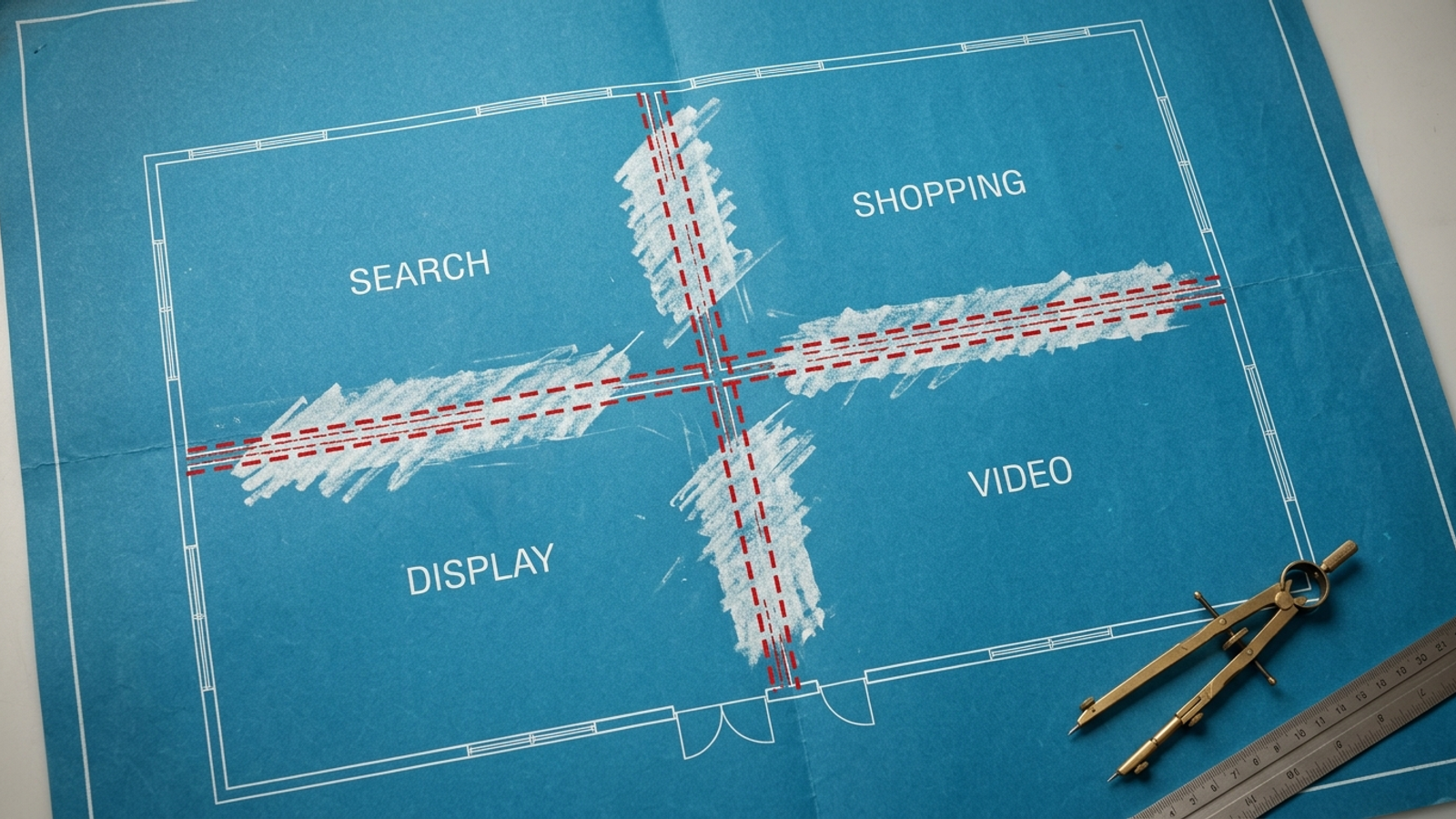
Line these changes up and the pattern is hard to miss. Google introduces a broader automated system, moves work from a narrower one into it, and leaves advertisers to judge a blended result. The exact controls differ. So do the dates and the force of each migration. What repeats is the question a buyer has to answer after every change: which decisions still belong to me, and where can the system spend past the boundary I thought I set?
| Turning point | Where the work moved | Boundary to recheck |
|---|---|---|
| Smart Shopping and Local, 2022 | Performance Max | Cross-channel allocation and reporting |
| Discovery, 2023–2024 | Demand Gen | Creative, audience, and placement mix |
| Video Action Campaigns, 2025–2026 | Demand Gen | Dedicated YouTube budget and performance |
| Display, announced in 2026 | Toward Demand Gen | Contextual, placement, and bidding controls |
| Search expansion, 2025–2026 | AI Max features and planned migrations | Query matching and landing-page routing |
That is a more useful reading of the timeline than “Google renamed everything.” A rename sends people hunting for an old button. A changed boundary sends them back to the account to check what is spending money. I would make that check in this order:
None of this requires pretending that manual account work was useless. Good buyers built those controls because they solved real problems. But repeatedly rebuilding a narrow structure will not, by itself, restore a channel boundary the product no longer offers. The work shifts toward setting objectives, checking the system’s decisions, and reacting when it finds an efficient way to hit the wrong goal.

That reaction time is where the traditional operating model strains. Google can adjust auctions continuously; an account reviewed once a week cannot answer just as quickly. It is why we built groas: an autonomous engine handles bidding, budget allocation, and search-intent routing around the clock, while a named strategist sets guardrails and stays accountable for attributable revenue.
I expect more names to change. I would not build next year’s plan around guessing them. I would build it around knowing what the system can move, seeing what that movement produces, and correcting it before a polished aggregate report makes waste look like progress.