
The Negative Keyword Lists I Paste Before a New Account Spends a Dollar
Four paste-ready negative keyword lists for new campaigns, plus the match-type checks that keep useful buyer queries from getting blocked.
September 27, 2026
•
min read



Four months. Roughly $58,000 spent. The Google Ads status column still said Learning. I would not start by asking why the algorithm had failed to graduate. I would open the change history.
The Google Ads learning phase is not a two-week timer that occasionally forgets to ring. Smart Bidding needs conversion signal and time to adjust to the conditions it is bidding under. Google has reframed calibration around roughly 50 conversion events or three conversion cycles, rather than a fixed number of days. Change the offer, the page, the budget, and finally the conversion goal, and waiting another fortnight will not restore a stable baseline.
This is an explicitly typical composite, not an incident I personally managed: an early-stage B2B SaaS account reconstructed to show the version of this failure growth teams keep creating. Across 122 days, four decisions repeatedly changed what the bidder was being asked to do. The status column was the symptom. The decisions were the story.
The company sold compliance automation software at a $9,600 annual contract value and spent roughly $14,500 a month across its core Search campaigns. By day 120, cost per acquisition hovered around $410 against a $190 target. Daily search traffic swung from 40 clicks to 110. The bid strategy status rotated through warnings including Learning (Bid strategy changed) and Learning (Composition change).
Those labels matter, but they are not a complete diagnosis. Google’s status documentation describes the kinds of changes that can send a strategy back into learning. You still have to match the warning to the change history and the performance data. In this reconstruction, that trail leads to four interventions, each made while the account was trying to recover from the last.
The founder’s verdict was that automated bidding did not work for B2B software. I understand the reaction: at $410 per acquisition, nobody wants a lecture about patience. But switching to manual CPC would have answered the wrong question. The first job was to find out what kept changing beneath the bidder.
The original offer was an ungated interactive product tour. It converted at 8.4% and produced roughly 28 conversions a week. The sales team had a fair objection: plenty of those people were tire-kickers who rarely closed on a $9,600 annual contract. More form fills were not automatically better pipeline.
Product marketing responded on a Tuesday by replacing the tour with a Book a Compliance Readiness Assessment calendar call requiring six qualifying fields. That was a different ask of a different buyer. Completions fell from 28 a week to four; the post-click conversion rate dropped to about 0.9%.
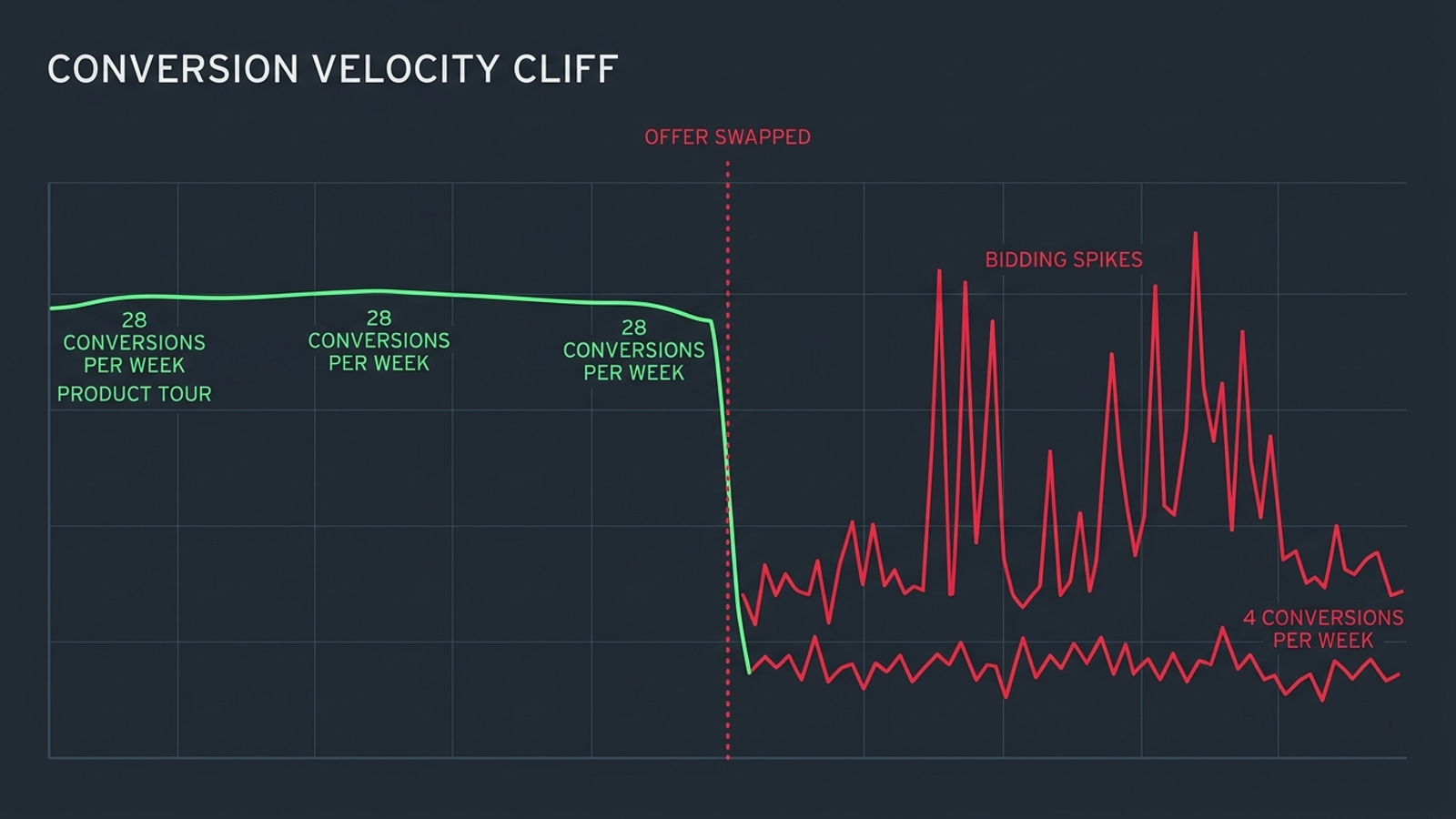
The sales complaint did not make the switch foolish. Making it inside the campaign’s existing primary conversion setup, all at once, was the wrong call. The bidder had been finding people likely to complete a low-friction tour. Now it had to find people willing to book a qualified call, with far fewer events to learn from. Average CPC rose from $4.20 to $6.90 as the account searched for volume, and the strategy went back into learning.
I would not describe that as the machine forgetting everything. It is simpler and more useful than that: the signal used to judge a successful auction changed abruptly. Google’s guidance on conversion goals and bidding changes is relevant here because a primary-action change gives the strategy a new objective, not just a new label in a report.
The safer decision was to give the assessment offer its own campaign and learning runway, rather than overwrite the action supporting the existing one. The tour could remain available as a secondary micro-conversion while the team assessed whether the new offer produced better customers. A stricter lead definition is useful only if the campaign can still generate enough signal to bid against it.
By week seven, the assessment offer was producing roughly 18 conversions a week. The account had not become comfortable, but it was beginning to settle. Then the web team shipped a new site theme on a Friday afternoon.
The headline changed from “Automated SOC 2 Compliance for Cloud Startups” to “Build Unshakable Trust Across Your Security Infrastructure.” Customer logos pushed the call to action below the fold. The destination moved from /soc2-readiness to /platform/compliance-readiness-assessment.
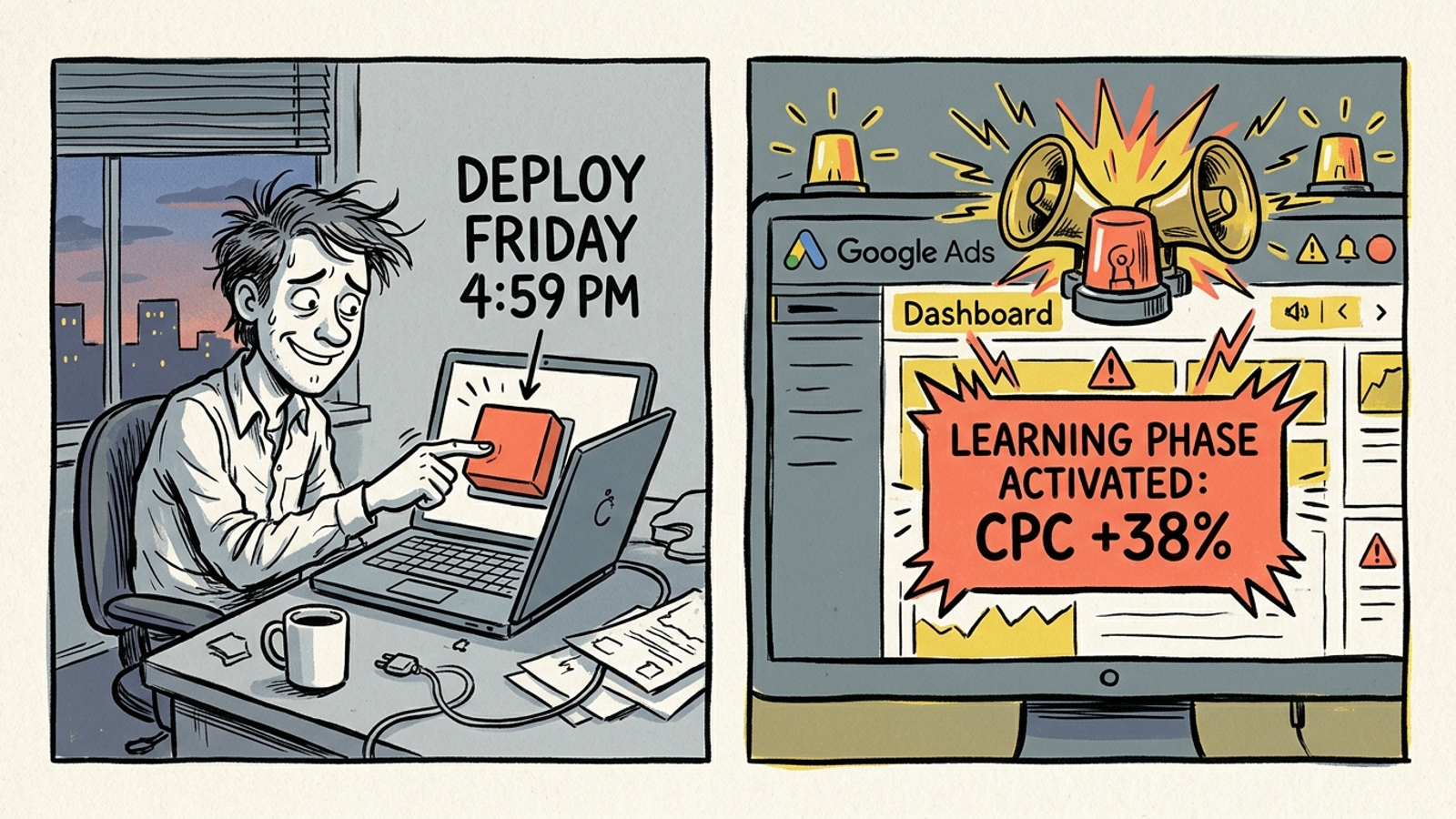
The new line may have looked better in a brand review. It was less specific to the searcher arriving from a SOC 2 ad. Moving the button also made the intended action harder to find. This was not merely a fresh coat of paint; it changed the post-click experience while the campaign was live.
Within 72 hours in this composite, average CPC rose 38%. Click-through rate stayed flat, while page conversion rate fell from 4.1% to 1.3%. Landing Page Experience moved from “Above Average” to “Below Average,” and the campaign returned to a learning status. The relevant diagnosis is not that every URL change erases all bidding history or automatically applies a fixed CPC penalty. It is that the team replaced a working destination without testing the replacement, then saw both auction cost and conversion performance deteriorate.
That distinction matters. Landing Page Experience contributes to Quality Score, but no tidy table can tell you the exact CPC surcharge for moving between its ratings. Nor can a status label, by itself, prove which part of a site launch caused every change in performance. The change history and the post-click numbers make the page the place to investigate first. Practitioner discussions of sudden account declines describe the same practical headache: when the destination changes under a live ad group, the old performance pattern becomes a poor guide to the new page.
The alternative was an isolated page experiment before a full cutover. Google Ads Experiments can split traffic between the original and a variant URL, letting the team compare outcomes without betting the whole campaign on a Friday deploy. groas’s paid-search approach also uses dynamic landing pages to adapt to search intent without making a production site launch the test. However the test is run, the principle is the same: prove the new destination before replacing the old one.
The board meeting was fourteen days away. Pipeline was pacing 35% behind model. Meanwhile, the Search campaign had logged 22 qualified demo requests in seven days at a $210 CPA: still above the original target, but at least close enough to show a direction.
Leadership decided to catch up by raising the daily campaign budget from $250 to $650 overnight. It was a 160% increase, made at the precise moment the account needed a stretch of ordinary days.
The problem was not that a budget increase comes with a universal reset switch. The problem was the size and timing of this one. A bidder cannot manufacture three times as many high-intent searches because a board meeting is coming. To use substantially more budget, it may have to compete in auctions with weaker conversion prospects or higher costs. Guidance on avoiding learning-period disruptions treats large, abrupt budget moves as a risk for exactly that reason: they change the conditions the strategy is trying to navigate.
The dashboard made the decision look worse before it could give a complete answer. These B2B buyers took about 12 days to evaluate the product, so many clicks bought that week had not yet produced a recorded conversion. Conversion lag meant the team was judging fresh spend before the corresponding outcomes could fully appear. The account was spending at the new rate while its newest results were still incomplete.
I would have argued for 15% to 20% weekly budget increases, not an overnight multiplier, while watching whether qualified demand kept pace. If leadership truly needed to pursue additional volume immediately, separate campaigns by intent or match type could take that test without forcing the existing campaign to absorb the whole jump. The point was not to protect a status badge at all costs. It was to keep the best-performing baseline legible.
Our account of a SaaS in-house team’s learning-phase trap makes the broader operational problem familiar: treating the budget as an unconstrained faucet makes it difficult to tell whether the bidding strategy is improving or merely adapting to the latest instruction. A quarterly target does not create more high-intent auctions.
The previous quarter had been missed, and pipeline was still behind. A newly hired RevOps director found a real tracking gap: HubSpot form fills were not passing qualified lead status back into Google Ads. She built an offline conversion import for CRM Sales Qualified Lead events, set it as the campaign’s Primary conversion action, and moved raw demo bookings to Secondary.
On paper, this was the most defensible intervention yet. A B2B campaign should care about SQLs, not celebrate every form fill as if it were revenue. But the account generated only six SQLs a month. The switch replaced roughly 18 weekly demo signals with fewer than 1.5 SQL signals a week.

That was the wrong call at that moment. The downstream event was more meaningful to the business, but too sparse here to serve as the campaign’s only primary bidding signal. Google’s discussion of conversion volume and Smart Bidding calibration helps explain the tradeoff. Roughly 50 events is a useful calibration reference, not a magic threshold at which a strategy suddenly works. Six a month left this account with very little feedback.
In the composite, impressions contracted 64% over five days, CPCs climbed, and the campaign entered another learning period. Those numbers do not mean every low-volume SQL import will produce the same result. They show why this particular cutover deserved a staged test rather than an immediate promotion to Primary.
The better sequence was to import SQLs and inspect them while the higher-volume lead action continued to support bidding. Once the downstream data was dependable and useful at the campaign’s volume, the team could plan a transition. Our breakdown of a B2B SaaS conversion-tracking fix covers that kind of overlap. The operational judgment is plain: track the outcome you care about before asking the bidder to rely on it alone.
By day 122, the campaign’s change history told a cleaner story than its learning-status column. First, the team replaced a high-volume tour with a much harder assessment booking. Then it launched a new page and URL without isolating the test. Next came a 160% daily budget increase to answer a pipeline shortfall. Finally, it made a low-volume SQL event the primary conversion goal.
Each decision had a reason. Sales wanted better leads. Marketing wanted better positioning. Leadership wanted more pipeline. RevOps wanted a truer measure of value. I would not dismiss any of those goals. The damage came from putting each decision directly into the live campaign while the previous change was still settling.
That is why “give it another two weeks” is such a poor diagnosis. Time cannot tell you whether the bidder is adapting to one stable job or receiving a new one every few weeks. The status documentation can point you toward changes worth checking; the change history tells you who made them and when. In this composite, the persistent learning phase was not a clock problem. It was an operating problem.
Traditional account management can make activity look like diligence. Someone tweaks a target, moves a budget, swaps a page, or changes a conversion setting so the account does not appear neglected. I spent enough time managing accounts by hand to know that some interventions are necessary. I also know a busy change history is not evidence of good management.
I would lock the baseline while it gathers usable signal: keep the conversion definition steady, test new pages and offers separately, and stage budget changes rather than making panic-driven jumps. That leaves room for judgment without asking the bidder to absorb every new idea in production. At groas, autonomous models handle continuous bidding and optimization within guardrails while a named strategist owns direction and accountability. The point of that division is not to remove human decisions. It is to stop urgent human decisions from repeatedly destroying the conditions needed to judge whether they worked.
The single rule I take from this postmortem is this: when a live bidding model needs a new offer, URL, budget regime, or conversion goal, isolate the change first and leave the baseline campaign alone long enough to learn.