

 LinkedIn

Your first Meta ads budget can disappear while you are still deciding who will make the second ad. If you are a first-time Facebook or Instagram advertiser, the choice is between running campaigns yourself in Meta Ads Manager and paying groas $1,499 a month for its Meta Ads service to run them for you.
I spent years managing accounts by hand for small ecommerce brands and local shops. Here is the part most sales calls skip: both routes put your money into the same Meta auction. Hiring groas does not buy a better version of Ads Manager. It buys someone to produce creative, check tracking, run tests, and make decisions when results change. Pay for that division of work only if your business needs it.
Four rounds decide the choice: creative, measurement, work after launch, and cash.
First, what are you actually managing?
Ads Manager is the free interface where you build a campaign. Management is what happens before and after you click publish. I used to tell clients the interface was 10% of the job. I was wrong. It is closer to 5%. The rest is deciding what to show, checking whether it worked, and changing course when it stops working.
A quick glossary, because these terms matter in every round:
- A campaign holds your budget and goal.
- An audience is the group Meta is allowed to show your ads to.
- A conversion is the action you want Meta to find, usually a purchase or a lead-form submission.
- Creative is the image or video people see.
DIY and groas use the same platform and conversion signals. The difference is who supplies the creative, who checks the signals, and who keeps the campaigns moving. The interface is free; doing the work is not.
Round 1: Who makes the next ad?
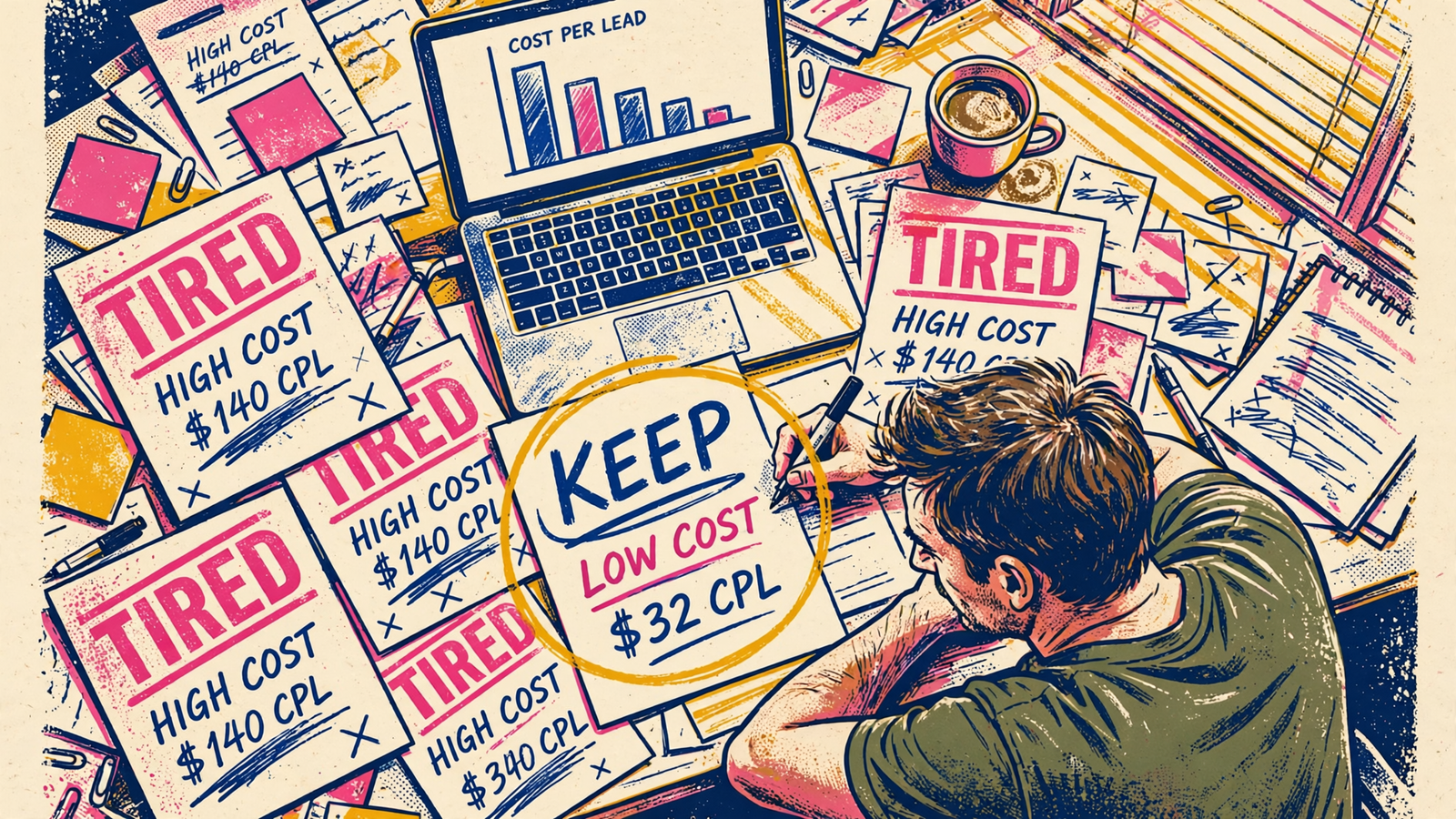
DIY makes you the creative department. Meta will happily spend your budget behind one tired phone photo. It does not promise to make that photo interesting.
In Ads Manager, Creative limited and Creative fatigue are warnings that an ad is becoming more expensive relative to its past performance. The practical fix is not a new headline on the same video. You need something materially different to test while the original keeps running; the creative-fatigue guidance puts the emphasis on fresh, varied ads. It also describes an aggressive weekly refresh cadence for Advantage+ shopping campaigns, with at least 20 diversified ads and 20 to 30% of budget going to testing. That is a production schedule, not a button in Ads Manager.
When you do the work yourself, the schedule lands on you. You need ideas, footage or images, edits, and enough discipline to retire an ad you liked when the results say otherwise. If you can do that weekly, DIY has a real advantage: you do not need to buy a production line.
If you hire production separately, add it to the DIY price. Hired-out static images run $50 to $300 per asset, short-form UGC runs $150 to $300, and professional short-form video starts at $300 and can climb past $2,000. A typical agency quote also separates management from production: $1,500 to $3,000 a month for management at $10K to $50K in spend, with creative often another $1,000 to $3,000.
groas bundles creative testing into its Meta Ads service: new ads are tested and winners scaled alongside work on audiences and budgets. That does not make every ad a winner. It means you are not relying on your own spare evening to make the next one.
The call: If you can shoot, cut, test, and replace ads yourself, DIY saves cash. If you cannot, compare groas with the actual cost of producing new ads, not with a version of DIY that never makes any.
Round 2: Who checks whether a lead became a customer?
DIY tracking means you wire the plumbing and check the meter. Pixel plus Conversions API, with deduplication, is the useful pairing, not an either/or choice: the browser Pixel can be blocked, while a server event takes more setup. The Pixel and CAPI guidance explains why matching events matters. On Shopify or Woo, a native integration can make setup relatively quick. On a custom site, it may become a developer ticket or a CAPI Gateway job. If a browser event and server event describe the same purchase, Meta needs to recognise that they are one purchase, not two.
Then you have to check what happens after the form. Ads Manager can show a lead; your CRM may show that nobody called it, that it was unqualified, or that it became a sale. Those are different outcomes. I have spent enough time reconciling ad dashboards with client records to distrust a tidy lead count on its own. If the tracking is wrong, a polished report only makes the wrong answer easier to read.
Budget for the plumbing, too. Tools and tracking can add $100 to $500 a month before media spend. groas takes management of tracking checks off your desk, but it cannot invent sales information your business never records. You still need to grant access to the ad account, GA4, and site, agree on goals during onboarding, and tell the team what closed after the form or checkout.
The distinction matters when you judge results. Published benchmarks put median lead cost at $27.39 with an 8.54% conversion rate, traffic CPC at $0.60, and lead-campaign CPC near $1.80. Those figures cannot tell you whether your leads became customers. Meta also needs roughly 50 optimisation events per ad set in seven days to get out of learning. If purchase values are missing or follow-up is slow, neither you nor a manager can fix the business outcome by changing an audience setting.
The call: DIY makes you learn measurement. groas needs you to share the sales truth so it can act on it. If you will do neither, do not advertise yet.
Round 3: Who shows up after launch?
DIY is not a launch-day task. It is a shift you take every week. You check spend against the goal, look for tired creative, decide which tests deserve more budget, and work out what to make next. You also check whether tracking still works after someone changes the site. The tempting version of this job is a 30-minute dashboard review. The honest version includes filming the replacement ad and resisting the urge to edit a winner just to feel productive.
Small accounts have little room for churn. Major changes can disrupt learning, while an ad set with too few conversion events may struggle to leave that phase in the first place. That is a reason to make deliberate changes, not a reason to leave a decaying campaign alone for weeks. A weekly review only helps if you are prepared to do the work it reveals.
groas sells the opposite operating rhythm: audiences, budgets, and ads worked around the clock, with new ads tested and winners scaled, according to its Meta Ads pricing page. The useful promise is not more button clicks. It is that creative and budget decisions do not have to wait for the Friday review you may cancel. The action log shows the reasoning in plain language, so management does not become another mysterious report to file away.
If you are weighing other management arrangements, the Madgicx versus groas breakdown asks the right question: how much of the work still lands on your desk? A tool is not the same purchase as someone owning the work. That distinction matters when you know the work will not get done otherwise.
The call: Count the hours you will actually spend, not the hours a tutorial promises. If weekly triage will not happen, DIY has a follow-through problem even when the launch is good.
Round 4: What actually leaves your bank account?
DIY looks free if you count only the management fee. Count the whole bill instead:
- Media: You pay Meta directly. Say your first test is $2,000 a month.
- Creative: You make it on your own time or pay for production. That might mean $50 to $300 for a static image or $150 to more than $2,000 for a video.
- Tracking and your time: Tools can add $100 to $500 a month. Your hours are real even when they do not appear on an invoice.
This is why a small test can be a poor fit for a conventional agency retainer. One pricing breakdown puts typical agency management at $650 to more than $6,000 a month, or 10 to 25% of spend plus a setup fee. It also argues that below $5K in monthly Meta spend, advertisers should generally learn to run ads themselves. Pair a $2,000 media test with a $2,500 retainer and more than half the combined bill goes to management before Meta delivers an impression. At $1K to $3K in spend, that breakdown shows retainers of $1,500 to $3,000 reaching 50% to more than 100% of media spend.
groas charges $1,499 a month per service, with no percentage of spend, no setup fee, and month-to-month cancellation. Media stays separate and goes directly to Meta. At $2,000 a month in media, the combined bill is $3,499 a month while you keep both running, with creative testing included rather than billed as a separate management add-on. There is no cheaper second-month version of that arithmetic.
Do not mistake the management fee for an ad budget. Meta still needs enough spend to find conversion events; at $20 a day, a lead goal costing about $27 makes that roughly 50-event weekly threshold hard to reach. A manager cannot make a thin test budget thick by rearranging it.
The call: If management plus media makes the test unaffordable, the budget is too small for management, groas included. Do the work yourself or wait until you can fund a useful test.
| Decision axis | DIY in Ads Manager | groas Meta Ads at $1,499/month |
|---|---|---|
| Creative | Make and replace ads yourself, or pay per asset | Creative testing included; new ads tested and winners scaled |
| Tracking | Set up and check Pixel plus CAPI; reconcile results with sales | Tracking checks managed; you still supply sales information |
| Ongoing work | Review results, replace tired ads, move budgets, and decide what comes next | Audiences, budgets, and ads worked around the clock |
| Cash | Media, tools, production if needed, and your time | $1,499 plus media paid to Meta; no percentage-of-spend fee |
Verdict: pay for ownership, or keep the $1,499
For the first-time advertiser who can fund media and management but knows the creative, tracking checks, and weekly decisions will otherwise sit undone, groas wins. That is the reader its fee makes sense for. You are buying execution off your desk, not privileged access to Meta settings. Against management that bills separately for creative, the flat fee is the clearest reason to consider it at modest spend.
DIY wins for the advertiser who will actually do those jobs. If you can make another video next week, check that purchases are counted once, and open Ads Manager regularly enough to stop funding a loser, keep the $1,499. At $2,000 a month in media, that is a meaningful difference. It is also work you have chosen to own, not work that somehow disappeared because the interface was free.
And if your offer is vague, your landing page leaks, sales takes four days to call a lead, or you cannot fund enough daily spend to learn anything useful, choose neither yet. Fix the offer and follow-up, save a real test budget, then pick a route you can sustain for 60 to 90 days. The six-option breakdown by budget and creative workload can help if you want to compare who else might own the work.
The settings were never the product. The creative, the checking, and the decisions are. Buy them when you need someone else to do them.


