

 LinkedIn

A prompt dashboard says your brand disappeared when a buyer changed six words. Did the wording cost you a citation, or did the engine search for something else?
I made the case in Stop Hunting for AI Citation Prompts. Write the Page Worth Quoting.. Prompt-tracking dashboards keep multiplying, and Google’s AI Overviews now sit beside ChatGPT and Perplexity where buyers meet your brand. Rather than ask you to take that earlier argument on faith, here is a test you can run on your own market.
The question: do citations follow prompt wording or the searches behind it? You will take three buyer questions, phrase each four or five ways, run them across the three engines, and compare cited URLs with the searches you can see and plain-search results you can check. My expectation is that wording matters most when it changes what the engine retrieves. But retrieval varies even when the prompt does not. This protocol puts that wobble on the page before you credit any clever phrasing.
Setup: pick three questions with a page to test
Do not start with a prompt tool’s suggestion list. Pull three questions you have heard on a sales call, seen in Search Console, or answered in support tickets. If you run garage door installs, you might use:
- How much does a garage door replacement cost?
- Is there a garage door installer near me with same-day service?
- Should I repair or replace a noisy garage door?
Choose questions buyers actually ask. Three is enough to look for a pattern without turning an afternoon test into a research project. If you have no indexable pages that answer them, do the work in Your Buyer Asks One Question. AI Searches for the Parts. first. There is little point testing whether a missing answer gets retrieved.
For each question, write four or five versions and log the exact text. Use a short version under six words, a full sentence over twelve words, an unbranded category version, and a command beginning with “find” or “list.” Keep the buyer’s intent fixed. Add a version naming you against a competitor if that comparison is something buyers genuinely ask, but mark it as a separate intent. “Find an installer” and “compare these two installers” are not just different wordings of the same request. If their citations differ, you cannot assign the difference to phrasing alone.
Controls: measure the wobble before the wordings
Run each version in ChatGPT with search on, Perplexity on its default setting, and a Google search that produces an AI Overview. Use fresh conversations, the same location and the same afternoon. Keep account state consistent; use logged-out sessions where available. Note when Google does not show an AI Overview rather than changing the query until it does. A missing Overview is part of the record, not a citation result.
Those controls matter more than an elaborate prompt list. One published tracking approach used 10 fixed prompts run five times across three engines, logged out with a fresh conversation each run. One run tells you what happened once. It does not tell you whether the next run would have cited somebody else without a single word changing.
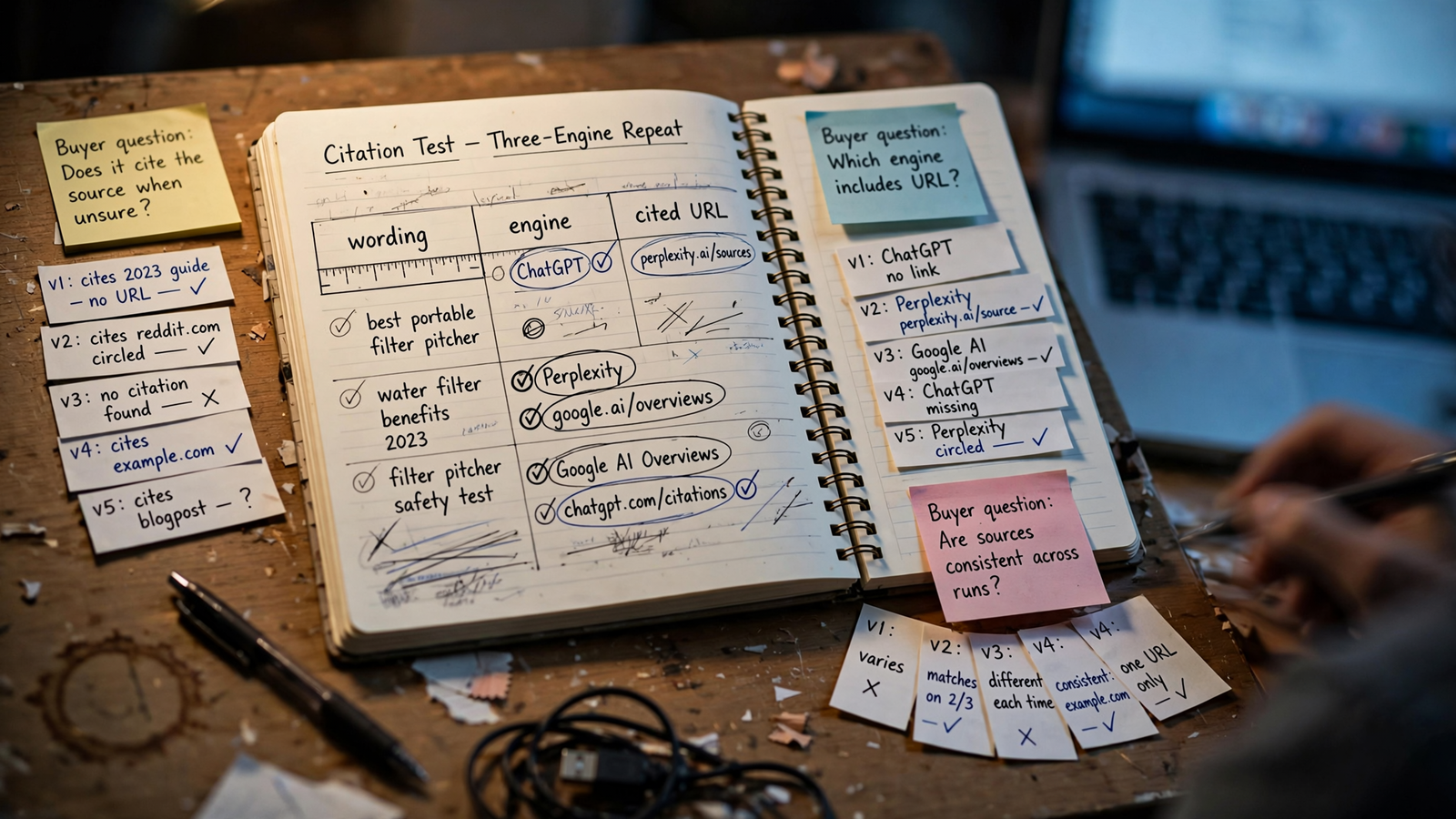
Before running all your variants, repeat the shortest wording three times in each engine, with a fresh conversation for each run. Record every result, including runs with no citation to your domain. In one test, only 2.2% of citations survived all three runs of the same prompt. SparkToro found fewer than 1 in 100 answer pairs named the same brand list. If your repeats bounce, a one-run difference between two wordings is not a discovery. It is a reason to keep measuring.
Treat this as a small protocol, not a race to produce a score:
- Fix the questions, variants, location and account state.
- Run and log the three identical-prompt repeats per engine.
- Run the remaining wordings in fresh conversations.
- Check the search results used as your retrieval baseline.
Log the repeats before you interpret the variants. Otherwise, ordinary run-to-run noise gets a new name: “prompt optimization.”
Record citations and visible searches in one sheet
Make one row per run. Your columns are buyer question, exact wording, engine, time, cited URLs in order, whether your domain appeared, and any searches the engine says it ran. Keep the repeat runs as separate rows. Do not roll them into a single yes-or-no brand mention.
Perplexity often lists sources and follow-up searches. ChatGPT with search sometimes shows what it checked. Copy any visible search strings exactly. A visible search is evidence; an unseen search is not a blank you get to fill in. Retrieval can fan out into sub-queries before sources are reranked for specificity, reliability and freshness, as this account of Perplexity’s source selection describes. Your sheet captures the part you can inspect, not every step inside an engine.
Now establish a baseline. For each buyer question, run three to five plain searches in Google and Bing. Note the domains in the top 10 for each search, and keep the search strings beside the results. These are comparison points, not a claim that either engine used those exact queries in the background.
There is a practical reason to check. ChatGPT in browsing mode searches via Bing and typically returns three to six clickable citations; in the same analysis, 44% of citations came from the first third of the results page. Another analysis found pages ranking for a main query and at least one fan-out were 161% more likely to be cited in AI Overviews. For a Google AI Overview supporting link, a page must be indexed and eligible to show with a snippet. None of those figures promises a citation for your page. They explain why ranking and eligibility belong in the sheet before you buy another prompt list.
Analysis: compare repeats, then search clusters
Start with the identical-prompt repeats. For each engine, write down which domains recur and which appear only once. Then look at the four or five variants of each buyer question. Count how many cited domains survive across variants, and check whether those domains also appeared in your repeats. Compare URLs too, but do not let two different pages on the same domain masquerade as two entirely separate sources.
If variants keep citing the same two or three domains, in a different order, stop treating every reorder as a wording win. The topic may be pulling the same shortlist. If one variant cites a new domain, first ask whether your identical-prompt runs changed at least that much. Reported retrieval overlap between two runs of the same question is often only 60% to 80%. Small changes need that control.
If the variants differ more than your repeats, inspect the visible searches. Group them by topic rather than demanding identical strings. A Surfer analysis of 10,000 keywords and 33,000 fan-out queries found that only about 27% of fan-out queries repeated across runs and 66% appeared once, while 90% fell into four or fewer topic clusters. A short price question might surface price and review searches; a longer question might surface how-to searches. In that case, the useful observation is not “the engine likes shorter prompts.” It is that the answers drew on different parts of the topic. If you included a competitor comparison, check that row separately: naming a competitor can change the job the search is doing.
Next, mark whether each cited domain appears in the top 10 of any of your plain searches for that buyer question. Note the source type as well: your own page, another vendor page, a listicle or a third-party explainer. In an October test of 31 “best agency” prompts, ChatGPT with web search cited named brands’ own sites for 119 of 210 citations, about 57%. Perplexity cited 561 pages, with 70% listicles and 7% vendor sites. That is a result from that test, not a quota to expect in yours. It gives you a reason to record which kind of page carries a claim, not just whether your brand gets mentioned.
I used to tell clients one strong page would cover every engine. I was wrong about the shape of it. A strong passage on your site can answer the question, while an engine that favors a third-party explanation may cite the page that repeats it. Your sheet should show the missing source type, not merely another red cell in a mention chart.
Decision: build for the gap the sheet exposes
If the same domains survive across wordings and hold positions in your baseline top 10, you probably do not have a wording problem. You have a page problem. Put a direct answer where a buyer and a search engine can find it. If a date, a number and a next step belong in that answer, do not bury them. The earlier piece makes the case for the page; the next question is whether your edit changes retrieval. Use Did the Fix Get You Cited? A Six-Week Test for AI Overviews, ChatGPT and Perplexity to check the follow-through.
If low overlap lines up with different search clusters, build for the cluster that matters to the buyer. Say your short wording draws price-comparison searches where listicles cite competitors, while a longer how-to version draws searches where your guide appears. A clearer price page addresses one gap; getting the relevant fact onto a source the engine already cites addresses another. Merely changing the adjective in the tracked prompt addresses neither.
If you appear nowhere, inspect the baseline first. Your page may not rank for the underlying searches, may not be indexed, or may leave the answer too deep for a useful supporting passage. Those are different things to check, but none is fixed by adding fifty prompt variants to a dashboard. Publish or repair the answer before you optimize the wording used to ask for it.
Tool check: demand the run log, not the mention score
After the test, you know what to ask any tool selling prompt tracking. A chart saying you appeared in 14% of answers last week tells you what its runs counted. It does not tell you why the count moved. I would rather pay for logs and rank checks before scores, because a score without its runs cannot separate a change in sources from ordinary wobble.
Ask four questions before you pay:
- Does the tool log every cited URL, in order, for each run, or only whether my brand was named?
- Does it capture visible search queries and let me compare them with Google and Bing results?
- How many repeats sit behind each prompt score, and can I see the spread?
- When citations change, can I inspect rankings, visible retrieval and wording side by side?
If the demo cannot show the runs behind the chart, walk away. Your own sheet can already tell you more than a mention percentage without a record of what was cited.
Limits: repeat before you change course
This is small on purpose, and small means fragile. Location and time of day can affect what you see even when you try to hold conditions steady. A logged-out session does not make every result identical. Three buyer questions cover the questions you chose, not your whole market. Visible searches are a partial view of retrieval, and your plain-search baseline is a comparison, not a transcript of an assistant’s work.
Repeat the sheet weekly for a month before rewriting everything. Use the same wordings, engines and hour. If the same domains win three weeks out of four, you have a more useful signal than one afternoon gave you. If winners rotate while your baseline rankings hold steady, treat the citation count cautiously. More prompts will not make a volatile result stable. A single run is a snapshot; repeated runs give you a control.
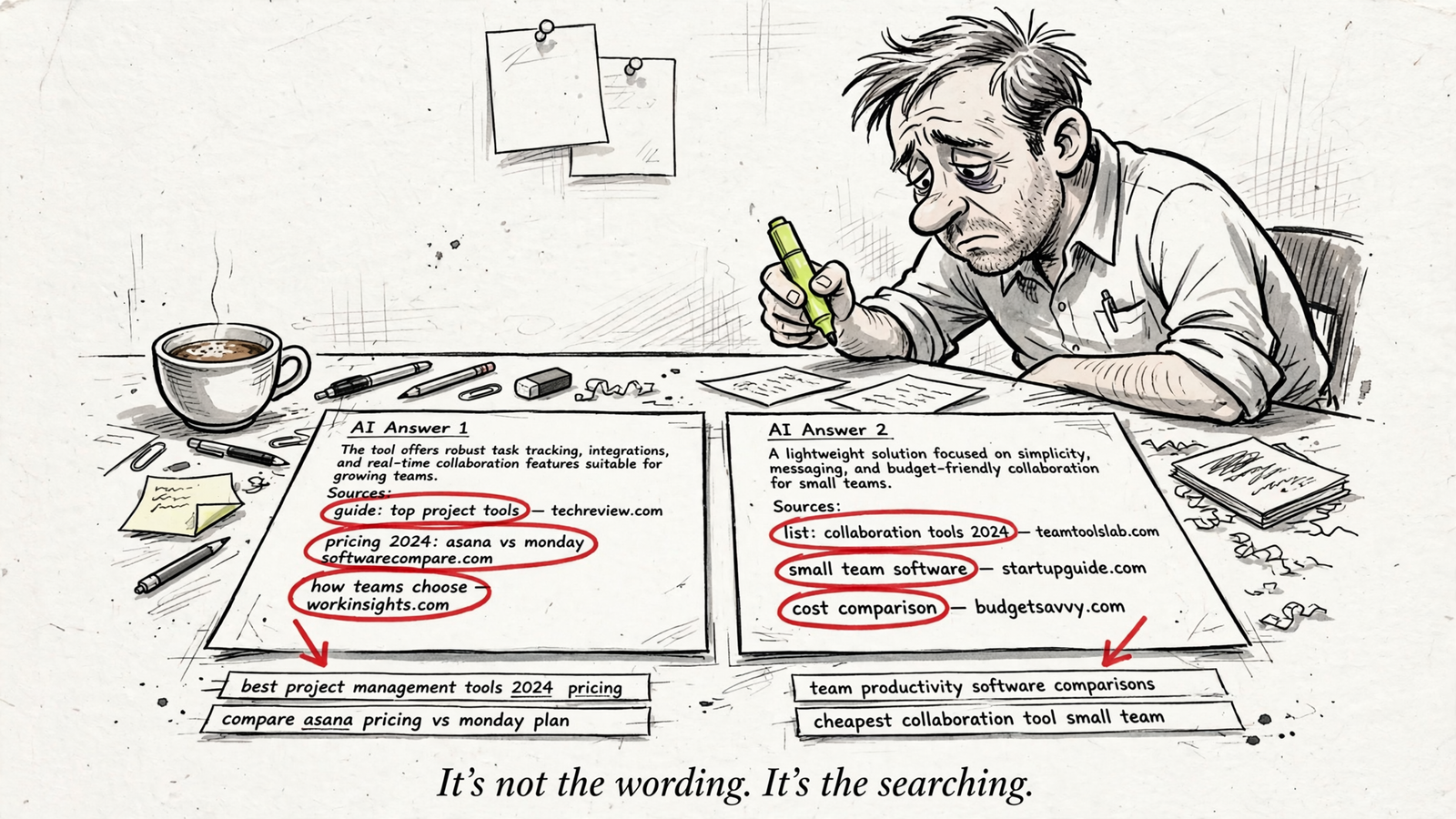
Run the protocol and either outcome changes what you do next. If citations keep following domains that rank across your wordings, stop shopping for phrasing and publish the passage worth quoting. If citations split with the searches behind different variants, build for the cluster your buyers care about and the sources those answers actually use. I prefer watching that retrieval week by week to arguing about prompts month by month. At groas, we bring publishing and citation checking into one SEO and AI search service for a flat fee, with changes logged and a strategist accountable for the direction. Either way, stop paying for a chart that moves. Find out what moved it.