

 LinkedIn

Two agency proposals promise rising ROAS, daily management and easy cancellation. Neither tells you whether your next ChatGPT order will pay its way. That is the comparison I care about: contribution economics and an accountable test, not which deck makes a new channel feel safest. A flat fee, daily oversight and a seven-day guarantee solve different buying problems. None proves that acquiring the next order will be profitable.
Myth 1: “The agency reports ROAS, so I will know whether I made money”
People believe this because ROAS looks like profit math. Spend $1, get $4 back. What the deck calls efficiency, I call a numerator that forgot the bills.
Free tool: the ROAS Calculator works out your return on ad spend, your break-even ROAS and the budget a revenue goal takes.
ROAS is revenue divided by ad spend. It does not subtract product cost, shipping, payment fees, discounts or the agency invoice. To judge whether an order pays, I start with contribution margin: what remains after the costs of making and fulfilling the sale. For an acquisition decision, I need that contribution before advertising, so I know what is available to pay for the customer.
Then I subtract acquisition costs. The order does not become profitable because the report turns green.
One ecommerce breakdown makes the problem blunt: at a 12% gross margin, 650% ROAS produces gross profit equal to only 78% of ad spend. The revenue looks healthy. The gross profit does not even cover the ads.
I used to report ROAS like it settled the argument. I was wrong.
Say your hero SKU sells for $80 and leaves $28 after product, freight and fees, before ads. That is the money available to acquire the order. Your break-even ROAS on those costs is 2.86, before allowing for the agency fee.
At 400% ROAS, you spend $20 to sell that $80 item. You have $8 left after media, not an automatic victory and not a loss before the management fee. Whether the test pays overall depends on how much contribution those orders leave against that invoice.
Ask every finalist to put these on the same page:
- Revenue per order after discounts.
- Product, shipping, handling and payment costs.
- Contribution per order before ads.
- Allowable acquisition cost and the treatment of management fees.
Break-even ROAS is 1 divided by the pre-ad contribution margin expressed as a decimal. It is useful arithmetic, not a substitute for deciding which bills belong in the calculation.
Get contribution per order in writing before you argue about ROAS targets. Otherwise, everyone can agree the campaign is efficient while disagreeing about whether it makes money.

Myth 2: “A flat management fee makes the test cheap”
This one survives because the invoice looks contained. $1,499 sounds like the cost of the test. It is not.
Your total monthly outlay combines platform ad spend and agency management fees. The fee does not buy the clicks themselves. Under a flat fee, raising the budget raises only ad spend. Under a fee of 10 to 20% of spend, it raises both. That makes the flat fee easier to plan around, not proof that the campaign can pay.
Say you approve a $1,000 ChatGPT test with groas. The approved media and management outlay is $2,499: $1,000 to OpenAI plus the separate $1,499 management fee, before any applicable refund. Compare that total exposure, not just the bold number on the proposal.
Then check what the media budget can plausibly buy.
Break-even CPC equals allowable CPA multiplied by landing-page conversion rate. A $50 allowable CPA at 4% conversion supports a $2 click. A suggested starting bid is not a hard auction floor, and it does not change your store economics. The question is whether the clicks you can actually buy convert cheaply enough.
Put the proposed test on paper
Say you approve $1,500 in media over 21 days. At a $4 click, that buys 375 visits. At a 3% purchase rate, that is roughly 11 orders.
If your contribution after product, shipping and fees is $28 per order, those 11 orders leave $308 to cover $1,500 in media plus the management fee. The proposed economics fail before anyone starts debating the quality of the weekly report.
That is what I want from a forecast: assumptions I can inspect, not a curve I can admire.
Remember that oCPC bills per valid click, not per conversion. The budget buys visits while the system chases buyers. A smaller budget limits exposure, but it also produces a thinner read. It does not make the same amount of learning cheaper.
A predictable fee solves a billing problem. It does not solve an acquisition problem. Approve the total cash exposure and the assumptions behind it together.
Myth 3: “Managing three channels together proves the new one works”
Coordinated management feels like proof. One team runs Google, Meta and ChatGPT, total sales rise, everyone nods.
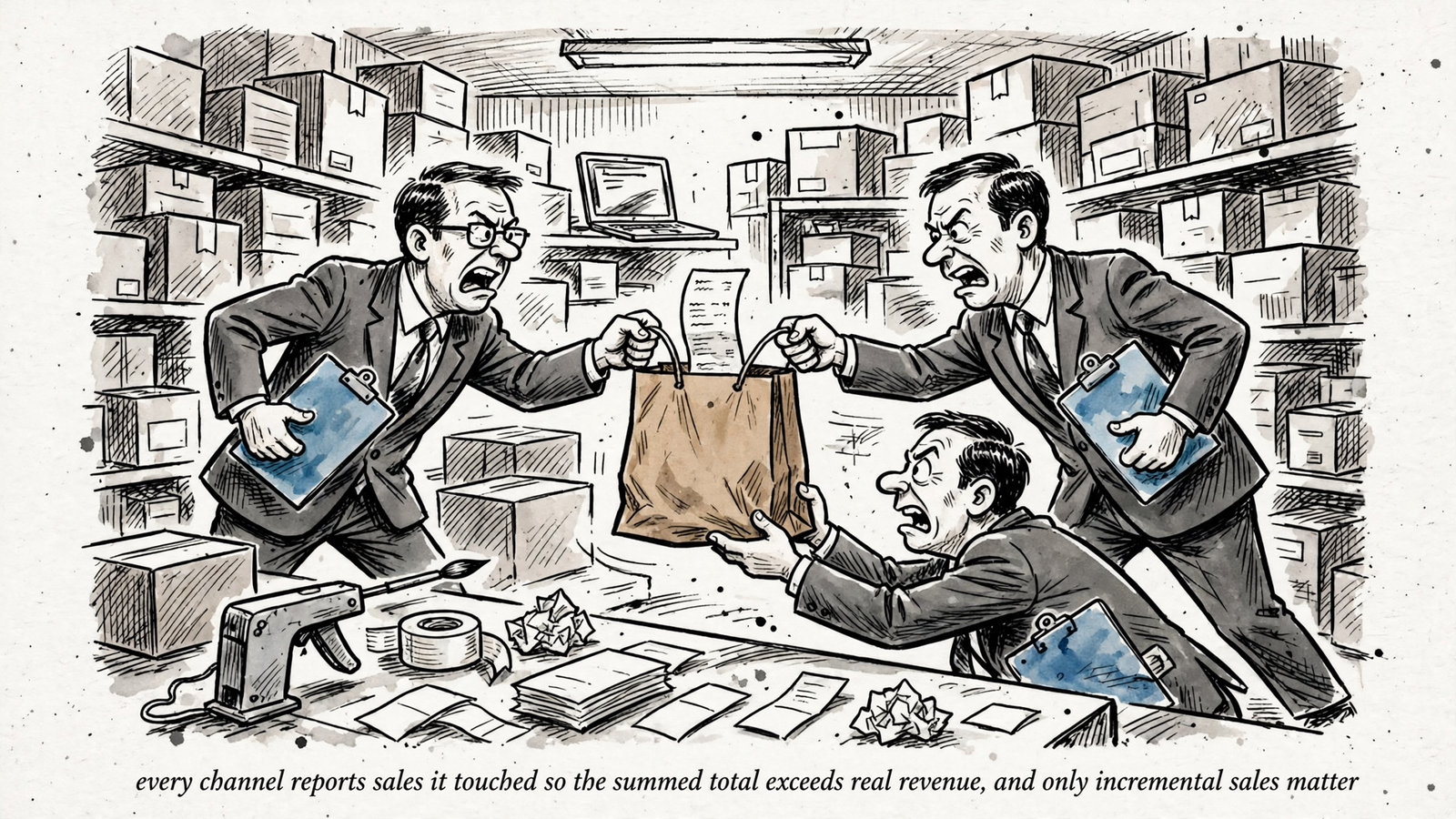
The problem is that multiple channels can claim the same sale, so their summed totals can exceed real revenue. Three platforms taking credit for one Shopify order do not create three customers. What the report calls full-funnel synergy, I call three people fighting over one shopping bag.
For the new channel, the sales that matter are incremental: orders that would not have happened without it.
Early ChatGPT clicks can look good and still come from people who would have bought through branded search anyway. A combined report cannot settle that question just because all the logos sit on one slide.
I want a channel-level read next to the combined number. The agency should explain how it will compare total store sales across a four-plus-week holdout or an on/off window, then judge cost per incremental sale rather than cost per reported sale. It should also explain what that comparison can reasonably establish. Naming a holdout is not the same as designing a useful one.
The distinction belongs in the proposal, not in an explanation delivered after the test disappoints:
- Reported sales: orders the platform attributes to its ads.
- Incremental sales: orders the test indicates would not otherwise have happened.
- Store revenue: the total against which overlapping platform claims need to make sense.
I am not asking the agency to stop coordinating channels. Shared management is convenient. It can also keep the buying process from turning into three separate arguments over the same customer.
But convenience and proof are different purchases. If ChatGPT gets credit for an order Google would have captured anyway, the attribution report may improve without the store acquiring another customer.
Hire for coordinated execution; judge the new channel on added orders. Do not let a rising combined number excuse an unanswered channel-level question.
Myth 4: “Daily management means the agency should change the campaign every day”
People buy daily management because silence feels like neglect. A quiet week reads as no work done. So some agencies move bids and budgets to have something to put in the report.
I did a version of this early on. Friday bid tweak, Monday slide with an arrow on it. Activity is easy to document. A useful decision takes more explaining.
There is a real mechanism behind the objection to constant tinkering. In Google Ads, significant changes can disrupt Smart Bidding learning, with settling taking about two weeks. That is a reason to respect evaluation windows in Google Ads, not evidence that ChatGPT follows the same learning schedule.
The principle I carry into a ChatGPT test is simpler: if the agency keeps changing the conditions before judging the previous change, what exactly has it learned?
Daily eyes are worth paying for. Daily hands need a reason.
Ask for the decision rule before the change and the evaluation window after it:
- What signal triggers action? Name the condition that justifies a bid, budget or targeting move.
- What does not trigger action? One heavy spending day should not automatically become an emergency.
- How long will you evaluate the change? Put the window in writing before the result arrives.
- What would make you revert? A decision rule needs an exit, not just an entrance.
Tracking fixes and changes to bidding strategy are not the same kind of intervention. A useful action log makes those distinctions visible. A list of edits without their reasons just gives the busywork better stationery.
This is where groas makes more sense to me than the generalist model: continuous oversight, logged actions and a named strategist responsible for direction. That is a stronger operating setup than paying for a periodic review dressed up as daily management. It still has to produce decisions that make sense inside the test.
If the answer is only “we optimize daily,” you have learned how often they claim to work, not how they decide. Ask what they leave alone, too.
Myth 5: “Cancel anytime and a seven-day guarantee remove the risk”
This is the one I find hardest to kill, because it feels like math and it is actually psychology.
A service guarantee can refund the covered fee. It does not refund OpenAI for the clicks, and it does not conjure profitable orders. Easy cancellation limits the commitment to the provider. Neither establishes whether the campaign deserves another dollar.
Promises of guaranteed rankings, specific lead counts or instant ROI are a classic agency red flag. The more useful commitments look boring by comparison: account ownership, reports tied to Shopify revenue rather than platform ROAS alone, and measurable milestones against a baseline.
A 30/60/90-day plan can make accountability visible. It cannot make an uneconomic test worth funding for 90 days. Calendar time is not learning time, and a milestone is not permission to ignore the loss limit.
Keep the guarantee. Write a separate kill rule.
Groas is a clean example of what the distinction should look like. It charges a flat $1,499 a month per service, separate from spend, and starts engagements with a seven-day money-back guarantee before continuing month-to-month. That is protection around the service purchase, not a promise that seven days of advertising will turn profitable.
I have written about why a 30-day guarantee should make you suspicious. The same distinction matters at seven days: a refund promise and a performance claim are different things.
I would rather test groas than the generalists on the shortlist because its operating model addresses the work: a flat fee separate from spend, continuous oversight, logged actions and a named strategist. Raising the media budget does not raise that flat management invoice. Those are useful reasons to choose a provider. I would not turn any of them into a forecast of profitable orders.
Before signing, send every finalist the same five questions. Put the answers on one page. The glossy deck becomes much less persuasive when it has to sit beside the same arithmetic as everyone else’s.

- What costs sit inside your profit math? Show contribution per order after product, shipping, fees and discounts, then break-even ROAS and allowable CPA. Explain where the management fee enters the calculation.
- What is my total approved cash exposure? Separate the management fee from media paid to OpenAI, and name who approves increases.
- How will you test whether ChatGPT adds orders? Specify the channel-level read and the holdout or on/off window, judged on cost per incremental sale.
- What is your change rule? State which signals trigger a bid or budget move, which do not, and when you will judge it.
- When do we kill it? Name the spend, order requirement and date that end the test even if everyone still likes the channel.
The last answer needs to be usable, not reassuring:
We spend $X by day Y. We need Z incremental orders at or below $W allowable CPA, judged against store revenue. If the test misses that rule, we stop.
An agency should be able to say your contribution and conversion rate do not support the proposed click cost. It may need a higher-converting landing page or a higher average order value before scaling makes sense. That answer might talk the agency out of this month’s fee. I would take it over a promise that carefully refunds everything except the expensive part.
Use the guarantee to limit hiring risk. Use contribution math and a kill rule to limit sales risk. A cancellation button cannot do both jobs.
Profit pays. Promises do not.


